HE WAY YEAST is grown and pro-
cessed affects its composition, pu-
Trity, and appearance. Information
about yeast production can help bakers
judge and use yeast better in their own pro-
cesses.
PRODUCTION PROCESS
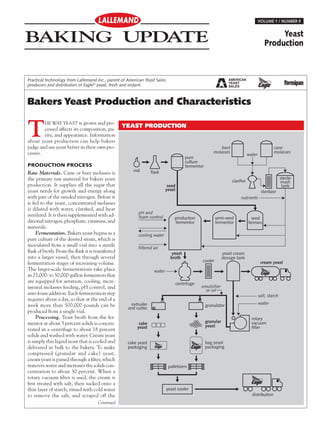
Raw Materials. Cane or beet molasses is
the primary raw material for bakers yeast
production. It supplies all the sugar that
yeast needs for growth and energy along
with part of the needed nitrogen. Before it
is fed to the yeast, concentrated molasses
is diluted with water, clarified, and heat
sterilized. It is then supplemented with ad-
ditional nitrogen, phosphate, vitamins, and
minerals.
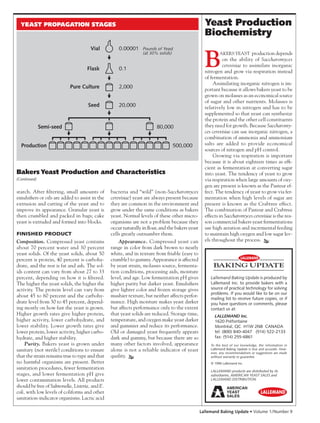
Fermentation. Bakers yeast begins as a
pure culture of the desired strain, which is
inoculated from a small vial into a sterile
flask of broth. From the flask it is transferred
into a larger vessel, then through several
fermentation stages of increasing volume.
The larger-scale fermentations take place
in 25,000- to 50,000-gallon fermentors that
are equipped for aeration, cooling, incre-
mental molasses feeding, pH control, and
anti-foam addition. Each fermentation step
requires about a day, so that at the end of a
week more than 500,000 pounds can be
produced from a single vial.
Processing. Yeast broth from the fer-
mentor at about 5 percent solids is concen-
trated in a centrifuge to about 18 percent
solids and washed with water. Cream yeast
is simply this liquid yeast that is cooled and
delivered in bulk to the bakery. To make
compressed (granular and cake) yeast,
cream yeast is passed through a filter, which
removes water and increases the solids con-
centration to about 30 percent. When a
rotary vacuum filter is used, the cream is
first treated with salt, then sucked onto a
thin layer of starch, rinsed with cold water
to remove the salt, and scraped off the
Bakers Yeast Production and Characteristics
Continued
AMERICAN
YEAST
SALES
LALLEMAND
BAKING UPDATE Yeast
Production
VOLUME 1 / NUMBER 9
Practical technology from Lallemand Inc., parent of American Yeast Sales,
producers and distributors of Eagle®
yeast, fresh and instant.
YEAST PRODUCTION
flask
pure
culture
fermentor
beet
molasses
cane
molasses
water
sterilizer
clarifier
seed
yeast
nutrients
production
fermentor
pH and
foam control
cooling water
filtered air
water
cooler
centrifuge
yeast
broth
yeast cream
storage tank
cream yeast
salt, starch
water
rotary
vacuum
filter
bag yeast
packaging
granular
yeast
granulatorextruder
and cutter
yeast cooler
palletizers
cake
yeast
cake yeast
packaging
distribution
sterile
mash
tank
emulsifier
or oil
seed
fermen.
semi-seed
fermentor
vial
AKERS YEAST production depends
on the ability of Saccharomyces
Bcerevisiae to assimilate inorganic
nitrogen and grow via respiration instead
of fermentation.
Assimilating inorganic nitrogen is im-
portant because it allows bakers yeast to be
grown on molasses as an economical source
of sugar and other nutrients. Molasses is
relatively low in nitrogen and has to be
supplemented so that yeast can synthesize
the protein and the other cell constituents
they need for growth. Because Saccharomy-
ces cerevisiae can use inorganic nitrogen, a
combination of ammonia and ammonium
salts are added to provide economical
sources of nitrogen and pH control.
Growing via respiration is important
because it is about eighteen times as effi-
cient as fermentation at converting sugar
into yeast. The tendency of yeast to grow
via respiration when large amounts of oxy-
gen are present is known as the Pasteur ef-
fect. The tendency of yeast to grow via fer-
mentation when high levels of sugar are
present is known as the Crabtree effect.
The combination of Pasteur and Crabtree
effects in Saccharomyces cerevisiae is the rea-
son commercial bakers yeast fermentations
use high aeration and incremental feeding
to maintain high oxygen and low sugar lev-
els throughout the process.
Yeast Production
Biochemistry
Lallemand Baking Update • Volume 1/Number 9
Bakers Yeast Production and Characteristics
(Continued)
starch. After filtering, small amounts of
emulsifiers or oils are added to assist in the
extrusion and cutting of the yeast and to
improve its appearance. Granular yeast is
then crumbled and packed in bags; cake
yeast is extruded and formed into blocks.
FINISHED PRODUCT
Composition. Compressed yeast contains
about 70 percent water and 30 percent
yeast solids. Of the yeast solids, about 50
percent is protein, 40 percent is carbohy-
drate, and the rest is fat and ash. The sol-
ids content can vary from about 27 to 33
percent, depending on how it is filtered.
The higher the yeast solids, the higher the
activity. The protein level can vary from
about 45 to 60 percent and the carbohy-
drate level from 30 to 45 percent, depend-
ing mostly on how fast the yeast is grown.
Higher growth rates give higher protein,
higher activity, lower carbohydrate, and
lower stability. Lower growth rates give
lower protein, lower activity, higher carbo-
hydrate, and higher stability.
Purity. Bakers yeast is grown under
sanitary (not sterile) conditions to ensure
that the strain remains true to type and that
no harmful organisms are present. Better
sanitation procedures, fewer fermentation
stages, and lower fermentation pH give
lower contamination levels. All products
should be free of Salmonella, Listeria, and E.
coli, with low levels of coliforms and other
sanitation-indicator organisms. Lactic acid
bacteria and “wild” (non-Saccharomyces
cerevisiae) yeast are always present because
they are common in the environment and
grow under the same conditions as bakers
yeast. Normal levels of these other micro-
organisms are not a problem because they
occur naturally in flour, and the bakers yeast
cells greatly outnumber them.
Appearance. Compressed yeast can
range in color from dark brown to nearly
white, and in texture from friable (easy to
crumble) to gummy. Appearance is affected
by yeast strain, molasses source, fermenta-
tion conditions, processing aids, moisture
level, and age. Low fermentation pH gives
higher purity but darker yeast. Emulsifiers
give lighter color and frozen storage gives
mushier texture, but neither affects perfor-
mance. High moisture makes yeast darker
but affects performance only to the extent
that yeast solids are reduced. Storage time,
temperature, and oxygen make yeast darker
and gummier and reduce its performance.
Old or damaged yeast frequently appears
dark and gummy, but because there are so
many other factors involved, appearance
alone is not a reliable indicator of yeast
quality.
Pounds of Yeast
(at 30% solids)
0.00001
0.1
2,000
20,000
80,000
500,000
Vial
Flask
Pure Culture
Seed
Semi-seed
Production
YEAST PROPAGATION STAGES
AMERICAN
YEAST
SALES
Lallemand Baking Update is produced by
Lallemand Inc. to provide bakers with a
source of practical technology for solving
problems. If you would like to be on our
mailing list to receive future copies, or if
you have questions or comments, please
contact us at:
LALLEMAND Inc.
1620 Préfontaine
Montréal, QC H1W 2N8 CANADA
tel: (800) 840-4047 (514) 522-2133
fax: (514) 255-6861
To the best of our knowledge, the information in
Lallemand Baking Update is true and accurate. How-
ever, any recommendations or suggestions are made
without warranty or guarantee.
© 1996 Lallemand Inc.
LALLEMAND products are distributed by its
subsidiaries, AMERICAN YEAST SALES and
LALLEMAND DISTRIBUTION.
LALLEMAND
BAKING UPDATE
LALLEMAND

Bakers yeast production and characteristics

  • 1.
    HE WAY YEASTis grown and pro- cessed affects its composition, pu- Trity, and appearance. Information about yeast production can help bakers judge and use yeast better in their own pro- cesses. PRODUCTION PROCESS Raw Materials. Cane or beet molasses is the primary raw material for bakers yeast production. It supplies all the sugar that yeast needs for growth and energy along with part of the needed nitrogen. Before it is fed to the yeast, concentrated molasses is diluted with water, clarified, and heat sterilized. It is then supplemented with ad- ditional nitrogen, phosphate, vitamins, and minerals. Fermentation. Bakers yeast begins as a pure culture of the desired strain, which is inoculated from a small vial into a sterile flask of broth. From the flask it is transferred into a larger vessel, then through several fermentation stages of increasing volume. The larger-scale fermentations take place in 25,000- to 50,000-gallon fermentors that are equipped for aeration, cooling, incre- mental molasses feeding, pH control, and anti-foam addition. Each fermentation step requires about a day, so that at the end of a week more than 500,000 pounds can be produced from a single vial. Processing. Yeast broth from the fer- mentor at about 5 percent solids is concen- trated in a centrifuge to about 18 percent solids and washed with water. Cream yeast is simply this liquid yeast that is cooled and delivered in bulk to the bakery. To make compressed (granular and cake) yeast, cream yeast is passed through a filter, which removes water and increases the solids con- centration to about 30 percent. When a rotary vacuum filter is used, the cream is first treated with salt, then sucked onto a thin layer of starch, rinsed with cold water to remove the salt, and scraped off the Bakers Yeast Production and Characteristics Continued AMERICAN YEAST SALES LALLEMAND BAKING UPDATE Yeast Production VOLUME 1 / NUMBER 9 Practical technology from Lallemand Inc., parent of American Yeast Sales, producers and distributors of Eagle® yeast, fresh and instant. YEAST PRODUCTION flask pure culture fermentor beet molasses cane molasses water sterilizer clarifier seed yeast nutrients production fermentor pH and foam control cooling water filtered air water cooler centrifuge yeast broth yeast cream storage tank cream yeast salt, starch water rotary vacuum filter bag yeast packaging granular yeast granulatorextruder and cutter yeast cooler palletizers cake yeast cake yeast packaging distribution sterile mash tank emulsifier or oil seed fermen. semi-seed fermentor vial
  • 2.
    AKERS YEAST productiondepends on the ability of Saccharomyces Bcerevisiae to assimilate inorganic nitrogen and grow via respiration instead of fermentation. Assimilating inorganic nitrogen is im- portant because it allows bakers yeast to be grown on molasses as an economical source of sugar and other nutrients. Molasses is relatively low in nitrogen and has to be supplemented so that yeast can synthesize the protein and the other cell constituents they need for growth. Because Saccharomy- ces cerevisiae can use inorganic nitrogen, a combination of ammonia and ammonium salts are added to provide economical sources of nitrogen and pH control. Growing via respiration is important because it is about eighteen times as effi- cient as fermentation at converting sugar into yeast. The tendency of yeast to grow via respiration when large amounts of oxy- gen are present is known as the Pasteur ef- fect. The tendency of yeast to grow via fer- mentation when high levels of sugar are present is known as the Crabtree effect. The combination of Pasteur and Crabtree effects in Saccharomyces cerevisiae is the rea- son commercial bakers yeast fermentations use high aeration and incremental feeding to maintain high oxygen and low sugar lev- els throughout the process. Yeast Production Biochemistry Lallemand Baking Update • Volume 1/Number 9 Bakers Yeast Production and Characteristics (Continued) starch. After filtering, small amounts of emulsifiers or oils are added to assist in the extrusion and cutting of the yeast and to improve its appearance. Granular yeast is then crumbled and packed in bags; cake yeast is extruded and formed into blocks. FINISHED PRODUCT Composition. Compressed yeast contains about 70 percent water and 30 percent yeast solids. Of the yeast solids, about 50 percent is protein, 40 percent is carbohy- drate, and the rest is fat and ash. The sol- ids content can vary from about 27 to 33 percent, depending on how it is filtered. The higher the yeast solids, the higher the activity. The protein level can vary from about 45 to 60 percent and the carbohy- drate level from 30 to 45 percent, depend- ing mostly on how fast the yeast is grown. Higher growth rates give higher protein, higher activity, lower carbohydrate, and lower stability. Lower growth rates give lower protein, lower activity, higher carbo- hydrate, and higher stability. Purity. Bakers yeast is grown under sanitary (not sterile) conditions to ensure that the strain remains true to type and that no harmful organisms are present. Better sanitation procedures, fewer fermentation stages, and lower fermentation pH give lower contamination levels. All products should be free of Salmonella, Listeria, and E. coli, with low levels of coliforms and other sanitation-indicator organisms. Lactic acid bacteria and “wild” (non-Saccharomyces cerevisiae) yeast are always present because they are common in the environment and grow under the same conditions as bakers yeast. Normal levels of these other micro- organisms are not a problem because they occur naturally in flour, and the bakers yeast cells greatly outnumber them. Appearance. Compressed yeast can range in color from dark brown to nearly white, and in texture from friable (easy to crumble) to gummy. Appearance is affected by yeast strain, molasses source, fermenta- tion conditions, processing aids, moisture level, and age. Low fermentation pH gives higher purity but darker yeast. Emulsifiers give lighter color and frozen storage gives mushier texture, but neither affects perfor- mance. High moisture makes yeast darker but affects performance only to the extent that yeast solids are reduced. Storage time, temperature, and oxygen make yeast darker and gummier and reduce its performance. Old or damaged yeast frequently appears dark and gummy, but because there are so many other factors involved, appearance alone is not a reliable indicator of yeast quality. Pounds of Yeast (at 30% solids) 0.00001 0.1 2,000 20,000 80,000 500,000 Vial Flask Pure Culture Seed Semi-seed Production YEAST PROPAGATION STAGES AMERICAN YEAST SALES Lallemand Baking Update is produced by Lallemand Inc. to provide bakers with a source of practical technology for solving problems. If you would like to be on our mailing list to receive future copies, or if you have questions or comments, please contact us at: LALLEMAND Inc. 1620 Préfontaine Montréal, QC H1W 2N8 CANADA tel: (800) 840-4047 (514) 522-2133 fax: (514) 255-6861 To the best of our knowledge, the information in Lallemand Baking Update is true and accurate. How- ever, any recommendations or suggestions are made without warranty or guarantee. © 1996 Lallemand Inc. LALLEMAND products are distributed by its subsidiaries, AMERICAN YEAST SALES and LALLEMAND DISTRIBUTION. LALLEMAND BAKING UPDATE LALLEMAND