INDUSTRIAL PRODUCTION OF ETHYL ALCOHOL
 One of the most important and best known industrial
fermentation is that in which ethyl alcohol is produced
from sugar by yeast under anaerobic condition.
 The production of alcohol became commercially feasible
on large scale shortly after the 1906 when industrial
alcohol act was passed. This act allowed the sale of tax-
free alcohol, if it was first denatured to prevent its use as
alcoholic beverage.
 The unit of measurement commonly used in reporting
the ethyl alcohol is the proof.
 Proof is twice the percent in the volume of ethyl alcohol.
For example 95 % ethyl alcohol by volume is 190 proof.
INDUSTRIAL PRODUCTION OF ETHYL ALCOHOL
FROM MOLASSES
• In India molasses (obtained from sugar factories)
is the most important raw material used for
alcohol production.
• The alcohol manufacturing process involves
following steps.
1) Microorganism
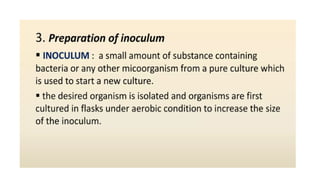
2) Preparation of inoculum
3) Preparation of fermentation medium
4) Fermentation conditions
5) Recovery
1. MICROORGANISM–
 Yeasts are the important organisms involved in alcohol
production.
 Certain types of yeast possessing following properties are
used
 A)Able to produce high concentration of alcohol.
 B)Having high alcohol tolerance
 C)Having uniform and stable biochemical characteristics.
 D)Capable of growing rapidly and vigorously in fermentation
medium
 Selected strains of Saccharomyces cerevisiae are most
commonly used. However, other yeast like
Schizosaccharomyces pombe, Saccharomyces
anamensis, Candida yeast may also be used under certain
conditions.
2. PREPARATION OF INOCULUM (YEAST CULTURE)
 Large amount of yeast culture is required in
industrial production of ethyl alcohol. The average
amount of inoculum used for inoculation of
fermentation medium is 4 % volume-by-volume.
 The medium used for inoculum preparation is same
as that of actual fermentation medium.
 Aeration is of benefit in preparing the inoculum, as
the purpose is to obtain large no. of yeast cells.
 Steps involved in building up of inoculum are
 A)10 ml of sterile medium in a test tube is
inoculated with pure culture of yeast and tube
incubated at 28 to 30 0
C for a suitable period.
 B)The tube culture is transferred to a flask
containing 200 ml of sterile medium. Flask is
incubated at 28 to 30 0
C to obtain sufficient cell
mass.
 C)The flask culture is transferred to a suitable glass
container containing about 4 lit of sterile medium
and incubated at 28 to 300
C.
 D)Finally this culture is used to inoculate a small
tank containing about 10-40 gallons of sterile
medium.
 After incubation, the inoculum is used to inoculate
the fermentation medium in fermenter.
3) PREPARATION OF FERMENTATION MEDIUM-
 Black strap molasses is the principal source of alcohol.
This is the syrup that is left after the recovery of
crystalline sugar from the concentrated juice of sugar
cane. It usually contains 48 to 55 % sugar, mainly
sucrose.
 To prepare fermentation medium molasses are diluted
to a sugar concentration 10 to 18 % (usually 12 %)by
adding required quantity of water.
 Higher sugar concentration adversely reacts on yeast
and alcohol produced may inhibit the action of yeast
with consequences that fermentation time is prolonged.
The use of low concentration of sugar is uneconomic.
 Molasses generally contain most of the nutrient
substances for yeast but ammonium sulphate or
phosphates may be added to the fermentation
medium to supply deficiencies of nitrogen and
phosphorus.
 The pH of the fermentation medium is adjusted to
4.8 to 5.5 by using H2SO4 or lactic acid. Lactic acid
bacteria can also be grown for pH adjustment.
 Due to acidic pH, medium usually does not get
contaminated by bacteria. Therefore, usually
fermentation medium is not sterilized but however,
pasteurization of fermentation medium may be
practiced.
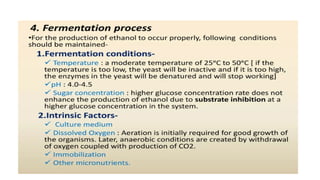
4) FERMENTATION CONDITIONS -
Following fermentation conditions are carefully
controlled to obtain maximum yield.
 Temperature-An optimum temp of 28-300
C is
maintained. Temp increases due to heat generation
during fermentation. This is controlled by circulating the
water through cooling coils. At a temp above 300
C alcohol
evaporates rapidly and also favors the growth of bacterial
contaminants.
 pH–Fermentation proceeds satisfactorily at pH 4.0 to
4.5. This pH favors the growth of yeast and inhibits the
growth of bacteria.
 Higher pH values increases the chances of contamination
while lower pH values inhibits alcohol production.
 H2SO4 is commonly used to adjust the pH of mash. Lactic
acid is also satisfactory.
 Lactic acid favors the growth of yeast but inhibits the
growth of butyric acid bacteria, which is harmful to the
yeast fermentation.
 Agitation and Aeration-Intermittent agitation is
required for mixing and cooling the medium.
 Aeration is required only in early stages of fermentation
for optimum reproduction of yeast cells but it is not
required for the production of alcohol.
 During fermentation, CO2 is evolved and anaerobic
conditions are maintained.
 Fermentation time - Fermentation starts within few
hours after the addition of yeast.
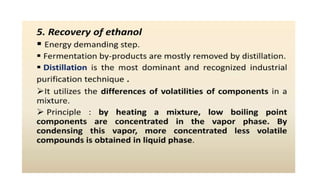
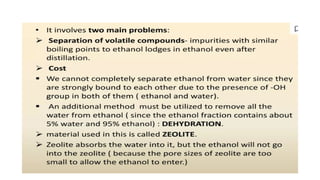
RECOVERY –
 The fermented mash (also called “beer”) is distilled
to separate the ethyl alcohol and Fusel oils from the
other constituents of the medium.
 During distillation, fractions containing different
concentrations of alcohol are separated.
 The solids called slops or stillage recovered during
distillation process are used as fertilizer constituent
as they contain potassium and phosphates.
 Other byproducts of fermentation called fusel oil
are also separated during distillation process.
 The alcohol obtained may be further purified,
dehydrated and denatured.
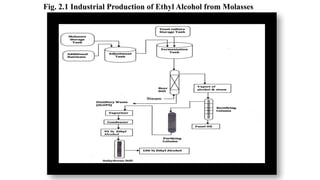
Fig. 2.1 Industrial Production of Ethyl Alcohol from Molasses
BY-PRODUCTS OF ALCOHOLIC FERMENTATION:-
 There are four main by-products of alcohol industry.
 These are A) CO2 B) Yeast C) Fusel oils D) Slops or Stillage
A) CO2- CO2 is produced in large quantities during
fermentation. It is collected and purified.
 Purified CO2 can be liquefied or converted into dry ice.
Large quantities of liquefied CO2 are used in the soft drink
industry for the manufacture of cold drinks, while dry ice
has many commercial applications.
B)Yeast- The yeast separated from fermented medium
can be safely used for feeding the animals (animal
feed). Thus this yeast is the valuable fodder, which is
rich in proteins, vitamins and essential trace elements.
 C) Fusel oils –
 During fermentation, some quantities of higher
alcohols mainly isoamyl alcohol and butyl alcohol is
formed.
 This fraction of higher alcohols is collectively
known as fusel oils.
 After refining they are used in the manufacture of
perfumes and potable liquors.
 However the bulk amount of this fraction is
converted into various acetates by esterification.
Esters of these higher alcohols are used in paint
industry and lacquer industry.
 D) Slops- During distillation process slops are
separated. The slops are usually discarded but may be
used in no. of ways.
 The slops may be used as substitute for some of the
water in diluting molasses for a new mash. The solids
from the slops may be concentrated and sold as a
fertilizer constituent as they contain potassium and
phosphates.
MECHANISM OF ALCOHOL FERMENTATION
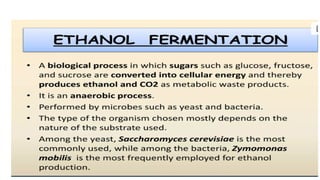
 Alcohol fermentation is an anaerobic fermentation
taking place in the absence of air or oxygen .The raw
materials like molasses and waste sulphite liquor
serves as the energy and carbon source for ethanol
producing micro-organisms.
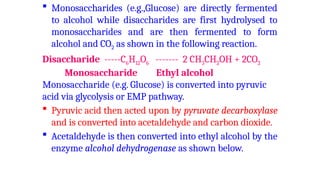
 Monosaccharides (e.g.,Glucose) are directly fermented
to alcohol while disaccharides are first hydrolysed to
monosaccharides and are then fermented to form
alcohol and CO2 as shown in the following reaction.
Disaccharide -----C6H12O6 ------- 2 CH3CH2OH + 2CO2
Monosaccharide Ethyl alcohol
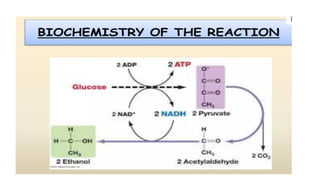
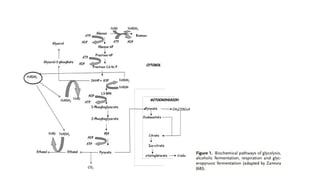
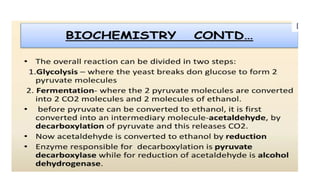
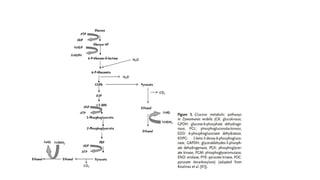
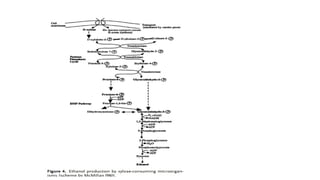
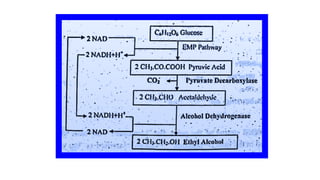
Monosaccharide (e.g. Glucose) is converted into pyruvic
acid via glycolysis or EMP pathway.
 Pyruvic acid then acted upon by pyruvate decarboxylase
and is converted into acetaldehyde and carbon dioxide.
 Acetaldehyde is then converted into ethyl alcohol by the
enzyme alcohol dehydrogenase as shown below.
INDUSTRIAL PRODUCTION OF ETHYL ALCOHOL
FROM WASTE SULPHITE LIQUOR
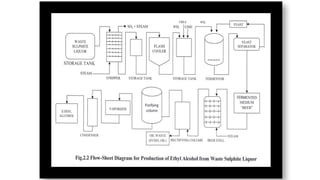
 Sulphite liquor is produced as a waste product in
the manufacture of pulp from wood and is
described separately in unit no.1
 Fermentation process involves following steps.
1. MICROORGANISM --
 Sulphite liquor fermentation utilizes yeast Candida
pseudotrophicalis because of the ability of this
organism to ferment pentose sugars.
 Although the Saccharomyces cerevisiae can also
be used, but in this case the pentose sugars of the
sulphite liquor are not fermented.
2. RAW MATERIAL–
 Sulphite liquor, the waste product of paper pulping industry is
the fundamental raw material in this process.
3. PREPARATION OF FERMENTATION MEDIUM –
 Waste sulphite liquor obtained during pulping process cannot
be used directly for fermentation as it contains SO2, which is
toxic to the growth of yeast.
 Therefore, it is necessary first to remove SO2, acetic acid and
formic acid that are present in liquor.
 Sulphite liquor is pumped into a column known as stripper
where it flows top to bottom.
 Simultaneously, steam is introduced at the bottom of column
and flows upward. This removes sulphur dioxide (SO2) and
other volatile materials. This process is called conditioning of
liquor.
 The hot sulphite liquor is cooled to 30O
C. A slurry (solution)
of lime is added to adjust the pH to 4.5. Urea is also added to
liquor as a source of nitrogen.
4 . FERMENTATION CONDITIONS–
 The conditioned sulphite liquor is pumped into the
fermentation tank.
 It is inoculated with yeast culture and following
fermentation conditions are maintained to obtain maximum
yield.
 pH- Fermentation is carried out at an optimum pH 4.5.
 Temp- Fermentation is carried out at an optimum temp of
30O
C.
 Agitation & Aeration- The medium is intermittently
agitated. No aeration is required as alcohol production takes
place under anaerobic conditions .
 Time- Fermentation process usually completes
within 20 hrs.
 Yield – The yield is about 22 gallons of alcohol per
ton of pulp.
5. RECOVERY –
 The alcohol is recovered from fermented mash as
that of alcohol from molasses.
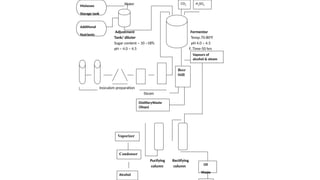
Molasses
Storage tank
Additional
Nutrients
Beer
Still
DistilleryWaste
(Slops)
Vapours of
alcohol & steam
Oil
Waste
CO2 H2SO4
Vaporizer
Condenser
Alcohol
Water
Adjustment Fermentor
Tank/ diluter Temp.70-800
F
Sugar content – 10 –18% pH 4.0 – 4.5
pH – 4.0 – 4.5 F. Time-50 hrs
Inoculom preparation
Steam
Purifying Rectifying
column column

ethanol fermentation production Recovery

  • 24.
    INDUSTRIAL PRODUCTION OFETHYL ALCOHOL  One of the most important and best known industrial fermentation is that in which ethyl alcohol is produced from sugar by yeast under anaerobic condition.  The production of alcohol became commercially feasible on large scale shortly after the 1906 when industrial alcohol act was passed. This act allowed the sale of tax- free alcohol, if it was first denatured to prevent its use as alcoholic beverage.  The unit of measurement commonly used in reporting the ethyl alcohol is the proof.  Proof is twice the percent in the volume of ethyl alcohol. For example 95 % ethyl alcohol by volume is 190 proof.
  • 25.
    INDUSTRIAL PRODUCTION OFETHYL ALCOHOL FROM MOLASSES • In India molasses (obtained from sugar factories) is the most important raw material used for alcohol production. • The alcohol manufacturing process involves following steps. 1) Microorganism 2) Preparation of inoculum 3) Preparation of fermentation medium 4) Fermentation conditions 5) Recovery
  • 26.
    1. MICROORGANISM–  Yeastsare the important organisms involved in alcohol production.  Certain types of yeast possessing following properties are used  A)Able to produce high concentration of alcohol.  B)Having high alcohol tolerance  C)Having uniform and stable biochemical characteristics.  D)Capable of growing rapidly and vigorously in fermentation medium  Selected strains of Saccharomyces cerevisiae are most commonly used. However, other yeast like Schizosaccharomyces pombe, Saccharomyces anamensis, Candida yeast may also be used under certain conditions.
  • 27.
    2. PREPARATION OFINOCULUM (YEAST CULTURE)  Large amount of yeast culture is required in industrial production of ethyl alcohol. The average amount of inoculum used for inoculation of fermentation medium is 4 % volume-by-volume.  The medium used for inoculum preparation is same as that of actual fermentation medium.  Aeration is of benefit in preparing the inoculum, as the purpose is to obtain large no. of yeast cells.  Steps involved in building up of inoculum are  A)10 ml of sterile medium in a test tube is inoculated with pure culture of yeast and tube incubated at 28 to 30 0 C for a suitable period.
  • 28.
     B)The tubeculture is transferred to a flask containing 200 ml of sterile medium. Flask is incubated at 28 to 30 0 C to obtain sufficient cell mass.  C)The flask culture is transferred to a suitable glass container containing about 4 lit of sterile medium and incubated at 28 to 300 C.  D)Finally this culture is used to inoculate a small tank containing about 10-40 gallons of sterile medium.  After incubation, the inoculum is used to inoculate the fermentation medium in fermenter.
  • 29.
    3) PREPARATION OFFERMENTATION MEDIUM-  Black strap molasses is the principal source of alcohol. This is the syrup that is left after the recovery of crystalline sugar from the concentrated juice of sugar cane. It usually contains 48 to 55 % sugar, mainly sucrose.  To prepare fermentation medium molasses are diluted to a sugar concentration 10 to 18 % (usually 12 %)by adding required quantity of water.  Higher sugar concentration adversely reacts on yeast and alcohol produced may inhibit the action of yeast with consequences that fermentation time is prolonged. The use of low concentration of sugar is uneconomic.
  • 30.
     Molasses generallycontain most of the nutrient substances for yeast but ammonium sulphate or phosphates may be added to the fermentation medium to supply deficiencies of nitrogen and phosphorus.  The pH of the fermentation medium is adjusted to 4.8 to 5.5 by using H2SO4 or lactic acid. Lactic acid bacteria can also be grown for pH adjustment.  Due to acidic pH, medium usually does not get contaminated by bacteria. Therefore, usually fermentation medium is not sterilized but however, pasteurization of fermentation medium may be practiced.
  • 31.
    4) FERMENTATION CONDITIONS- Following fermentation conditions are carefully controlled to obtain maximum yield.  Temperature-An optimum temp of 28-300 C is maintained. Temp increases due to heat generation during fermentation. This is controlled by circulating the water through cooling coils. At a temp above 300 C alcohol evaporates rapidly and also favors the growth of bacterial contaminants.  pH–Fermentation proceeds satisfactorily at pH 4.0 to 4.5. This pH favors the growth of yeast and inhibits the growth of bacteria.  Higher pH values increases the chances of contamination while lower pH values inhibits alcohol production.
  • 32.
     H2SO4 iscommonly used to adjust the pH of mash. Lactic acid is also satisfactory.  Lactic acid favors the growth of yeast but inhibits the growth of butyric acid bacteria, which is harmful to the yeast fermentation.  Agitation and Aeration-Intermittent agitation is required for mixing and cooling the medium.  Aeration is required only in early stages of fermentation for optimum reproduction of yeast cells but it is not required for the production of alcohol.  During fermentation, CO2 is evolved and anaerobic conditions are maintained.  Fermentation time - Fermentation starts within few hours after the addition of yeast.
  • 33.
    RECOVERY –  Thefermented mash (also called “beer”) is distilled to separate the ethyl alcohol and Fusel oils from the other constituents of the medium.  During distillation, fractions containing different concentrations of alcohol are separated.  The solids called slops or stillage recovered during distillation process are used as fertilizer constituent as they contain potassium and phosphates.  Other byproducts of fermentation called fusel oil are also separated during distillation process.  The alcohol obtained may be further purified, dehydrated and denatured.
  • 34.
    Fig. 2.1 IndustrialProduction of Ethyl Alcohol from Molasses
  • 35.
    BY-PRODUCTS OF ALCOHOLICFERMENTATION:-  There are four main by-products of alcohol industry.  These are A) CO2 B) Yeast C) Fusel oils D) Slops or Stillage A) CO2- CO2 is produced in large quantities during fermentation. It is collected and purified.  Purified CO2 can be liquefied or converted into dry ice. Large quantities of liquefied CO2 are used in the soft drink industry for the manufacture of cold drinks, while dry ice has many commercial applications. B)Yeast- The yeast separated from fermented medium can be safely used for feeding the animals (animal feed). Thus this yeast is the valuable fodder, which is rich in proteins, vitamins and essential trace elements.
  • 36.
     C) Fuseloils –  During fermentation, some quantities of higher alcohols mainly isoamyl alcohol and butyl alcohol is formed.  This fraction of higher alcohols is collectively known as fusel oils.  After refining they are used in the manufacture of perfumes and potable liquors.  However the bulk amount of this fraction is converted into various acetates by esterification. Esters of these higher alcohols are used in paint industry and lacquer industry.
  • 37.
     D) Slops-During distillation process slops are separated. The slops are usually discarded but may be used in no. of ways.  The slops may be used as substitute for some of the water in diluting molasses for a new mash. The solids from the slops may be concentrated and sold as a fertilizer constituent as they contain potassium and phosphates. MECHANISM OF ALCOHOL FERMENTATION  Alcohol fermentation is an anaerobic fermentation taking place in the absence of air or oxygen .The raw materials like molasses and waste sulphite liquor serves as the energy and carbon source for ethanol producing micro-organisms.
  • 38.
     Monosaccharides (e.g.,Glucose)are directly fermented to alcohol while disaccharides are first hydrolysed to monosaccharides and are then fermented to form alcohol and CO2 as shown in the following reaction. Disaccharide -----C6H12O6 ------- 2 CH3CH2OH + 2CO2 Monosaccharide Ethyl alcohol Monosaccharide (e.g. Glucose) is converted into pyruvic acid via glycolysis or EMP pathway.  Pyruvic acid then acted upon by pyruvate decarboxylase and is converted into acetaldehyde and carbon dioxide.  Acetaldehyde is then converted into ethyl alcohol by the enzyme alcohol dehydrogenase as shown below.
  • 40.
    INDUSTRIAL PRODUCTION OFETHYL ALCOHOL FROM WASTE SULPHITE LIQUOR  Sulphite liquor is produced as a waste product in the manufacture of pulp from wood and is described separately in unit no.1  Fermentation process involves following steps. 1. MICROORGANISM --  Sulphite liquor fermentation utilizes yeast Candida pseudotrophicalis because of the ability of this organism to ferment pentose sugars.  Although the Saccharomyces cerevisiae can also be used, but in this case the pentose sugars of the sulphite liquor are not fermented.
  • 41.
    2. RAW MATERIAL– Sulphite liquor, the waste product of paper pulping industry is the fundamental raw material in this process. 3. PREPARATION OF FERMENTATION MEDIUM –  Waste sulphite liquor obtained during pulping process cannot be used directly for fermentation as it contains SO2, which is toxic to the growth of yeast.  Therefore, it is necessary first to remove SO2, acetic acid and formic acid that are present in liquor.  Sulphite liquor is pumped into a column known as stripper where it flows top to bottom.  Simultaneously, steam is introduced at the bottom of column and flows upward. This removes sulphur dioxide (SO2) and other volatile materials. This process is called conditioning of liquor.
  • 42.
     The hotsulphite liquor is cooled to 30O C. A slurry (solution) of lime is added to adjust the pH to 4.5. Urea is also added to liquor as a source of nitrogen. 4 . FERMENTATION CONDITIONS–  The conditioned sulphite liquor is pumped into the fermentation tank.  It is inoculated with yeast culture and following fermentation conditions are maintained to obtain maximum yield.  pH- Fermentation is carried out at an optimum pH 4.5.  Temp- Fermentation is carried out at an optimum temp of 30O C.  Agitation & Aeration- The medium is intermittently agitated. No aeration is required as alcohol production takes place under anaerobic conditions .
  • 43.
     Time- Fermentationprocess usually completes within 20 hrs.  Yield – The yield is about 22 gallons of alcohol per ton of pulp. 5. RECOVERY –  The alcohol is recovered from fermented mash as that of alcohol from molasses.
  • 45.
    Molasses Storage tank Additional Nutrients Beer Still DistilleryWaste (Slops) Vapours of alcohol& steam Oil Waste CO2 H2SO4 Vaporizer Condenser Alcohol Water Adjustment Fermentor Tank/ diluter Temp.70-800 F Sugar content – 10 –18% pH 4.0 – 4.5 pH – 4.0 – 4.5 F. Time-50 hrs Inoculom preparation Steam Purifying Rectifying column column