YOGHURT & KEFIR
PRODUCTION
SUBMITTED TO-: DR.R.S SINGH
SUBMITTED BY :-BEANT KAUR
19011016
YOGHURT
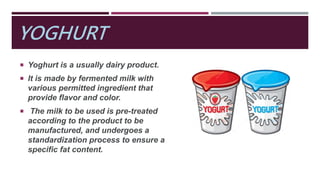
 Yoghurt is a usually dairy product.
 It is made by fermented milk with
various permitted ingredient that
provide flavor and color.
 The milk to be used is pre-treated
according to the product to be
manufactured, and undergoes a
standardization process to ensure a
specific fat content.
HISTORY
 1st made hundreds of years ago in the middle
east my nomads.
 Fermented milk from animals and turned it into
yoghurt to eat.
 Probably discovered by someone trying to heat
milk to preserved it over a fire .The natural
bacteria turned the milk sour making it a type
of yoghurt.
YOGHURT FERMENTATION
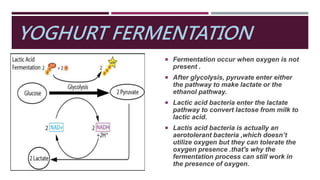
 Fermentation occur when oxygen is not
present .
 After glycolysis, pyruvate enter either
the pathway to make lactate or the
ethanol pathway.
 Lactic acid bacteria enter the lactate
pathway to convert lactose from milk to
lactic acid.
 Lactis acid bacteria is actually an
aerotolerant bacteria ,which doesn’t
utilize oxygen but they can tolerate the
oxygen presence .that's why the
fermentation process can still work in
the presence of oxygen.
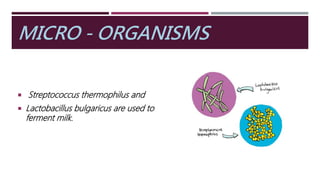
MICRO - ORGANISMS
 Streptococcus thermophilus and
 Lactobacillus bulgaricus are used to
ferment milk.
TYPES OF YOGHURT
 Set yoghurt :- This type of yoghurt is incubated and cooled in final
package.it is characterised by a firm jelly like texture.
 Stirred yoghurt :-This type of yoghurt is incubated in a tank and the
final coagulum is "broken" by stirring prior to cooling and packing. The
texture of a stirred yoghurt will be less firm than a set yoghurt. There is
usually a slight reformation of the coagulm after the yoghurt has been
packed.
 Drinking Yoghurt:-This type of yoghurt is very similar to stirred yoghurt,
having the coagulum "broken!" prior to cooling. In a drinking yoghurt the
agitation used to "break" the coagulum is severe. Little if any reformation of
the coagulum will reoccur after packing.
 Frozen yoghurt :- it is incubated like stirred yoghurt cooling is achieved
by pumping through a freeze like ice cream.it has a texture like ice cream.
 Concentrated yoghurt:- it is incubated stirred yoghurt. After
coagulum is broken ,some water is boiled off.it produce rough and gritty
texture .this is often called strained yoghurt due to the fat that the liquid that is
released from the coagulum upon heating used to be strained off in a manner
similar to making soft cheese.
 Flavoured yoghurt:- The flavoured are added just before yoghurt is
poured into the pots .common additives are fruits or berries ,usually as a
puree or as whole fruits in a syrup. These additives have as much as 50%
sugar in them .
YOGHURT PROCESSING STEPS
 1. Adjust Milk Composition & Blend Ingredients
Milk composition may be adjusted to achieve the desired fat and solids content. Often dry milk
is added to increase the amount of whey protein to provide a desirable texture. Ingredients such
as stabilizers are added at this time.
 2. Pasteurize Milk
The milk mixture is pasteurized at 185°F (85°C) for 30 minutes or at 203°F (95°C) for 10
minutes. A high heat treatment is used to denature the whey (serum) proteins. This allows the
proteins to form a more stable gel, which prevents separation of the water during storage. The
high heat treatment also further reduces the number of spoilage organisms in the milk to provide
a better environment for the starter cultures to grow.
 3. Homogenize
The blend is homogenized (2000 to 2500 psi) to mix all ingredients thoroughly and improve yogurt
consistency.
 4. Cool Milk
The milk is cooled to 108°F (42°C) to bring the yogurt to the ideal growth temperature for the starter
culture.
 5. Inoculate with Starter Cultures
The starter cultures are mixed into the cooled milk.
 6. Hold
The milk is held at (42°C) until a pH 4.5 is reached. This allows the fermentation to progress to form a soft
gel and the characteristic flavor of yogurt. This process can take several hours
 7. Cool
The yogurt is cooled to 7°C to stop the fermentation process.
 8. Add Fruit & Flavors
Fruit and flavors are added at different steps depending on the type of yogurt. For set style yogurt the fruit
is added in the bottom of the cup and then the inoculated yogurt is poured on top and the yogurt is
fermented in the cup. For swiss style yogurt the fruit is blended with the fermented, cooled yogurt prior to
packaging.
 9. Package
The yogurt is pumped from the fermentation vat and packaged as desired.
KEFIR PRODUCTION
 Kefir is prepared from milk by inoculation with kefir grain which are a composition of lactic acid bacteria
and yeast.
 These microorganisms bind together with casein and complex sugar by matrix of polysaccharides called
Kefiran.
 Kefir is reported to have antibacterial, antidiabetic and immunomodulating properties as well as
technological roles as a thickener, gelling agent and emulsifier.
 Kefir grains grow in size 5 to 7% of the biomass is generally separated from fermented milk and reused.
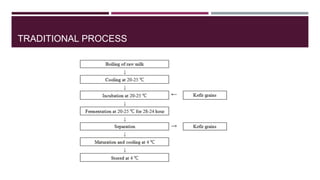
TRADITIONAL PROCESS
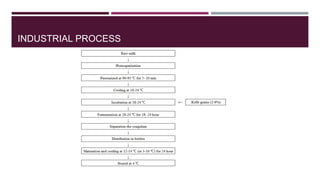
INDUSTRIAL PROCESS
 https://www.slideshare.net/AchutharamTharamaraj/kefir-an-alternative-fermented-mlik
 https://www.ejmsb.org/archive/view_article?pid=jmsb-36-1-1
 http://www.madehow.com/Volume-4/Yogurt.html
 https://delishably.com/dairy/How_to_make_your_own_yogurt_-_An_illustrated_guide
Thank you

Yoghurt and; kefir Production

  • 1.
    YOGHURT & KEFIR PRODUCTION SUBMITTEDTO-: DR.R.S SINGH SUBMITTED BY :-BEANT KAUR 19011016
  • 2.
    YOGHURT  Yoghurt isa usually dairy product.  It is made by fermented milk with various permitted ingredient that provide flavor and color.  The milk to be used is pre-treated according to the product to be manufactured, and undergoes a standardization process to ensure a specific fat content.
  • 3.
    HISTORY  1st madehundreds of years ago in the middle east my nomads.  Fermented milk from animals and turned it into yoghurt to eat.  Probably discovered by someone trying to heat milk to preserved it over a fire .The natural bacteria turned the milk sour making it a type of yoghurt.
  • 4.
    YOGHURT FERMENTATION  Fermentationoccur when oxygen is not present .  After glycolysis, pyruvate enter either the pathway to make lactate or the ethanol pathway.  Lactic acid bacteria enter the lactate pathway to convert lactose from milk to lactic acid.  Lactis acid bacteria is actually an aerotolerant bacteria ,which doesn’t utilize oxygen but they can tolerate the oxygen presence .that's why the fermentation process can still work in the presence of oxygen.
  • 5.
    MICRO - ORGANISMS Streptococcus thermophilus and  Lactobacillus bulgaricus are used to ferment milk.
  • 6.
    TYPES OF YOGHURT Set yoghurt :- This type of yoghurt is incubated and cooled in final package.it is characterised by a firm jelly like texture.  Stirred yoghurt :-This type of yoghurt is incubated in a tank and the final coagulum is "broken" by stirring prior to cooling and packing. The texture of a stirred yoghurt will be less firm than a set yoghurt. There is usually a slight reformation of the coagulm after the yoghurt has been packed.
  • 7.
     Drinking Yoghurt:-Thistype of yoghurt is very similar to stirred yoghurt, having the coagulum "broken!" prior to cooling. In a drinking yoghurt the agitation used to "break" the coagulum is severe. Little if any reformation of the coagulum will reoccur after packing.  Frozen yoghurt :- it is incubated like stirred yoghurt cooling is achieved by pumping through a freeze like ice cream.it has a texture like ice cream.
  • 8.
     Concentrated yoghurt:-it is incubated stirred yoghurt. After coagulum is broken ,some water is boiled off.it produce rough and gritty texture .this is often called strained yoghurt due to the fat that the liquid that is released from the coagulum upon heating used to be strained off in a manner similar to making soft cheese.  Flavoured yoghurt:- The flavoured are added just before yoghurt is poured into the pots .common additives are fruits or berries ,usually as a puree or as whole fruits in a syrup. These additives have as much as 50% sugar in them .
  • 9.
    YOGHURT PROCESSING STEPS 1. Adjust Milk Composition & Blend Ingredients Milk composition may be adjusted to achieve the desired fat and solids content. Often dry milk is added to increase the amount of whey protein to provide a desirable texture. Ingredients such as stabilizers are added at this time.  2. Pasteurize Milk The milk mixture is pasteurized at 185°F (85°C) for 30 minutes or at 203°F (95°C) for 10 minutes. A high heat treatment is used to denature the whey (serum) proteins. This allows the proteins to form a more stable gel, which prevents separation of the water during storage. The high heat treatment also further reduces the number of spoilage organisms in the milk to provide a better environment for the starter cultures to grow.
  • 10.
     3. Homogenize Theblend is homogenized (2000 to 2500 psi) to mix all ingredients thoroughly and improve yogurt consistency.  4. Cool Milk The milk is cooled to 108°F (42°C) to bring the yogurt to the ideal growth temperature for the starter culture.  5. Inoculate with Starter Cultures The starter cultures are mixed into the cooled milk.  6. Hold The milk is held at (42°C) until a pH 4.5 is reached. This allows the fermentation to progress to form a soft gel and the characteristic flavor of yogurt. This process can take several hours
  • 11.
     7. Cool Theyogurt is cooled to 7°C to stop the fermentation process.  8. Add Fruit & Flavors Fruit and flavors are added at different steps depending on the type of yogurt. For set style yogurt the fruit is added in the bottom of the cup and then the inoculated yogurt is poured on top and the yogurt is fermented in the cup. For swiss style yogurt the fruit is blended with the fermented, cooled yogurt prior to packaging.  9. Package The yogurt is pumped from the fermentation vat and packaged as desired.
  • 12.
    KEFIR PRODUCTION  Kefiris prepared from milk by inoculation with kefir grain which are a composition of lactic acid bacteria and yeast.  These microorganisms bind together with casein and complex sugar by matrix of polysaccharides called Kefiran.  Kefir is reported to have antibacterial, antidiabetic and immunomodulating properties as well as technological roles as a thickener, gelling agent and emulsifier.  Kefir grains grow in size 5 to 7% of the biomass is generally separated from fermented milk and reused.
  • 13.
  • 14.
  • 15.
     https://www.slideshare.net/AchutharamTharamaraj/kefir-an-alternative-fermented-mlik  https://www.ejmsb.org/archive/view_article?pid=jmsb-36-1-1 http://www.madehow.com/Volume-4/Yogurt.html  https://delishably.com/dairy/How_to_make_your_own_yogurt_-_An_illustrated_guide
  • 16.