Cervical Trauma
การแบ่งชนิดของการบาดเจ็บของกระดูกส่วนคอ
 Upper Cervical spine injury :: skull base -> Axis C2
Occipital condyle Fracture
Atlanto occipital dislocation
Jefferson fracture
Odontoid fracture
Hangman’s fracture
 Sub-axial cervical spine injury :: C3 -> C7
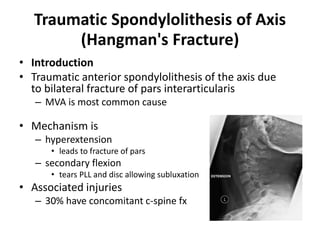
Traumatic Spondylolithesis of Axis
(Hangman's Fracture)
• Introduction
• Traumatic anterior spondylolithesis of the axis due
to bilateral fracture of pars interarticularis
– MVA is most common cause
• Mechanism is
– hyperextension
• leads to fracture of pars
– secondary flexion
• tears PLL and disc allowing subluxation
• Associated injuries
– 30% have concomitant c-spine fx
Presentation
• Symptoms
– neck pain
• Physical Exam
– patients are usually neurologically intact
Imaging
• Radiographs
– flexion and extension radiographs show
subluxation
• CT
– study of choice to delineate fracture pattern
Classification & Treatment
Treatment
• Nonoperative
– rigid cervical collar 4-6 weeks
• indications
– Type I fractures (< 3mm horizontal displacement)
– closed reduction followed by halo immobilization for 8-12
weeks
• indications
– Type II with 3-5 mm displacement
– Type IIA
• reduction technique
– Type II
» cervical axial traction combined with extension
– Type IIA
» hyperextension (avoid axial traction in Type IIA)
Treatment
• Operative
– reduction with surgical stabilization
• indications
– Type II with > 5 mm displacement and severe angulation
– Type III (facet dislocations)
• technique
– anterior C2-3 interbody fusion
– posterior C1-3 fusion
– bilateral C2 pars screw osteosynthesis
Closed Cervical Traction
• Indications
– subaxial cervical fractures with malalignment
– unilateral and bilateral facet dislocations
– displaced odontoid fractures
– select hangman's fractures
– C1-2 rotatory subluxation
• Contraindications
– patient who is not awake, alert, and cooperative
– presence of a skull fracture may be a contraindication
Patient position
• Preferred setting
– emergency room, operating room, ICU for close
observation and frequent flouroscopy/radiographs
• Patient position
– supine with reverse trendelenburg or use of arm and leg
weights and can help prevent patient migration to the top
of the bed with addition of weights.
• Sedation
– small doses of diazepam can be administered to aid in
muscle relaxation
– however patient must remain awake and able to converse
Pin Placement
• Pin placement (Garner-Wells pins)
– pin placement is 1 cm above pinna in line with external
auditory meatus and below the equator of the skull.
• Pin tightness
– On Gardner-Wells tons pins are tightened until spring
loaded indicator protrudes 1 mm above surface
– over tightening of the pins can result in penetration fo the
inner table of the calvarium
• Pin strength
– stainless steel pins have higher failure loads than titanium
and MRI-compatible graphite and should be used with
traction of > 50lbs.
Reduction with Serial Traction
• Serial traction
– an intital 10lbs is added.
– weights are increased at 10lb increments every 20 minutes
– serial exams and radiographs are taken after each weight is placed
– maximal weight is controversial
• some authors recommend weight limits of 70 lbs
• recent studies report up to 140 lbs is safe
• Reduction maneuvers
– reduction of a unilateral facet dislocation
• reduction maneuver performed after facet is distracted to a perched position
• maintain axial load and rotate head 30-40 degree past midline in the direction
of the dislocation
• stop once resistance is felt and confirm with radiographs
– reduction of bilateral facet dislocation
• reduction maneuver performed after facet is distracted to a perched position
• palpate the stepoff in the spinal process posteriorly and apply an anterior
directed force caudal to the level of the dislocation
• rotate the head 40 degree beyond midline in one direction, and then rotate 40
degreee in the other direction while axial traction is maintained.
Complications
• Failure to reduce
• Change in neurologic exam
Halo Orthosis Immobilization
• Fixes skull relative to torso
– provides most rigid form of cervical spine external
immobilization
– ideal for upper C-spine injury
• Allows intercalated paradoxical motion in the
subaxial cervical spine
– therefore not ideal for lower cervical spine
injuries (lateral bending least controlled)
• "snaking phenomenon"
– recumbent lateral radiograph shows focal kyphosis in midcervical
spine
– yet, upright lateral radiograph shows maintained lordosis in
midcervical spine
Indications
• Indications
• definitive treatment of cervical spine trauma including
– occipital condyle fx
– occiptiocervical dislocation
– stable Type II Atlas fx (stable Jefferson fx)
– type II odontoid fractures in young patients
– type II and IIA hangman’s fractures
• adjunctive postoperative stabilization following cervical spine surgery
• Contraindications
– absolute
• cranial fractures
• infection
• severe soft-tissue injury
– relative
• polytrauma
• severe chest trauma
• barrel-shaped chest
• obesity
• advanced age
• CT scan prior to halo application
– indications
• clinical suspicion for cranial fracture
• children younger than 10 to determine thickness of bone
Complications
• Loosening (36%)
• Infection (20%)
• Discomfort (18%)
• Dural puncture (1%)
• Abducens nerve palsy
• Supraorbital nerve palsy
• Supratrochlear nerve palsy
• Medical complications

Cervical trauma

  • 1.
  • 2.
    การแบ่งชนิดของการบาดเจ็บของกระดูกส่วนคอ  Upper Cervicalspine injury :: skull base -> Axis C2 Occipital condyle Fracture Atlanto occipital dislocation Jefferson fracture Odontoid fracture Hangman’s fracture  Sub-axial cervical spine injury :: C3 -> C7
  • 3.
    Traumatic Spondylolithesis ofAxis (Hangman's Fracture) • Introduction • Traumatic anterior spondylolithesis of the axis due to bilateral fracture of pars interarticularis – MVA is most common cause • Mechanism is – hyperextension • leads to fracture of pars – secondary flexion • tears PLL and disc allowing subluxation • Associated injuries – 30% have concomitant c-spine fx
  • 4.
    Presentation • Symptoms – neckpain • Physical Exam – patients are usually neurologically intact
  • 5.
    Imaging • Radiographs – flexionand extension radiographs show subluxation • CT – study of choice to delineate fracture pattern
  • 6.
  • 7.
    Treatment • Nonoperative – rigidcervical collar 4-6 weeks • indications – Type I fractures (< 3mm horizontal displacement) – closed reduction followed by halo immobilization for 8-12 weeks • indications – Type II with 3-5 mm displacement – Type IIA • reduction technique – Type II » cervical axial traction combined with extension – Type IIA » hyperextension (avoid axial traction in Type IIA)
  • 8.
    Treatment • Operative – reductionwith surgical stabilization • indications – Type II with > 5 mm displacement and severe angulation – Type III (facet dislocations) • technique – anterior C2-3 interbody fusion – posterior C1-3 fusion – bilateral C2 pars screw osteosynthesis
  • 9.
    Closed Cervical Traction •Indications – subaxial cervical fractures with malalignment – unilateral and bilateral facet dislocations – displaced odontoid fractures – select hangman's fractures – C1-2 rotatory subluxation • Contraindications – patient who is not awake, alert, and cooperative – presence of a skull fracture may be a contraindication
  • 11.
    Patient position • Preferredsetting – emergency room, operating room, ICU for close observation and frequent flouroscopy/radiographs • Patient position – supine with reverse trendelenburg or use of arm and leg weights and can help prevent patient migration to the top of the bed with addition of weights. • Sedation – small doses of diazepam can be administered to aid in muscle relaxation – however patient must remain awake and able to converse
  • 12.
    Pin Placement • Pinplacement (Garner-Wells pins) – pin placement is 1 cm above pinna in line with external auditory meatus and below the equator of the skull. • Pin tightness – On Gardner-Wells tons pins are tightened until spring loaded indicator protrudes 1 mm above surface – over tightening of the pins can result in penetration fo the inner table of the calvarium • Pin strength – stainless steel pins have higher failure loads than titanium and MRI-compatible graphite and should be used with traction of > 50lbs.
  • 13.
    Reduction with SerialTraction • Serial traction – an intital 10lbs is added. – weights are increased at 10lb increments every 20 minutes – serial exams and radiographs are taken after each weight is placed – maximal weight is controversial • some authors recommend weight limits of 70 lbs • recent studies report up to 140 lbs is safe • Reduction maneuvers – reduction of a unilateral facet dislocation • reduction maneuver performed after facet is distracted to a perched position • maintain axial load and rotate head 30-40 degree past midline in the direction of the dislocation • stop once resistance is felt and confirm with radiographs – reduction of bilateral facet dislocation • reduction maneuver performed after facet is distracted to a perched position • palpate the stepoff in the spinal process posteriorly and apply an anterior directed force caudal to the level of the dislocation • rotate the head 40 degree beyond midline in one direction, and then rotate 40 degreee in the other direction while axial traction is maintained.
  • 14.
    Complications • Failure toreduce • Change in neurologic exam
  • 15.
    Halo Orthosis Immobilization •Fixes skull relative to torso – provides most rigid form of cervical spine external immobilization – ideal for upper C-spine injury • Allows intercalated paradoxical motion in the subaxial cervical spine – therefore not ideal for lower cervical spine injuries (lateral bending least controlled) • "snaking phenomenon" – recumbent lateral radiograph shows focal kyphosis in midcervical spine – yet, upright lateral radiograph shows maintained lordosis in midcervical spine
  • 17.
    Indications • Indications • definitivetreatment of cervical spine trauma including – occipital condyle fx – occiptiocervical dislocation – stable Type II Atlas fx (stable Jefferson fx) – type II odontoid fractures in young patients – type II and IIA hangman’s fractures • adjunctive postoperative stabilization following cervical spine surgery • Contraindications – absolute • cranial fractures • infection • severe soft-tissue injury – relative • polytrauma • severe chest trauma • barrel-shaped chest • obesity • advanced age • CT scan prior to halo application – indications • clinical suspicion for cranial fracture • children younger than 10 to determine thickness of bone
  • 18.
    Complications • Loosening (36%) •Infection (20%) • Discomfort (18%) • Dural puncture (1%) • Abducens nerve palsy • Supraorbital nerve palsy • Supratrochlear nerve palsy • Medical complications