Dr Mohit Goel
JRIII
Cysts and cystic-appearing lesions
of the knee
Cysts
Synovial cysts
Synovial cysts connect to the joint space, since they represent
herniation of synovial tissue into the surrounding soft tissues.
At times, it may be difficult or even impossible to distinguish them
from bursae or ganglia, which lack a true connection to the joint but at
times can connect to the joint.
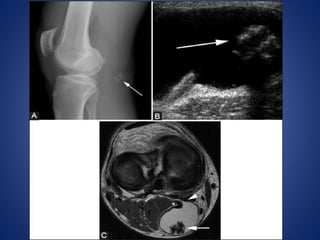
Popliteal (Baker's) cyst
It is most common cyst in the knee.
It represents a communication between the posterior joint capsule
and the normally occurring gastrocnemius-semimembranosus
bursa/recess.
This connection can have a "ball-valve" like mechanism, which is
typically opened during knee flexion and closed during extension.
Popliteal cysts are lined by synovium, may be simple or septated,
and contain hemorrhage, debris, or even osseous loose bodies.
Visualizing a communicating fluid collection arising between the
tendons of the medial head of the gastrocnemius and
semimembranosus is the key to making the diagnosis.
Although many popliteal cysts are asymptomatic, large cysts may
cause nerve entrapment, compress adjacent vascular structures, or
limit knee flexion.
Popliteal cysts can be complicated by cyst rupture, which can be
indistinguishable clinically from deep venous thrombosis and result
in edema in the surrounding fascial planes and subcutaneous fat.
Proximal tibiofibular joint cyst
It is a synovial joint that connects to the knee joint in 10% of
patients.
It is hypothesized that increased knee joint pressure in these
patients can result in the formation of a synovial cyst in the PTFJ.
These cysts are more common in patients with chronic knee pain
and osteoarthritis, but have also been described in high-
performance athletes.
Although relatively uncommon (<1% of MRI examinations) and often
asymptomatic, large PTFJ cysts can compress the common peroneal
nerve and result in foot drop and muscle weakness
Bursae
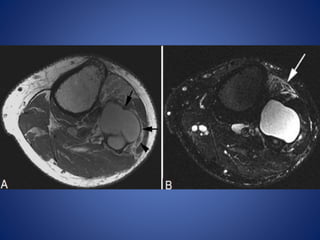
Bursae are cystic lesions containing synovial fluid that reduces friction
between moving structures such as tendons, ligaments, bone, and skin.
Bursae are often not visible on imaging unless irritated or inflamed due
to trauma, infection, or arthritis.
In general, bursae do not connect to the joint space, which
distinguishes them from synovial cysts and normal joint recesses;
however, at times, they can connect to the joint, such as the iliopsoas
bursa
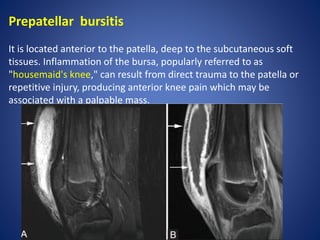
Prepatellar bursitis
It is located anterior to the patella, deep to the subcutaneous soft
tissues. Inflammation of the bursa, popularly referred to as
"housemaid's knee," can result from direct trauma to the patella or
repetitive injury, producing anterior knee pain which may be
associated with a palpable mass.
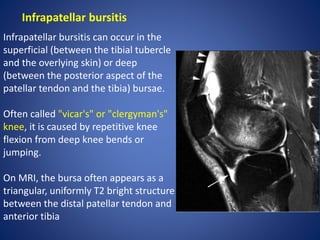
Infrapatellar bursitis
Infrapatellar bursitis can occur in the
superficial (between the tibial tubercle
and the overlying skin) or deep
(between the posterior aspect of the
patellar tendon and the tibia) bursae.
Often called "vicar's" or "clergyman's"
knee, it is caused by repetitive knee
flexion from deep knee bends or
jumping.
On MRI, the bursa often appears as a
triangular, uniformly T2 bright structure
between the distal patellar tendon and
anterior tibia
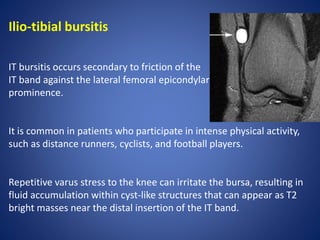
Ilio-tibial bursitis
IT bursitis occurs secondary to friction of the
IT band against the lateral femoral epicondylar
prominence.
It is common in patients who participate in intense physical activity,
such as distance runners, cyclists, and football players.
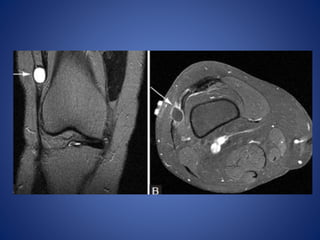
Repetitive varus stress to the knee can irritate the bursa, resulting in
fluid accumulation within cyst-like structures that can appear as T2
bright masses near the distal insertion of the IT band.
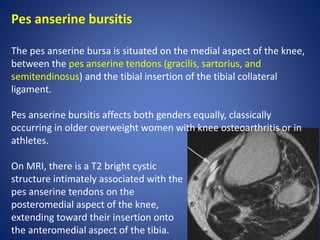
Pes anserine bursitis
The pes anserine bursa is situated on the medial aspect of the knee,
between the pes anserine tendons (gracilis, sartorius, and
semitendinosus) and the tibial insertion of the tibial collateral
ligament.
Pes anserine bursitis affects both genders equally, classically
occurring in older overweight women with knee osteoarthritis or in
athletes.
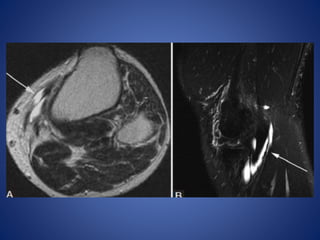
On MRI, there is a T2 bright cystic
structure intimately associated with the
pes anserine tendons on the
posteromedial aspect of the knee,
extending toward their insertion onto
the anteromedial aspect of the tibia.
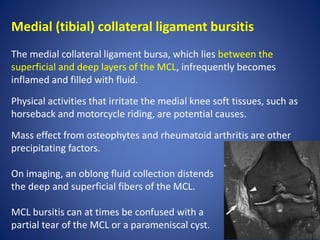
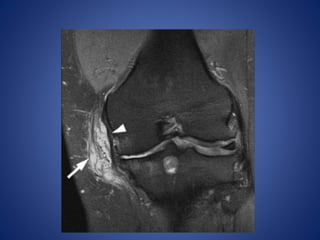
Medial (tibial) collateral ligament bursitis
The medial collateral ligament bursa, which lies between the
superficial and deep layers of the MCL, infrequently becomes
inflamed and filled with fluid.
Physical activities that irritate the medial knee soft tissues, such as
horseback and motorcycle riding, are potential causes.
Mass effect from osteophytes and rheumatoid arthritis are other
precipitating factors.
On imaging, an oblong fluid collection distends
the deep and superficial fibers of the MCL.
MCL bursitis can at times be confused with a
partial tear of the MCL or a parameniscal cyst.
Ganglia
Ganglia are myxoid lesions of unknown cause which are
characterized by dense connective tissue filled with gelatinous fluid
rich in hyaluronic acid and other mucopolysaccharides.
Unlike synovial cysts, ganglia do not communicate with the joint
space and lack a cellular lining.
Based on imaging, however, it is difficult (or impossible) to
distinguish ganglia from synovial cysts.
Long-standing ganglia can cause pressure erosions in the adjacent
bone, mimicking an aggressive process.
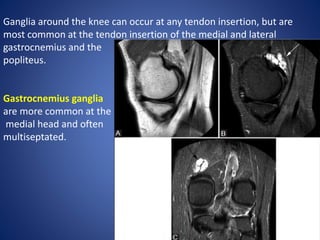
Ganglia around the knee can occur at any tendon insertion, but are
most common at the tendon insertion of the medial and lateral
gastrocnemius and the
popliteus.
Gastrocnemius ganglia
are more common at the
medial head and often
multiseptated.
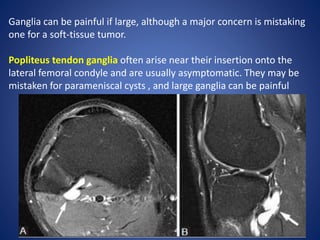
Ganglia can be painful if large, although a major concern is mistaking
one for a soft-tissue tumor.
Popliteus tendon ganglia often arise near their insertion onto the
lateral femoral condyle and are usually asymptomatic. They may be
mistaken for parameniscal cysts , and large ganglia can be painful
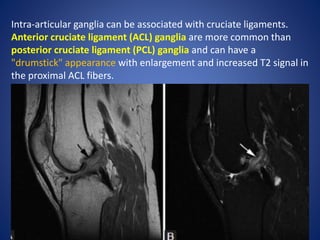
Intra-articular ganglia can be associated with cruciate ligaments.
Anterior cruciate ligament (ACL) ganglia are more common than
posterior cruciate ligament (PCL) ganglia and can have a
"drumstick" appearance with enlargement and increased T2 signal in
the proximal ACL fibers.
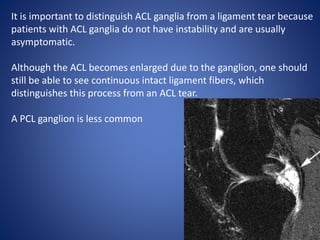
It is important to distinguish ACL ganglia from a ligament tear because
patients with ACL ganglia do not have instability and are usually
asymptomatic.
Although the ACL becomes enlarged due to the ganglion, one should
still be able to see continuous intact ligament fibers, which
distinguishes this process from an ACL tear.
A PCL ganglion is less common
Meniscal cysts
Meniscal cysts are believed to form as a result of tears in the
meniscal fibrocartilage, with extrusion of synovial fluid through the
meniscal tear.
Medial parameniscal cysts are 2 times more common than lateral
cysts .
Medial meniscal cysts are typically associated with posterior horn
tears, whereas lateral meniscal cysts arise from anterior horn and
body tears.
Lateral cysts are more symptomatic, with patients presenting with a
painful palpable lump
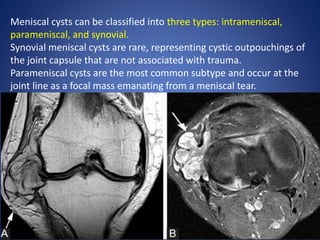
Meniscal cysts can be classified into three types: intrameniscal,
parameniscal, and synovial.
Synovial meniscal cysts are rare, representing cystic outpouchings of
the joint capsule that are not associated with trauma.
Parameniscal cysts are the most common subtype and occur at the
joint line as a focal mass emanating from a meniscal tear.
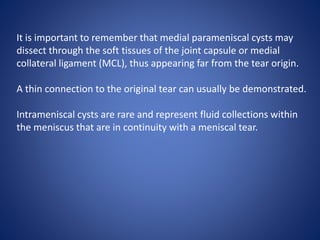
It is important to remember that medial parameniscal cysts may
dissect through the soft tissues of the joint capsule or medial
collateral ligament (MCL), thus appearing far from the tear origin.
A thin connection to the original tear can usually be demonstrated.
Intrameniscal cysts are rare and represent fluid collections within
the meniscus that are in continuity with a meniscal tear.
Cyst mimickers
Traumatic lesions
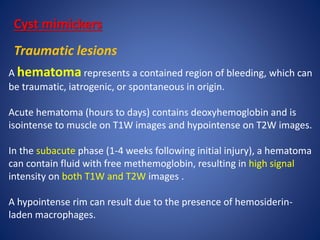
A hematoma represents a contained region of bleeding, which can
be traumatic, iatrogenic, or spontaneous in origin.
Acute hematoma (hours to days) contains deoxyhemoglobin and is
isointense to muscle on T1W images and hypointense on T2W images.
In the subacute phase (1-4 weeks following initial injury), a hematoma
can contain fluid with free methemoglobin, resulting in high signal
intensity on both T1W and T2W images .
A hypointense rim can result due to the presence of hemosiderin-
laden macrophages.
Seromas
Seromas are sterile collections of inflammatory exudate contained
within a confined tissue space.
They most commonly form when a potential space is created during
the surgery.
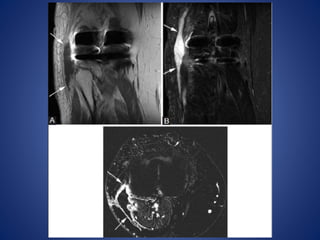
MRI reveals a simple, thin-walled cystic mass that has high T2
intensity and is isointense or hypointense to muscle on T1W images.
There can be rim enhancement, but the mass should not contain
solid internal enhancement. If a hematoma is complicated by
infection, there can be fat stranding in the surrounding soft tissues.
Vascular
Focal enlargement of veins, arteries, and lymphatic structures
around the knee can produce a "cystic" mass.
These conditions include aneurysms, varices, hemangiomas, and
lymphangiomas.
In contrast to the entities described previously, these vascular
lesions can have internal solid enhancement that mimics a tumor
and may be confused with malignancy.
Identifying a connection between the lesion and the vessel of
origin can help make the proper diagnosis and avoid a potentially
disastrous biopsy.
Aneurysms of the popliteal artery
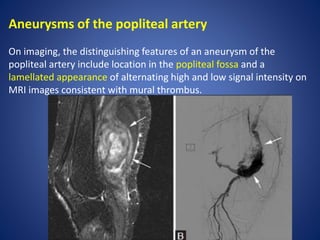
On imaging, the distinguishing features of an aneurysm of the
popliteal artery include location in the popliteal fossa and a
lamellated appearance of alternating high and low signal intensity on
MRI images consistent with mural thrombus.
Hemangiomas
They are typically soft, compressible, non-pulsatile masses that give a
bluish discoloration to the involved skin and subcutaneous tissues. [
On imaging, hemangiomas appear as dilated venous channels which
may contain thrombus and phleboliths.
These masses typically have low-to-intermediate signal intensity on
T1W images, high signal intensity on fluid-sensitive sequences, and
contain foci of low signal on all sequences from phleboliths.
Lymphatic malformations
MRI demonstrates a similar appearance to that of venous
malformations; they may be macrocystic or microcystic, with the latter
form predominating in the extremities. They typically lack internal or
solid areas of enhancement.
Neoplasms
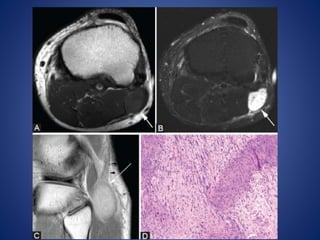
Schwannomas
On MRI imaging, a PNST appears as a fusiform mass arising from a
nerve, occasionally producing a "tail" on both ends where the nerve
enters and exits the mass.
Both schwannomas and neurofibromas can have a rim of peripheral
fat, known as the "split fat" sign and/or a central focus of low signal
within the hyperintense mass on T2W images, called a "target sign."
THANK YOU

Knee cystic lesions

  • 1.
    Dr Mohit Goel JRIII Cystsand cystic-appearing lesions of the knee
  • 3.
    Cysts Synovial cysts Synovial cystsconnect to the joint space, since they represent herniation of synovial tissue into the surrounding soft tissues. At times, it may be difficult or even impossible to distinguish them from bursae or ganglia, which lack a true connection to the joint but at times can connect to the joint.
  • 4.
    Popliteal (Baker's) cyst Itis most common cyst in the knee. It represents a communication between the posterior joint capsule and the normally occurring gastrocnemius-semimembranosus bursa/recess. This connection can have a "ball-valve" like mechanism, which is typically opened during knee flexion and closed during extension. Popliteal cysts are lined by synovium, may be simple or septated, and contain hemorrhage, debris, or even osseous loose bodies.
  • 5.
    Visualizing a communicatingfluid collection arising between the tendons of the medial head of the gastrocnemius and semimembranosus is the key to making the diagnosis. Although many popliteal cysts are asymptomatic, large cysts may cause nerve entrapment, compress adjacent vascular structures, or limit knee flexion. Popliteal cysts can be complicated by cyst rupture, which can be indistinguishable clinically from deep venous thrombosis and result in edema in the surrounding fascial planes and subcutaneous fat.

  • 7.
    Proximal tibiofibular jointcyst It is a synovial joint that connects to the knee joint in 10% of patients. It is hypothesized that increased knee joint pressure in these patients can result in the formation of a synovial cyst in the PTFJ. These cysts are more common in patients with chronic knee pain and osteoarthritis, but have also been described in high- performance athletes. Although relatively uncommon (<1% of MRI examinations) and often asymptomatic, large PTFJ cysts can compress the common peroneal nerve and result in foot drop and muscle weakness
  • 10.
    Bursae Bursae are cysticlesions containing synovial fluid that reduces friction between moving structures such as tendons, ligaments, bone, and skin. Bursae are often not visible on imaging unless irritated or inflamed due to trauma, infection, or arthritis. In general, bursae do not connect to the joint space, which distinguishes them from synovial cysts and normal joint recesses; however, at times, they can connect to the joint, such as the iliopsoas bursa
  • 11.
    Prepatellar bursitis It islocated anterior to the patella, deep to the subcutaneous soft tissues. Inflammation of the bursa, popularly referred to as "housemaid's knee," can result from direct trauma to the patella or repetitive injury, producing anterior knee pain which may be associated with a palpable mass.
  • 12.
    Infrapatellar bursitis Infrapatellar bursitiscan occur in the superficial (between the tibial tubercle and the overlying skin) or deep (between the posterior aspect of the patellar tendon and the tibia) bursae. Often called "vicar's" or "clergyman's" knee, it is caused by repetitive knee flexion from deep knee bends or jumping. On MRI, the bursa often appears as a triangular, uniformly T2 bright structure between the distal patellar tendon and anterior tibia
  • 13.
    Ilio-tibial bursitis IT bursitisoccurs secondary to friction of the IT band against the lateral femoral epicondylar prominence. It is common in patients who participate in intense physical activity, such as distance runners, cyclists, and football players. Repetitive varus stress to the knee can irritate the bursa, resulting in fluid accumulation within cyst-like structures that can appear as T2 bright masses near the distal insertion of the IT band.
  • 15.
    Pes anserine bursitis Thepes anserine bursa is situated on the medial aspect of the knee, between the pes anserine tendons (gracilis, sartorius, and semitendinosus) and the tibial insertion of the tibial collateral ligament. Pes anserine bursitis affects both genders equally, classically occurring in older overweight women with knee osteoarthritis or in athletes. On MRI, there is a T2 bright cystic structure intimately associated with the pes anserine tendons on the posteromedial aspect of the knee, extending toward their insertion onto the anteromedial aspect of the tibia.
  • 17.
    Medial (tibial) collateralligament bursitis The medial collateral ligament bursa, which lies between the superficial and deep layers of the MCL, infrequently becomes inflamed and filled with fluid. Physical activities that irritate the medial knee soft tissues, such as horseback and motorcycle riding, are potential causes. Mass effect from osteophytes and rheumatoid arthritis are other precipitating factors. On imaging, an oblong fluid collection distends the deep and superficial fibers of the MCL. MCL bursitis can at times be confused with a partial tear of the MCL or a parameniscal cyst.
  • 19.
    Ganglia Ganglia are myxoidlesions of unknown cause which are characterized by dense connective tissue filled with gelatinous fluid rich in hyaluronic acid and other mucopolysaccharides. Unlike synovial cysts, ganglia do not communicate with the joint space and lack a cellular lining. Based on imaging, however, it is difficult (or impossible) to distinguish ganglia from synovial cysts. Long-standing ganglia can cause pressure erosions in the adjacent bone, mimicking an aggressive process.
  • 20.
    Ganglia around theknee can occur at any tendon insertion, but are most common at the tendon insertion of the medial and lateral gastrocnemius and the popliteus. Gastrocnemius ganglia are more common at the medial head and often multiseptated.
  • 21.
    Ganglia can bepainful if large, although a major concern is mistaking one for a soft-tissue tumor. Popliteus tendon ganglia often arise near their insertion onto the lateral femoral condyle and are usually asymptomatic. They may be mistaken for parameniscal cysts , and large ganglia can be painful
  • 22.
    Intra-articular ganglia canbe associated with cruciate ligaments. Anterior cruciate ligament (ACL) ganglia are more common than posterior cruciate ligament (PCL) ganglia and can have a "drumstick" appearance with enlargement and increased T2 signal in the proximal ACL fibers.
  • 23.
    It is importantto distinguish ACL ganglia from a ligament tear because patients with ACL ganglia do not have instability and are usually asymptomatic. Although the ACL becomes enlarged due to the ganglion, one should still be able to see continuous intact ligament fibers, which distinguishes this process from an ACL tear. A PCL ganglion is less common
  • 24.
    Meniscal cysts Meniscal cystsare believed to form as a result of tears in the meniscal fibrocartilage, with extrusion of synovial fluid through the meniscal tear. Medial parameniscal cysts are 2 times more common than lateral cysts . Medial meniscal cysts are typically associated with posterior horn tears, whereas lateral meniscal cysts arise from anterior horn and body tears. Lateral cysts are more symptomatic, with patients presenting with a painful palpable lump
  • 25.
    Meniscal cysts canbe classified into three types: intrameniscal, parameniscal, and synovial. Synovial meniscal cysts are rare, representing cystic outpouchings of the joint capsule that are not associated with trauma. Parameniscal cysts are the most common subtype and occur at the joint line as a focal mass emanating from a meniscal tear.
  • 26.
    It is importantto remember that medial parameniscal cysts may dissect through the soft tissues of the joint capsule or medial collateral ligament (MCL), thus appearing far from the tear origin. A thin connection to the original tear can usually be demonstrated. Intrameniscal cysts are rare and represent fluid collections within the meniscus that are in continuity with a meniscal tear.
  • 27.
    Cyst mimickers Traumatic lesions Ahematoma represents a contained region of bleeding, which can be traumatic, iatrogenic, or spontaneous in origin. Acute hematoma (hours to days) contains deoxyhemoglobin and is isointense to muscle on T1W images and hypointense on T2W images. In the subacute phase (1-4 weeks following initial injury), a hematoma can contain fluid with free methemoglobin, resulting in high signal intensity on both T1W and T2W images . A hypointense rim can result due to the presence of hemosiderin- laden macrophages.
  • 29.
    Seromas Seromas are sterilecollections of inflammatory exudate contained within a confined tissue space. They most commonly form when a potential space is created during the surgery. MRI reveals a simple, thin-walled cystic mass that has high T2 intensity and is isointense or hypointense to muscle on T1W images. There can be rim enhancement, but the mass should not contain solid internal enhancement. If a hematoma is complicated by infection, there can be fat stranding in the surrounding soft tissues.
  • 31.
    Vascular Focal enlargement ofveins, arteries, and lymphatic structures around the knee can produce a "cystic" mass. These conditions include aneurysms, varices, hemangiomas, and lymphangiomas. In contrast to the entities described previously, these vascular lesions can have internal solid enhancement that mimics a tumor and may be confused with malignancy. Identifying a connection between the lesion and the vessel of origin can help make the proper diagnosis and avoid a potentially disastrous biopsy.
  • 32.
    Aneurysms of thepopliteal artery On imaging, the distinguishing features of an aneurysm of the popliteal artery include location in the popliteal fossa and a lamellated appearance of alternating high and low signal intensity on MRI images consistent with mural thrombus.
  • 33.
    Hemangiomas They are typicallysoft, compressible, non-pulsatile masses that give a bluish discoloration to the involved skin and subcutaneous tissues. [ On imaging, hemangiomas appear as dilated venous channels which may contain thrombus and phleboliths. These masses typically have low-to-intermediate signal intensity on T1W images, high signal intensity on fluid-sensitive sequences, and contain foci of low signal on all sequences from phleboliths.
  • 35.
    Lymphatic malformations MRI demonstratesa similar appearance to that of venous malformations; they may be macrocystic or microcystic, with the latter form predominating in the extremities. They typically lack internal or solid areas of enhancement.
  • 36.
    Neoplasms Schwannomas On MRI imaging,a PNST appears as a fusiform mass arising from a nerve, occasionally producing a "tail" on both ends where the nerve enters and exits the mass. Both schwannomas and neurofibromas can have a rim of peripheral fat, known as the "split fat" sign and/or a central focus of low signal within the hyperintense mass on T2W images, called a "target sign."
  • 38.

Editor's Notes

  • #7 Popliteal cyst. (A) radiograph demonstrates coarse calcifications (arrow) in the popliteal fossa. (B) USG image at the level of popliteal fossa demonstrates a cystic lesion containing echogenic calcifications (arrow) with posterior acoustic shadowing. (C) Axial T2W image through right knee demonstrates the hyperintense popliteal cyst fluid arising between semimembranosus (arrowhead) tendon and medial head of gastrocnemius (asterisk), with hypointense loose bodies (arrow) layering dependently
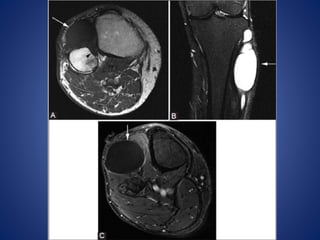
  • #9 PTFJ cyst. Axial T1W MR image (A) demonstrates uniformly hypointense mass (arrow) with small tail (arrowhead), arising from proximal tibiofibular joint. Lesion (arrow) is hyperintense on STIR (B) and does not enhance on post-contrast T1W fat-saturated image
  • #10 PTFJ cyst. A 57-year-old man with foot drop. Axial (PD) image (A) shows large cyst (arrows) compressing the common peroneal nerve (arrowhead). There is muscle edema (arrow) in anterior tibialis on the axial STIR image (B)
  • #12 Prepatellar bursitis. A 16-year-old female with anterior knee pain. (A) T2W fat-saturated image demonstrates enlarged fluid-filled space in prepatellar region (arrows) with surrounding fat stranding. (B) T1W post-contrast image demonstrates only peripheral enhancement (arrows)
  • #13 Infrapatellar bursitis. A 28-year-old male with anterior knee pain. Sagittal fat-saturated T2W image shows triangular pocket of fluid (arrow) between distal patellar tendon and anterior tibia. There is also bone contusion in lateral femoral condyle and fluid in suprapatellar recess (arrowheads), resulting from transient lateral patellar dislocation
  • #15 Iliotibial band cyst. A 46-year-old man with palpable abnormality. (A) Coronal T2W fat-saturated image demonstrates well-circumscribed hyperintense cyst (arrows) abutting the iliotibial band, which does not enhance internally following contrast administration on the post-contrast T1W fat-saturated image (B)
  • #17 Pes anserine bursitis. A 30-year-old male with medial knee pain. (A) Axial T2W and (B) sagittal T2W fat-saturated images demonstrate fluid signal (arrows) adjacent to the insertion of the pes anserine tendons
  • #19 Medial collateral ligament bursitis. A 56-year-old man with medial knee mass and pain. Coronal T2W fat-saturated image shows an oblong heterogeneous cystic mass (arrow) adjacent to the medial collateral ligament (arrowhead)
  • #21 Gastrocnemius ganglion. A 45-year-old male with knee pain. Sagittal PDW image (A) demonstrates lobulated lesion (arrows) at insertion of medial head of gastrocnemius that is hyperintense on sagittal (B) and coronal (C) T2W fat-saturated images
  • #22 Popliteus ganglion. A 34-year-old woman with knee pain. (A) Axial and (B) sagittal T2W fat-saturated images show a cystic lesion (arrow) in the popliteus tendon sheath
  • #23 ACL ganglion. A 31-year-old male with knee pain. (A) Sagittal PDW and (B) T2W fat-saturated images demonstrate cystic lesion in proximal fibers of anterior cruciate ligament (arrows), which expands ligament fibers and produces "drumstick" appearance. Note the presence of continuous intact ACL fibers
  • #24 PCL ganglion. A 28-year-old male with persistent pain after injury. Sagittal T2W fat-saturated image demonstrates multilobulated cystic lesion (arrow) involving distal posterior cruciate ligament
  • #26 Meniscal cyst. A 42-year-old female with knee pain and palpable lateral mass. (A) Coronal PDW image of the right knee demonstrates a multilobulated cyst (arrow) with internal septations, which arises from tear of body of lateral meniscus. (B) T2W fat-saturated image demonstrates cystic nature of this lesion (arrow), which did not enhance following contrast administration (not shown)
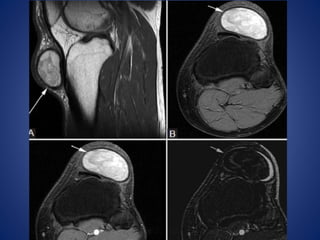
  • #29 Hematoma. A 46-year-old male with pain and swelling after fall. (A) Sagittal T1W image demonstrates a hyperintense lesion (arrows) with hypointense rim and surrounding fat stranding. Axial pre (B) and post (C) T1W fat-saturated, and subtracted post-contrast images (D) confirm lack of enhancement. Crescentic misregistration artifact is seen at the lateral aspect of the hematoma
  • #31 Seroma. A 71-year-old female with swelling following total knee arthroplasty. (A) Coronal T1W and (B) T2W fat-saturated images demonstrate linear fluid collection (arrows) along the lateral aspect of knee. (C) Post-contrast axial subtraction image shows rim enhancement only (arrows). Percutaneous needle drainage yielded non-infected serous fluid
  • #33 Popliteal artery aneurysm. A 62-year-old male with pulsatile mass in popliteal fossa. (A) Sagittal T2W fat-saturated image demonstrates heterogeneous mass in the region of popliteal fossa (arrows). (B) Digital subtraction angiography shows partial thrombosis of large popliteal fossa aneurysm (arrows)
  • #35 Intramuscular hemangioma. A 54-year-old female with knee mass and pain. (A) Sagittal T2W fat-saturated and (B) axial T1W fat-saturated post-contrast images show a lobulated enhancing cystic mass (arrows) in the vastus medialis
  • #36 Lymphatic malformation. A 23-year-old female with palpable medial knee mass. (A) Coronal T1W image shows multilobulated cystic lesion (arrows) in the medial aspect of the knee that is isointense and hyperintense to muscle. (B) Axial fat-suppressed T2W image shows fluid-fluid levels (arrow) in this multicystic lesion
  • #38 Schwannoma. A 38-year-old male with knee pain. Axial (A) T1W and (B) T2W fat-suppressed images show T2-hyperintense lesion (arrows) in the lateral soft tissue of the knee. (C) Coronal PDW image confirms that the mass (arrow) arises from common peroneal nerve (arrowheads).