Introduction to Databases
     Transparencies


   © Pearson Education Limited 1995, 2005
Chapter 1 - Objectives

  Some common uses of database systems.
  Characteristics of file-based systems.
  Problems with file-based approach.
  Meaning of the term database.
  Meaning of the term Database Management
  System (DBMS).


               © Pearson Education Limited 1995, 2005
Chapter 1 - Objectives
  Typical functions of a DBMS.
  Major components of the DBMS environment.
  Personnel involved in the DBMS environment.
  History of the development of DBMSs.
  Advantages and disadvantages of DBMSs.


               © Pearson Education Limited 1995, 2005
Examples of Database Applications

  Purchases from the supermarket
  Purchases using your credit card
  Booking a holiday at the travel agents
  Using the local library
  Taking out insurance
  Renting a video
  Using the Internet
  Studying at university

                © Pearson Education Limited 1995, 2005
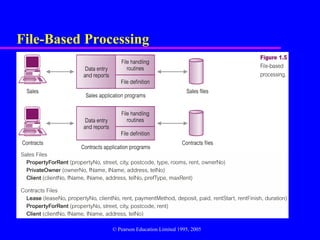
File-Based Systems

  Collection of application programs that
  perform services for the end users (e.g. reports).


  Each program defines and manages its own
  data.


                 © Pearson Education Limited 1995, 2005
File-Based Processing


               © Pearson Education Limited 1995, 2005
Limitations of File-Based Approach
  Separation and isolation of data
   – Each program maintains its own set of data.
   – Users of one program may be unaware of
     potentially useful data held by other programs.

  Duplication of data
   – Same data is held by different programs.
   – Wasted space and potentially different values
     and/or different formats for the same item.


                  © Pearson Education Limited 1995, 2005
Limitations of File-Based Approach

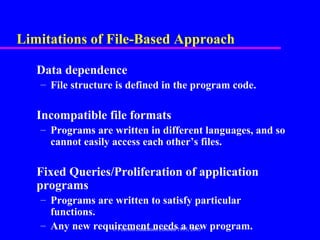
   Data dependence
   – File structure is defined in the program code.

   Incompatible file formats
   – Programs are written in different languages, and so
     cannot easily access each other’s files.

   Fixed Queries/Proliferation of application
   programs
   – Programs are written to satisfy particular
     functions.
   – Any new requirement needs1995,new program.
                 © Pearson Education Limited a 2005
Database Approach
  Arose because:
   – Definition of data was embedded in application
     programs, rather than being stored separately and
     independently.
   – No control over access and manipulation of data
     beyond that imposed by application programs.

  Result:
   – the database and Database Management System
     (DBMS).


                  © Pearson Education Limited 1995, 2005
Database
  Shared collection of logically related data (and
  a description of this data), designed to meet the
  information needs of an organization.

  System catalog (metadata) provides description
  of data to enable program–data independence.

  Logically related data comprises entities,
  attributes, and relationships of an
  organization’s information.

                 © Pearson Education Limited 1995, 2005
Database Management System (DBMS)

  A software system that enables users to define,
  create, maintain, and control access to the
  database.

  (Database) application program: a computer
  program that interacts with database by
  issuing an appropriate request (SQL
  statement) to the DBMS.


                © Pearson Education Limited 1995, 2005
Database Management System (DBMS)


             © Pearson Education Limited 1995, 2005
Database Approach

  Data definition language (DDL).
   – Permits specification of data types, structures and
     any data constraints.
   – All specifications are stored in the database.


  Data manipulation language (DML).
   – General enquiry facility (query language) of the
     data.


                   © Pearson Education Limited 1995, 2005
Database Approach

  Controlled access to database may
  include:
  –   a security system
  –   an integrity system
  –   a concurrency control system
  –   a recovery control system
  –   a user-accessible catalog.


                  © Pearson Education Limited 1995, 2005
Views

  Allows each user to have his or her own view of
  the database.

  A view is essentially some subset of the
  database.


                 © Pearson Education Limited 1995, 2005
Views - Benefits
   Reduce complexity
   Provide a level of security
   Provide a mechanism to customize the
   appearance of the database
   Present a consistent, unchanging picture of the
   structure of the database, even if the
   underlying database is changed


                 © Pearson Education Limited 1995, 2005
Components of DBMS Environment


            © Pearson Education Limited 1995, 2005
Components of DBMS Environment
  Hardware
   – Can range from a PC to a network of
     computers.
  Software
   – DBMS, operating system, network software (if
     necessary) and also the application programs.
  Data
  – Used by the organization and a description
    of this data called the schema.


                 © Pearson Education Limited 1995, 2005
Components of DBMS Environment

  Procedures
   – Instructions and rules that should be applied to
     the design and use of the database and DBMS.
  People


                 © Pearson Education Limited 1995, 2005
History of Database Systems

  First-generation
   – Hierarchical and Network

  Second generation
   – Relational

  Third generation
   – Object-Relational
   – Object-Oriented


                  © Pearson Education Limited 1995, 2005
Advantages of DBMSs
  Control of data redundancy
  Data consistency
  More information from the same amount of
  data
  Sharing of data
  Improved data integrity
  Improved security
  Enforcement of standards
  Economy of scale

               © Pearson Education Limited 1995, 2005
Advantages of DBMSs

  Balance conflicting requirements
  Improved data accessibility and responsiveness
  Increased productivity
  Improved maintenance through data
  independence
  Increased concurrency
  Improved backup and recovery services


                © Pearson Education Limited 1995, 2005
Exercise : (lab session 9/8/07)
Discuss the roles of following personnel in database
environment: (people)

    Data Administrator (DA)
    Database Administrator (DBA)
    Database Designers (Logical and Physical)
    Application Programmers
    End Users (naive and sophisticated)


                     © Pearson Education Limited 1995, 2005

File system-and-database-chapter01-connoly

  • 1.
    Introduction to Databases Transparencies © Pearson Education Limited 1995, 2005
  • 2.
    Chapter 1 -Objectives Some common uses of database systems. Characteristics of file-based systems. Problems with file-based approach. Meaning of the term database. Meaning of the term Database Management System (DBMS). © Pearson Education Limited 1995, 2005
  • 3.
    Chapter 1 -Objectives Typical functions of a DBMS. Major components of the DBMS environment. Personnel involved in the DBMS environment. History of the development of DBMSs. Advantages and disadvantages of DBMSs. © Pearson Education Limited 1995, 2005
  • 4.
    Examples of DatabaseApplications Purchases from the supermarket Purchases using your credit card Booking a holiday at the travel agents Using the local library Taking out insurance Renting a video Using the Internet Studying at university © Pearson Education Limited 1995, 2005
  • 5.
    File-Based Systems Collection of application programs that perform services for the end users (e.g. reports). Each program defines and manages its own data. © Pearson Education Limited 1995, 2005
  • 6.
    File-Based Processing © Pearson Education Limited 1995, 2005
  • 7.
    Limitations of File-BasedApproach Separation and isolation of data – Each program maintains its own set of data. – Users of one program may be unaware of potentially useful data held by other programs. Duplication of data – Same data is held by different programs. – Wasted space and potentially different values and/or different formats for the same item. © Pearson Education Limited 1995, 2005
  • 8.
    Limitations of File-BasedApproach Data dependence – File structure is defined in the program code. Incompatible file formats – Programs are written in different languages, and so cannot easily access each other’s files. Fixed Queries/Proliferation of application programs – Programs are written to satisfy particular functions. – Any new requirement needs1995,new program. © Pearson Education Limited a 2005
  • 9.
    Database Approach Arose because: – Definition of data was embedded in application programs, rather than being stored separately and independently. – No control over access and manipulation of data beyond that imposed by application programs. Result: – the database and Database Management System (DBMS). © Pearson Education Limited 1995, 2005
  • 10.
    Database Sharedcollection of logically related data (and a description of this data), designed to meet the information needs of an organization. System catalog (metadata) provides description of data to enable program–data independence. Logically related data comprises entities, attributes, and relationships of an organization’s information. © Pearson Education Limited 1995, 2005
  • 11.
    Database Management System(DBMS) A software system that enables users to define, create, maintain, and control access to the database. (Database) application program: a computer program that interacts with database by issuing an appropriate request (SQL statement) to the DBMS. © Pearson Education Limited 1995, 2005
  • 12.
    Database Management System(DBMS) © Pearson Education Limited 1995, 2005
  • 13.
    Database Approach Data definition language (DDL). – Permits specification of data types, structures and any data constraints. – All specifications are stored in the database. Data manipulation language (DML). – General enquiry facility (query language) of the data. © Pearson Education Limited 1995, 2005
  • 14.
    Database Approach Controlled access to database may include: – a security system – an integrity system – a concurrency control system – a recovery control system – a user-accessible catalog. © Pearson Education Limited 1995, 2005
  • 15.
    Views Allowseach user to have his or her own view of the database. A view is essentially some subset of the database. © Pearson Education Limited 1995, 2005
  • 16.
    Views - Benefits Reduce complexity Provide a level of security Provide a mechanism to customize the appearance of the database Present a consistent, unchanging picture of the structure of the database, even if the underlying database is changed © Pearson Education Limited 1995, 2005
  • 17.
    Components of DBMSEnvironment © Pearson Education Limited 1995, 2005
  • 18.
    Components of DBMSEnvironment Hardware – Can range from a PC to a network of computers. Software – DBMS, operating system, network software (if necessary) and also the application programs. Data – Used by the organization and a description of this data called the schema. © Pearson Education Limited 1995, 2005
  • 19.
    Components of DBMSEnvironment Procedures – Instructions and rules that should be applied to the design and use of the database and DBMS. People © Pearson Education Limited 1995, 2005
  • 20.
    History of DatabaseSystems First-generation – Hierarchical and Network Second generation – Relational Third generation – Object-Relational – Object-Oriented © Pearson Education Limited 1995, 2005
  • 21.
    Advantages of DBMSs Control of data redundancy Data consistency More information from the same amount of data Sharing of data Improved data integrity Improved security Enforcement of standards Economy of scale © Pearson Education Limited 1995, 2005
  • 22.
    Advantages of DBMSs Balance conflicting requirements Improved data accessibility and responsiveness Increased productivity Improved maintenance through data independence Increased concurrency Improved backup and recovery services © Pearson Education Limited 1995, 2005
  • 23.
    Exercise : (labsession 9/8/07) Discuss the roles of following personnel in database environment: (people) Data Administrator (DA) Database Administrator (DBA) Database Designers (Logical and Physical) Application Programmers End Users (naive and sophisticated) © Pearson Education Limited 1995, 2005