DISTRIBUTION, ELECTRONIC DATA HANDLING
AND CONTROLLED & UNCONTROLLED
DOCUMENTATION.
PREPARED BY : KHUSHBOO
KUNKULOL
• Documentation :
Document is any written statement or proof of any activity such as
raw material handling ,SOP , Validation etc. in Pharmaceutical Industries
. Documentation is required to minimize the risk of misinterpretation ,
error inherent in oral and written communication to provide
unambiguous procedure.
• Purpose :
• Defines specification and procedure for all material and method of
manufacture and control.
• Ensure all personnel know what to do, when to do, where to do.
• Ensure that authorized persons have all the information necessary
for handling of product.
• Ensure the documented evidence , provide records for
investigation.
• Ensure the availability of data for validation and review.
DISTRIBUTION PROCEDURE :
• Written procedure shall be established and followed by describing
the distribution of drug product.
• They shall include :
1. A procedure whereby oldest stock of a drug product is
distributed first. Deviation from this requirement is permitted if such
deviation is temporary and appropriate .
2. A system by which distribution of each lot of drug product
can be readily determined to facilitate its recall if necessary .
• Distribution records must be constructed and procedure
established to facilitate recall of defective product.
• A system approval is necessary and specific release of each lot of
drug by quality control function before distribution can occur .
• The manufacture must maintain record of all distribution
transaction involving in-process or finished product .
• All records should be indexed by either the manufacturing batch
no. as a means of accountability until shipment passes from direct
control of manufacture.
• This type of indexing permits an efficient determination of receiver.
• Depending on marketing procedure of individual company,
distribution record may contain list of shipment for packaging or
labelling or to an independent distributor , wholesaler , retail
pharmacist, a physician, or possibly the ultimate consumer.
• A variety of distribution record are utilized. Two of more commonly
used are :
1. To record the lots or control no. on the retained copies
of shipping invoice.
2. To record the dates on which each lot commenced
distribution.
• The distribution process also include other consideration such as
first in / first out movement of the product must be maintain.
 IN CASE OF API :
1. APIs should be released for distribution to third party only after
have been approved by quality unit.
2. API may be transferred to isolated area under company’s
control after providing appropriate documentation .
3. API must be transported in manner that it doesn’t adversely
affect the quality of final product.
4. Special transport or storage condition of API must be stated on
label along with first in/ first out movement date and time to permit its
recall if necessary.
DISTRIBUTION RECORDS:
 INTRODUCTION:
Distribution are written data related to distribution of drug
from manufacturer to distributor. They are one of the most important
record required by GMP regulation. These records should be
maintained in such a way that a batch related distribution record are
easily available.
 OBJECTIVE:
The objective of this guideline is that if there is some adverse
drug reaction or some quality defect, the manufacturer should be able
to recall the batch of drug promptly. The information contained in
these records is a key for notification of customers in event of product
recall.
• Distribution record shall contain the name and strength of product
and description of dosage form , name, and address of the
consignee ,date and quantity shipped and lot or control number of
drug product.
• For compressed medical gas product , distribution records are not
required to contain lot or control number.
• The primary purpose of this section is to ensure that adequate
data are available to access trade customers should recall be
initiated.
• Distribution record include wide range of documentation such as
invoice, bills of lading, customers receipt and internal warehouse
storage and inventory records.
• The information required need not to be on every document. Also,
customer codes and product codes may be used as alternates to
customer name, address and product name.
• Record for distribution shall be maintained in manner such that
finished batch of drug can be traced to retain level to facilitate
prompt and complete recall of batch if and when necessary.
ELECTRONIC DATA HANDLING:
• Electronic data handling is also known as EDH, a
frequently used term for automatic information processing. It
uses the computers to collect, manipulate, record,
classification and to summarize data. EDH meaning can be
described as the processing of data using electronic means
such as computers, calculators, servers and other similar
electronic data processing equipment. A computer is the best
example of an EDH system , where total data is stored .
 Electronic records in an automation system & are easier to keep
than manual records. Records generated and maintained by the
automation system include:
 Recipe handling.
 System configuration .
 Device calibration .
 Operator input .
 Audit trail .
 Alarm and event history .
 Trends and batch records.
 API first in/ first come.
 FDA has provided a tool which makes data more secure , accurate,
long-lasting and authenticate. This tool is known as ALCOA.
Where,
A- ATTRIBUTABLE
L- LEGIBLE
C- CONTEMPORANEOUS
O- ORIGINAL
A- ACCURATE.
ATTRIBUTABLE:
All data generated or collected must be attributable to the
person generating data (who/ when responsible ).
GOAL:
To identify the person who is responsible for particular
activity.
WHY:
To ensure whether the person was trained for the
activity or not.
LEGIBLE:
All data recorded must readable ( legible) and
permanent which support the electronic data.
GOAL:
To generate an easy to read and understand data.
WHY:
To ensure what was actually recorded ?
CONTEMPORANEOUS:
Contemporaneous means to record the result , measurement or
data at the time when work is performed/ carried out.
Date and time stamps should be order that execution for data
should be credible and data should never be back dated.
GOAL:
To record the data whenever activity held.
WHY:
To get actual timing of the activity done.
ORIGINAL:
Original data sometimes refers to as source data or primary
data, is the medium in which data point is recorded for first time.
This could be a data base , an approved protocol or form, or a
dedicated notebook. Its important to understand where your original
data will be generated so that its content and meaning are preserved.
GOAL:
Whatever activity it may, shall be recorded as it is.
WHY:
To ensure the authenticity of activity.
ACCURACY:
The data and records should be accurate i.e., free from
errors, should be truthful, and must reflective of observation.
Editing should not be performed without documentation and
annotation of the amendments.
GOAL:
Whatever data/ outcomes should be recorded as it is.
WHY:
To ensure the authenticity of data.
ALCOA PLUS (+) :
C:COMPLETE – No deletion takes place from date of
documenting means data must critical to recreate the event.
C:CONSISTANCE – Data should be chronologically
arranged with time and date stamps included for any addition
to original data.
E:ENDURING – The material used to record the data
should be in manner which will last long duration of time.
E:AVAILABLE – Data should be accessible whenever
needed over life of data.
 CONTROLLED AND UNCONTROLLED
DOCUMENTS:
It may not always be obvious to determine what type
of documents must be controlled and what type of documents
can remain uncontrolled.
CONTROLLED DOCUMENT:
A controlled copy is always at the correct / latest
revision level. When a change is made, it is retrieved and
replaced.
Some document require ‘control’ to determine how a
document is
• Created
• Checked
• Approved
• To whom distributed
• From whom restricted
• Who is in charge of management
• Exactly how long document is managed.
CONTROL OF DOCUMENTS:
 Documents shall be periodically reviewed ( recommended
once/year )
 QA & Document control centre are responsible to ensure
that issued documents are controlled, effective and
implemented.
 Use of electronic signatures as well as electronic
maintenance and submission, is an acceptable substitution
for paper, when pratical.
• UNCONTROLLED DOCUMENT:
Documents that is not subjected to amendments,
changes or revisions and not traceable.
OR
The photocopy of master copy of controlled
documents or written procedure which shall be given to any
department or person for reference purpose only.
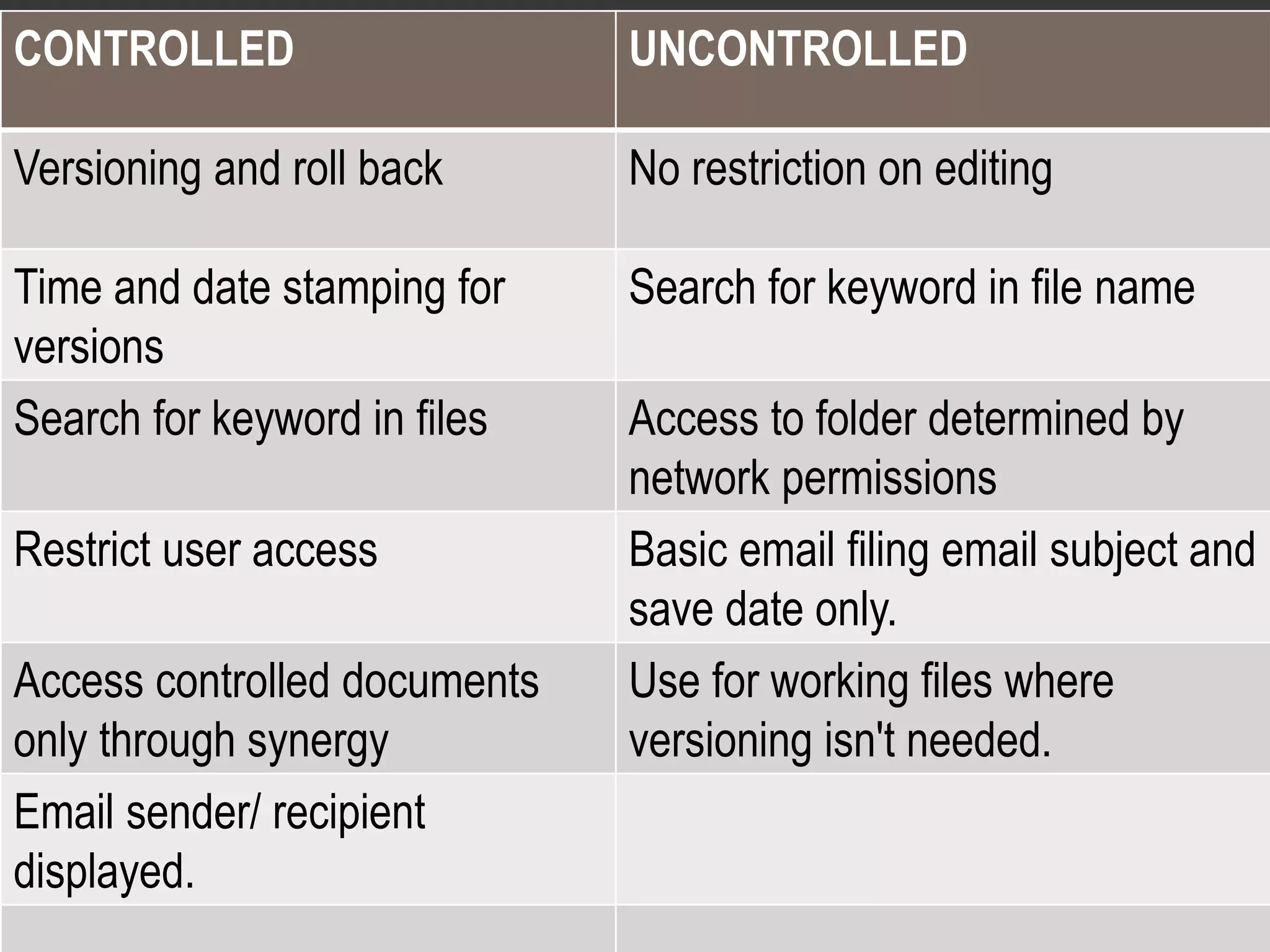
CONTROLLED UNCONTROLLED
Versioning and roll back No restriction on editing
Time and date stamping for
versions
Search for keyword in file name
Search for keyword in files Access to folder determined by
network permissions
Restrict user access Basic email filing email subject and
save date only.
Access controlled documents
only through synergy
Use for working files where
versioning isn't needed.
Email sender/ recipient
displayed.
THANK YOU

Distribution, Electronic data handling and controlled documentation by Khushboo kunkulol.

  • 1.
    DISTRIBUTION, ELECTRONIC DATAHANDLING AND CONTROLLED & UNCONTROLLED DOCUMENTATION. PREPARED BY : KHUSHBOO KUNKULOL
  • 2.
    • Documentation : Documentis any written statement or proof of any activity such as raw material handling ,SOP , Validation etc. in Pharmaceutical Industries . Documentation is required to minimize the risk of misinterpretation , error inherent in oral and written communication to provide unambiguous procedure. • Purpose : • Defines specification and procedure for all material and method of manufacture and control. • Ensure all personnel know what to do, when to do, where to do. • Ensure that authorized persons have all the information necessary for handling of product. • Ensure the documented evidence , provide records for investigation. • Ensure the availability of data for validation and review.
  • 3.
    DISTRIBUTION PROCEDURE : •Written procedure shall be established and followed by describing the distribution of drug product. • They shall include : 1. A procedure whereby oldest stock of a drug product is distributed first. Deviation from this requirement is permitted if such deviation is temporary and appropriate . 2. A system by which distribution of each lot of drug product can be readily determined to facilitate its recall if necessary .
  • 4.
    • Distribution recordsmust be constructed and procedure established to facilitate recall of defective product. • A system approval is necessary and specific release of each lot of drug by quality control function before distribution can occur . • The manufacture must maintain record of all distribution transaction involving in-process or finished product . • All records should be indexed by either the manufacturing batch no. as a means of accountability until shipment passes from direct control of manufacture. • This type of indexing permits an efficient determination of receiver.
  • 5.
    • Depending onmarketing procedure of individual company, distribution record may contain list of shipment for packaging or labelling or to an independent distributor , wholesaler , retail pharmacist, a physician, or possibly the ultimate consumer. • A variety of distribution record are utilized. Two of more commonly used are : 1. To record the lots or control no. on the retained copies of shipping invoice. 2. To record the dates on which each lot commenced distribution. • The distribution process also include other consideration such as first in / first out movement of the product must be maintain.
  • 6.
     IN CASEOF API : 1. APIs should be released for distribution to third party only after have been approved by quality unit. 2. API may be transferred to isolated area under company’s control after providing appropriate documentation . 3. API must be transported in manner that it doesn’t adversely affect the quality of final product. 4. Special transport or storage condition of API must be stated on label along with first in/ first out movement date and time to permit its recall if necessary.
  • 7.
    DISTRIBUTION RECORDS:  INTRODUCTION: Distributionare written data related to distribution of drug from manufacturer to distributor. They are one of the most important record required by GMP regulation. These records should be maintained in such a way that a batch related distribution record are easily available.  OBJECTIVE: The objective of this guideline is that if there is some adverse drug reaction or some quality defect, the manufacturer should be able to recall the batch of drug promptly. The information contained in these records is a key for notification of customers in event of product recall.
  • 9.
    • Distribution recordshall contain the name and strength of product and description of dosage form , name, and address of the consignee ,date and quantity shipped and lot or control number of drug product. • For compressed medical gas product , distribution records are not required to contain lot or control number. • The primary purpose of this section is to ensure that adequate data are available to access trade customers should recall be initiated. • Distribution record include wide range of documentation such as invoice, bills of lading, customers receipt and internal warehouse storage and inventory records.
  • 10.
    • The informationrequired need not to be on every document. Also, customer codes and product codes may be used as alternates to customer name, address and product name. • Record for distribution shall be maintained in manner such that finished batch of drug can be traced to retain level to facilitate prompt and complete recall of batch if and when necessary.
  • 11.
    ELECTRONIC DATA HANDLING: •Electronic data handling is also known as EDH, a frequently used term for automatic information processing. It uses the computers to collect, manipulate, record, classification and to summarize data. EDH meaning can be described as the processing of data using electronic means such as computers, calculators, servers and other similar electronic data processing equipment. A computer is the best example of an EDH system , where total data is stored .
  • 12.
     Electronic recordsin an automation system & are easier to keep than manual records. Records generated and maintained by the automation system include:  Recipe handling.  System configuration .  Device calibration .  Operator input .  Audit trail .  Alarm and event history .  Trends and batch records.  API first in/ first come.
  • 13.
     FDA hasprovided a tool which makes data more secure , accurate, long-lasting and authenticate. This tool is known as ALCOA. Where, A- ATTRIBUTABLE L- LEGIBLE C- CONTEMPORANEOUS O- ORIGINAL A- ACCURATE.
  • 14.
    ATTRIBUTABLE: All data generatedor collected must be attributable to the person generating data (who/ when responsible ). GOAL: To identify the person who is responsible for particular activity. WHY: To ensure whether the person was trained for the activity or not.
  • 15.
    LEGIBLE: All data recordedmust readable ( legible) and permanent which support the electronic data. GOAL: To generate an easy to read and understand data. WHY: To ensure what was actually recorded ?
  • 16.
    CONTEMPORANEOUS: Contemporaneous means torecord the result , measurement or data at the time when work is performed/ carried out. Date and time stamps should be order that execution for data should be credible and data should never be back dated. GOAL: To record the data whenever activity held. WHY: To get actual timing of the activity done.
  • 17.
    ORIGINAL: Original data sometimesrefers to as source data or primary data, is the medium in which data point is recorded for first time. This could be a data base , an approved protocol or form, or a dedicated notebook. Its important to understand where your original data will be generated so that its content and meaning are preserved. GOAL: Whatever activity it may, shall be recorded as it is. WHY: To ensure the authenticity of activity.
  • 18.
    ACCURACY: The data andrecords should be accurate i.e., free from errors, should be truthful, and must reflective of observation. Editing should not be performed without documentation and annotation of the amendments. GOAL: Whatever data/ outcomes should be recorded as it is. WHY: To ensure the authenticity of data.
  • 19.
    ALCOA PLUS (+): C:COMPLETE – No deletion takes place from date of documenting means data must critical to recreate the event. C:CONSISTANCE – Data should be chronologically arranged with time and date stamps included for any addition to original data. E:ENDURING – The material used to record the data should be in manner which will last long duration of time. E:AVAILABLE – Data should be accessible whenever needed over life of data.
  • 20.
     CONTROLLED ANDUNCONTROLLED DOCUMENTS: It may not always be obvious to determine what type of documents must be controlled and what type of documents can remain uncontrolled. CONTROLLED DOCUMENT: A controlled copy is always at the correct / latest revision level. When a change is made, it is retrieved and replaced.
  • 21.
    Some document require‘control’ to determine how a document is • Created • Checked • Approved • To whom distributed • From whom restricted • Who is in charge of management • Exactly how long document is managed.
  • 22.
    CONTROL OF DOCUMENTS: Documents shall be periodically reviewed ( recommended once/year )  QA & Document control centre are responsible to ensure that issued documents are controlled, effective and implemented.  Use of electronic signatures as well as electronic maintenance and submission, is an acceptable substitution for paper, when pratical.
  • 23.
    • UNCONTROLLED DOCUMENT: Documentsthat is not subjected to amendments, changes or revisions and not traceable. OR The photocopy of master copy of controlled documents or written procedure which shall be given to any department or person for reference purpose only.
  • 24.
    CONTROLLED UNCONTROLLED Versioning androll back No restriction on editing Time and date stamping for versions Search for keyword in file name Search for keyword in files Access to folder determined by network permissions Restrict user access Basic email filing email subject and save date only. Access controlled documents only through synergy Use for working files where versioning isn't needed. Email sender/ recipient displayed.
  • 25.