Change Control
By Amit Gupta
PSA Chemicals & Pharmaceuticals Pvt. Ltd.
Contents
• Definition
• Change in specification and method of analysis
• Scope
• Other product specific changes
• General changes
• Change control procedure-Flow chart
• Classification of change control
• Types of Change control
• Evaluation & Action Plan
• Parameters to be considered for impact and risk assessment for change control evaluation
• Approval
• Closing of Change control
• Trending of change controls
• Determination of Notification to the Agency
• Reference Guideline
Definition
• Change – Any addition to, deletion of, or modification to any approved /
authorized procedures, process, materials or product is defined as a change.
• A formal system to evaluate, document, approve and implement changes that
might affect the validated status of facilities, equipment and process.
• A change is a permanent planned alteration to any approved process or
procedure that may affect the safety, quality and efficacy of blood component.
• CCF is a process that ensure changes to material, method, equipment, process,
facility are properly documented, validated, approved & traceable.
Scope
• Master Documents
• Specifications
• Test Procedure
• Master Formula
• Manufacturing Process
• Facility, Equipment, Area
• Other Documents
• Software, PLC, Instruments, Server
• SAP, ERP
• Planned Deviation (Temporary Changes)
• SOPs
Change in specification and method of analysis:
 Revision of specification limits
 Change in analytical procedure
 Pharmacopoeial changes
 Tightening or relaxation in manufacturing specification
 Addition or deletion of test
 Change in document template
 Inclusion of additional instruction/ simplification or editorial changes without changing actual method of
analysis and specification limit
Other product specific changes
 New-product introduction
 Change in vendor of product specific starting materials
 Change in starting material manufacturing process
 Change in customer of product
 Change in storage condition based on destination market
 Change in master formula records
 Addition or deletion of stability study condition
 Extension or reduction of product shelf life
2. General changes:
 Change on Standard Operating Procedure (SOP)
 Facility change
 Equipment change
 Modification of equipment
 Upgrade equipment or system software
 Permanent change in working shift timing
 Change in layouts and drawings
 Modification of facility
 Heating Ventilation and Air Conditioning (HVAC) system modification
 Revision of documents, such as, Site Master File, Validation Master Plan, Quality
Manual, Protocols, or any other GMP documents
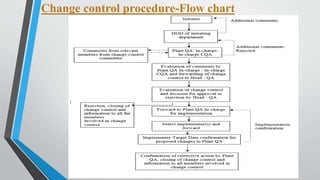
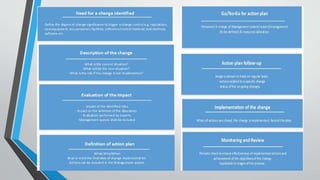
Change control procedure-Flow chart
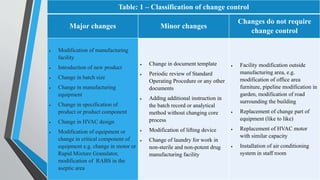
Classification of change control
• Major : A change that would be likely to have a significant impact on quality
attributes of a process, material, product, procedure, and registration
requirements.
• Major changes are those changes that have a direct impact or potential impact
on the product quality, safety, strength, identity, efficacy, and purity of a
product, validation status of the process, equipment, utility, facility or GMP
compliance, procedures, systems or regulatory filings.
• Minor : Minor changes are those changes that do not have a direct impact
or potential to have a direct impact on the product quality, identity, safety,
strength, purity, and efficacy of a product or validation status of the
process, equipment, utility, facility or GMP compliance/ procedures, and
systems or regulatory filings.
Table: 1 – Classification of change control
Major changes Minor changes
Changes do not require
change control
 Modification of manufacturing
facility
 Introduction of new product
 Change in batch size
 Change in manufacturing
equipment
 Change in specification of
product or product component
 Change in HVAC design
 Modification of equipment or
change in critical component of
equipment e.g. change in motor or
Rapid Mixture Granulator,
modification of RABS in the
aseptic area
 Change in document template
 Periodic review of Standard
Operating Procedure or any other
documents
 Adding additional instruction in
the batch record or analytical
method without changing core
process
 Modification of lifting device
 Change of laundry for work in
non-sterile and non-potent drug
manufacturing facility
 Facility modification outside
manufacturing area, e.g.
modification of office area
furniture, pipeline modification in
garden, modification of road
surrounding the building
 Replacement of change part of
equipment (like to like)
 Replacement of HVAC motor
with similar capacity
 Installation of air conditioning
system in staff room
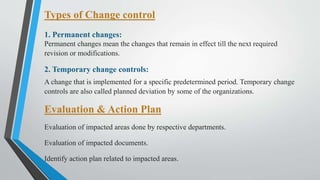
Types of Change control
1. Permanent changes:
Permanent changes mean the changes that remain in effect till the next required
revision or modifications.
2. Temporary change controls:
A change that is implemented for a specific predetermined period. Temporary change
controls are also called planned deviation by some of the organizations.
Evaluation & Action Plan
Evaluation of impacted areas done by respective departments.
Evaluation of impacted documents.
Identify action plan related to impacted areas.
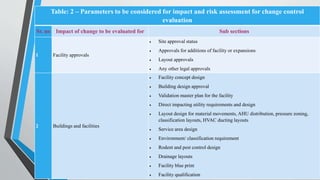
Table: 2 – Parameters to be considered for impact and risk assessment for change control
evaluation
Sr. no Impact of change to be evaluated for Sub sections
1 Facility approvals
 Site approval status
 Approvals for additions of facility or expansions
 Layout approvals
 Any other legal approvals
2 Buildings and facilities
 Facility concept design
 Building design approval
 Validation master plan for the facility
 Direct impacting utility requirements and design
 Layout design for material movements, AHU distribution, pressure zoning,
classification layouts, HVAC ducting layouts
 Service area design
 Environment/ classification requirement
 Rodent and pest control design
 Drainage layouts
 Facility blue print
 Facility qualification
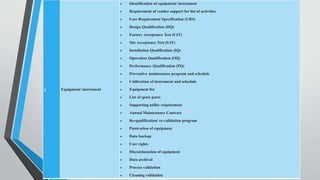
3 Equipment/ instrument
 Identification of equipment/ instrument
 Requirement of vendor support for list of activities
 User Requirement Specification (URS)
 Design Qualification (DQ)
 Factory Acceptance Test (FAT)
 Site Acceptance Test (SAT)
 Installation Qualification (IQ)
 Operation Qualification (OQ)
 Performance Qualification (PQ)
 Preventive maintenance program and schedule
 Calibration of instrument and schedule
 Equipment list
 List of spare parts
 Supporting utility requirement
 Annual Maintenance Contract
 Re-qualification/ re-validation program
 Passivation of equipment
 Data backup
 User rights
 Discontinuation of equipment
 Data archival
 Process validation
 Cleaning validation
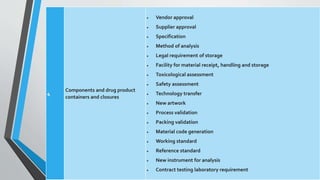
4
Components and drug product
containers and closures
 Vendor approval
 Supplier approval
 Specification
 Method of analysis
 Legal requirement of storage
 Facility for material receipt, handling and storage
 Toxicological assessment
 Safety assessment
 Technology transfer
 New artwork
 Process validation
 Packing validation
 Material code generation
 Working standard
 Reference standard
 New instrument for analysis
 Contract testing laboratory requirement
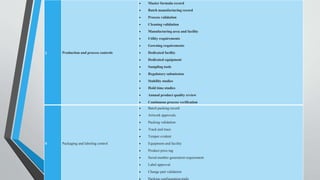
5 Production and process controls
 Master formula record
 Batch manufacturing record
 Process validation
 Cleaning validation
 Manufacturing area and facility
 Utility requirements
 Gowning requirements
 Dedicated facility
 Dedicated equipment
 Sampling tools
 Regulatory submission
 Stability studies
 Hold time studies
 Annual product quality review
 Continuous process verification
6 Packaging and labeling control
 Batch packing record
 Artwork approvals
 Packing validation
 Track and trace
 Temper evident
 Equipment and facility
 Product price tag
 Serial number generation requirement
 Label approval
 Change part validation
 Packing configuration trails
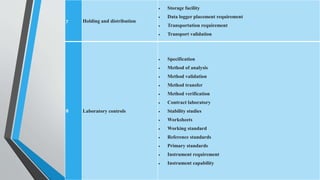
7 Holding and distribution
 Storage facility
 Data logger placement requirement
 Transportation requirement
 Transport validation
8 Laboratory controls
 Specification
 Method of analysis
 Method validation
 Method transfer
 Method verification
 Contract laboratory
 Stability studies
 Worksheets
 Working standard
 Reference standards
 Primary standards
 Instrument requirement
 Instrument capability
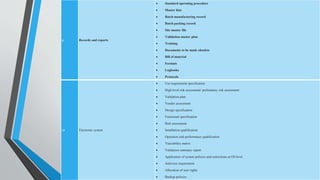
9 Records and reports
 Standard operating procedure
 Master lists
 Batch manufacturing record
 Batch packing record
 Site master file
 Validation master plan
 Training
 Documents to be made obsolete
 Bill of material
 Formats
 Logbooks
 Protocols
10 Electronic system
 Use requirement specification
 High level risk assessment/ preliminary risk assessment
 Validation plan
 Vendor assessment
 Design specification
 Functional specification
 Risk assessment
 Installation qualification
 Operation and performance qualification
 Traceability matrix
 Validation summary report
 Application of system policies and restrictions at OS level
 Antivirus requirement
 Allocation of user rights
 Backup policies
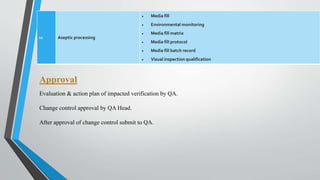
11 Aseptic processing
 Media fill
 Environmental monitoring
 Media fill matrix
 Media fill protocol
 Media fill batch record
 Visual inspection qualification
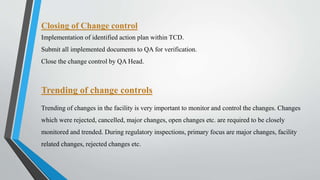
Approval
Evaluation & action plan of impacted verification by QA.
Change control approval by QA Head.
After approval of change control submit to QA.
Trending of change controls
Trending of changes in the facility is very important to monitor and control the changes. Changes
which were rejected, cancelled, major changes, open changes etc. are required to be closely
monitored and trended. During regulatory inspections, primary focus are major changes, facility
related changes, rejected changes etc.
Closing of Change control
Implementation of identified action plan within TCD.
Submit all implemented documents to QA for verification.
Close the change control by QA Head.
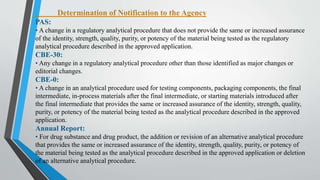
Determination of Notification to the Agency
PAS:
• A change in a regulatory analytical procedure that does not provide the same or increased assurance
of the identity, strength, quality, purity, or potency of the material being tested as the regulatory
analytical procedure described in the approved application.
CBE-30:
• Any change in a regulatory analytical procedure other than those identified as major changes or
editorial changes.
CBE-0:
• A change in an analytical procedure used for testing components, packaging components, the final
intermediate, in-process materials after the final intermediate, or starting materials introduced after
the final intermediate that provides the same or increased assurance of the identity, strength, quality,
purity, or potency of the material being tested as the analytical procedure described in the approved
application.
Annual Report:
• For drug substance and drug product, the addition or revision of an alternative analytical procedure
that provides the same or increased assurance of the identity, strength, quality, purity, or potency of
the material being tested as the analytical procedure described in the approved application or deletion
of an alternative analytical procedure.
Reference Guideline
• ICH 10 PHARMACEUTICAL QUALITY SYSTEM
• Eudralex Volume-4, annexure-15
• 21 CFR, 211.100 (Production & process control)
• 21 CFR, 211.160 (specifications, standards, sampling plans, test procedures,
or other laboratory control)
• PICS: PI 002-3
• APIC-Guideline Technical Change Control revised Nov 2018

CCF PPT By Amit Gupta.pptx

  • 1.
    Change Control By AmitGupta PSA Chemicals & Pharmaceuticals Pvt. Ltd.
  • 2.
    Contents • Definition • Changein specification and method of analysis • Scope • Other product specific changes • General changes • Change control procedure-Flow chart • Classification of change control • Types of Change control • Evaluation & Action Plan • Parameters to be considered for impact and risk assessment for change control evaluation • Approval • Closing of Change control • Trending of change controls • Determination of Notification to the Agency • Reference Guideline
  • 3.
    Definition • Change –Any addition to, deletion of, or modification to any approved / authorized procedures, process, materials or product is defined as a change. • A formal system to evaluate, document, approve and implement changes that might affect the validated status of facilities, equipment and process. • A change is a permanent planned alteration to any approved process or procedure that may affect the safety, quality and efficacy of blood component. • CCF is a process that ensure changes to material, method, equipment, process, facility are properly documented, validated, approved & traceable.
  • 4.
    Scope • Master Documents •Specifications • Test Procedure • Master Formula • Manufacturing Process • Facility, Equipment, Area • Other Documents • Software, PLC, Instruments, Server • SAP, ERP • Planned Deviation (Temporary Changes) • SOPs
  • 5.
    Change in specificationand method of analysis:  Revision of specification limits  Change in analytical procedure  Pharmacopoeial changes  Tightening or relaxation in manufacturing specification  Addition or deletion of test  Change in document template  Inclusion of additional instruction/ simplification or editorial changes without changing actual method of analysis and specification limit Other product specific changes  New-product introduction  Change in vendor of product specific starting materials  Change in starting material manufacturing process  Change in customer of product  Change in storage condition based on destination market  Change in master formula records  Addition or deletion of stability study condition  Extension or reduction of product shelf life
  • 6.
    2. General changes: Change on Standard Operating Procedure (SOP)  Facility change  Equipment change  Modification of equipment  Upgrade equipment or system software  Permanent change in working shift timing  Change in layouts and drawings  Modification of facility  Heating Ventilation and Air Conditioning (HVAC) system modification  Revision of documents, such as, Site Master File, Validation Master Plan, Quality Manual, Protocols, or any other GMP documents
  • 7.
  • 8.
    Classification of changecontrol • Major : A change that would be likely to have a significant impact on quality attributes of a process, material, product, procedure, and registration requirements. • Major changes are those changes that have a direct impact or potential impact on the product quality, safety, strength, identity, efficacy, and purity of a product, validation status of the process, equipment, utility, facility or GMP compliance, procedures, systems or regulatory filings. • Minor : Minor changes are those changes that do not have a direct impact or potential to have a direct impact on the product quality, identity, safety, strength, purity, and efficacy of a product or validation status of the process, equipment, utility, facility or GMP compliance/ procedures, and systems or regulatory filings.
  • 9.
    Table: 1 –Classification of change control Major changes Minor changes Changes do not require change control  Modification of manufacturing facility  Introduction of new product  Change in batch size  Change in manufacturing equipment  Change in specification of product or product component  Change in HVAC design  Modification of equipment or change in critical component of equipment e.g. change in motor or Rapid Mixture Granulator, modification of RABS in the aseptic area  Change in document template  Periodic review of Standard Operating Procedure or any other documents  Adding additional instruction in the batch record or analytical method without changing core process  Modification of lifting device  Change of laundry for work in non-sterile and non-potent drug manufacturing facility  Facility modification outside manufacturing area, e.g. modification of office area furniture, pipeline modification in garden, modification of road surrounding the building  Replacement of change part of equipment (like to like)  Replacement of HVAC motor with similar capacity  Installation of air conditioning system in staff room
  • 10.
    Types of Changecontrol 1. Permanent changes: Permanent changes mean the changes that remain in effect till the next required revision or modifications. 2. Temporary change controls: A change that is implemented for a specific predetermined period. Temporary change controls are also called planned deviation by some of the organizations. Evaluation & Action Plan Evaluation of impacted areas done by respective departments. Evaluation of impacted documents. Identify action plan related to impacted areas.
  • 11.
    Table: 2 –Parameters to be considered for impact and risk assessment for change control evaluation Sr. no Impact of change to be evaluated for Sub sections 1 Facility approvals  Site approval status  Approvals for additions of facility or expansions  Layout approvals  Any other legal approvals 2 Buildings and facilities  Facility concept design  Building design approval  Validation master plan for the facility  Direct impacting utility requirements and design  Layout design for material movements, AHU distribution, pressure zoning, classification layouts, HVAC ducting layouts  Service area design  Environment/ classification requirement  Rodent and pest control design  Drainage layouts  Facility blue print  Facility qualification
  • 12.
    3 Equipment/ instrument Identification of equipment/ instrument  Requirement of vendor support for list of activities  User Requirement Specification (URS)  Design Qualification (DQ)  Factory Acceptance Test (FAT)  Site Acceptance Test (SAT)  Installation Qualification (IQ)  Operation Qualification (OQ)  Performance Qualification (PQ)  Preventive maintenance program and schedule  Calibration of instrument and schedule  Equipment list  List of spare parts  Supporting utility requirement  Annual Maintenance Contract  Re-qualification/ re-validation program  Passivation of equipment  Data backup  User rights  Discontinuation of equipment  Data archival  Process validation  Cleaning validation
  • 13.
    4 Components and drugproduct containers and closures  Vendor approval  Supplier approval  Specification  Method of analysis  Legal requirement of storage  Facility for material receipt, handling and storage  Toxicological assessment  Safety assessment  Technology transfer  New artwork  Process validation  Packing validation  Material code generation  Working standard  Reference standard  New instrument for analysis  Contract testing laboratory requirement
  • 14.
    5 Production andprocess controls  Master formula record  Batch manufacturing record  Process validation  Cleaning validation  Manufacturing area and facility  Utility requirements  Gowning requirements  Dedicated facility  Dedicated equipment  Sampling tools  Regulatory submission  Stability studies  Hold time studies  Annual product quality review  Continuous process verification 6 Packaging and labeling control  Batch packing record  Artwork approvals  Packing validation  Track and trace  Temper evident  Equipment and facility  Product price tag  Serial number generation requirement  Label approval  Change part validation  Packing configuration trails
  • 15.
    7 Holding anddistribution  Storage facility  Data logger placement requirement  Transportation requirement  Transport validation 8 Laboratory controls  Specification  Method of analysis  Method validation  Method transfer  Method verification  Contract laboratory  Stability studies  Worksheets  Working standard  Reference standards  Primary standards  Instrument requirement  Instrument capability
  • 16.
    9 Records andreports  Standard operating procedure  Master lists  Batch manufacturing record  Batch packing record  Site master file  Validation master plan  Training  Documents to be made obsolete  Bill of material  Formats  Logbooks  Protocols 10 Electronic system  Use requirement specification  High level risk assessment/ preliminary risk assessment  Validation plan  Vendor assessment  Design specification  Functional specification  Risk assessment  Installation qualification  Operation and performance qualification  Traceability matrix  Validation summary report  Application of system policies and restrictions at OS level  Antivirus requirement  Allocation of user rights  Backup policies
  • 17.
    11 Aseptic processing Media fill  Environmental monitoring  Media fill matrix  Media fill protocol  Media fill batch record  Visual inspection qualification Approval Evaluation & action plan of impacted verification by QA. Change control approval by QA Head. After approval of change control submit to QA.
  • 18.
    Trending of changecontrols Trending of changes in the facility is very important to monitor and control the changes. Changes which were rejected, cancelled, major changes, open changes etc. are required to be closely monitored and trended. During regulatory inspections, primary focus are major changes, facility related changes, rejected changes etc. Closing of Change control Implementation of identified action plan within TCD. Submit all implemented documents to QA for verification. Close the change control by QA Head.
  • 19.
    Determination of Notificationto the Agency PAS: • A change in a regulatory analytical procedure that does not provide the same or increased assurance of the identity, strength, quality, purity, or potency of the material being tested as the regulatory analytical procedure described in the approved application. CBE-30: • Any change in a regulatory analytical procedure other than those identified as major changes or editorial changes. CBE-0: • A change in an analytical procedure used for testing components, packaging components, the final intermediate, in-process materials after the final intermediate, or starting materials introduced after the final intermediate that provides the same or increased assurance of the identity, strength, quality, purity, or potency of the material being tested as the analytical procedure described in the approved application. Annual Report: • For drug substance and drug product, the addition or revision of an alternative analytical procedure that provides the same or increased assurance of the identity, strength, quality, purity, or potency of the material being tested as the analytical procedure described in the approved application or deletion of an alternative analytical procedure.
  • 21.
    Reference Guideline • ICH10 PHARMACEUTICAL QUALITY SYSTEM • Eudralex Volume-4, annexure-15 • 21 CFR, 211.100 (Production & process control) • 21 CFR, 211.160 (specifications, standards, sampling plans, test procedures, or other laboratory control) • PICS: PI 002-3 • APIC-Guideline Technical Change Control revised Nov 2018