Topic : DNA The Code of Life
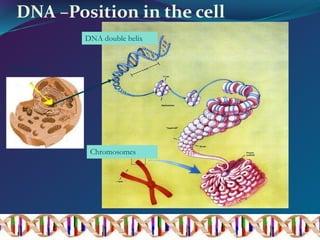
DNA –Position in the cell
Nucleus
DNA double helix
Chromosomes
• In each chromosome, the DNA is grouped into
"genes."
• Your genome contains about 35,000 genes.
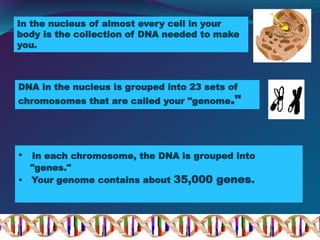
In the nucleus of almost every cell in your
body is the collection of DNA needed to make
you.
DNA in the nucleus is grouped into 23 sets of
chromosomes that are called your "genome."
• Instructions is called genetic code
• The DNA in your genes tells the cell what
amino acids (protein building blocks) to put
together to make a protein.
Instructions to make your whole
body and keep it working is
contained in DNA
DNA Structure
 DNA consists of two molecules that are
arranged into a ladder-like structure
called a Double Helix.
 A molecule of DNA is made up of millions
of tiny subunits called Nucleotides.
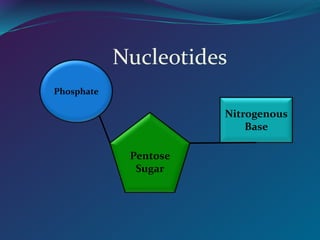
 Each nucleotide consists of:
1. Phosphate group
2. Pentose sugar
3. Nitrogenous base
Nucleotides
Phosphate
Pentose
Sugar
Nitrogenous
Base
Nucleotides
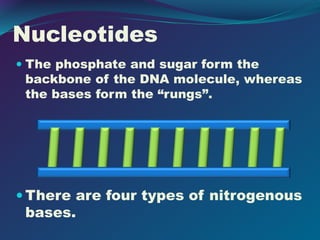
 The phosphate and sugar form the
backbone of the DNA molecule, whereas
the bases form the “rungs”.
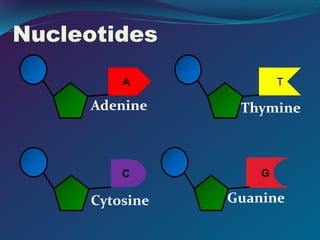
 There are four types of nitrogenous
bases.
Nucleotides
A
Adenine
T
Thymine
G
Guanine
C
Cytosine
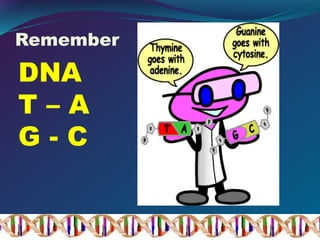
Remember
DNA
T – A
G - C
Nucleotides
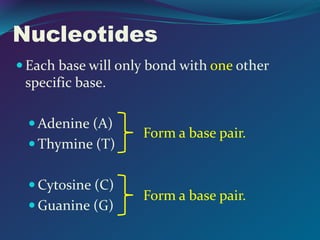
 Each base will only bond with one other
specific base.
 Adenine (A)
 Thymine (T)
 Cytosine (C)
 Guanine (G)
Form a base pair.
Form a base pair.
DNA Structure
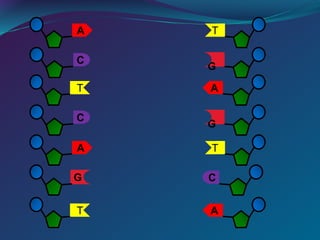
 Because of this complementary base pairing,
the order of the bases in one strand
determines the order of the bases in the other
strand.
G
G
A
T
T
A
A
C
T
G
C
A
T
C
DNA Structure
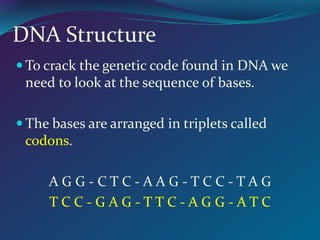
 To crack the genetic code found in DNA we
need to look at the sequence of bases.
 The bases are arranged in triplets called
codons.
A G G - C T C - A A G - T C C - T A G
T C C - G A G - T T C - A G G - A T C
DNA Structure
 A gene is a section of DNA that codes for a
protein.
 Each unique gene has a unique sequence of
bases.
 This unique sequence of bases will code for
the production of a unique protein.
 It is these proteins and combination of proteins
that give us a unique phenotype.
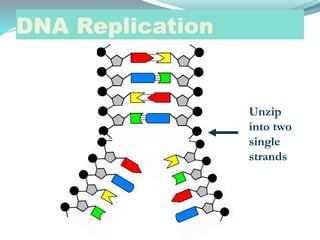
DNA Replication
Unzip
into two
single
strands
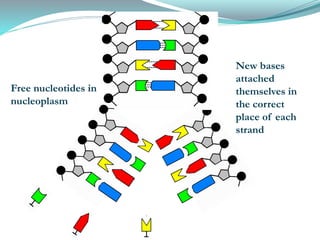
New bases
attached
themselves in
the correct
place of each
strand
Free nucleotides in
nucleoplasm
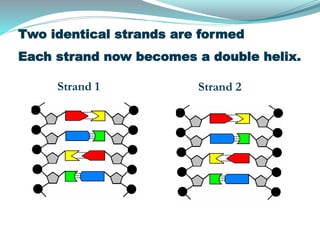
Two identical strands are formed
Each strand now becomes a double helix.
Strand 1 Strand 2
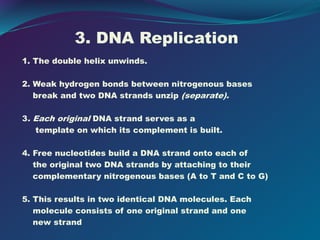
3. DNA Replication
1. The double helix unwinds.
2. Weak hydrogen bonds between nitrogenous bases
break and two DNA strands unzip (separate).
3. Each original DNA strand serves as a
template on which its complement is built.
4. Free nucleotides build a DNA strand onto each of
the original two DNA strands by attaching to their
complementary nitrogenous bases (A to T and C to G)
5. This results in two identical DNA molecules. Each
molecule consists of one original strand and one
new strand
4.Significance of DNA replication:
 Important for growth, reproduction
 Mutations can cause variation
 The main enzyme that catalyze the process is
DNA polymerases
 Forms building block for amino acids that forms
proteins
 Three bases provides more than the 20
combinations needed to code amino acids
 The sequence of the three bases is called a
codon.
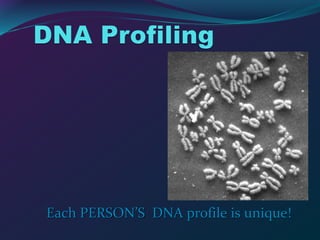
Each PERSON’S DNA profile is unique!
What is DNA Profiling?
A technique used by scientists to
distinguish between individuals of
the same species using only
samples of their DNA
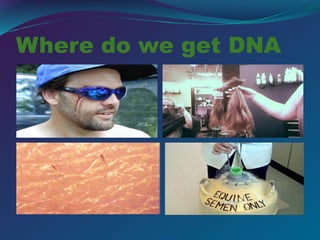
Where do we get DNA
DNA profiling
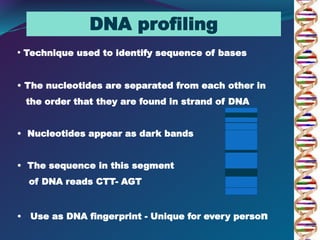
• Technique used to identify sequence of bases
• The nucleotides are separated from each other in
the order that they are found in strand of DNA
• Nucleotides appear as dark bands
• The sequence in this segment
of DNA reads CTT- AGT
• Use as DNA fingerprint - Unique for every person
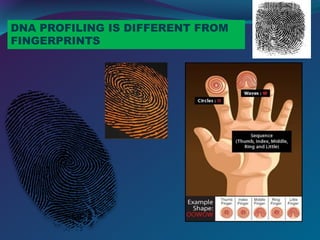
DNA PROFILING IS DIFFERENT FROM
FINGERPRINTS
DNA Profiling can solve
crimes
 The pattern of the DNA profile is then
compared with those of the victim and the
suspect.
 If the profile matches the suspect it provides
strong evidence that the suspect was present
at the crime scene (NB: it does not prove they
committed the crime).
 If the profile doesn’t match the suspect then
that suspect may be eliminated from the
enquiry.
Solving Medical Problems
 A child’s paternity (father) and
maternity(mother) can be determined.
 This information can be used in
-Paternity suits
-Inheritance cases
-Immigration cases
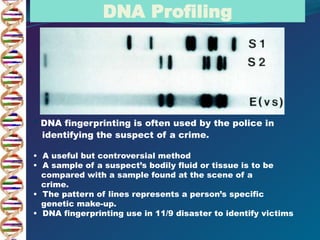
• DNA fingerprinting is often used by the police in
identifying the suspect of a crime.
• A useful but controversial method
• A sample of a suspect’s bodily fluid or tissue is to be
compared with a sample found at the scene of a
crime.
• The pattern of lines represents a person’s specific
genetic make-up.
• DNA fingerprinting use in 11/9 disaster to identify victims
DNA Profiling
Three types of RNA and
their functions
1. Messenger RNA (mRNA)
2. Transfer RNA (tRNA)
3. Ribosomal RNA (rRNA)
1. Messenger RNA (mRNA)
Acts as a template for
protein synthesis
Has the same sequence of
bases as the DNA strand
that has the gene sequence.
2. Transfer RNA (tRNA)
 One for each triplet codon that codes for a
specific amino-acid (the building blocks of
proteins).
 tRNA molecules are covalently attached to the
corresponding amino-acid at one end
 At the other end they have a triplet sequence
(called the anti-codon) that is complementary
to the triplet codon on the mRNA.
3. Ribosomal RNA (rRNA)
Make up an integral part of
the ribosome, the protein
synthesis machinery in the
cell.
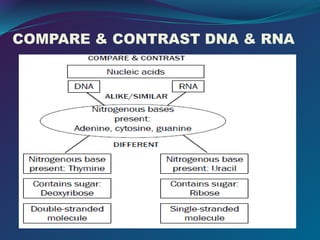
COMPARE & CONTRAST DNA & RNA
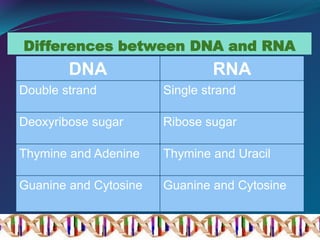
Differences between DNA and RNA
DNA RNA
Double strand Single strand
Deoxyribose sugar Ribose sugar
Thymine and Adenine Thymine and Uracil
Guanine and Cytosine Guanine and Cytosine
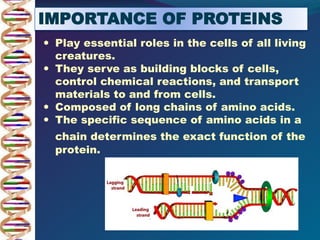
 Play essential roles in the cells of all living
creatures.
 They serve as building blocks of cells,
control chemical reactions, and transport
materials to and from cells.
 Composed of long chains of amino acids.
 The specific sequence of amino acids in a
chain determines the exact function of the
protein.
IMPORTANCE OF PROTEINS
DNA MUST REPLICATE
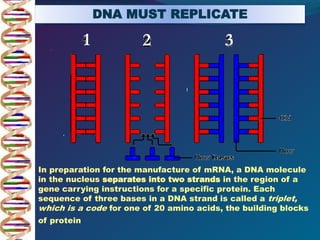
In preparation for the manufacture of mRNA, a DNA molecule
in the nucleus separates into two strands in the region of a
gene carrying instructions for a specific protein. Each
sequence of three bases in a DNA strand is called a triplet,
which is a code for one of 20 amino acids, the building blocks
of protein.
1 2 3
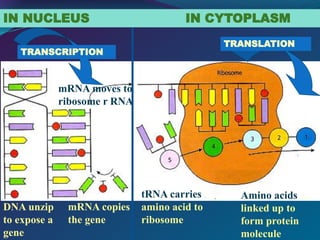
DNA unzip
to expose a
gene
mRNA copies
the gene
mRNA moves to
ribosome r RNA
tRNA carries
amino acid to
ribosome
Amino acids
linked up to
form protein
molecule
IN NUCLEUS IN CYTOPLASM
TRANSLATION
TRANSCRIPTION
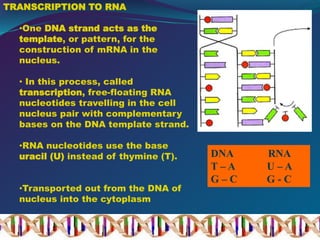
TRANSCRIPTION TO RNA
•One DNA strand acts as the
template, or pattern, for the
construction of mRNA in the
nucleus.
• In this process, called
transcription, free-floating RNA
nucleotides travelling in the cell
nucleus pair with complementary
bases on the DNA template strand.
•RNA nucleotides use the base
uracil (U) instead of thymine (T).
•Transported out from the DNA of
nucleus into the cytoplasm
DNA RNA
T – A U – A
G – C G - C
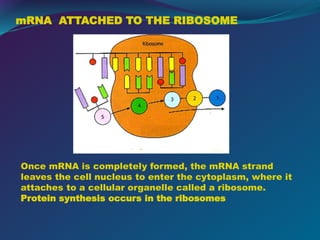
Once mRNA is completely formed, the mRNA strand
leaves the cell nucleus to enter the cytoplasm, where it
attaches to a cellular organelle called a ribosome.
Protein synthesis occurs in the ribosomes
mRNA ATTACHED TO THE RIBOSOME
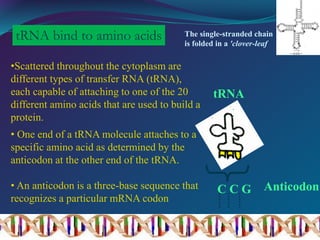
The single-stranded chain
is folded in a 'clover-leaf’
tRNA bind to amino acids
•Scattered throughout the cytoplasm are
different types of transfer RNA (tRNA),
each capable of attaching to one of the 20
different amino acids that are used to build a
protein.
• One end of a tRNA molecule attaches to a
specific amino acid as determined by the
anticodon at the other end of the tRNA.
• An anticodon is a three-base sequence that
recognizes a particular mRNA codon
Anticodon
C C G
tRNA
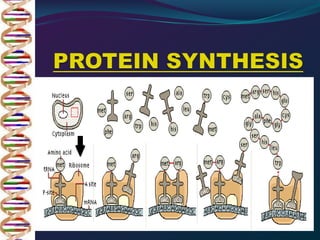
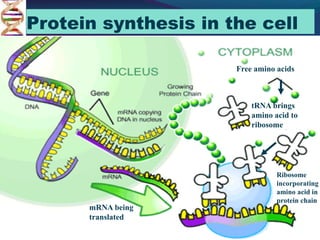
Protein synthesis in the cell
Free amino acids
tRNA brings
amino acid to
ribosome
Ribosome
incorporating
amino acid in
protein chain
mRNA being
translated

dna structure agricultural sciences gr12

  • 1.
    Topic : DNAThe Code of Life
  • 3.
    DNA –Position inthe cell Nucleus DNA double helix Chromosomes
  • 4.
    • In eachchromosome, the DNA is grouped into "genes." • Your genome contains about 35,000 genes. In the nucleus of almost every cell in your body is the collection of DNA needed to make you. DNA in the nucleus is grouped into 23 sets of chromosomes that are called your "genome."
  • 5.
    • Instructions iscalled genetic code • The DNA in your genes tells the cell what amino acids (protein building blocks) to put together to make a protein. Instructions to make your whole body and keep it working is contained in DNA
  • 6.
    DNA Structure  DNAconsists of two molecules that are arranged into a ladder-like structure called a Double Helix.  A molecule of DNA is made up of millions of tiny subunits called Nucleotides.  Each nucleotide consists of: 1. Phosphate group 2. Pentose sugar 3. Nitrogenous base
  • 7.
  • 8.
    Nucleotides  The phosphateand sugar form the backbone of the DNA molecule, whereas the bases form the “rungs”.  There are four types of nitrogenous bases.
  • 9.
  • 10.
  • 11.
    Nucleotides  Each basewill only bond with one other specific base.  Adenine (A)  Thymine (T)  Cytosine (C)  Guanine (G) Form a base pair. Form a base pair.
  • 12.
    DNA Structure  Becauseof this complementary base pairing, the order of the bases in one strand determines the order of the bases in the other strand.
  • 13.
  • 14.
    DNA Structure  Tocrack the genetic code found in DNA we need to look at the sequence of bases.  The bases are arranged in triplets called codons. A G G - C T C - A A G - T C C - T A G T C C - G A G - T T C - A G G - A T C
  • 15.
    DNA Structure  Agene is a section of DNA that codes for a protein.  Each unique gene has a unique sequence of bases.  This unique sequence of bases will code for the production of a unique protein.  It is these proteins and combination of proteins that give us a unique phenotype.
  • 16.
  • 17.
    New bases attached themselves in thecorrect place of each strand Free nucleotides in nucleoplasm
  • 18.
    Two identical strandsare formed Each strand now becomes a double helix. Strand 1 Strand 2
  • 19.
    3. DNA Replication 1.The double helix unwinds. 2. Weak hydrogen bonds between nitrogenous bases break and two DNA strands unzip (separate). 3. Each original DNA strand serves as a template on which its complement is built. 4. Free nucleotides build a DNA strand onto each of the original two DNA strands by attaching to their complementary nitrogenous bases (A to T and C to G) 5. This results in two identical DNA molecules. Each molecule consists of one original strand and one new strand
  • 20.
    4.Significance of DNAreplication:  Important for growth, reproduction  Mutations can cause variation  The main enzyme that catalyze the process is DNA polymerases  Forms building block for amino acids that forms proteins  Three bases provides more than the 20 combinations needed to code amino acids  The sequence of the three bases is called a codon.
  • 21.
    Each PERSON’S DNAprofile is unique!
  • 22.
    What is DNAProfiling? A technique used by scientists to distinguish between individuals of the same species using only samples of their DNA
  • 23.
    Where do weget DNA
  • 24.
    DNA profiling • Techniqueused to identify sequence of bases • The nucleotides are separated from each other in the order that they are found in strand of DNA • Nucleotides appear as dark bands • The sequence in this segment of DNA reads CTT- AGT • Use as DNA fingerprint - Unique for every person
  • 25.
    DNA PROFILING ISDIFFERENT FROM FINGERPRINTS
  • 26.
    DNA Profiling cansolve crimes  The pattern of the DNA profile is then compared with those of the victim and the suspect.  If the profile matches the suspect it provides strong evidence that the suspect was present at the crime scene (NB: it does not prove they committed the crime).  If the profile doesn’t match the suspect then that suspect may be eliminated from the enquiry.
  • 27.
    Solving Medical Problems A child’s paternity (father) and maternity(mother) can be determined.  This information can be used in -Paternity suits -Inheritance cases -Immigration cases
  • 28.
    • DNA fingerprintingis often used by the police in identifying the suspect of a crime. • A useful but controversial method • A sample of a suspect’s bodily fluid or tissue is to be compared with a sample found at the scene of a crime. • The pattern of lines represents a person’s specific genetic make-up. • DNA fingerprinting use in 11/9 disaster to identify victims DNA Profiling
  • 29.
    Three types ofRNA and their functions 1. Messenger RNA (mRNA) 2. Transfer RNA (tRNA) 3. Ribosomal RNA (rRNA)
  • 30.
    1. Messenger RNA(mRNA) Acts as a template for protein synthesis Has the same sequence of bases as the DNA strand that has the gene sequence.
  • 31.
    2. Transfer RNA(tRNA)  One for each triplet codon that codes for a specific amino-acid (the building blocks of proteins).  tRNA molecules are covalently attached to the corresponding amino-acid at one end  At the other end they have a triplet sequence (called the anti-codon) that is complementary to the triplet codon on the mRNA.
  • 32.
    3. Ribosomal RNA(rRNA) Make up an integral part of the ribosome, the protein synthesis machinery in the cell.
  • 33.
  • 34.
    Differences between DNAand RNA DNA RNA Double strand Single strand Deoxyribose sugar Ribose sugar Thymine and Adenine Thymine and Uracil Guanine and Cytosine Guanine and Cytosine
  • 36.
     Play essentialroles in the cells of all living creatures.  They serve as building blocks of cells, control chemical reactions, and transport materials to and from cells.  Composed of long chains of amino acids.  The specific sequence of amino acids in a chain determines the exact function of the protein. IMPORTANCE OF PROTEINS
  • 37.
    DNA MUST REPLICATE Inpreparation for the manufacture of mRNA, a DNA molecule in the nucleus separates into two strands in the region of a gene carrying instructions for a specific protein. Each sequence of three bases in a DNA strand is called a triplet, which is a code for one of 20 amino acids, the building blocks of protein. 1 2 3
  • 38.
    DNA unzip to exposea gene mRNA copies the gene mRNA moves to ribosome r RNA tRNA carries amino acid to ribosome Amino acids linked up to form protein molecule IN NUCLEUS IN CYTOPLASM TRANSLATION TRANSCRIPTION
  • 39.
    TRANSCRIPTION TO RNA •OneDNA strand acts as the template, or pattern, for the construction of mRNA in the nucleus. • In this process, called transcription, free-floating RNA nucleotides travelling in the cell nucleus pair with complementary bases on the DNA template strand. •RNA nucleotides use the base uracil (U) instead of thymine (T). •Transported out from the DNA of nucleus into the cytoplasm DNA RNA T – A U – A G – C G - C
  • 40.
    Once mRNA iscompletely formed, the mRNA strand leaves the cell nucleus to enter the cytoplasm, where it attaches to a cellular organelle called a ribosome. Protein synthesis occurs in the ribosomes mRNA ATTACHED TO THE RIBOSOME
  • 41.
    The single-stranded chain isfolded in a 'clover-leaf’ tRNA bind to amino acids •Scattered throughout the cytoplasm are different types of transfer RNA (tRNA), each capable of attaching to one of the 20 different amino acids that are used to build a protein. • One end of a tRNA molecule attaches to a specific amino acid as determined by the anticodon at the other end of the tRNA. • An anticodon is a three-base sequence that recognizes a particular mRNA codon Anticodon C C G tRNA
  • 42.
    Protein synthesis inthe cell Free amino acids tRNA brings amino acid to ribosome Ribosome incorporating amino acid in protein chain mRNA being translated