Written Report Guidelines
Guidelines
 The written report should have the following
sections:
(1) Title page
(2) Abstract
(3) Introduction
(4) Materials and Methods
(5) Results
(6) Discussion
(7) Conclusions
(8) References
Title page
 The TITLE PAGE identifies
1. The full name of the project
2. The course (BBA 407)
3. The name of the principal author (write NONE if
a principal author was not used)
4. The names of the other group members
5. The group number
Abstract
 The ABSTRACT is not a part of the body of the
report itself. Rather, the abstract is a brief
summary of the report contents that is often
separately circulated so potential readers can
decide whether to read the report.
 The abstract should very concisely summarize
the whole report: why it was written, what was
discovered or developed, and what is claimed to
be the significance of the effort.
 The abstract does not include figures or tables,
and only the most significant numerical values or
results should be given.
Introduction
 The INTRODUCTION should provide a clear
statement of the problem posed by the project,
and why the problem is of interest.
 It should reflect the scenario, if available. If
needed, the introduction also needs to present
background information so that the reader can
understand the significance of the problem.
 A brief summary of the unique approach your
group used to solve the problem should be given,
possibly also including a concise introduction to
theory or concepts used later to analyze and to
discuss the results.
Materials and Methods
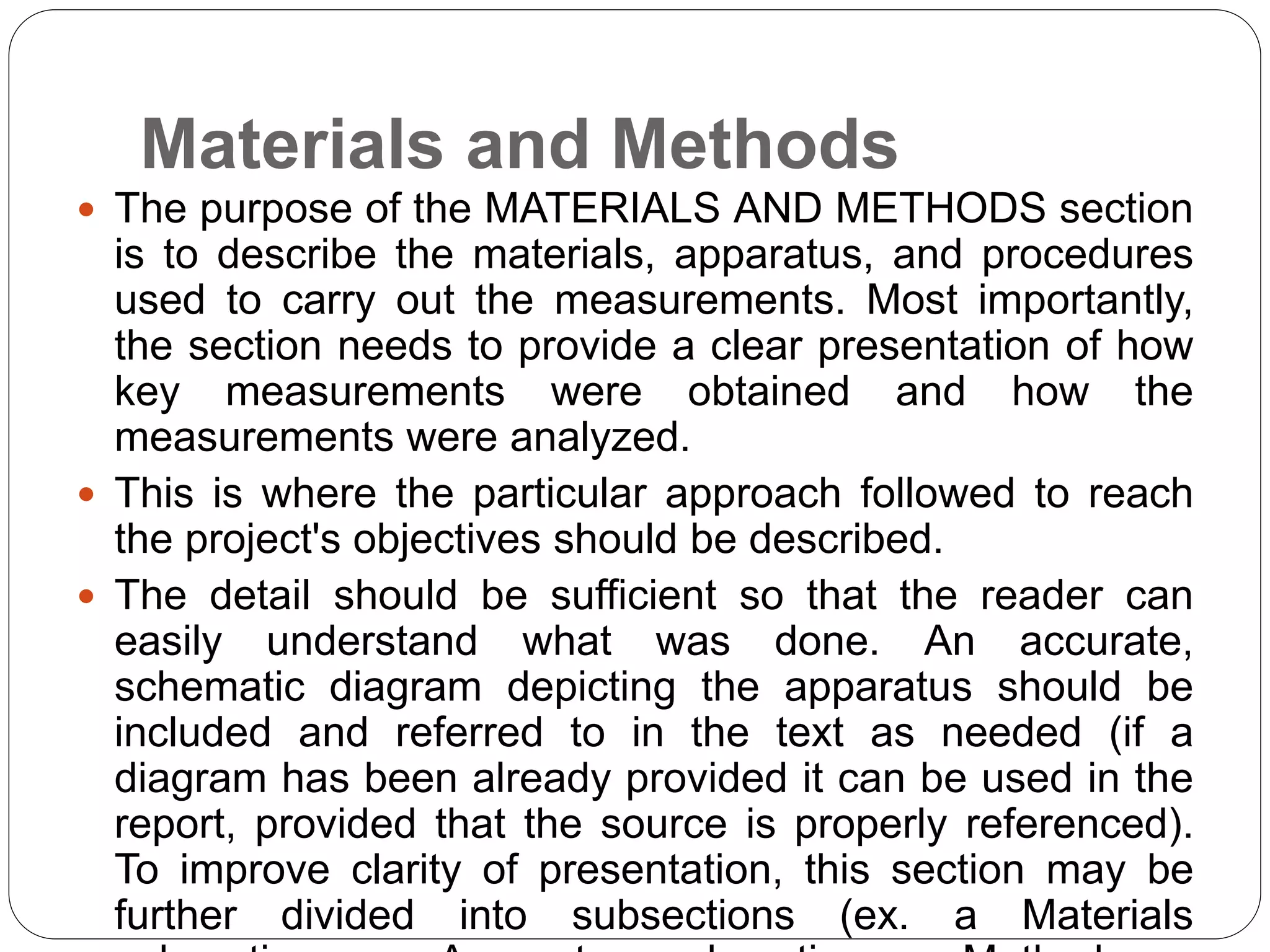
 The purpose of the MATERIALS AND METHODS section
is to describe the materials, apparatus, and procedures
used to carry out the measurements. Most importantly,
the section needs to provide a clear presentation of how
key measurements were obtained and how the
measurements were analyzed.
 This is where the particular approach followed to reach
the project's objectives should be described.
 The detail should be sufficient so that the reader can
easily understand what was done. An accurate,
schematic diagram depicting the apparatus should be
included and referred to in the text as needed (if a
diagram has been already provided it can be used in the
report, provided that the source is properly referenced).
To improve clarity of presentation, this section may be
further divided into subsections (ex. a Materials
Results
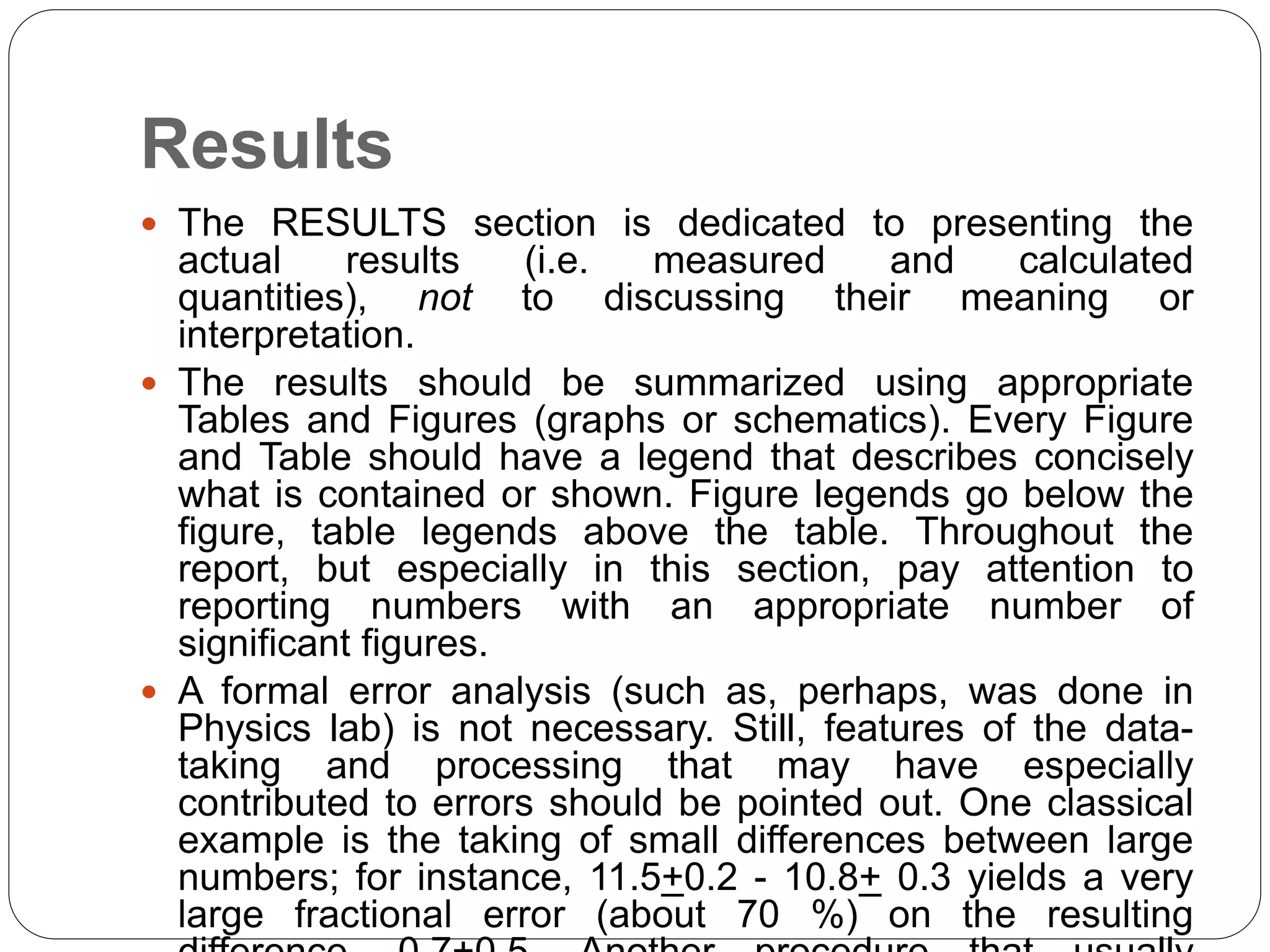
 The RESULTS section is dedicated to presenting the
actual results (i.e. measured and calculated
quantities), not to discussing their meaning or
interpretation.
 The results should be summarized using appropriate
Tables and Figures (graphs or schematics). Every Figure
and Table should have a legend that describes concisely
what is contained or shown. Figure legends go below the
figure, table legends above the table. Throughout the
report, but especially in this section, pay attention to
reporting numbers with an appropriate number of
significant figures.
 A formal error analysis (such as, perhaps, was done in
Physics lab) is not necessary. Still, features of the data-
taking and processing that may have especially
contributed to errors should be pointed out. One classical
example is the taking of small differences between large
numbers; for instance, 11.5+0.2 - 10.8+ 0.3 yields a very
large fractional error (about 70 %) on the resulting
Discussion
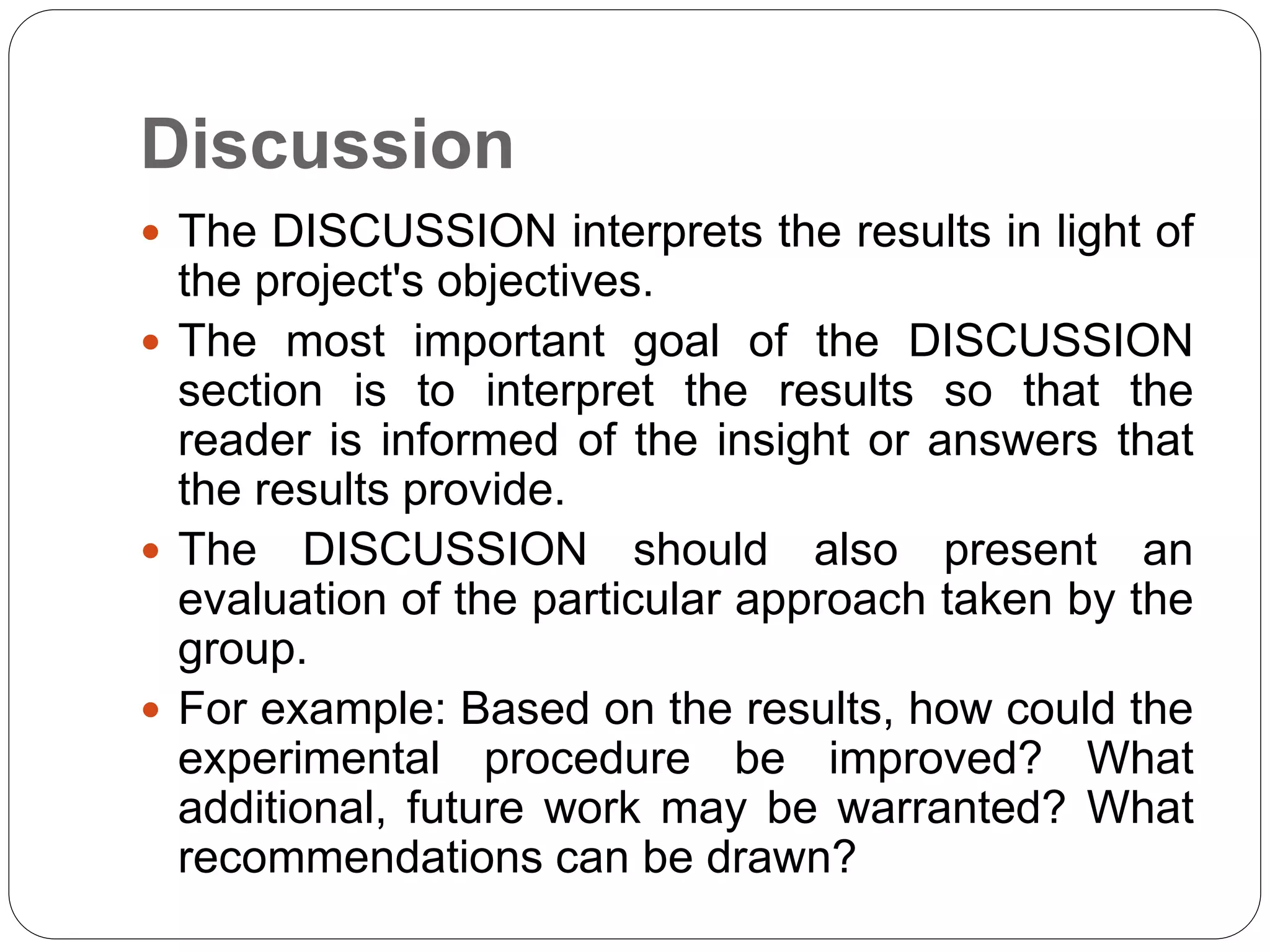
 The DISCUSSION interprets the results in light of
the project's objectives.
 The most important goal of the DISCUSSION
section is to interpret the results so that the
reader is informed of the insight or answers that
the results provide.
 The DISCUSSION should also present an
evaluation of the particular approach taken by the
group.
 For example: Based on the results, how could the
experimental procedure be improved? What
additional, future work may be warranted? What
recommendations can be drawn?
Conclusions
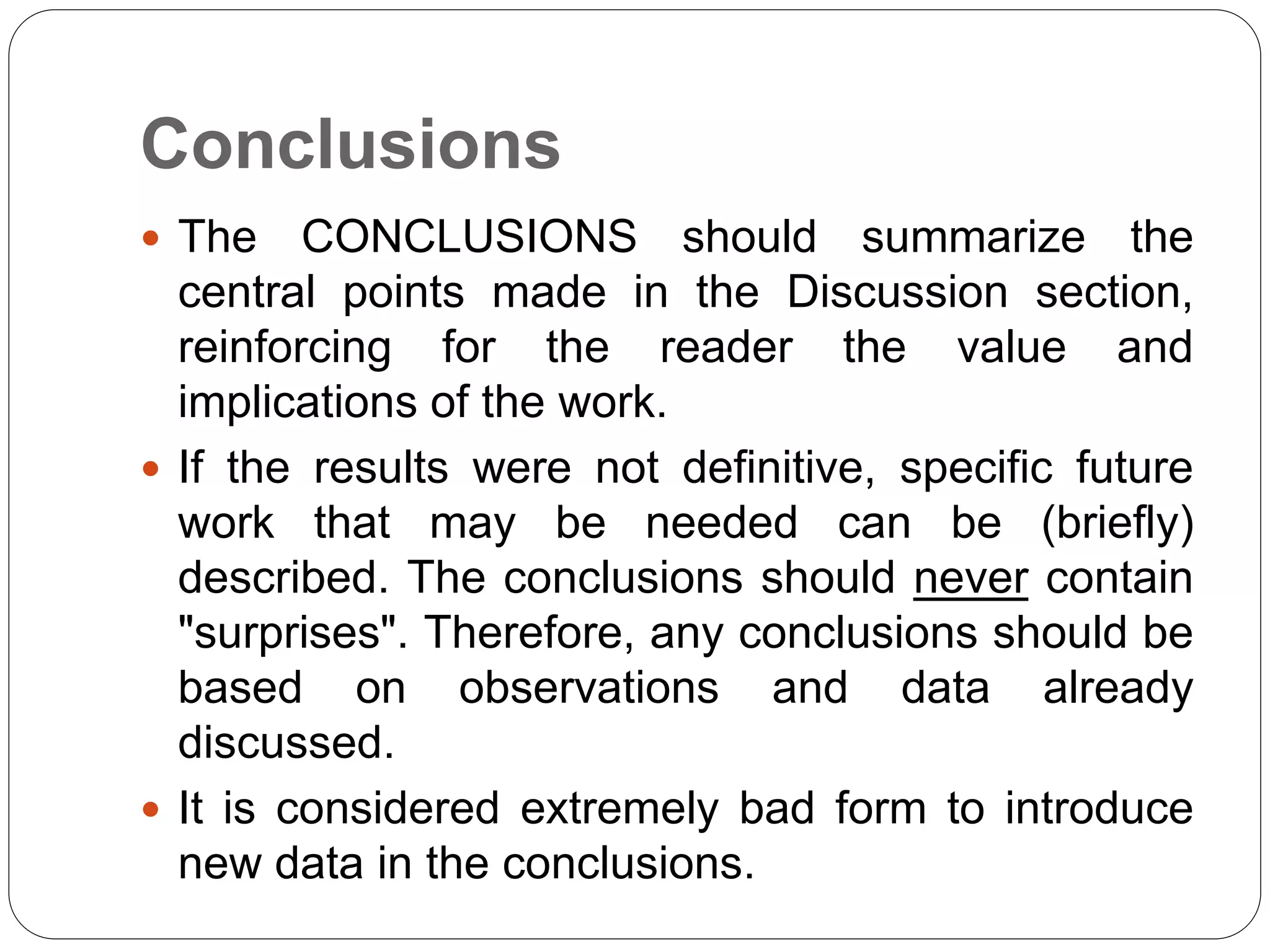
 The CONCLUSIONS should summarize the
central points made in the Discussion section,
reinforcing for the reader the value and
implications of the work.
 If the results were not definitive, specific future
work that may be needed can be (briefly)
described. The conclusions should never contain
"surprises". Therefore, any conclusions should be
based on observations and data already
discussed.
 It is considered extremely bad form to introduce
new data in the conclusions.
References
 The REFERENCES section should contain complete
citations following standard form.
 The form of the citation depends on the type of source
being referenced, and is different for whole books,
chapters in books, and articles published in a journal.
 One good format to follow is that used in
the Chemical Engineering Progress journal, published
by AIChE. The references should be numbered and
listed in the order they were cited in the body of the
report.
 In the text of the report, a particular reference can be
cited by using a numerical superscript that
corresponds to its number in the reference list.
 If a reference has not been actually consulted, it
should be listed "as discussed in [name of the work
that discussed the reference]".
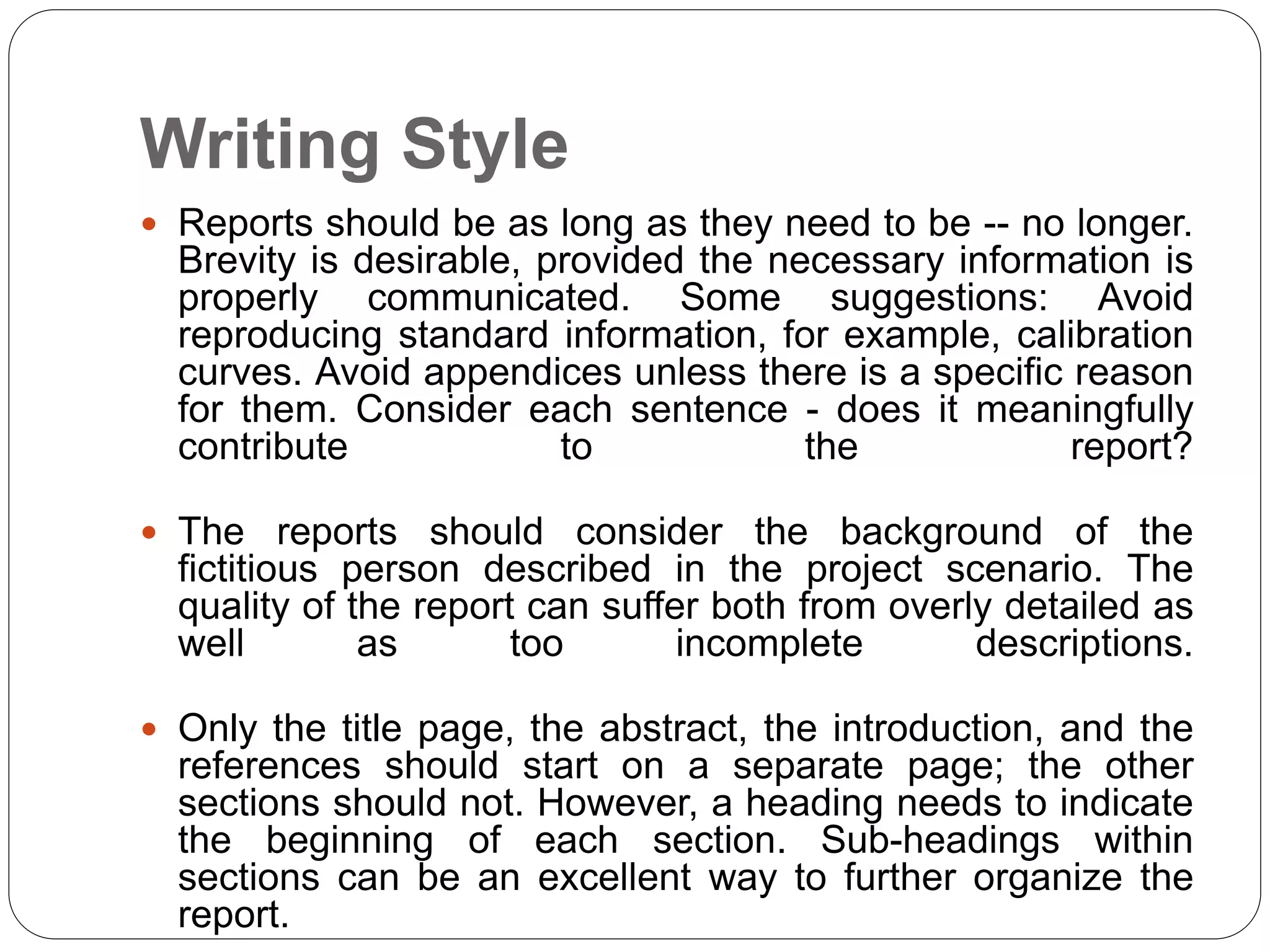
Writing Style
 Reports should be as long as they need to be -- no longer.
Brevity is desirable, provided the necessary information is
properly communicated. Some suggestions: Avoid
reproducing standard information, for example, calibration
curves. Avoid appendices unless there is a specific reason
for them. Consider each sentence - does it meaningfully
contribute to the report?
 The reports should consider the background of the
fictitious person described in the project scenario. The
quality of the report can suffer both from overly detailed as
well as too incomplete descriptions.
 Only the title page, the abstract, the introduction, and the
references should start on a separate page; the other
sections should not. However, a heading needs to indicate
the beginning of each section. Sub-headings within
sections can be an excellent way to further organize the
report.
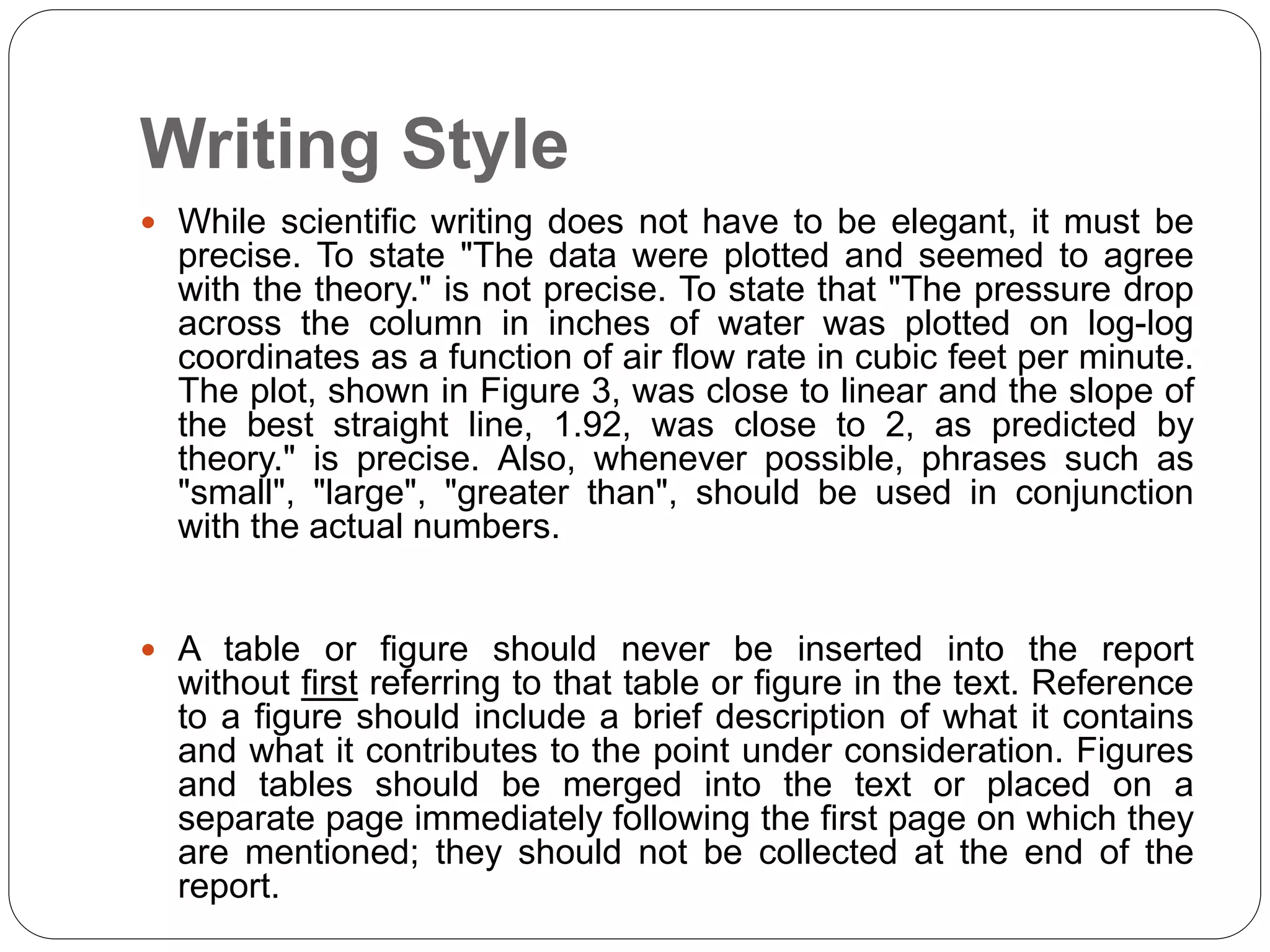
Writing Style
 While scientific writing does not have to be elegant, it must be
precise. To state "The data were plotted and seemed to agree
with the theory." is not precise. To state that "The pressure drop
across the column in inches of water was plotted on log-log
coordinates as a function of air flow rate in cubic feet per minute.
The plot, shown in Figure 3, was close to linear and the slope of
the best straight line, 1.92, was close to 2, as predicted by
theory." is precise. Also, whenever possible, phrases such as
"small", "large", "greater than", should be used in conjunction
with the actual numbers.
 A table or figure should never be inserted into the report
without first referring to that table or figure in the text. Reference
to a figure should include a brief description of what it contains
and what it contributes to the point under consideration. Figures
and tables should be merged into the text or placed on a
separate page immediately following the first page on which they
are mentioned; they should not be collected at the end of the
report.
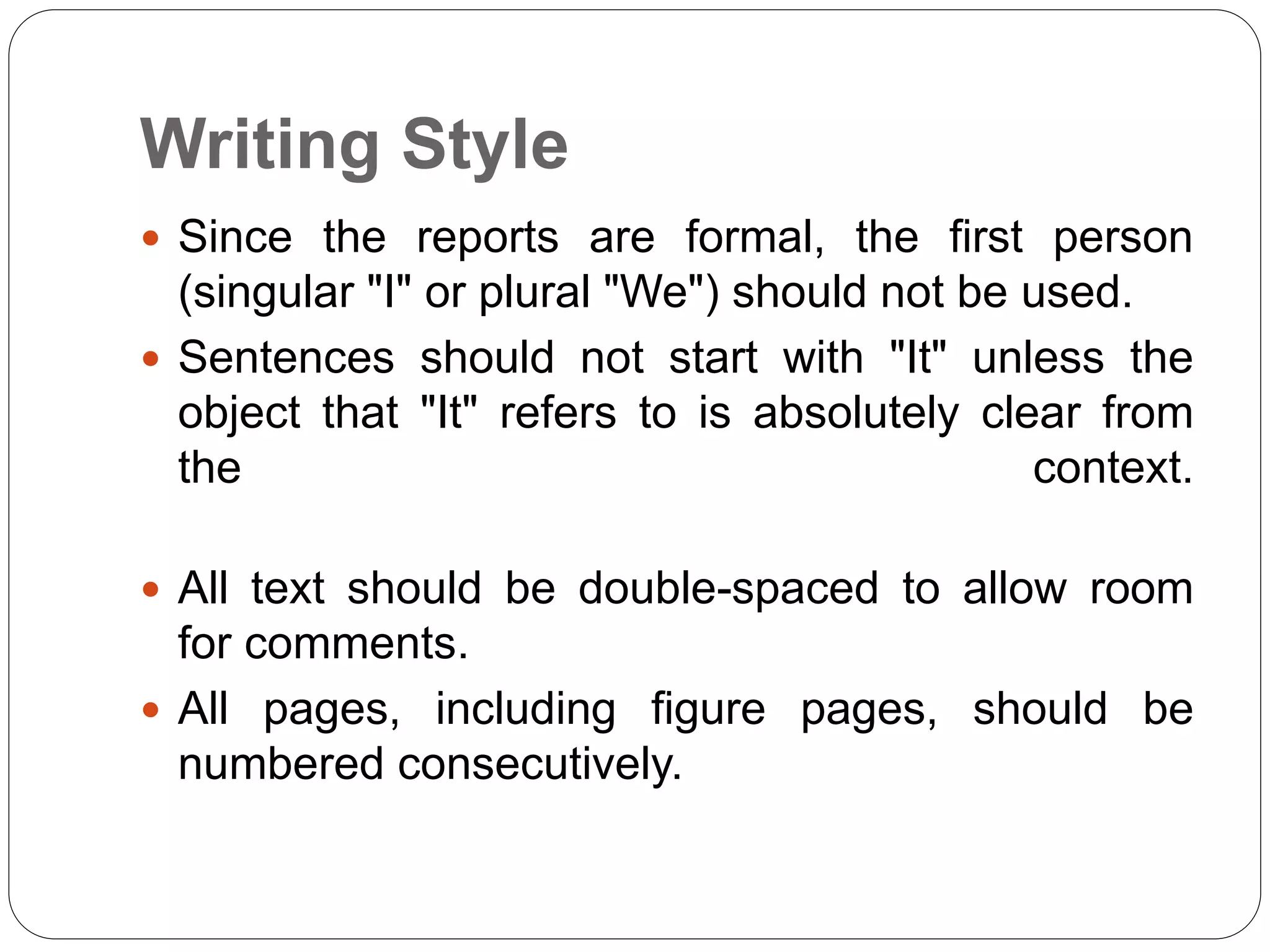
Writing Style
 Since the reports are formal, the first person
(singular "I" or plural "We") should not be used.
 Sentences should not start with "It" unless the
object that "It" refers to is absolutely clear from
the context.
 All text should be double-spaced to allow room
for comments.
 All pages, including figure pages, should be
numbered consecutively.
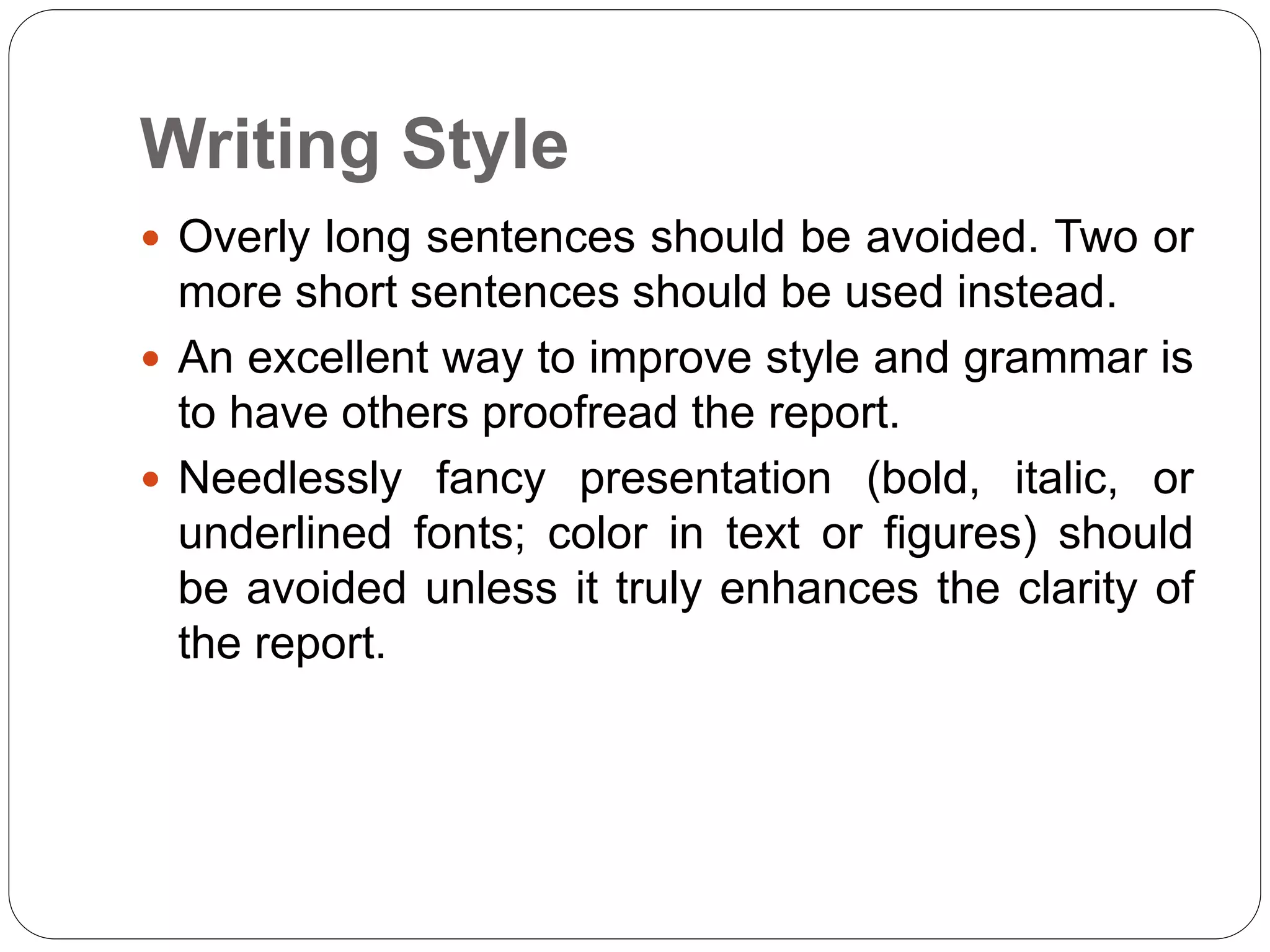
Writing Style
 Overly long sentences should be avoided. Two or
more short sentences should be used instead.
 An excellent way to improve style and grammar is
to have others proofread the report.
 Needlessly fancy presentation (bold, italic, or
underlined fonts; color in text or figures) should
be avoided unless it truly enhances the clarity of
the report.
Figures
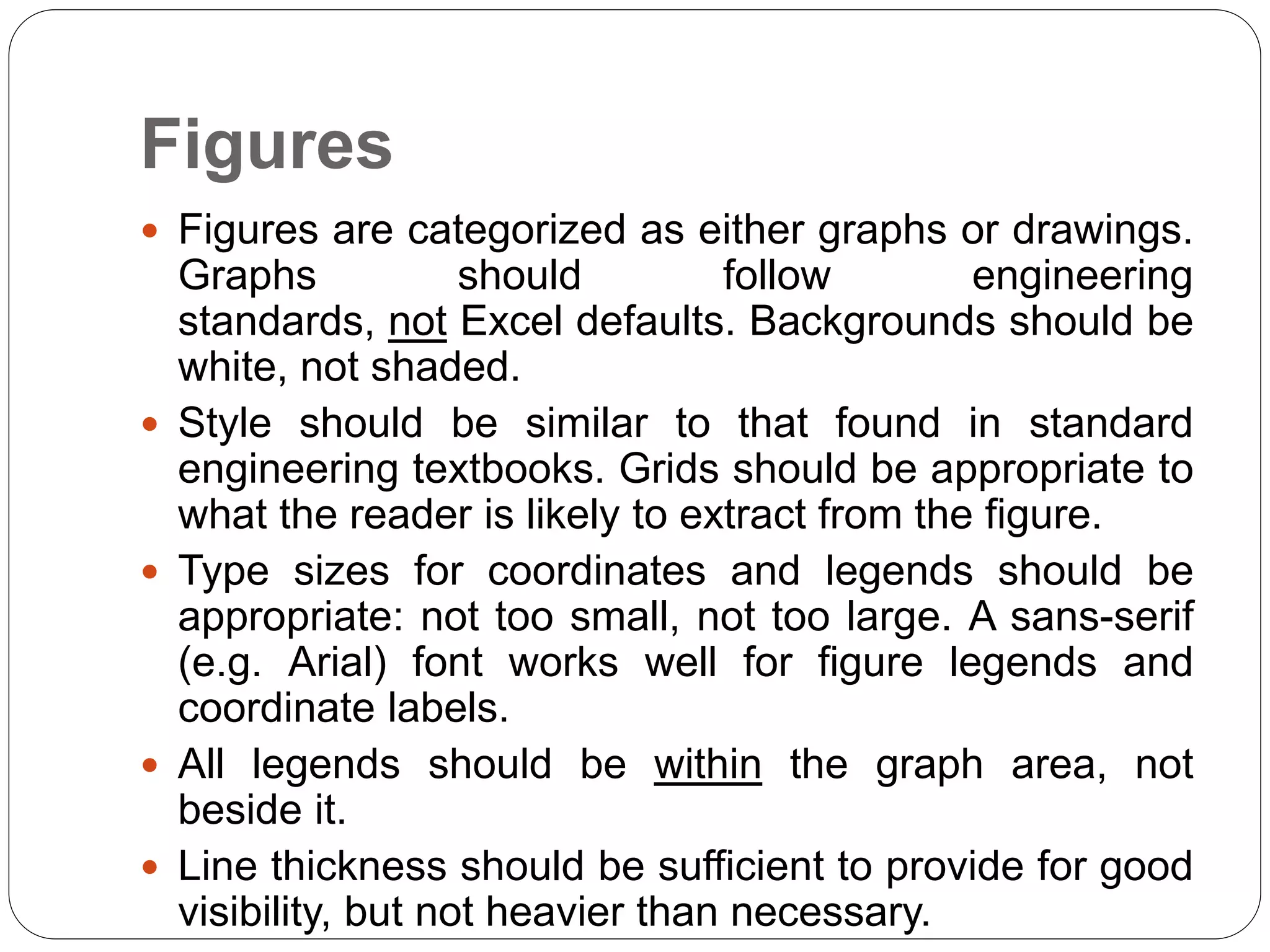
 Figures are categorized as either graphs or drawings.
Graphs should follow engineering
standards, not Excel defaults. Backgrounds should be
white, not shaded.
 Style should be similar to that found in standard
engineering textbooks. Grids should be appropriate to
what the reader is likely to extract from the figure.
 Type sizes for coordinates and legends should be
appropriate: not too small, not too large. A sans-serif
(e.g. Arial) font works well for figure legends and
coordinate labels.
 All legends should be within the graph area, not
beside it.
 Line thickness should be sufficient to provide for good
visibility, but not heavier than necessary.
Figures
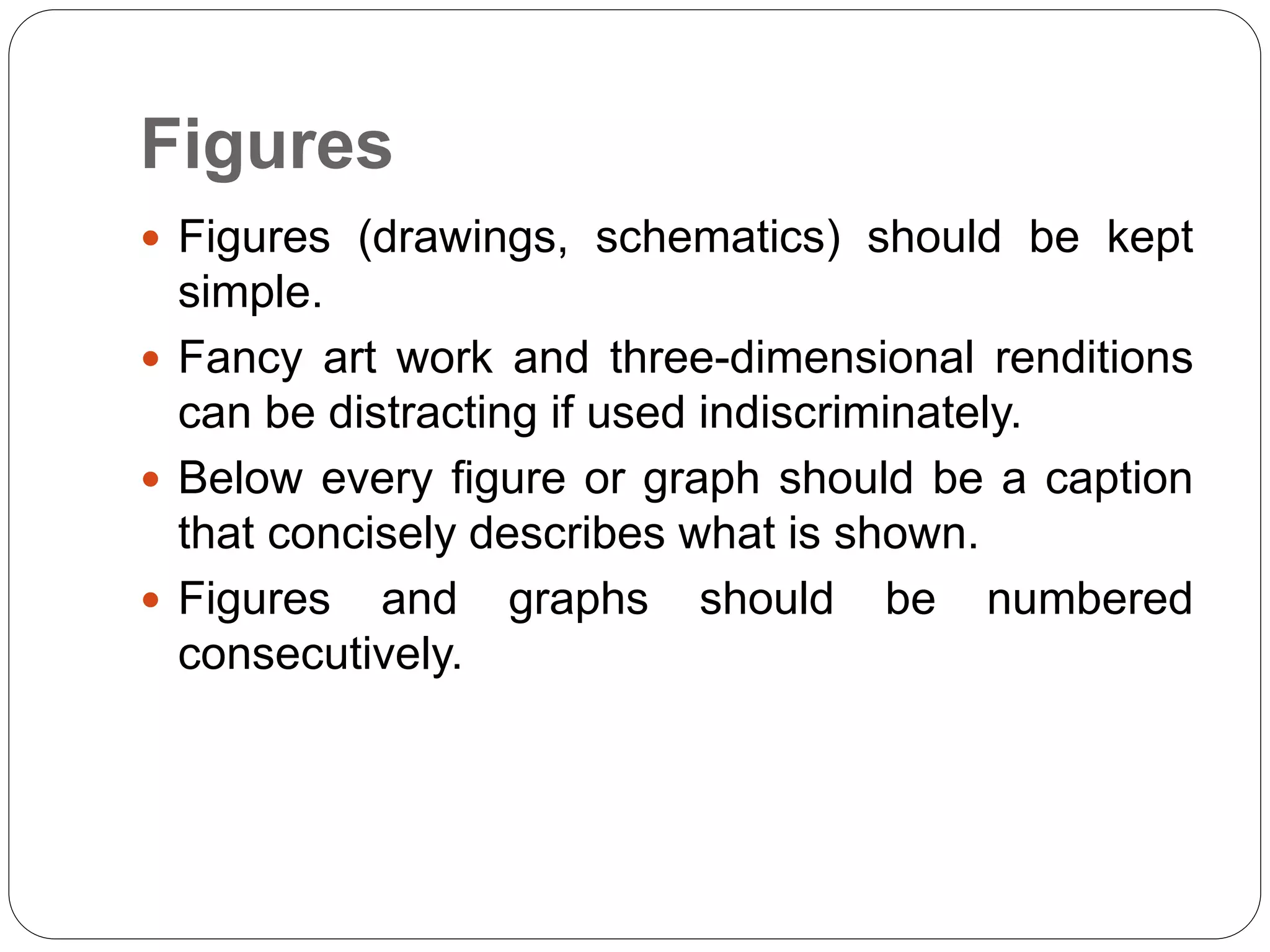
 Figures (drawings, schematics) should be kept
simple.
 Fancy art work and three-dimensional renditions
can be distracting if used indiscriminately.
 Below every figure or graph should be a caption
that concisely describes what is shown.
 Figures and graphs should be numbered
consecutively.
Tables
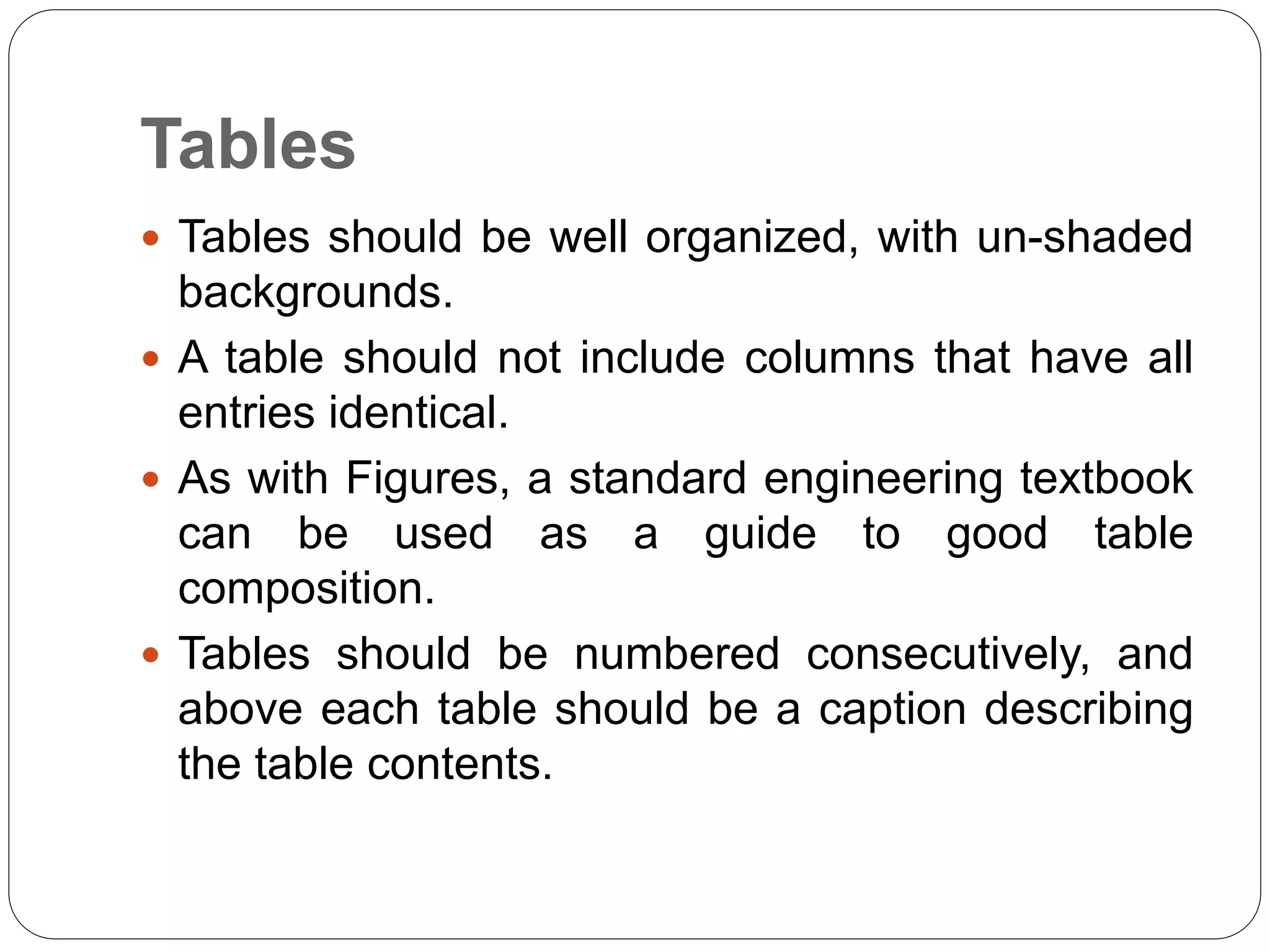
 Tables should be well organized, with un-shaded
backgrounds.
 A table should not include columns that have all
entries identical.
 As with Figures, a standard engineering textbook
can be used as a guide to good table
composition.
 Tables should be numbered consecutively, and
above each table should be a caption describing
the table contents.
Some Common Abbreviations
Used in Marking
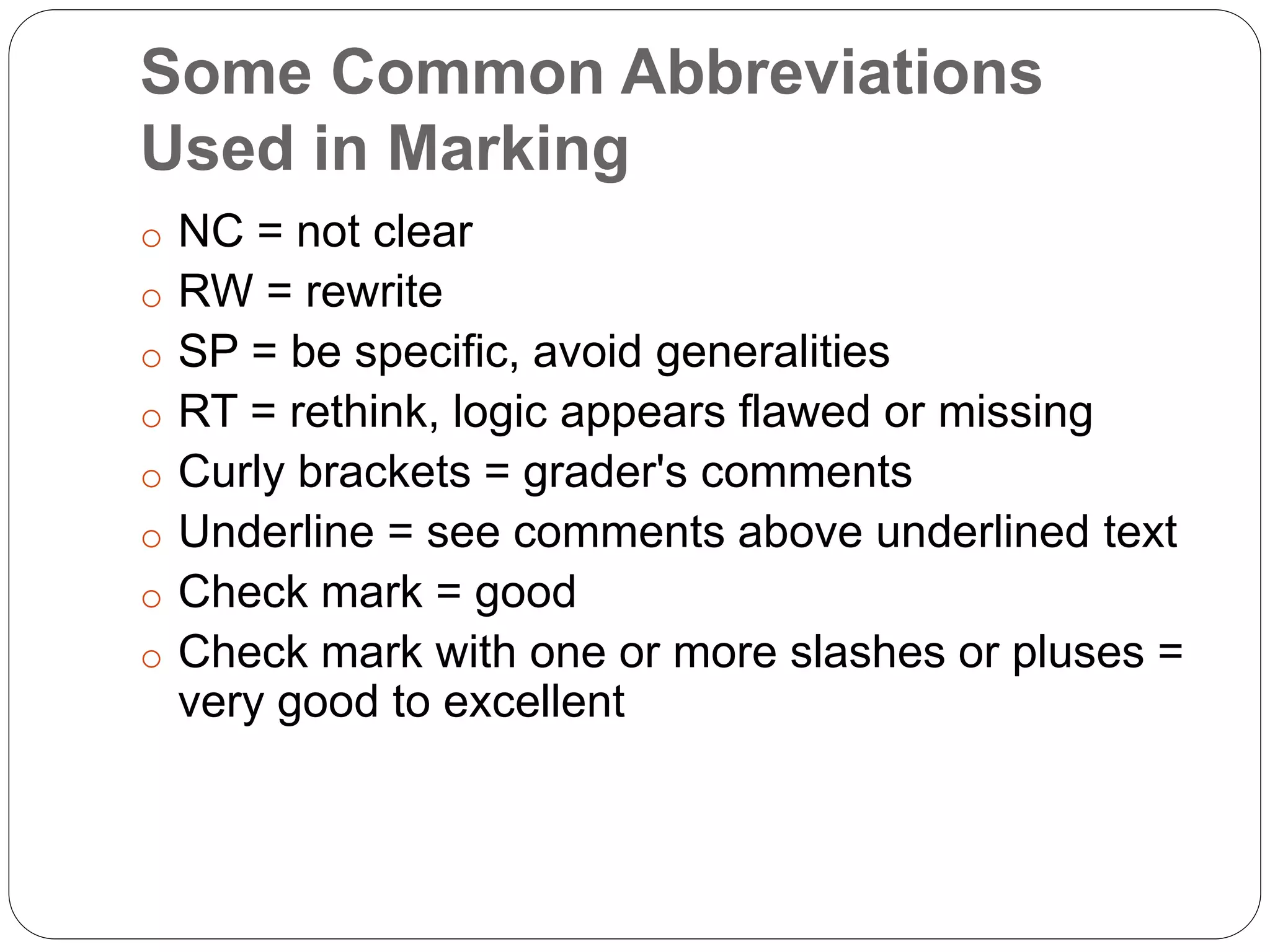
o NC = not clear
o RW = rewrite
o SP = be specific, avoid generalities
o RT = rethink, logic appears flawed or missing
o Curly brackets = grader's comments
o Underline = see comments above underlined text
o Check mark = good
o Check mark with one or more slashes or pluses =
very good to excellent

Business Research Methods: Written report guidelines

  • 1.
  • 2.
    Guidelines  The writtenreport should have the following sections: (1) Title page (2) Abstract (3) Introduction (4) Materials and Methods (5) Results (6) Discussion (7) Conclusions (8) References
  • 3.
    Title page  TheTITLE PAGE identifies 1. The full name of the project 2. The course (BBA 407) 3. The name of the principal author (write NONE if a principal author was not used) 4. The names of the other group members 5. The group number
  • 4.
    Abstract  The ABSTRACTis not a part of the body of the report itself. Rather, the abstract is a brief summary of the report contents that is often separately circulated so potential readers can decide whether to read the report.  The abstract should very concisely summarize the whole report: why it was written, what was discovered or developed, and what is claimed to be the significance of the effort.  The abstract does not include figures or tables, and only the most significant numerical values or results should be given.
  • 5.
    Introduction  The INTRODUCTIONshould provide a clear statement of the problem posed by the project, and why the problem is of interest.  It should reflect the scenario, if available. If needed, the introduction also needs to present background information so that the reader can understand the significance of the problem.  A brief summary of the unique approach your group used to solve the problem should be given, possibly also including a concise introduction to theory or concepts used later to analyze and to discuss the results.
  • 6.
    Materials and Methods The purpose of the MATERIALS AND METHODS section is to describe the materials, apparatus, and procedures used to carry out the measurements. Most importantly, the section needs to provide a clear presentation of how key measurements were obtained and how the measurements were analyzed.  This is where the particular approach followed to reach the project's objectives should be described.  The detail should be sufficient so that the reader can easily understand what was done. An accurate, schematic diagram depicting the apparatus should be included and referred to in the text as needed (if a diagram has been already provided it can be used in the report, provided that the source is properly referenced). To improve clarity of presentation, this section may be further divided into subsections (ex. a Materials
  • 7.
    Results  The RESULTSsection is dedicated to presenting the actual results (i.e. measured and calculated quantities), not to discussing their meaning or interpretation.  The results should be summarized using appropriate Tables and Figures (graphs or schematics). Every Figure and Table should have a legend that describes concisely what is contained or shown. Figure legends go below the figure, table legends above the table. Throughout the report, but especially in this section, pay attention to reporting numbers with an appropriate number of significant figures.  A formal error analysis (such as, perhaps, was done in Physics lab) is not necessary. Still, features of the data- taking and processing that may have especially contributed to errors should be pointed out. One classical example is the taking of small differences between large numbers; for instance, 11.5+0.2 - 10.8+ 0.3 yields a very large fractional error (about 70 %) on the resulting
  • 8.
    Discussion  The DISCUSSIONinterprets the results in light of the project's objectives.  The most important goal of the DISCUSSION section is to interpret the results so that the reader is informed of the insight or answers that the results provide.  The DISCUSSION should also present an evaluation of the particular approach taken by the group.  For example: Based on the results, how could the experimental procedure be improved? What additional, future work may be warranted? What recommendations can be drawn?
  • 9.
    Conclusions  The CONCLUSIONSshould summarize the central points made in the Discussion section, reinforcing for the reader the value and implications of the work.  If the results were not definitive, specific future work that may be needed can be (briefly) described. The conclusions should never contain "surprises". Therefore, any conclusions should be based on observations and data already discussed.  It is considered extremely bad form to introduce new data in the conclusions.
  • 10.
    References  The REFERENCESsection should contain complete citations following standard form.  The form of the citation depends on the type of source being referenced, and is different for whole books, chapters in books, and articles published in a journal.  One good format to follow is that used in the Chemical Engineering Progress journal, published by AIChE. The references should be numbered and listed in the order they were cited in the body of the report.  In the text of the report, a particular reference can be cited by using a numerical superscript that corresponds to its number in the reference list.  If a reference has not been actually consulted, it should be listed "as discussed in [name of the work that discussed the reference]".
  • 11.
    Writing Style  Reportsshould be as long as they need to be -- no longer. Brevity is desirable, provided the necessary information is properly communicated. Some suggestions: Avoid reproducing standard information, for example, calibration curves. Avoid appendices unless there is a specific reason for them. Consider each sentence - does it meaningfully contribute to the report?  The reports should consider the background of the fictitious person described in the project scenario. The quality of the report can suffer both from overly detailed as well as too incomplete descriptions.  Only the title page, the abstract, the introduction, and the references should start on a separate page; the other sections should not. However, a heading needs to indicate the beginning of each section. Sub-headings within sections can be an excellent way to further organize the report.
  • 12.
    Writing Style  Whilescientific writing does not have to be elegant, it must be precise. To state "The data were plotted and seemed to agree with the theory." is not precise. To state that "The pressure drop across the column in inches of water was plotted on log-log coordinates as a function of air flow rate in cubic feet per minute. The plot, shown in Figure 3, was close to linear and the slope of the best straight line, 1.92, was close to 2, as predicted by theory." is precise. Also, whenever possible, phrases such as "small", "large", "greater than", should be used in conjunction with the actual numbers.  A table or figure should never be inserted into the report without first referring to that table or figure in the text. Reference to a figure should include a brief description of what it contains and what it contributes to the point under consideration. Figures and tables should be merged into the text or placed on a separate page immediately following the first page on which they are mentioned; they should not be collected at the end of the report.
  • 13.
    Writing Style  Sincethe reports are formal, the first person (singular "I" or plural "We") should not be used.  Sentences should not start with "It" unless the object that "It" refers to is absolutely clear from the context.  All text should be double-spaced to allow room for comments.  All pages, including figure pages, should be numbered consecutively.
  • 14.
    Writing Style  Overlylong sentences should be avoided. Two or more short sentences should be used instead.  An excellent way to improve style and grammar is to have others proofread the report.  Needlessly fancy presentation (bold, italic, or underlined fonts; color in text or figures) should be avoided unless it truly enhances the clarity of the report.
  • 15.
    Figures  Figures arecategorized as either graphs or drawings. Graphs should follow engineering standards, not Excel defaults. Backgrounds should be white, not shaded.  Style should be similar to that found in standard engineering textbooks. Grids should be appropriate to what the reader is likely to extract from the figure.  Type sizes for coordinates and legends should be appropriate: not too small, not too large. A sans-serif (e.g. Arial) font works well for figure legends and coordinate labels.  All legends should be within the graph area, not beside it.  Line thickness should be sufficient to provide for good visibility, but not heavier than necessary.
  • 16.
    Figures  Figures (drawings,schematics) should be kept simple.  Fancy art work and three-dimensional renditions can be distracting if used indiscriminately.  Below every figure or graph should be a caption that concisely describes what is shown.  Figures and graphs should be numbered consecutively.
  • 17.
    Tables  Tables shouldbe well organized, with un-shaded backgrounds.  A table should not include columns that have all entries identical.  As with Figures, a standard engineering textbook can be used as a guide to good table composition.  Tables should be numbered consecutively, and above each table should be a caption describing the table contents.
  • 18.
    Some Common Abbreviations Usedin Marking o NC = not clear o RW = rewrite o SP = be specific, avoid generalities o RT = rethink, logic appears flawed or missing o Curly brackets = grader's comments o Underline = see comments above underlined text o Check mark = good o Check mark with one or more slashes or pluses = very good to excellent