ThesisPreparation  and  KnowledgeHow Theses Get Written:Some Cool Tips
Outline Part 1: Writing your thesis (1) Context: What is a thesis (for)? (2) How Do I Get Started? (3) What Should My Thesis Contain? (4) How Do I Get Finished? (5) Summary Part 2: The Examiner’s View (1) “Uh oh, not another thesis to read…” (2) “What’s this one about?” (3) “Now there must be some corrections…” (4) “Let’s see, what can I ask the candidate?”
What is a thesis? An argument An exposition of an original piece of research The product of an apprenticeship Probably the largest (most self-indulgent) piece ofwork you’ll ever do Something that could be published: E.g. at least one paper in a scholarly journal but you will probably never publish the whole thesis
Examination Issues Your examiners need to appreciate your research: Choose your examiners well Target your thesis at them Keep abreast of their work Talk to them regularly Ask around about what is the norm for your university E.g. at U of T, it is normal to interact regularly with your thesis committee Your examiners need to be told about your research: If it’s not in your thesis, they won’t find out about it No matter how good your research is, you MUST write a good thesis
How do I get started? Do this today:                      I do really mean  Decide your title    Before you go to bed tonight Write your title page     Tomorrow is too late Start a binder (Look at some theses in your area) Plan your argument… You can change things later But you can’t change it unless you have something to change!
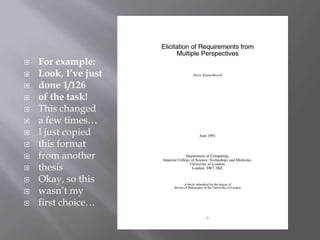
For example:               Look, I’ve justdone 1/126of the task!This changeda few times…I just copiedthis formatfrom anotherthesisOkay, so thiswasn’t myfirst choice…
Plan Your ArgumentOne sentence for each: ExampleIntroduction(area of study)“The success of a software development project depends oncapturing stakeholders’ needs in a specification ...The problem(that I tackle)“However, specifications often reflect the analyst’s own bias,rather than the inputs of the many different stakeholders…What the literature saysabout this problem“Current methods described in the literature fail to addressidentification and integration of multiple views.How I tackle this problem “By treating the specification activity as a dialogue betweenstakeholders, we can model each perspective separately.How I implement mysolution“We provide a set of tools for exploring disagreement betweenperspectives, and use these tools as the basis for a computer supportednegotiation process.The result “This approach is shown to significantly improve
Plan your arguementOne sentence for each: ExampleIntroduction(area of study)“The success of a software development project depends oncapturing stakeholders’ needs in a specification ...The problem(that I tackle)“However, specifications often reflect the analyst’s own bias,rather than the inputs of the many different stakeholders…What the literature saysabout this problem“Current methods described in the literature fail to addressidentification and integration of multiple views.How I tackle this problem “By treating the specification activity as a dialogue betweenstakeholders, we can model each perspective separately.How I implement mysolution“We provide a set of tools for exploring disagreement betweenperspectives, and use these tools as the basis for a computersupportednegotiation process.The result “This approach is shown to significantly improve traceability andvalidity of specifications and overall stakeholder satisfaction.”
Another Example :One sentence for each: ExampleIntroduction(area of study)“A Ph.D. is examined by submission of a thesis...The problem(that I tackle)“Many students fail to complete their theses within theregulation four years...What the literature says aboutthis problem“Empirical studies indicate that late submission is highlycorrelated with delaying the start of the write-up...How I tackle this problem “A model of PhD study that encourages an early start tothe thesis writing task is clearly desirable...How I implement my solution“Such a model encourages the student to plan a structurefor the thesis and collect material for each chapterthroughout their study...The result “Application of this model dramatically improvessubmission rates.”
Plan your thesis Convert this argument into a chapter outline At least one chapter per sentence ...maybe more than one for some sentences Start a binder with a division for each chapter Collect material in this binder Set out clearly what each chapter should say Don’t be afraid to change your mind As you write the thesis, your ideas will evolve Don’t wait for them to stop evolving: It’s much easier to change an outline that you’ve written down than one youhaven’t.
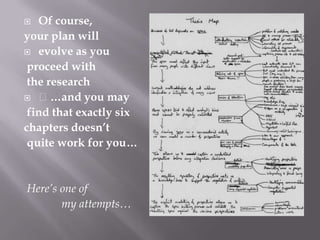
Of course, your plan willevolve as you proceed with the research …and you may find that exactly sixchapters doesn’t quite work for you… Here’s one of             my attempts…
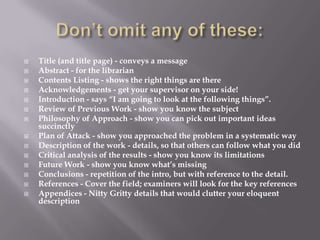
Don’t omit any of these:Title (and title page) - conveys a messageAbstract - for the librarianContents Listing - shows the right things are thereAcknowledgements - get your supervisor on your side!Introduction - says “I am going to look at the following things”.Review of Previous Work - show you know the subjectPhilosophy of Approach - show you can pick out important ideas succinctlyPlan of Attack - show you approached the problem in a systematic wayDescription of the work - details, so that others can follow what you didCritical analysis of the results - show you know its limitationsFuture Work - show you know what’s missingConclusions - repetition of the intro, but with reference to the detail.References - Cover the field; examiners will look for the key referencesAppendices - Nitty Gritty details that would clutter your eloquent description
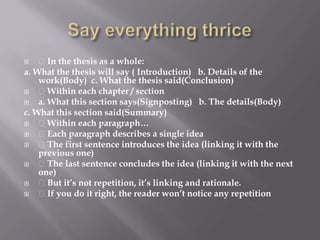
Say everything thrice In the thesis as a whole:a. What the thesis will say ( Introduction)   b. Details of the work(Body)  c. What the thesis said(Conclusion) Within each chapter / sectiona. What this section says(Signposting)   b. The details(Body)c. What this section said(Summary) Within each paragraph… Each paragraph describes a single idea The first sentence introduces the idea (linking it with the previous one) The last sentence concludes the idea (linking it with the next one) But it’s not repetition, it’s linking and rationale. If you do it right, the reader won’t notice any repetition
Bibliography Keep a database of complete references Use a consistent citation style Use a tool Bibtex, Refer, Endnote, ProCite, or whatever. New tools: Mendeley, Zotero, CiteULike,… Attention to detail is important Get the spellings right Keep complete references page numbers, volume numbers, editors names, locations and dates for conferenceproceedings, etc. Find out what the local rules are for citation style If there are no local rules, use [Author, Year] format This improves readability by saving the reader flicking to the back Assume the reader is familiar with the main references But that doesn’t mean you should skip them
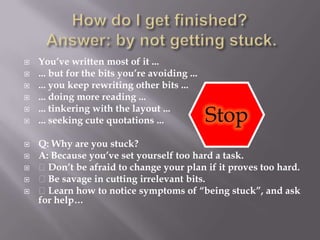
How do I get finished? Answer: by not getting stuck.You’ve written most of it ...... but for the bits you’re avoiding ...... you keep rewriting other bits ...... doing more reading ...... tinkering with the layout ...... seeking cute quotations ...Q: Why are you stuck?A: Because you’ve set yourself too hard a task. Don’t be afraid to change your plan if it proves too hard. Be savage in cutting irrelevant bits. Learn how to notice symptoms of “being stuck”, and ask for help…Stop
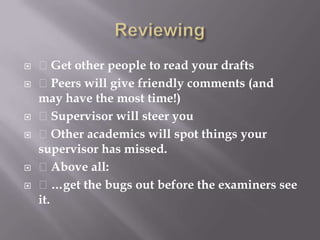
Reviewing Get other people to read your drafts Peers will give friendly comments (and may have the most time!) Supervisor will steer you Other academics will spot things your supervisor has missed. Above all: …get the bugs out before the examiners see it.
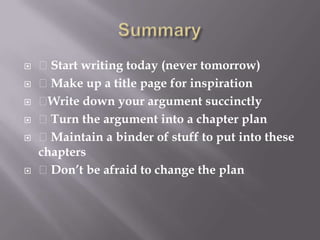
Summary Start writing today (never tomorrow) Make up a title page for inspirationWrite down your argument succinctly Turn the argument into a chapter plan Maintain a binder of stuff to put into these chapters Don’t be afraid to change the plan
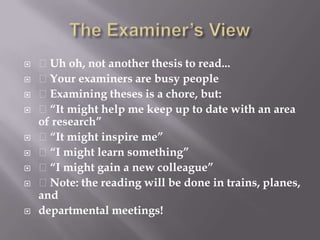
The Examiner’s View Uh oh, not another thesis to read... Your examiners are busy people Examining theses is a chore, but: “It might help me keep up to date with an area of research” “It might inspire me” “I might learn something” “I might gain a new colleague” Note: the reading will be done in trains, planes, anddepartmental meetings!
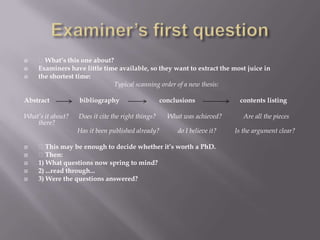
Examiner’s first question What’s this one about?Examiners have little time available, so they want to extract the most juice inthe shortest time:Typical scanning order of a new thesis:Abstract                  bibliography                        conclusions                           contents listingWhat’s it about?      Does it cite the right things?       What was achieved?             Are all the pieces there?                                Has it been published already?           do I believe it?           Is the argument clear? This may be enough to decide whether it’s worth a PhD. Then:1) What questions now spring to mind?2) ...read through...3) Were the questions answered?
Good luck with your papers !GoodbyeDesigned and written by : Malissa Hope Collins

Thesis powerpoint

  • 1.
    ThesisPreparation and KnowledgeHow Theses Get Written:Some Cool Tips
  • 2.
    Outline Part 1:Writing your thesis (1) Context: What is a thesis (for)? (2) How Do I Get Started? (3) What Should My Thesis Contain? (4) How Do I Get Finished? (5) Summary Part 2: The Examiner’s View (1) “Uh oh, not another thesis to read…” (2) “What’s this one about?” (3) “Now there must be some corrections…” (4) “Let’s see, what can I ask the candidate?”
  • 3.
    What is athesis? An argument An exposition of an original piece of research The product of an apprenticeship Probably the largest (most self-indulgent) piece ofwork you’ll ever do Something that could be published: E.g. at least one paper in a scholarly journal but you will probably never publish the whole thesis
  • 4.
    Examination Issues Yourexaminers need to appreciate your research: Choose your examiners well Target your thesis at them Keep abreast of their work Talk to them regularly Ask around about what is the norm for your university E.g. at U of T, it is normal to interact regularly with your thesis committee Your examiners need to be told about your research: If it’s not in your thesis, they won’t find out about it No matter how good your research is, you MUST write a good thesis
  • 5.
    How do Iget started? Do this today: I do really mean  Decide your title Before you go to bed tonight Write your title page Tomorrow is too late Start a binder (Look at some theses in your area) Plan your argument… You can change things later But you can’t change it unless you have something to change!
  • 6.
    For example: Look, I’ve justdone 1/126of the task!This changeda few times…I just copiedthis formatfrom anotherthesisOkay, so thiswasn’t myfirst choice…
  • 7.
    Plan Your ArgumentOnesentence for each: ExampleIntroduction(area of study)“The success of a software development project depends oncapturing stakeholders’ needs in a specification ...The problem(that I tackle)“However, specifications often reflect the analyst’s own bias,rather than the inputs of the many different stakeholders…What the literature saysabout this problem“Current methods described in the literature fail to addressidentification and integration of multiple views.How I tackle this problem “By treating the specification activity as a dialogue betweenstakeholders, we can model each perspective separately.How I implement mysolution“We provide a set of tools for exploring disagreement betweenperspectives, and use these tools as the basis for a computer supportednegotiation process.The result “This approach is shown to significantly improve
  • 8.
    Plan your arguementOnesentence for each: ExampleIntroduction(area of study)“The success of a software development project depends oncapturing stakeholders’ needs in a specification ...The problem(that I tackle)“However, specifications often reflect the analyst’s own bias,rather than the inputs of the many different stakeholders…What the literature saysabout this problem“Current methods described in the literature fail to addressidentification and integration of multiple views.How I tackle this problem “By treating the specification activity as a dialogue betweenstakeholders, we can model each perspective separately.How I implement mysolution“We provide a set of tools for exploring disagreement betweenperspectives, and use these tools as the basis for a computersupportednegotiation process.The result “This approach is shown to significantly improve traceability andvalidity of specifications and overall stakeholder satisfaction.”
  • 9.
    Another Example :Onesentence for each: ExampleIntroduction(area of study)“A Ph.D. is examined by submission of a thesis...The problem(that I tackle)“Many students fail to complete their theses within theregulation four years...What the literature says aboutthis problem“Empirical studies indicate that late submission is highlycorrelated with delaying the start of the write-up...How I tackle this problem “A model of PhD study that encourages an early start tothe thesis writing task is clearly desirable...How I implement my solution“Such a model encourages the student to plan a structurefor the thesis and collect material for each chapterthroughout their study...The result “Application of this model dramatically improvessubmission rates.”
  • 10.
    Plan your thesisConvert this argument into a chapter outline At least one chapter per sentence ...maybe more than one for some sentences Start a binder with a division for each chapter Collect material in this binder Set out clearly what each chapter should say Don’t be afraid to change your mind As you write the thesis, your ideas will evolve Don’t wait for them to stop evolving: It’s much easier to change an outline that you’ve written down than one youhaven’t.
  • 11.
    Of course, yourplan willevolve as you proceed with the research …and you may find that exactly sixchapters doesn’t quite work for you… Here’s one of my attempts…
  • 12.
    Don’t omit anyof these:Title (and title page) - conveys a messageAbstract - for the librarianContents Listing - shows the right things are thereAcknowledgements - get your supervisor on your side!Introduction - says “I am going to look at the following things”.Review of Previous Work - show you know the subjectPhilosophy of Approach - show you can pick out important ideas succinctlyPlan of Attack - show you approached the problem in a systematic wayDescription of the work - details, so that others can follow what you didCritical analysis of the results - show you know its limitationsFuture Work - show you know what’s missingConclusions - repetition of the intro, but with reference to the detail.References - Cover the field; examiners will look for the key referencesAppendices - Nitty Gritty details that would clutter your eloquent description
  • 13.
    Say everything thriceIn the thesis as a whole:a. What the thesis will say ( Introduction) b. Details of the work(Body) c. What the thesis said(Conclusion) Within each chapter / sectiona. What this section says(Signposting) b. The details(Body)c. What this section said(Summary) Within each paragraph… Each paragraph describes a single idea The first sentence introduces the idea (linking it with the previous one) The last sentence concludes the idea (linking it with the next one) But it’s not repetition, it’s linking and rationale. If you do it right, the reader won’t notice any repetition
  • 14.
    Bibliography Keep adatabase of complete references Use a consistent citation style Use a tool Bibtex, Refer, Endnote, ProCite, or whatever. New tools: Mendeley, Zotero, CiteULike,… Attention to detail is important Get the spellings right Keep complete references page numbers, volume numbers, editors names, locations and dates for conferenceproceedings, etc. Find out what the local rules are for citation style If there are no local rules, use [Author, Year] format This improves readability by saving the reader flicking to the back Assume the reader is familiar with the main references But that doesn’t mean you should skip them
  • 15.
    How do Iget finished? Answer: by not getting stuck.You’ve written most of it ...... but for the bits you’re avoiding ...... you keep rewriting other bits ...... doing more reading ...... tinkering with the layout ...... seeking cute quotations ...Q: Why are you stuck?A: Because you’ve set yourself too hard a task. Don’t be afraid to change your plan if it proves too hard. Be savage in cutting irrelevant bits. Learn how to notice symptoms of “being stuck”, and ask for help…Stop
  • 16.
    Reviewing Get otherpeople to read your drafts Peers will give friendly comments (and may have the most time!) Supervisor will steer you Other academics will spot things your supervisor has missed. Above all: …get the bugs out before the examiners see it.
  • 17.
    Summary Start writingtoday (never tomorrow) Make up a title page for inspirationWrite down your argument succinctly Turn the argument into a chapter plan Maintain a binder of stuff to put into these chapters Don’t be afraid to change the plan
  • 18.
    The Examiner’s ViewUh oh, not another thesis to read... Your examiners are busy people Examining theses is a chore, but: “It might help me keep up to date with an area of research” “It might inspire me” “I might learn something” “I might gain a new colleague” Note: the reading will be done in trains, planes, anddepartmental meetings!
  • 19.
    Examiner’s first questionWhat’s this one about?Examiners have little time available, so they want to extract the most juice inthe shortest time:Typical scanning order of a new thesis:Abstract bibliography conclusions contents listingWhat’s it about? Does it cite the right things? What was achieved? Are all the pieces there? Has it been published already? do I believe it? Is the argument clear? This may be enough to decide whether it’s worth a PhD. Then:1) What questions now spring to mind?2) ...read through...3) Were the questions answered?
  • 20.
    Good luck withyour papers !GoodbyeDesigned and written by : Malissa Hope Collins