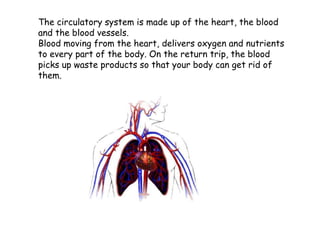
The circulatory system is made up of the heart, the blood 
and the blood vessels. 
Blood moving from the heart, delivers oxygen and nutrients 
to every part of the body. On the return trip, the blood 
picks up waste products so that your body can get rid of 
them.
The heart is about the size of your fist and it is 
located a bit to the left in the middle of your 
chest. It weighs between 200 and 425 grams. 
The heart is a muscle. It contracts and relaxes 
around 70 times a minute at rest, more if you 
are exercising. 
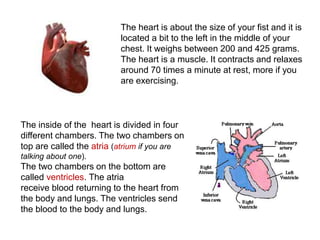
The inside of the heart is divided in four 
different chambers. The two chambers on 
top are called the atria (atrium if you are 
talking about one). 
The two chambers on the bottom are 
called ventricles. The atria 
receive blood returning to the heart from 
the body and lungs. The ventricles send 
the blood to the body and lungs.
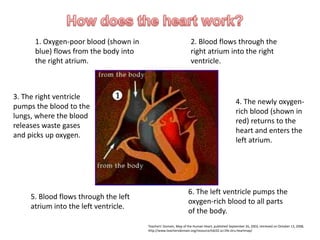
1. Oxygen-poor blood (shown in 
blue) flows from the body into 
the right atrium. 
2. Blood flows through the 
right atrium into the right 
ventricle. 
3. The right ventricle 
pumps the blood to the 
lungs, where the blood 
releases waste gases 
and picks up oxygen. 
4. The newly oxygen-rich 
blood (shown in 
red) returns to the 
heart and enters the 
left atrium. 
5. Blood flows through the left 
atrium into the left ventricle. 
6. The left ventricle pumps the 
oxygen-rich blood to all parts 
of the body. 
Teachers' Domain, Map of the Human Heart, published September 26, 2003, retrieved on October 13, 2008, 
http://www.teachersdomain.org/resource/tdc02.sci.life.stru.heartmap/
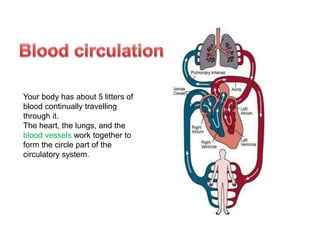
Your body has about 5 litters of 
blood continually travelling 
through it. 
The heart, the lungs, and the 
blood vessels work together to 
form the circle part of the 
circulatory system.
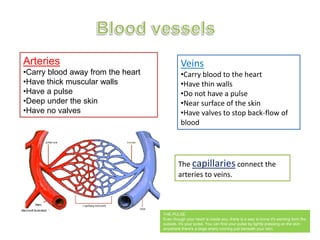
Arteries 
•Carry blood away from the heart 
•Have thick muscular walls 
•Have a pulse 
•Deep under the skin 
•Have no valves 
Veins 
•Carry blood to the heart 
•Have thin walls 
•Do not have a pulse 
•Near surface of the skin 
•Have valves to stop back-flow of 
blood 
The capillaries connect the 
arteries to veins. 
THE PULSE 
Even though your heart is inside you, there is a way to know it's working from the 
outside. It's your pulse. You can find your pulse by lightly pressing on the skin 
anywhere there's a large artery running just beneath your skin.
http://texasheart.org/HIC/Anatomy 
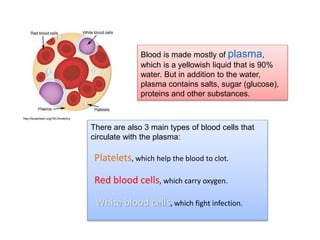
Blood is made mostly of plasma, 
which is a yellowish liquid that is 90% 
water. But in addition to the water, 
plasma contains salts, sugar (glucose), 
proteins and other substances. 
There are also 3 main types of blood cells that 
circulate with the plasma: 
Platelets, which help the blood to clot. 
Red blood cells, which carry oxygen. 
White blood cells, which fight infection.
What color is blood? 
Sometimes it is reddish, and sometimes it is 
bluish. 
Look at your arm. Can you see the blue veins? 
Why are they blue? 
When blood is full of oxygen it is red, but when it 
is low on oxygen it turns bluish. 
Why don’t you ever see blue blood? 
Because as it leaves your body, it quickly turns 
red, as it takes in oxygen.
There are 4 different blood types: A, B, AB, and O. 
Genes that you inherit from your parents (1 from your mother and 1 from 
your father) determine your blood type. 
Blood is made by the cells inside your bones, so your body can usually 
replace any blood lost through small cuts or wounds. But when a lot of blood 
is lost we might need a blood transfusion (blood donated by other people). 
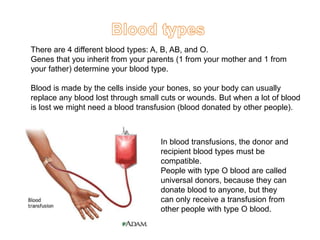
In blood transfusions, the donor and 
recipient blood types must be 
compatible. 
People with type O blood are called 
universal donors, because they can 
donate blood to anyone, but they 
can only receive a transfusion from 
other people with type O blood.

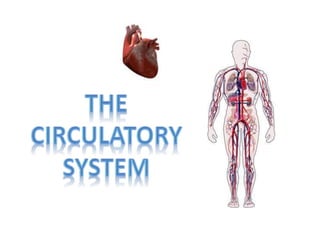
Circulatory system

  • 2.
    The circulatory systemis made up of the heart, the blood and the blood vessels. Blood moving from the heart, delivers oxygen and nutrients to every part of the body. On the return trip, the blood picks up waste products so that your body can get rid of them.
  • 3.
    The heart isabout the size of your fist and it is located a bit to the left in the middle of your chest. It weighs between 200 and 425 grams. The heart is a muscle. It contracts and relaxes around 70 times a minute at rest, more if you are exercising. The inside of the heart is divided in four different chambers. The two chambers on top are called the atria (atrium if you are talking about one). The two chambers on the bottom are called ventricles. The atria receive blood returning to the heart from the body and lungs. The ventricles send the blood to the body and lungs.
  • 4.
    1. Oxygen-poor blood(shown in blue) flows from the body into the right atrium. 2. Blood flows through the right atrium into the right ventricle. 3. The right ventricle pumps the blood to the lungs, where the blood releases waste gases and picks up oxygen. 4. The newly oxygen-rich blood (shown in red) returns to the heart and enters the left atrium. 5. Blood flows through the left atrium into the left ventricle. 6. The left ventricle pumps the oxygen-rich blood to all parts of the body. Teachers' Domain, Map of the Human Heart, published September 26, 2003, retrieved on October 13, 2008, http://www.teachersdomain.org/resource/tdc02.sci.life.stru.heartmap/
  • 5.
    Your body hasabout 5 litters of blood continually travelling through it. The heart, the lungs, and the blood vessels work together to form the circle part of the circulatory system.
  • 6.
    Arteries •Carry bloodaway from the heart •Have thick muscular walls •Have a pulse •Deep under the skin •Have no valves Veins •Carry blood to the heart •Have thin walls •Do not have a pulse •Near surface of the skin •Have valves to stop back-flow of blood The capillaries connect the arteries to veins. THE PULSE Even though your heart is inside you, there is a way to know it's working from the outside. It's your pulse. You can find your pulse by lightly pressing on the skin anywhere there's a large artery running just beneath your skin.
  • 7.
    http://texasheart.org/HIC/Anatomy Blood ismade mostly of plasma, which is a yellowish liquid that is 90% water. But in addition to the water, plasma contains salts, sugar (glucose), proteins and other substances. There are also 3 main types of blood cells that circulate with the plasma: Platelets, which help the blood to clot. Red blood cells, which carry oxygen. White blood cells, which fight infection.
  • 8.
    What color isblood? Sometimes it is reddish, and sometimes it is bluish. Look at your arm. Can you see the blue veins? Why are they blue? When blood is full of oxygen it is red, but when it is low on oxygen it turns bluish. Why don’t you ever see blue blood? Because as it leaves your body, it quickly turns red, as it takes in oxygen.
  • 9.
    There are 4different blood types: A, B, AB, and O. Genes that you inherit from your parents (1 from your mother and 1 from your father) determine your blood type. Blood is made by the cells inside your bones, so your body can usually replace any blood lost through small cuts or wounds. But when a lot of blood is lost we might need a blood transfusion (blood donated by other people). In blood transfusions, the donor and recipient blood types must be compatible. People with type O blood are called universal donors, because they can donate blood to anyone, but they can only receive a transfusion from other people with type O blood.