Azotobacter : Beneficial Microbes
Presented by:
Khushbu’s Microbiology
Genus of usually motile
 Oval or spherical bacteria
 Thick-walled cysts
 May produce large quantities of
capsular slime.
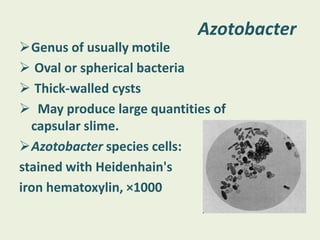
Azotobacter species cells:
stained with Heidenhain's
iron hematoxylin, ×1000
Azotobacter
Description
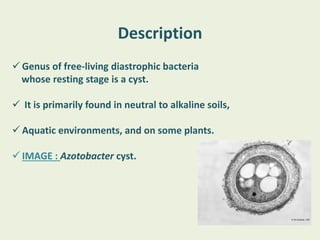
 Genus of free-living diastrophic bacteria
whose resting stage is a cyst.
 It is primarily found in neutral to alkaline soils,
 Aquatic environments, and on some plants.
 IMAGE : Azotobacter cyst.
Significance
 It has several metabolic capabilities : including atmospheric
nitrogen fixation by conversion to ammonia.
 Their unique system of three distinct nitrogenase enzymes
makes these bacteria of particular interest to scientists, who
may work toward a better understanding of nitrogen fixation
and its role in agriculture.
 Azotobacter spp: the highest metabolic rate of any organisms.
Advantages of Azotobacter:
 Heaviest breathing organism and requires a
large amount of organic carbon for its
growth.
 Competitor for nutrients in soil
 Growth promoting substances
 Fungistatic substances.
Nitrogen fixation
• Azotobacter species are free-living, nitrogen-
fixing bacteria; in contrast to Rhizobium species,
• They normally fix molecular nitrogen from the
atmosphere without symbiotic relations with
plants, some Azotobacter species are associated
with plants.
• Nitrogen fixation is inhibited in the presence of
available nitrogen sources, such as ammonium
ions and nitrates.
Nitrogen fixation
Azotobacter species have a full range of
enzymes needed to perform the nitrogen
fixation:
 ferredoxin,
 hydrogenase,
 important enzyme nitrogenase.
The process of nitrogen fixation requires an
influx of energy in the form of adenosine
triphosphate
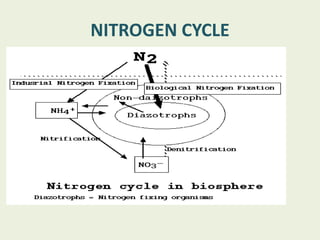
NITROGEN CYCLE
• THANKS

Azotobacter beneficial microbes

  • 1.
    Azotobacter : BeneficialMicrobes Presented by: Khushbu’s Microbiology
  • 2.
    Genus of usuallymotile  Oval or spherical bacteria  Thick-walled cysts  May produce large quantities of capsular slime. Azotobacter species cells: stained with Heidenhain's iron hematoxylin, ×1000 Azotobacter
  • 3.
    Description  Genus offree-living diastrophic bacteria whose resting stage is a cyst.  It is primarily found in neutral to alkaline soils,  Aquatic environments, and on some plants.  IMAGE : Azotobacter cyst.
  • 4.
    Significance  It hasseveral metabolic capabilities : including atmospheric nitrogen fixation by conversion to ammonia.  Their unique system of three distinct nitrogenase enzymes makes these bacteria of particular interest to scientists, who may work toward a better understanding of nitrogen fixation and its role in agriculture.  Azotobacter spp: the highest metabolic rate of any organisms.
  • 5.
    Advantages of Azotobacter: Heaviest breathing organism and requires a large amount of organic carbon for its growth.  Competitor for nutrients in soil  Growth promoting substances  Fungistatic substances.
  • 6.
    Nitrogen fixation • Azotobacterspecies are free-living, nitrogen- fixing bacteria; in contrast to Rhizobium species, • They normally fix molecular nitrogen from the atmosphere without symbiotic relations with plants, some Azotobacter species are associated with plants. • Nitrogen fixation is inhibited in the presence of available nitrogen sources, such as ammonium ions and nitrates.
  • 7.
    Nitrogen fixation Azotobacter specieshave a full range of enzymes needed to perform the nitrogen fixation:  ferredoxin,  hydrogenase,  important enzyme nitrogenase. The process of nitrogen fixation requires an influx of energy in the form of adenosine triphosphate
  • 8.
  • 9.