Actinomyces
Presented By :
Khushbu’s Microbiology
Actinomyces:
Genus of the actinobacteria
 Prokaryotic organisms :
 Classified as bacteria,
but are unique enough
to be discussed as an individual
group.
Micrograph of actinomycosis,
Gram stain
Actinomyces:
Genus of the actinobacteria
 Genus of the actinobacteria class of bacteria.
 Gram-positive
 Facultatively anaerobic
 Except A.Meyeri & A. Israelii
: obligate anaerobe
 Grow best under anaerobic conditions.
PROPERTIES
Actinomyces : species may form endospores,
Individual bacteria : rod shaped,
 Actinomyces colonies : form fungus-like
branched networks of hyphae.
 The aspect of these colonies initially led to
the incorrect assumption that the organism
was a fungus and to the name actinomyces,
"ray fungus" :from greek actis, ray, beam
and mykes, fungus.
Actinomyces
Actinomyces
Scientific classification
Domain: Bacteria
Phylum: Actinobacteria
Class: Actinobacteria
Order: Actinomycetales
Family: Actinomycetaceae
Genus: Actinomyces
Harz 1877
Scanning electron
micrograph of
Actinomyces israelii
life cycle of sporulating actinomycetes
• Order Actinomycetales
• Any member of a heterogeneous group of gram-
positive
• Generally anaerobic bacteria noted for a
filamentous and branching growth pattern that
results, in most forms, in an extensive colony, or
mycelium.
• The mycelium in some species may break apart
to form rod- or coccoid-shaped forms.
Actinomycete
• Order Actinomycetales
• Any member of a heterogeneous group of gram-
positive
• Generally anaerobic bacteria noted for a
filamentous and branching growth pattern that
results, in most forms, in an extensive colony, or
mycelium.
• The mycelium in some species may break apart
to form rod- or coccoid-shaped forms.
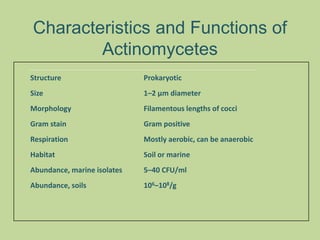
Characteristics and Functions of
Actinomycetes
Structure Prokaryotic
Size 1–2 μm diameter
Morphology Filamentous lengths of cocci
Gram stain Gram positive
Respiration Mostly aerobic, can be anaerobic
Habitat Soil or marine
Abundance, marine isolates 5–40 CFU/ml
Abundance, soils 106–108/g
• THANKS :

Actinomyces

  • 1.
  • 2.
    Actinomyces: Genus of theactinobacteria  Prokaryotic organisms :  Classified as bacteria, but are unique enough to be discussed as an individual group. Micrograph of actinomycosis, Gram stain
  • 3.
    Actinomyces: Genus of theactinobacteria  Genus of the actinobacteria class of bacteria.  Gram-positive  Facultatively anaerobic  Except A.Meyeri & A. Israelii : obligate anaerobe  Grow best under anaerobic conditions.
  • 4.
    PROPERTIES Actinomyces : speciesmay form endospores, Individual bacteria : rod shaped,  Actinomyces colonies : form fungus-like branched networks of hyphae.  The aspect of these colonies initially led to the incorrect assumption that the organism was a fungus and to the name actinomyces, "ray fungus" :from greek actis, ray, beam and mykes, fungus.
  • 5.
    Actinomyces Actinomyces Scientific classification Domain: Bacteria Phylum:Actinobacteria Class: Actinobacteria Order: Actinomycetales Family: Actinomycetaceae Genus: Actinomyces Harz 1877 Scanning electron micrograph of Actinomyces israelii
  • 6.
    life cycle ofsporulating actinomycetes • Order Actinomycetales • Any member of a heterogeneous group of gram- positive • Generally anaerobic bacteria noted for a filamentous and branching growth pattern that results, in most forms, in an extensive colony, or mycelium. • The mycelium in some species may break apart to form rod- or coccoid-shaped forms.
  • 7.
    Actinomycete • Order Actinomycetales •Any member of a heterogeneous group of gram- positive • Generally anaerobic bacteria noted for a filamentous and branching growth pattern that results, in most forms, in an extensive colony, or mycelium. • The mycelium in some species may break apart to form rod- or coccoid-shaped forms.
  • 8.
    Characteristics and Functionsof Actinomycetes Structure Prokaryotic Size 1–2 μm diameter Morphology Filamentous lengths of cocci Gram stain Gram positive Respiration Mostly aerobic, can be anaerobic Habitat Soil or marine Abundance, marine isolates 5–40 CFU/ml Abundance, soils 106–108/g
  • 9.