FUNDAMENTALS OF SOIL
SCIENCE (2+1)
SOIL MOISTURE
CONSTANTS
BY TO
BASKAR S Dr.RAJAKUMAR R
BATCH-’A’ Asst.Prof.
CB.AG.U4AGR19018 19SAC111
SOIL MOISTURE
Soil moisture is the water or moisture content stored
in the soil and it is affected by precipitation,
temperature and soil characteristics (texture &
structure).
Soil moisture held in the spaces (pores) between the
soil particles.
SOIL – WATER RELATIONSHIP
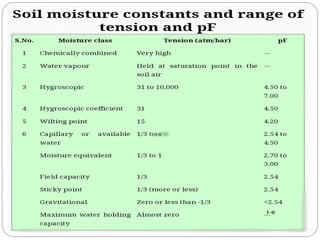
SOIL MOISTURE CONSTANTS
The amount of water that a soil contains at each of
the equilibrium points (hygroscopic coefficient,
capillary point) is known as soil moisture constant.
It represents definite soil moisture relationship and
retention of soil moisture in field.
Soil moisture constants are the reference point for
irrigation water management.
Based on soil characteristics, it will differ.
FIVE SOIL MOISTURE
CONSTANTS
Field capacity
Permanent wilting point
Hygroscopic coefficient
Available water capacity
Maximum water holding capacity
FIELD CAPACITY
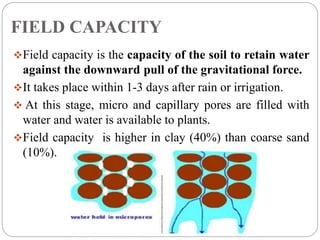
Field capacity is the capacity of the soil to retain water
against the downward pull of the gravitational force.
It takes place within 1-3 days after rain or irrigation.
 At this stage, micro and capillary pores are filled with
water and water is available to plants.
Field capacity is higher in clay (40%) than coarse sand
(10%).
DETERMINATION OF FIELD
CAPACITY
It is determined by ponding water over the area of 2-
5m2 for 2-3 days ( spreading polythene sheet on straw
mulch over surface prevents evaporation).
As a thumb rule, 1 day of drainage will be adequate for
sandy soil, 2 days for silt loam soils & 3 days for clay
loam soils.
It is also known as maximum capillary capacity.
At this stage, water is held with a force of 0.33 atm.
It is the upper limit of hygroscopic coefficient.
PERMANENT WILTING POINT
Permanent wilting point is considered as lower limit of
available soil moisture.
The stage at which plants start wilting for want of
water is termed as wilting point.
The percentage amount of water held by the soil at this
stage is known as wilting coefficient.
It is the point at which soil is unable supply water to
plants.
At this point, water is held with a force of 15 atm.
HYGROSCOPIC COEFFECIENT
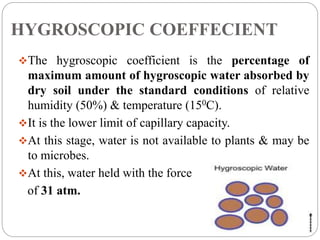
The hygroscopic coefficient is the percentage of
maximum amount of hygroscopic water absorbed by
dry soil under the standard conditions of relative
humidity (50%) & temperature (150C).
It is the lower limit of capillary capacity.
At this stage, water is not available to plants & may be
to microbes.
At this, water held with the force
of 31 atm.
AVAILABLE WATER CAPACITY
Available soil moisture is the amount of water
required to apply to soil at the wilting point to
reach the field capacity.
The available water is the difference in amount of
water in field capacity (0.33 bars) and permanent
wilting point (15 bars).
The available soil moisture is expressed as depth per
unit of soil.
FORMULA
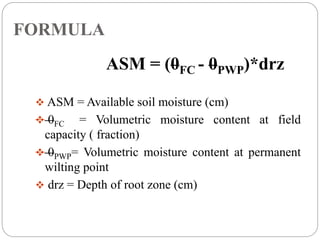
ASM = (0FC - 0PWP)*drz
 ASM = Available soil moisture (cm)
 0FC = Volumetric moisture content at field
capacity ( fraction)
 0PWP= Volumetric moisture content at permanent
wilting point
 drz = Depth of root zone (cm)
MAXIMUM WATER RETENION
CAPACITY
It refers to the condition when all the macro and
micro pores are completely filled with water.
At this stage, soil is at maximum water retention
capacity.
It is also known as saturation capacity or maximum
retentive capacity.
Soil moisture tension is very low between 1/100 to
1/1000 (almost zero) and equal to free water surface.
It is the measure of total pore space of soil.
REFERENCES
https://www.srs.fs.fed.us/pubs/osp/op_se166.pdf
http://daad.wb.tu-harburg.de/?id=298
http://ecoursesonline.iasri.res.in
https://www.earthsciweek.org
https://www.tankonyvtar.hu
THANK YOU

Soil moisture constants

  • 1.
    FUNDAMENTALS OF SOIL SCIENCE(2+1) SOIL MOISTURE CONSTANTS BY TO BASKAR S Dr.RAJAKUMAR R BATCH-’A’ Asst.Prof. CB.AG.U4AGR19018 19SAC111
  • 2.
    SOIL MOISTURE Soil moistureis the water or moisture content stored in the soil and it is affected by precipitation, temperature and soil characteristics (texture & structure). Soil moisture held in the spaces (pores) between the soil particles.
  • 3.
    SOIL – WATERRELATIONSHIP
  • 4.
    SOIL MOISTURE CONSTANTS Theamount of water that a soil contains at each of the equilibrium points (hygroscopic coefficient, capillary point) is known as soil moisture constant. It represents definite soil moisture relationship and retention of soil moisture in field. Soil moisture constants are the reference point for irrigation water management. Based on soil characteristics, it will differ.
  • 5.
    FIVE SOIL MOISTURE CONSTANTS Fieldcapacity Permanent wilting point Hygroscopic coefficient Available water capacity Maximum water holding capacity
  • 6.
    FIELD CAPACITY Field capacityis the capacity of the soil to retain water against the downward pull of the gravitational force. It takes place within 1-3 days after rain or irrigation.  At this stage, micro and capillary pores are filled with water and water is available to plants. Field capacity is higher in clay (40%) than coarse sand (10%).
  • 7.
    DETERMINATION OF FIELD CAPACITY Itis determined by ponding water over the area of 2- 5m2 for 2-3 days ( spreading polythene sheet on straw mulch over surface prevents evaporation). As a thumb rule, 1 day of drainage will be adequate for sandy soil, 2 days for silt loam soils & 3 days for clay loam soils. It is also known as maximum capillary capacity. At this stage, water is held with a force of 0.33 atm. It is the upper limit of hygroscopic coefficient.
  • 8.
    PERMANENT WILTING POINT Permanentwilting point is considered as lower limit of available soil moisture. The stage at which plants start wilting for want of water is termed as wilting point. The percentage amount of water held by the soil at this stage is known as wilting coefficient. It is the point at which soil is unable supply water to plants. At this point, water is held with a force of 15 atm.
  • 9.
    HYGROSCOPIC COEFFECIENT The hygroscopiccoefficient is the percentage of maximum amount of hygroscopic water absorbed by dry soil under the standard conditions of relative humidity (50%) & temperature (150C). It is the lower limit of capillary capacity. At this stage, water is not available to plants & may be to microbes. At this, water held with the force of 31 atm.
  • 10.
    AVAILABLE WATER CAPACITY Availablesoil moisture is the amount of water required to apply to soil at the wilting point to reach the field capacity. The available water is the difference in amount of water in field capacity (0.33 bars) and permanent wilting point (15 bars). The available soil moisture is expressed as depth per unit of soil.
  • 11.
    FORMULA ASM = (0FC- 0PWP)*drz  ASM = Available soil moisture (cm)  0FC = Volumetric moisture content at field capacity ( fraction)  0PWP= Volumetric moisture content at permanent wilting point  drz = Depth of root zone (cm)
  • 12.
    MAXIMUM WATER RETENION CAPACITY Itrefers to the condition when all the macro and micro pores are completely filled with water. At this stage, soil is at maximum water retention capacity. It is also known as saturation capacity or maximum retentive capacity. Soil moisture tension is very low between 1/100 to 1/1000 (almost zero) and equal to free water surface. It is the measure of total pore space of soil.
  • 14.
  • 15.