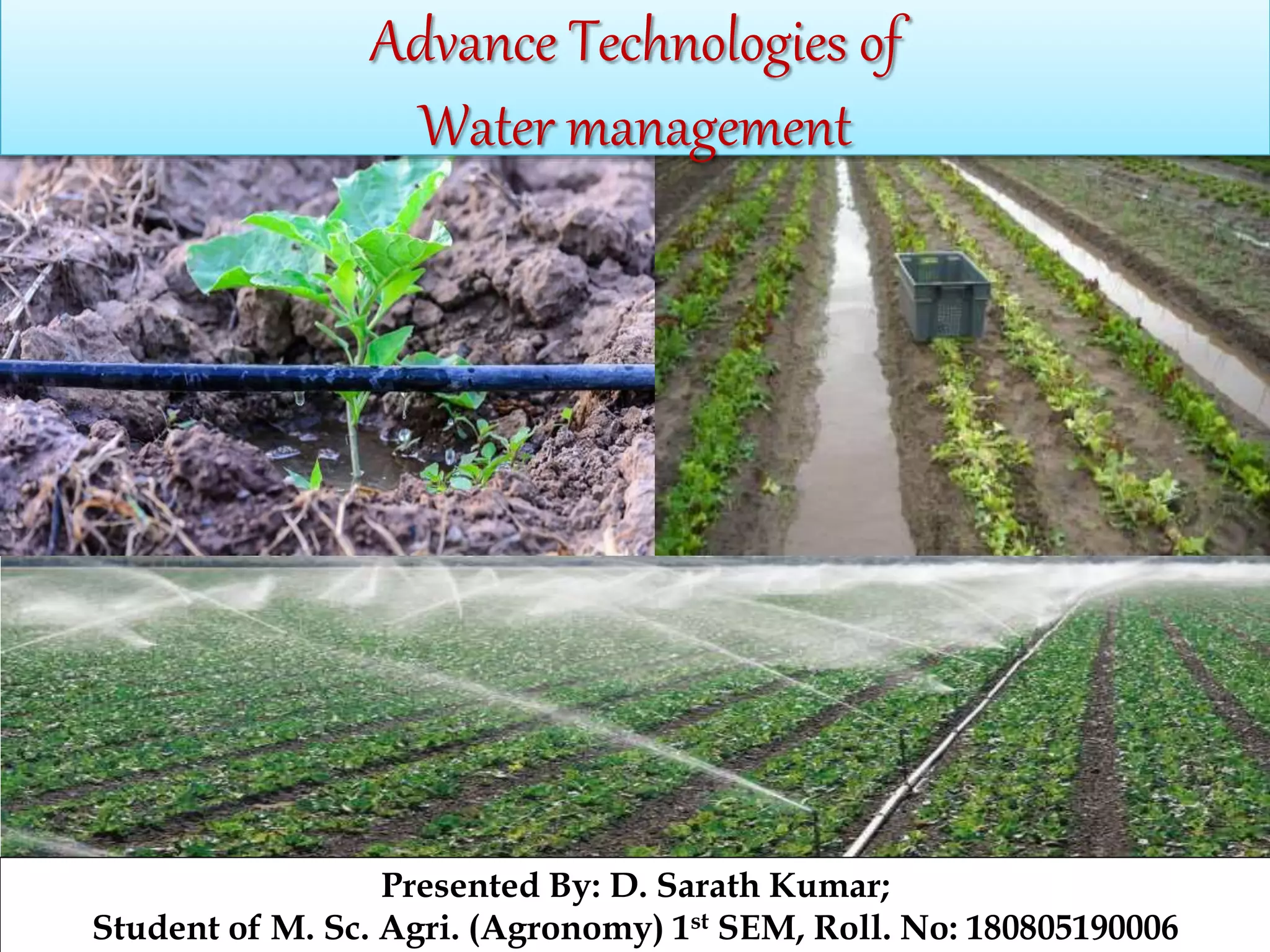
Advance Technologies of
Water management
Presented By: D. Sarath Kumar;
Student of M. Sc. Agri. (Agronomy) 1st SEM, Roll. No: 180805190006
Introduction
• Present day conventional method of rice cultivation utilizes 5,000 liters of
water for producing one kg of rice than its actual requirement of 3,000
liters.
• About 2,000 liters is lost due to flooding and seepage losses.
• Further, decline in water table necessitates the need for improved water-use
efficiency and water productivity in agriculture, particularly in rice
cultivation.
• Thus, new approach of different water management methods are
developed.
Broad Bed Furrow System
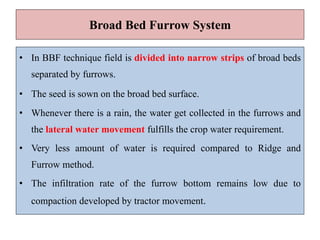
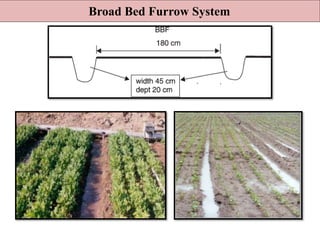
• In BBF technique field is divided into narrow strips of broad beds
separated by furrows.
• The seed is sown on the broad bed surface.
• Whenever there is a rain, the water get collected in the furrows and
the lateral water movement fulfills the crop water requirement.
• Very less amount of water is required compared to Ridge and
Furrow method.
• The infiltration rate of the furrow bottom remains low due to
compaction developed by tractor movement.
Broad Bed Furrow System
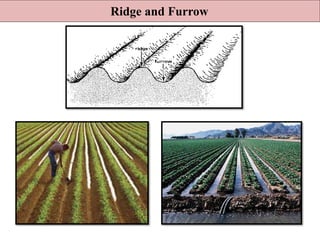
Ridge and Furrow
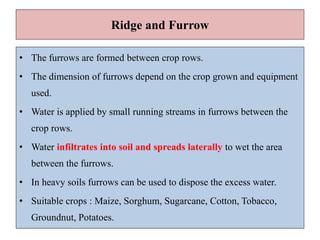
• The furrows are formed between crop rows.
• The dimension of furrows depend on the crop grown and equipment
used.
• Water is applied by small running streams in furrows between the
crop rows.
• Water infiltrates into soil and spreads laterally to wet the area
between the furrows.
• In heavy soils furrows can be used to dispose the excess water.
• Suitable crops : Maize, Sorghum, Sugarcane, Cotton, Tobacco,
Groundnut, Potatoes.
Ridge and Furrow
Water Management in SRI
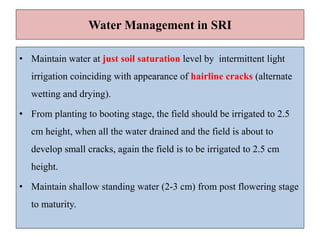
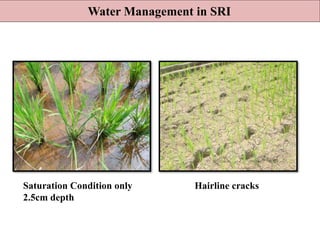
• Maintain water at just soil saturation level by intermittent light
irrigation coinciding with appearance of hairline cracks (alternate
wetting and drying).
• From planting to booting stage, the field should be irrigated to 2.5
cm height, when all the water drained and the field is about to
develop small cracks, again the field is to be irrigated to 2.5 cm
height.
• Maintain shallow standing water (2-3 cm) from post flowering stage
to maturity.
Water Management in SRI
Hairline cracksSaturation Condition only
2.5cm depth
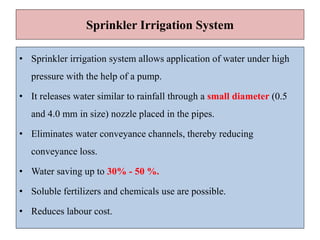
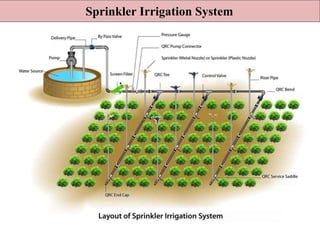
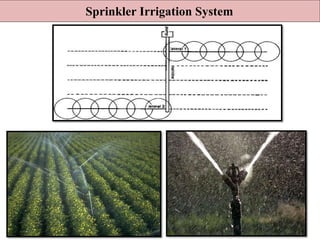
Sprinkler Irrigation System
• Sprinkler irrigation system allows application of water under high
pressure with the help of a pump.
• It releases water similar to rainfall through a small diameter (0.5
and 4.0 mm in size) nozzle placed in the pipes.
• Eliminates water conveyance channels, thereby reducing
conveyance loss.
• Water saving up to 30% - 50 %.
• Soluble fertilizers and chemicals use are possible.
• Reduces labour cost.
Sprinkler Irrigation System
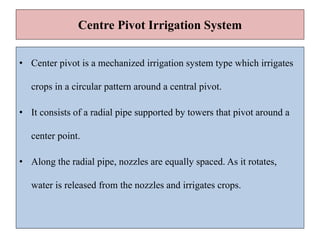
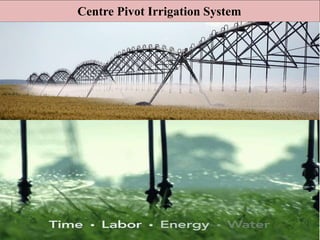
Centre Pivot Irrigation System
• Center pivot is a mechanized irrigation system type which irrigates
crops in a circular pattern around a central pivot.
• It consists of a radial pipe supported by towers that pivot around a
center point.
• Along the radial pipe, nozzles are equally spaced. As it rotates,
water is released from the nozzles and irrigates crops.
Centre Pivot Irrigation System
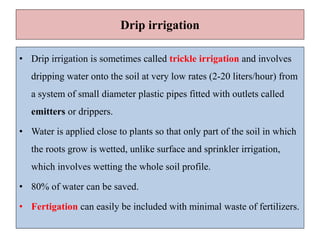
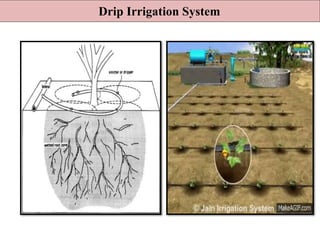
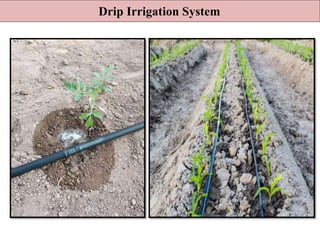
Drip irrigation
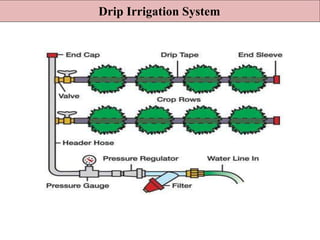
• Drip irrigation is sometimes called trickle irrigation and involves
dripping water onto the soil at very low rates (2-20 liters/hour) from
a system of small diameter plastic pipes fitted with outlets called
emitters or drippers.
• Water is applied close to plants so that only part of the soil in which
the roots grow is wetted, unlike surface and sprinkler irrigation,
which involves wetting the whole soil profile.
• 80% of water can be saved.
• Fertigation can easily be included with minimal waste of fertilizers.
Drip Irrigation System
Other Irrigations
• Misting and Fogging: Flow rate is 10-30 lit/hour and 3.5 to 10
kg/cm2 pressure.
• Pop-up Sprinkler:
• Set Move Irrigation:
• Sub-surface irrigation:

Advanced irrigation techomolgies techonolgies

  • 1.
    Advance Technologies of Watermanagement Presented By: D. Sarath Kumar; Student of M. Sc. Agri. (Agronomy) 1st SEM, Roll. No: 180805190006
  • 2.
    Introduction • Present dayconventional method of rice cultivation utilizes 5,000 liters of water for producing one kg of rice than its actual requirement of 3,000 liters. • About 2,000 liters is lost due to flooding and seepage losses. • Further, decline in water table necessitates the need for improved water-use efficiency and water productivity in agriculture, particularly in rice cultivation. • Thus, new approach of different water management methods are developed.
  • 3.
    Broad Bed FurrowSystem • In BBF technique field is divided into narrow strips of broad beds separated by furrows. • The seed is sown on the broad bed surface. • Whenever there is a rain, the water get collected in the furrows and the lateral water movement fulfills the crop water requirement. • Very less amount of water is required compared to Ridge and Furrow method. • The infiltration rate of the furrow bottom remains low due to compaction developed by tractor movement.
  • 4.
  • 5.
    Ridge and Furrow •The furrows are formed between crop rows. • The dimension of furrows depend on the crop grown and equipment used. • Water is applied by small running streams in furrows between the crop rows. • Water infiltrates into soil and spreads laterally to wet the area between the furrows. • In heavy soils furrows can be used to dispose the excess water. • Suitable crops : Maize, Sorghum, Sugarcane, Cotton, Tobacco, Groundnut, Potatoes.
  • 6.
  • 7.
    Water Management inSRI • Maintain water at just soil saturation level by intermittent light irrigation coinciding with appearance of hairline cracks (alternate wetting and drying). • From planting to booting stage, the field should be irrigated to 2.5 cm height, when all the water drained and the field is about to develop small cracks, again the field is to be irrigated to 2.5 cm height. • Maintain shallow standing water (2-3 cm) from post flowering stage to maturity.
  • 8.
    Water Management inSRI Hairline cracksSaturation Condition only 2.5cm depth
  • 9.
    Sprinkler Irrigation System •Sprinkler irrigation system allows application of water under high pressure with the help of a pump. • It releases water similar to rainfall through a small diameter (0.5 and 4.0 mm in size) nozzle placed in the pipes. • Eliminates water conveyance channels, thereby reducing conveyance loss. • Water saving up to 30% - 50 %. • Soluble fertilizers and chemicals use are possible. • Reduces labour cost.
  • 10.
  • 11.
  • 12.
    Centre Pivot IrrigationSystem • Center pivot is a mechanized irrigation system type which irrigates crops in a circular pattern around a central pivot. • It consists of a radial pipe supported by towers that pivot around a center point. • Along the radial pipe, nozzles are equally spaced. As it rotates, water is released from the nozzles and irrigates crops.
  • 13.
  • 14.
    Drip irrigation • Dripirrigation is sometimes called trickle irrigation and involves dripping water onto the soil at very low rates (2-20 liters/hour) from a system of small diameter plastic pipes fitted with outlets called emitters or drippers. • Water is applied close to plants so that only part of the soil in which the roots grow is wetted, unlike surface and sprinkler irrigation, which involves wetting the whole soil profile. • 80% of water can be saved. • Fertigation can easily be included with minimal waste of fertilizers.
  • 15.
  • 16.
  • 17.
  • 18.
    Other Irrigations • Mistingand Fogging: Flow rate is 10-30 lit/hour and 3.5 to 10 kg/cm2 pressure. • Pop-up Sprinkler: • Set Move Irrigation: • Sub-surface irrigation: