POINTS TO BE COVERED
 INTRODUCTION
 TYPES OF IRRIGATIONS
 PROBLEMS ON IRRIGATION SYSTEM
 TYPE OF AUTOMATION
 SOIL MOISTURE SENSOR
 CONTROL UNIT
 LITERATURE REVIEW
 ADVANTAGES
 CONCLUSION
INTRODUCTION
 Irrigation is the artificial application of water to
the land or soil.
 It is used to assist in the growing of agricultural
crops, maintenance of landscapes, and
revegetation of disturbed soils in dry areas and
during periods of inadequate rainfall.
 irrigation also has a few other uses in crop
production, which include protecting plants
against frost.
TYPES OF IRRIGATIONS
 Surface Irrigation
 Drip Irrigation
 Sprinkler Irrigation
PROBLEMS IN IRRIGATION
 Over Irrigation because of poor distribution
and management of waste water.
 Under Irrigation leads to increased soil salinity
with consequent buildup of toxic salt due to
evaporation.
 Farm Lands & Fields situated miles away from
your home. Extensive travel required,
sometimes several times in a day to start &
stop the irrigation water pumps.
 Land is more, we need more manpower.
TYPES OF AUTOMATION
A. Time Based System
It is based on the time.
B. Volume Based System
It is based on quantity/volume of water.
C. Sensor Based System
It is the moisture sensing system.
SOIL MOISTURE SENSOR
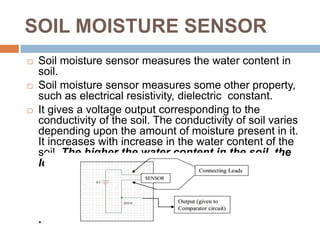
 Soil moisture sensor measures the water content in
soil.
 Soil moisture sensor measures some other property,
such as electrical resistivity, dielectric constant.
 It gives a voltage output corresponding to the
conductivity of the soil. The conductivity of soil varies
depending upon the amount of moisture present in it.
It increases with increase in the water content of the
soil. The higher the water content in the soil, the
lower the electrical resistance.
.
CONTROL UNIT
 The basic operation of control unit is the
controlling solenoid by microcontroller which is
defined by particular program.
 solenoid is connected with an output pin of
microcontroller via a relay circuit which is
connected with a transistor.
SOLENOID
 Electromagnetic device which produces a
magnetic field when electric current passed
through it.
 These are used mainly in opening and closing
of valves.
 Operation of valves is done using a relay
circuit.
RELAY CIRCUIT
 A relay is an electrical switch
that uses an electromagnet to
move the switch from the off
to on position instead of a
person moving the switch .
LITERATURE REVIEW
 Wireless application of drip irigation supported by
soil moisture sensors,volume 6(7)
Author Name - Mahir Dursun and Semih Ozden
Date - 4th april, 2011
In this study, a wireless data acquisition network was
implemented and applied to irrigate dwarf cherry trees.
The application of sensor-based site specific irrigation
has some advantages such as preventing moisture
stress of trees, diminishing of excessive waster usage.
ADVANTAGES
 This makes increase in productivity
 Reduces water consumption
 Reduces manpower
 Much land will be irrigated
CONCLUSION
 The Microcontroller based drip irrigation
system proves to be a real time
feedback control system which monitors and
controls all the activities of drip irrigation
system efficiently. The present proposal is a
model to modernize the agriculture industries
at a mass scale with optimum expenditure.
Using this system, one can save manpower,
water to improve production and ultimately
profit.
automated irrigation.pptx

automated irrigation.pptx

  • 1.
    POINTS TO BECOVERED  INTRODUCTION  TYPES OF IRRIGATIONS  PROBLEMS ON IRRIGATION SYSTEM  TYPE OF AUTOMATION  SOIL MOISTURE SENSOR  CONTROL UNIT  LITERATURE REVIEW  ADVANTAGES  CONCLUSION
  • 2.
    INTRODUCTION  Irrigation isthe artificial application of water to the land or soil.  It is used to assist in the growing of agricultural crops, maintenance of landscapes, and revegetation of disturbed soils in dry areas and during periods of inadequate rainfall.  irrigation also has a few other uses in crop production, which include protecting plants against frost.
  • 3.
    TYPES OF IRRIGATIONS Surface Irrigation  Drip Irrigation  Sprinkler Irrigation
  • 4.
    PROBLEMS IN IRRIGATION Over Irrigation because of poor distribution and management of waste water.  Under Irrigation leads to increased soil salinity with consequent buildup of toxic salt due to evaporation.  Farm Lands & Fields situated miles away from your home. Extensive travel required, sometimes several times in a day to start & stop the irrigation water pumps.  Land is more, we need more manpower.
  • 5.
    TYPES OF AUTOMATION A.Time Based System It is based on the time. B. Volume Based System It is based on quantity/volume of water. C. Sensor Based System It is the moisture sensing system.
  • 6.
    SOIL MOISTURE SENSOR Soil moisture sensor measures the water content in soil.  Soil moisture sensor measures some other property, such as electrical resistivity, dielectric constant.  It gives a voltage output corresponding to the conductivity of the soil. The conductivity of soil varies depending upon the amount of moisture present in it. It increases with increase in the water content of the soil. The higher the water content in the soil, the lower the electrical resistance. .
  • 7.
    CONTROL UNIT  Thebasic operation of control unit is the controlling solenoid by microcontroller which is defined by particular program.  solenoid is connected with an output pin of microcontroller via a relay circuit which is connected with a transistor.
  • 8.
    SOLENOID  Electromagnetic devicewhich produces a magnetic field when electric current passed through it.  These are used mainly in opening and closing of valves.  Operation of valves is done using a relay circuit.
  • 9.
    RELAY CIRCUIT  Arelay is an electrical switch that uses an electromagnet to move the switch from the off to on position instead of a person moving the switch .
  • 10.
    LITERATURE REVIEW  Wirelessapplication of drip irigation supported by soil moisture sensors,volume 6(7) Author Name - Mahir Dursun and Semih Ozden Date - 4th april, 2011 In this study, a wireless data acquisition network was implemented and applied to irrigate dwarf cherry trees. The application of sensor-based site specific irrigation has some advantages such as preventing moisture stress of trees, diminishing of excessive waster usage.
  • 11.
    ADVANTAGES  This makesincrease in productivity  Reduces water consumption  Reduces manpower  Much land will be irrigated
  • 12.
    CONCLUSION  The Microcontrollerbased drip irrigation system proves to be a real time feedback control system which monitors and controls all the activities of drip irrigation system efficiently. The present proposal is a model to modernize the agriculture industries at a mass scale with optimum expenditure. Using this system, one can save manpower, water to improve production and ultimately profit.