5/29/2017 1
Department Of Textile Engineering
Presentation On: Roving Frame
Prepared by: Temesggen Feleke
Msc. in Textile Manufacturing
Ethiopia
contents
introduction
objectives
operating sequence
operating regions of roving frame
production calculation
faults and causes in roving frame
recent developments in roving frame
5/29/2017 2
Introduction
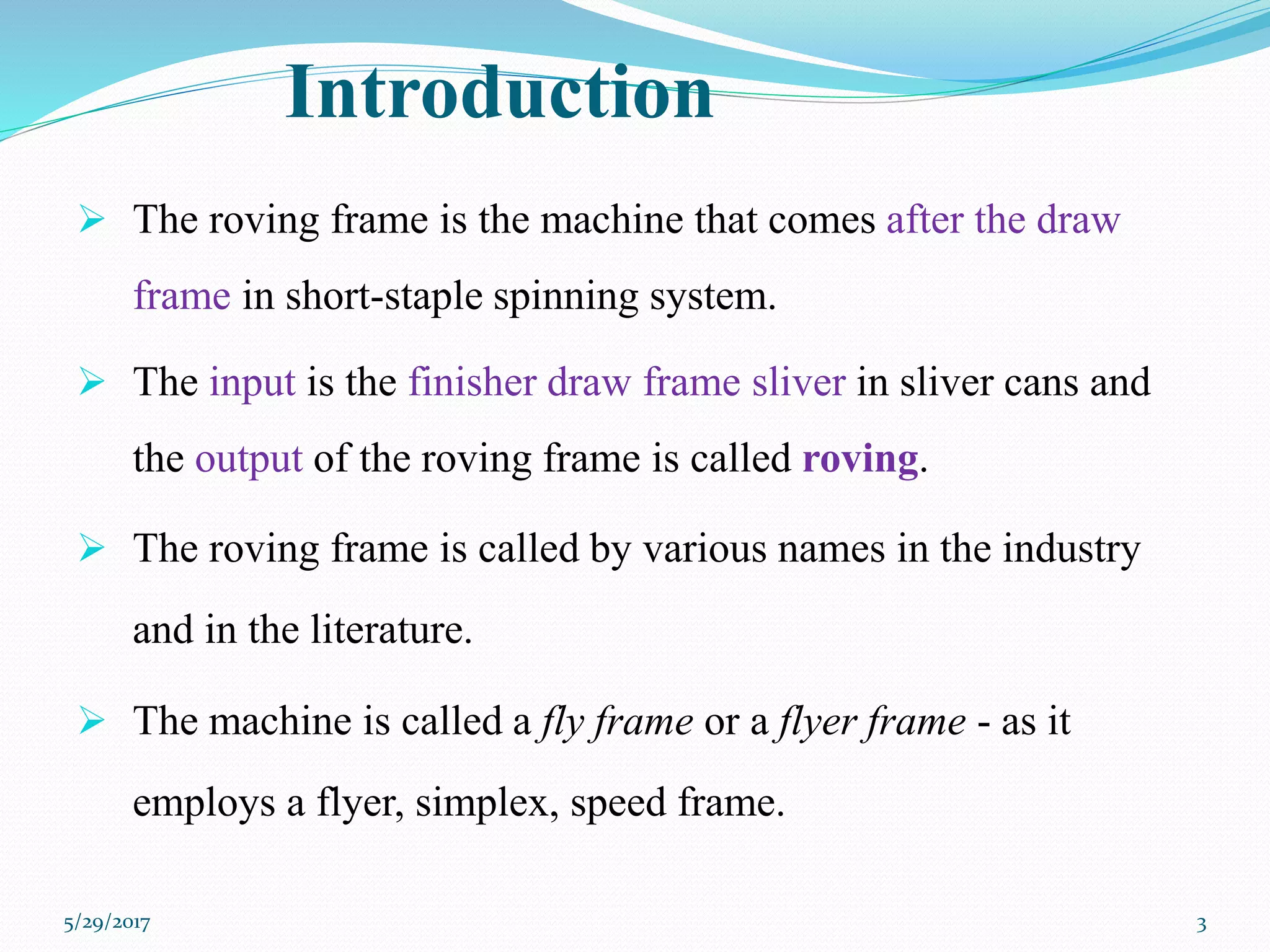
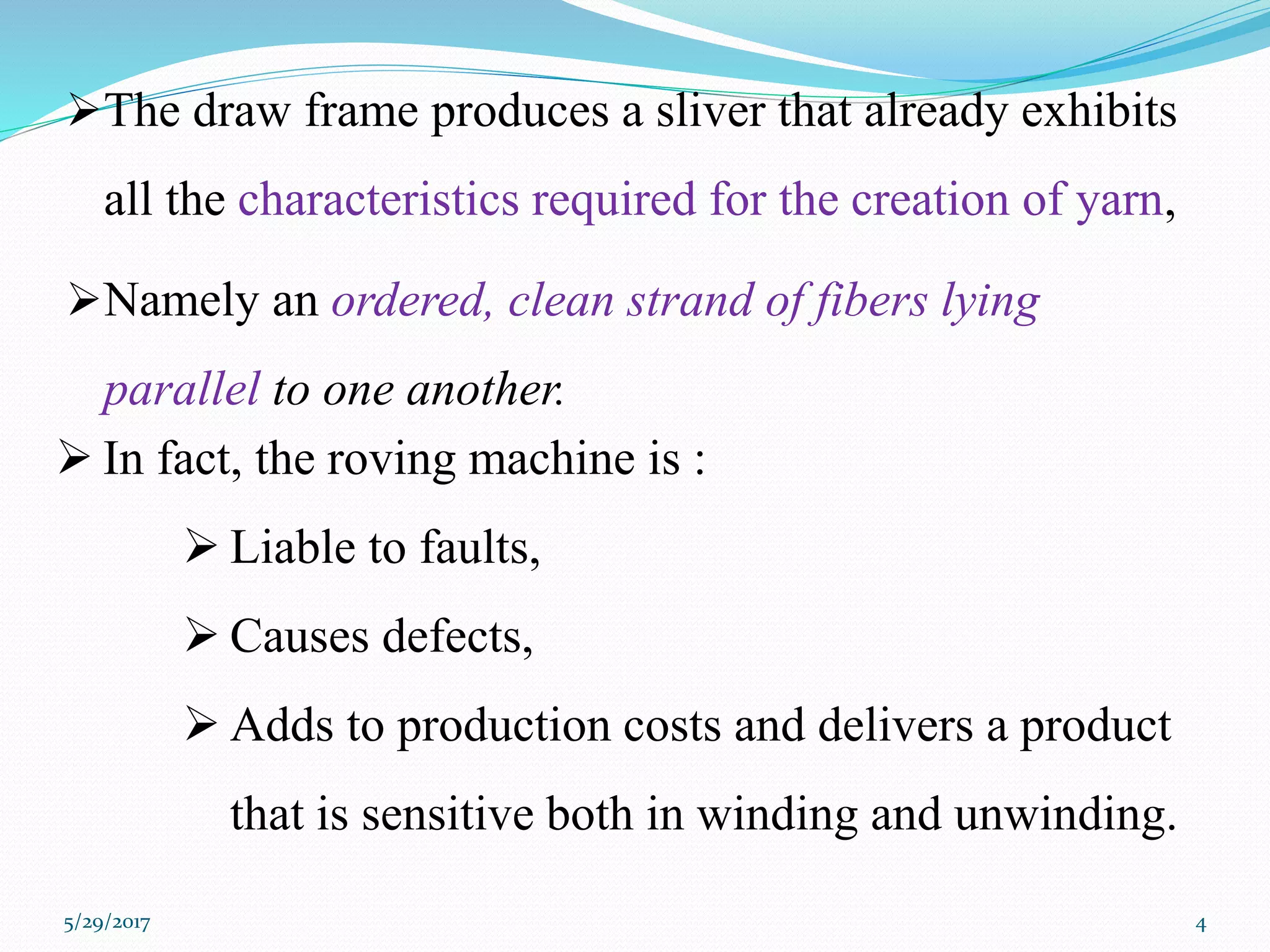
 The roving frame is the machine that comes after the draw
frame in short-staple spinning system.
 The input is the finisher draw frame sliver in sliver cans and
the output of the roving frame is called roving.
 The roving frame is called by various names in the industry
and in the literature.
 The machine is called a fly frame or a flyer frame - as it
employs a flyer, simplex, speed frame.
5/29/2017 3
The draw frame produces a sliver that already exhibits
all the characteristics required for the creation of yarn,
Namely an ordered, clean strand of fibers lying
parallel to one another.
 In fact, the roving machine is :
 Liable to faults,
 Causes defects,
 Adds to production costs and delivers a product
that is sensitive both in winding and unwinding.
5/29/2017 4
 Two principal reasons for the use of
roving frame are:
1) The required high draft in the ring frame (DT
= 300 – 500), and
2) Draw frame cans are not convenient for
transport and presentation of feed material to
the ring frame.
5/29/2017 5
Objectives of Roving frame
 To draft the sliver to a thin strand,
 To impart to the drafted strand a protective
twist and
 To wind the drafted and twisted roving
material onto a suitable package for further
use.
5/29/2017 6
Operating Sequence
The draw frame sliver cans are arranged in 4 or 6 rows in the
creel zone and the sliver from each can is fed to the drafting
system.
The drafting system drafts the sliver to a fine strand of
material ready for twisting.
The draft usually employed in fly frames ranges from 5 to 20.
Coarser roving need less and finer roving need higher drafts.
The delivered roving has a hank (or, count) in the range of
about 1s to 3s Ne.
5/29/2017 7
5/29/2017 8
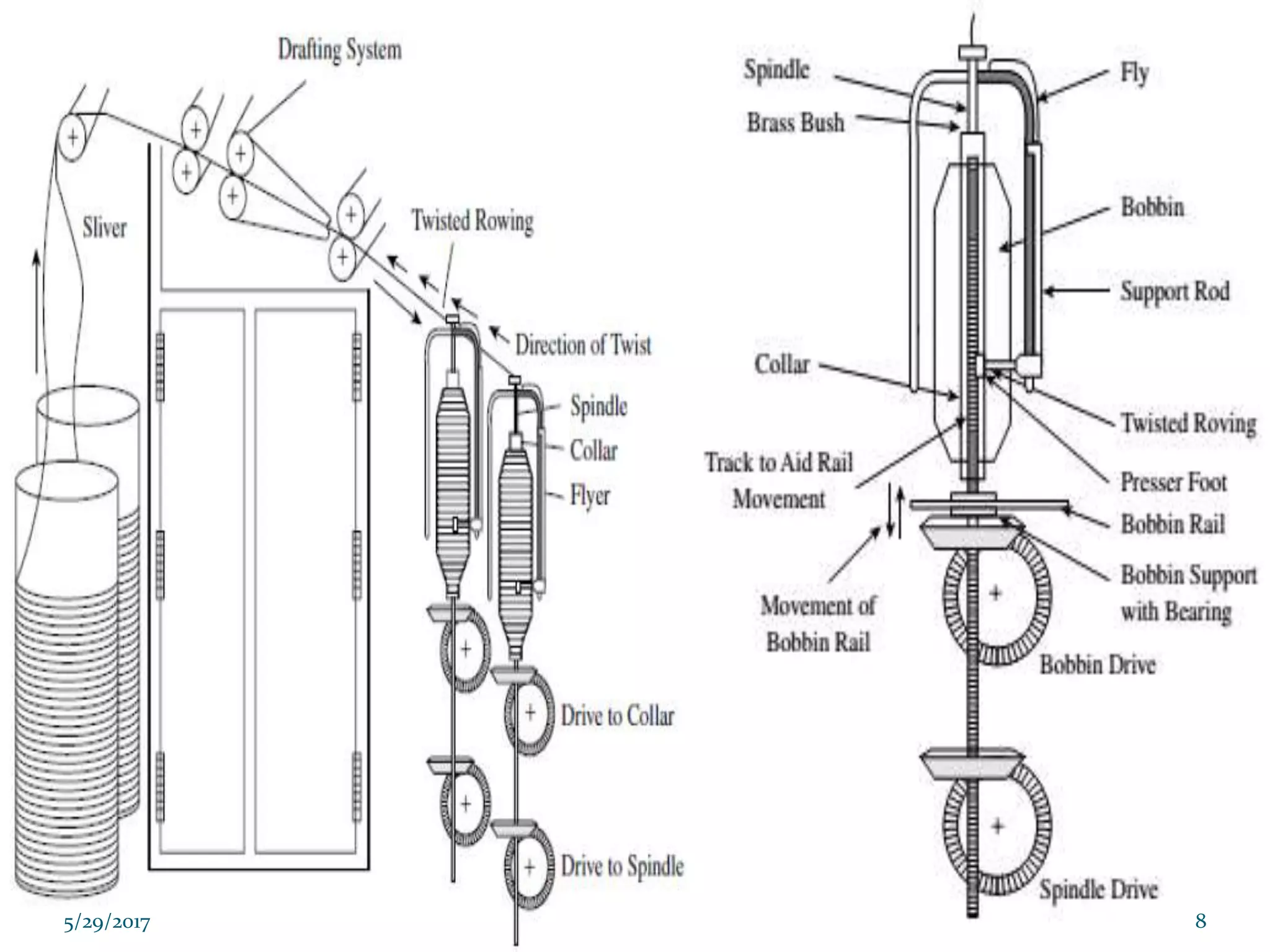
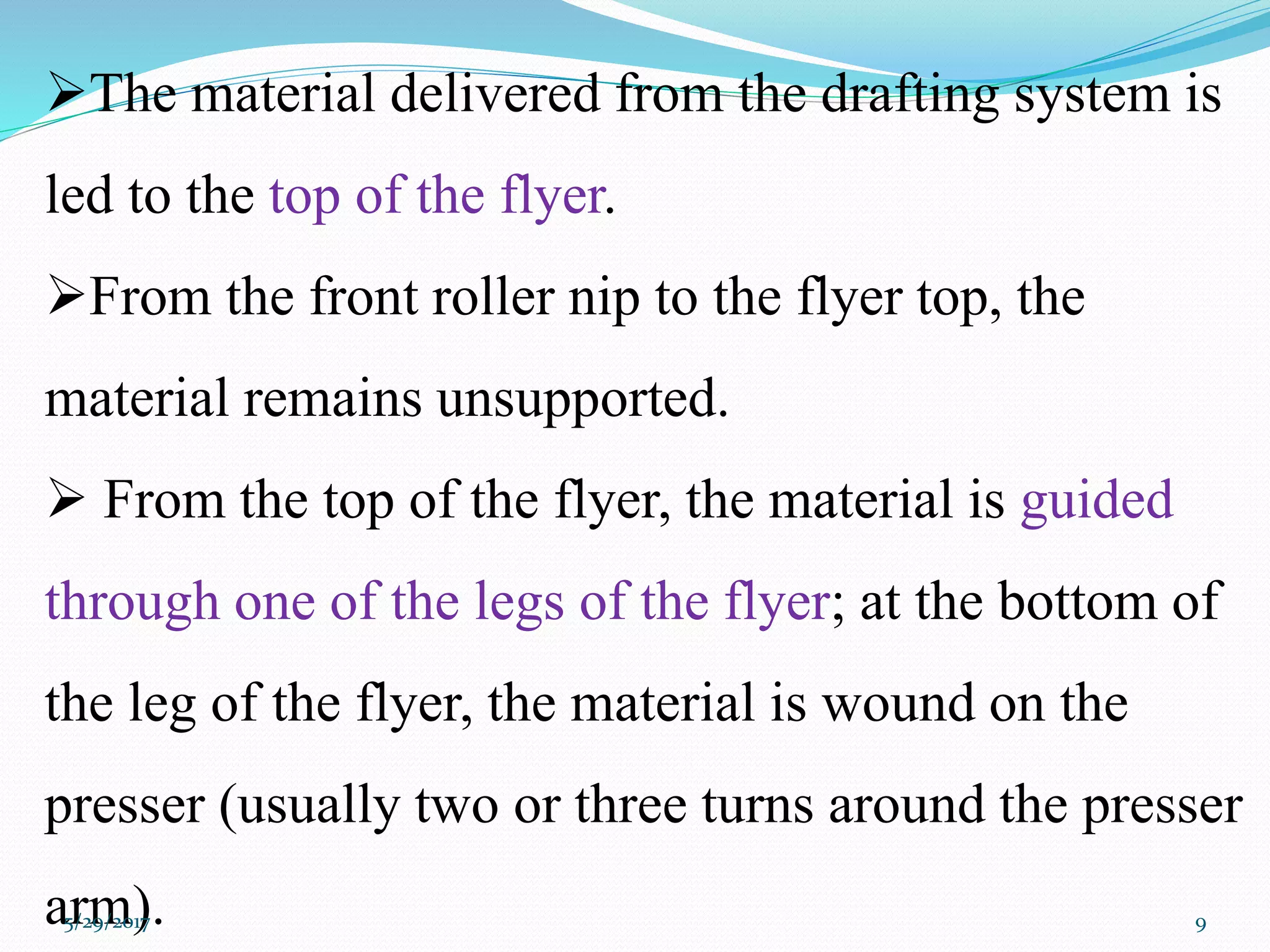
The material delivered from the drafting system is
led to the top of the flyer.
From the front roller nip to the flyer top, the
material remains unsupported.
 From the top of the flyer, the material is guided
through one of the legs of the flyer; at the bottom of
the leg of the flyer, the material is wound on the
presser (usually two or three turns around the presser
arm).5/29/2017 9
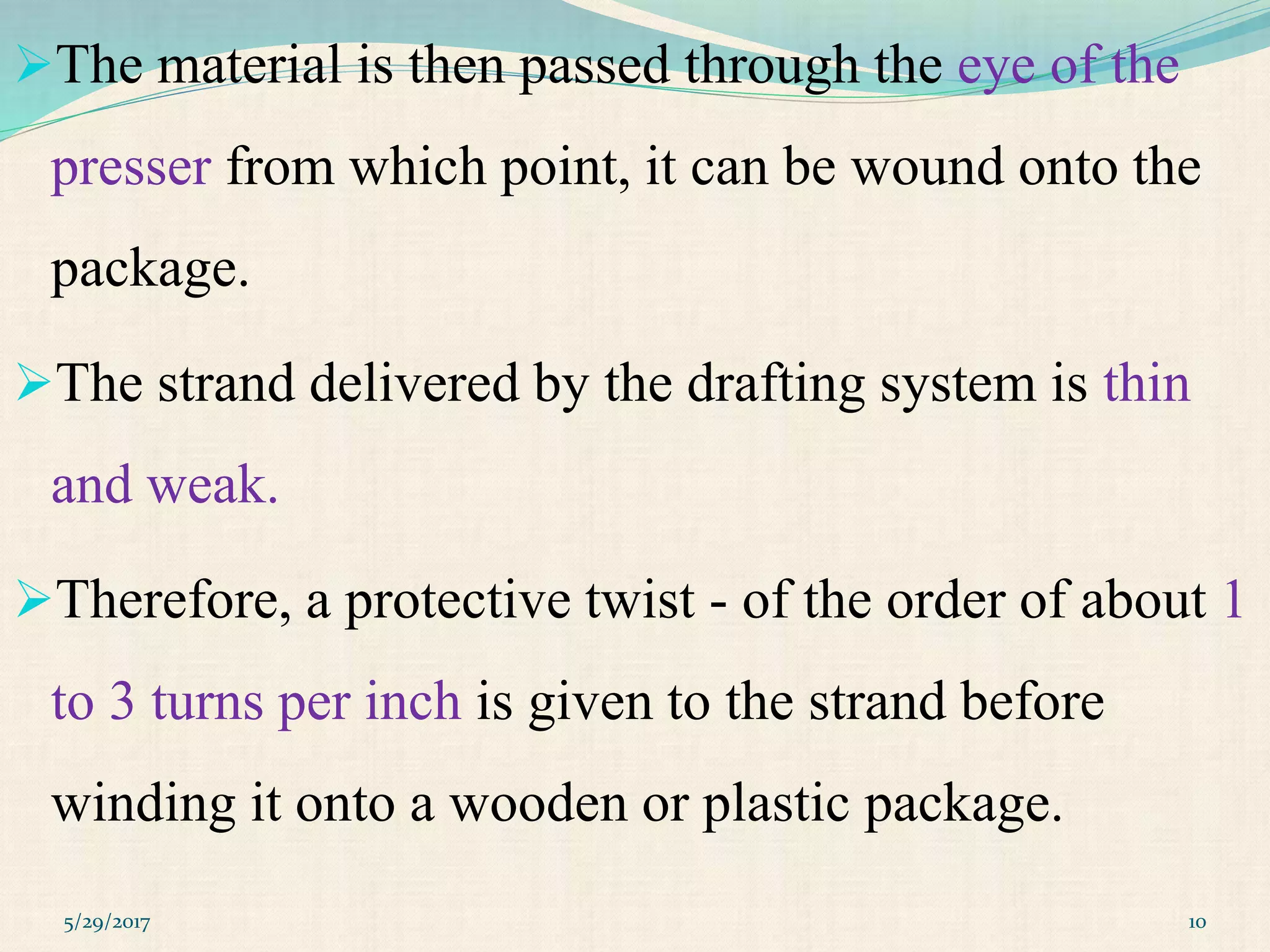
The material is then passed through the eye of the
presser from which point, it can be wound onto the
package.
The strand delivered by the drafting system is thin
and weak.
Therefore, a protective twist - of the order of about 1
to 3 turns per inch is given to the strand before
winding it onto a wooden or plastic package.
5/29/2017 10
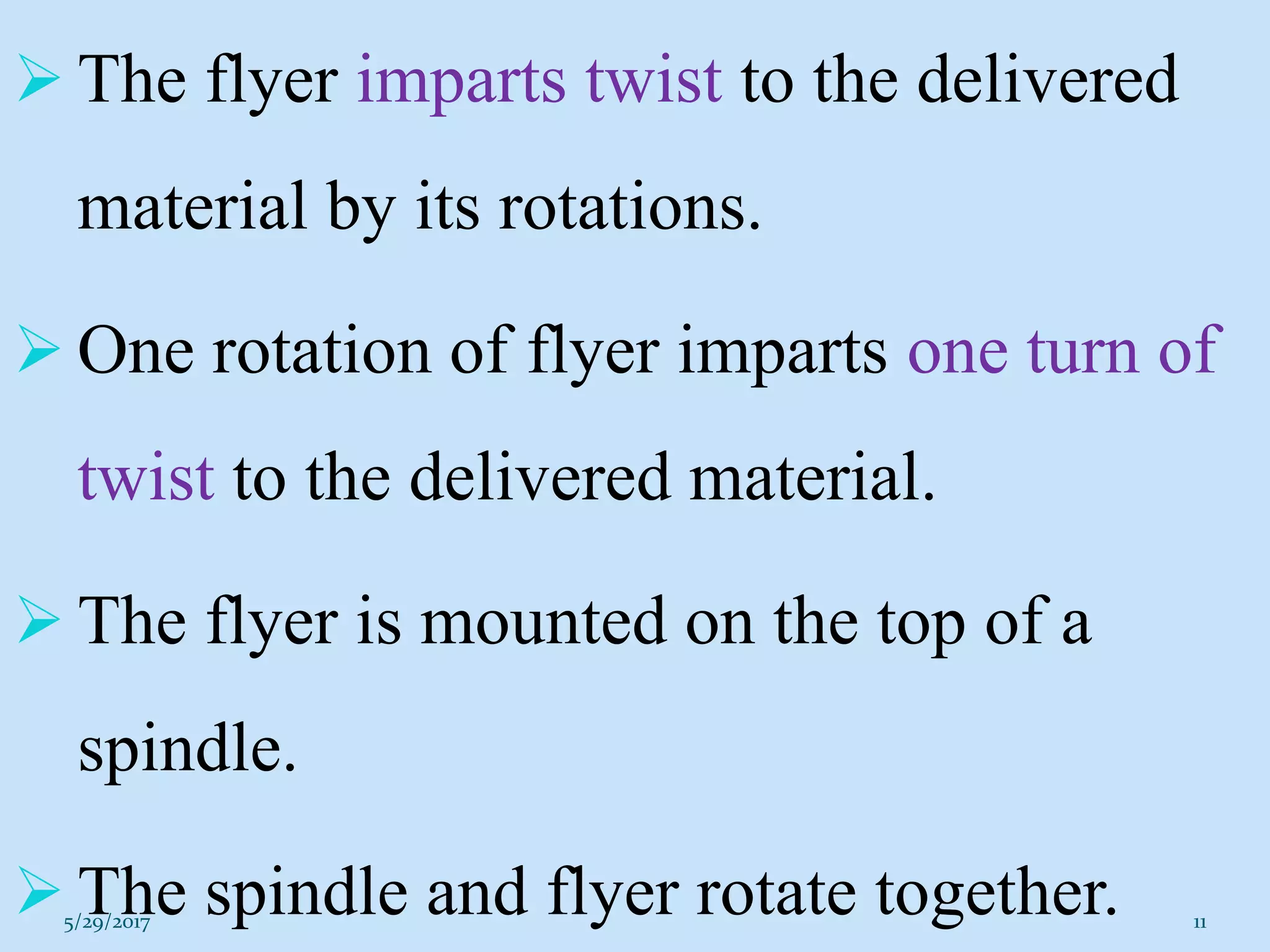
 The flyer imparts twist to the delivered
material by its rotations.
 One rotation of flyer imparts one turn of
twist to the delivered material.
 The flyer is mounted on the top of a
spindle.
 The spindle and flyer rotate together.5/29/2017 11
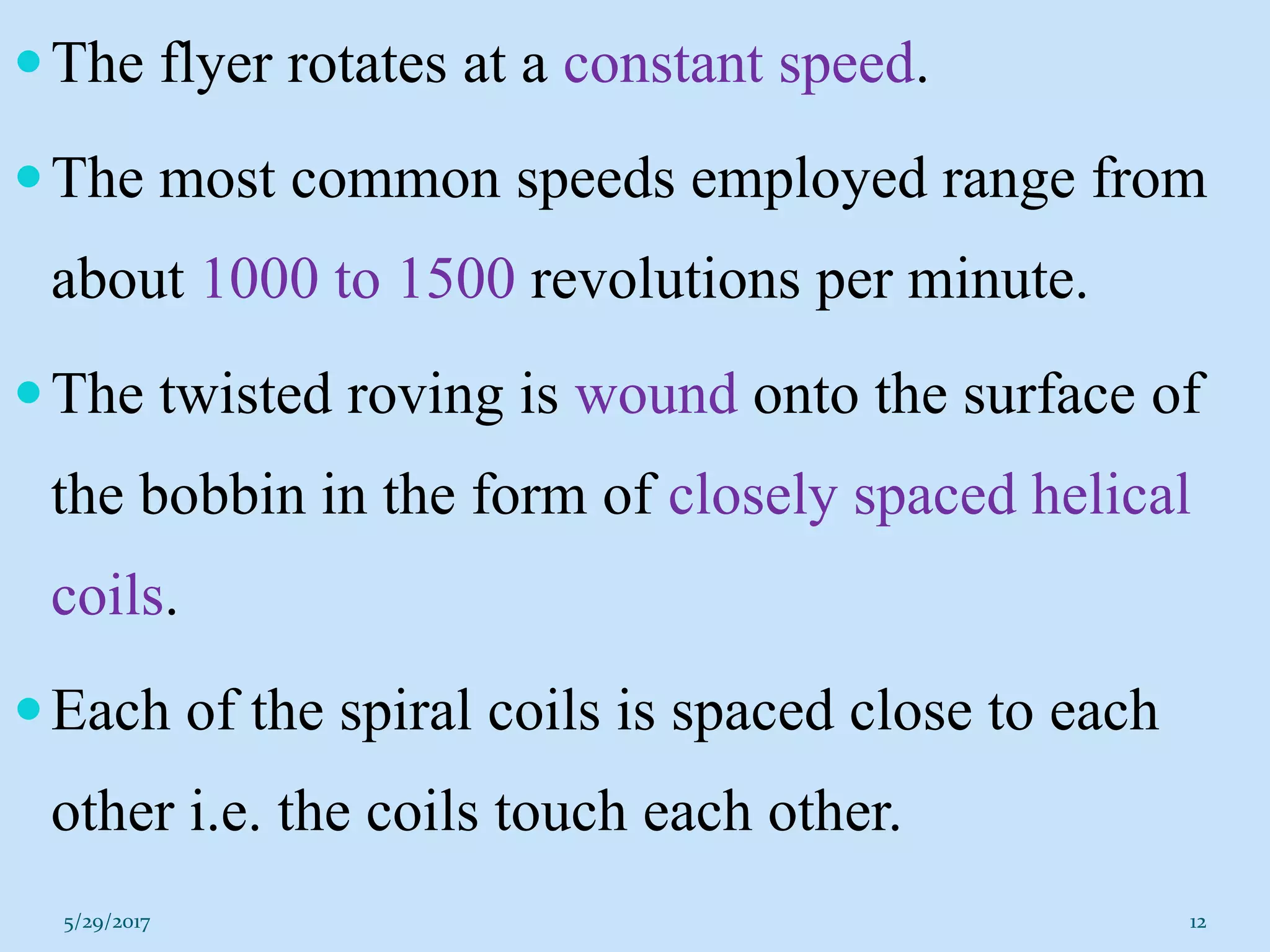
The flyer rotates at a constant speed.
The most common speeds employed range from
about 1000 to 1500 revolutions per minute.
The twisted roving is wound onto the surface of
the bobbin in the form of closely spaced helical
coils.
Each of the spiral coils is spaced close to each
other i.e. the coils touch each other.
5/29/2017 12
To effect winding in this manner, the roving
bobbin is moved up and down.
Once a layer of roving has been wound, the
direction of movement of the bobbin is
reversed and a fresh layer is wound over the
previous layer.
The process continues till the bobbin is full.
5/29/2017 13
 The bobbins and the associated driving gears are
placed in a bobbin rail; the spindle and the associated
driving gears are housed in the spindle rail.
 The spindle rail is stationary.
 The bobbin rail along with the bobbins moves
vertically up and down during the running of the
machine to enable winding of the material in
traverses.
5/29/2017 14
 To effect winding of material onto the bobbin, the bobbin
has a rotational speed which is equal to flyer speed plus the
additional rotations for winding.
 As each layer is completed, the diameter of the bobbin
increases.
 This would mean that the additional rotations required for
winding have to be reduced after the completion of each
layer.
 Note that the delivery rate from the drafting system remains
constant.
5/29/2017 15
Operating regions of the roving
frame
5/29/2017 16
The creel
 Above the cans there are several rows of driven rollers to
help the slivers on their way to the drafting arrangement.
5/29/2017 17
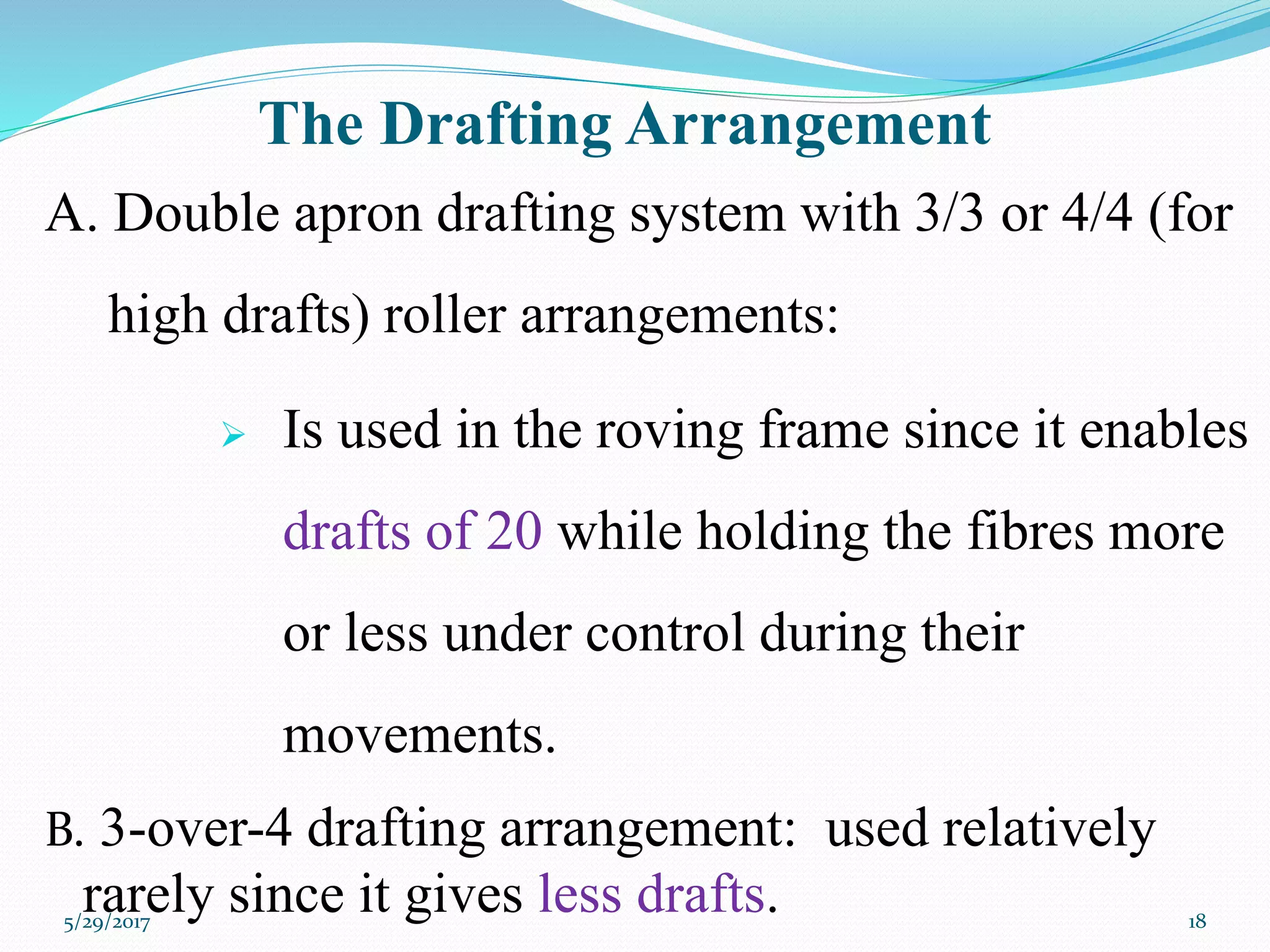
The Drafting Arrangement
A. Double apron drafting system with 3/3 or 4/4 (for
high drafts) roller arrangements:
 Is used in the roving frame since it enables
drafts of 20 while holding the fibres more
or less under control during their
movements.
B. 3-over-4 drafting arrangement: used relatively
rarely since it gives less drafts.5/29/2017 18
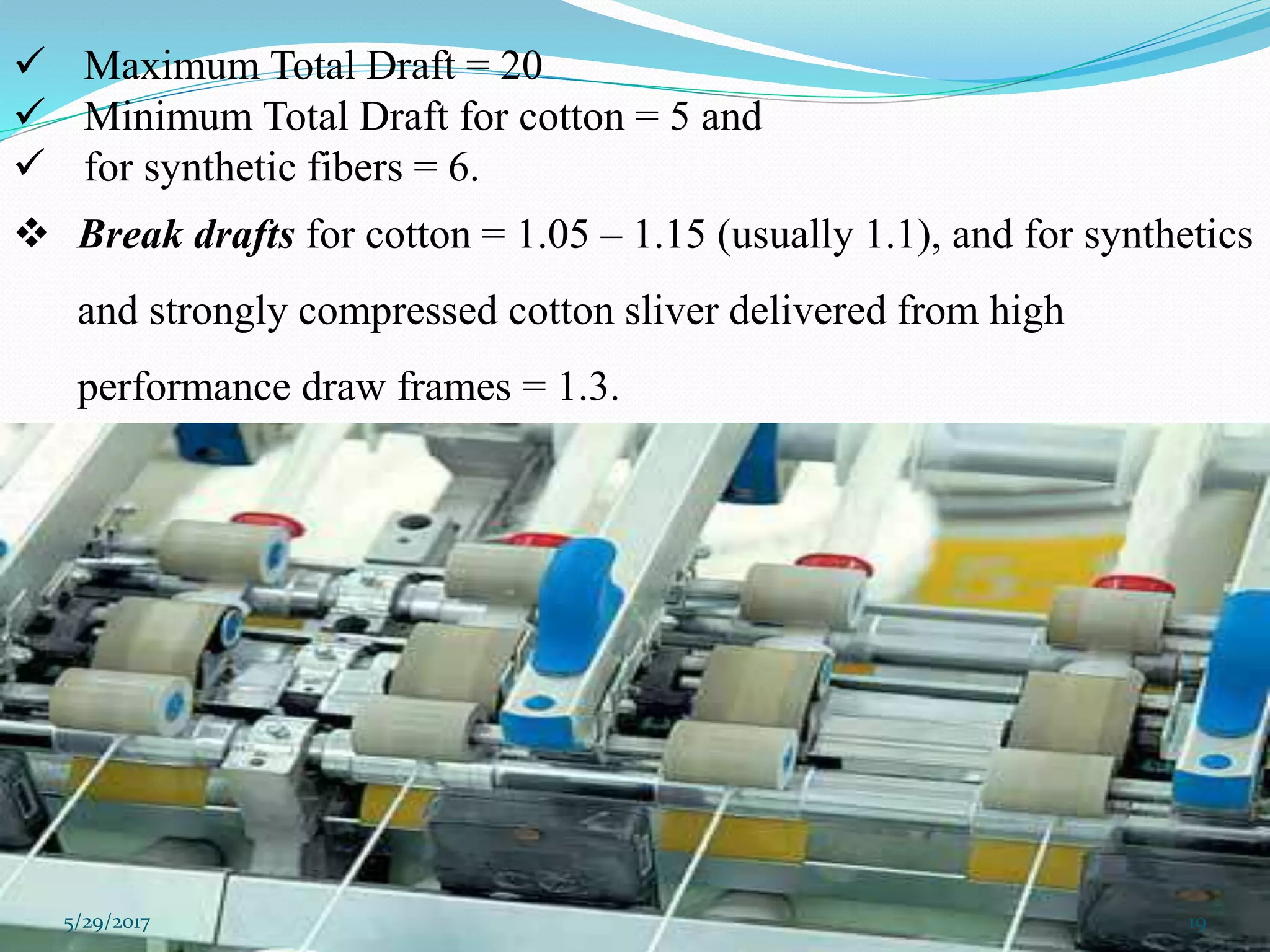
 Maximum Total Draft = 20
 Minimum Total Draft for cotton = 5 and
 for synthetic fibers = 6.
 Break drafts for cotton = 1.05 – 1.15 (usually 1.1), and for synthetics
and strongly compressed cotton sliver delivered from high
performance draw frames = 1.3.
5/29/2017 19
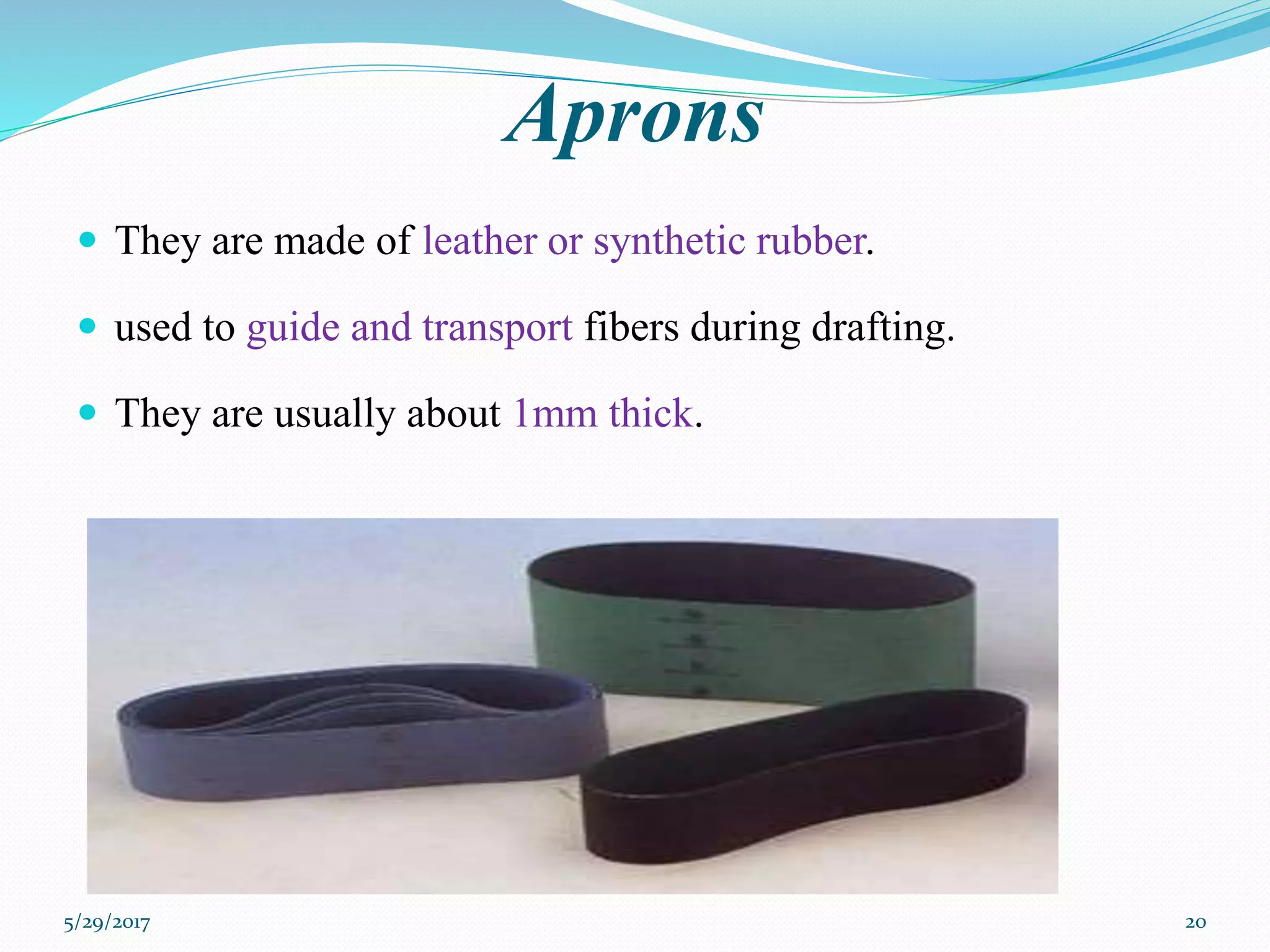
Aprons
 They are made of leather or synthetic rubber.
 used to guide and transport fibers during drafting.
 They are usually about 1mm thick.
5/29/2017 20
Spindle and Flyer
 The spindle is simply a support and drive element
for the flyer.
 The spindle tip is conical and is provided with a
slot.
 Functions of the flyer:
1.Inserting twist ,Twist = Flyer rotation rate
Delivery speed
2.Leading the very sensitive strand from the flyer
top to the package
5/29/2017 21
Build up of the bobbin
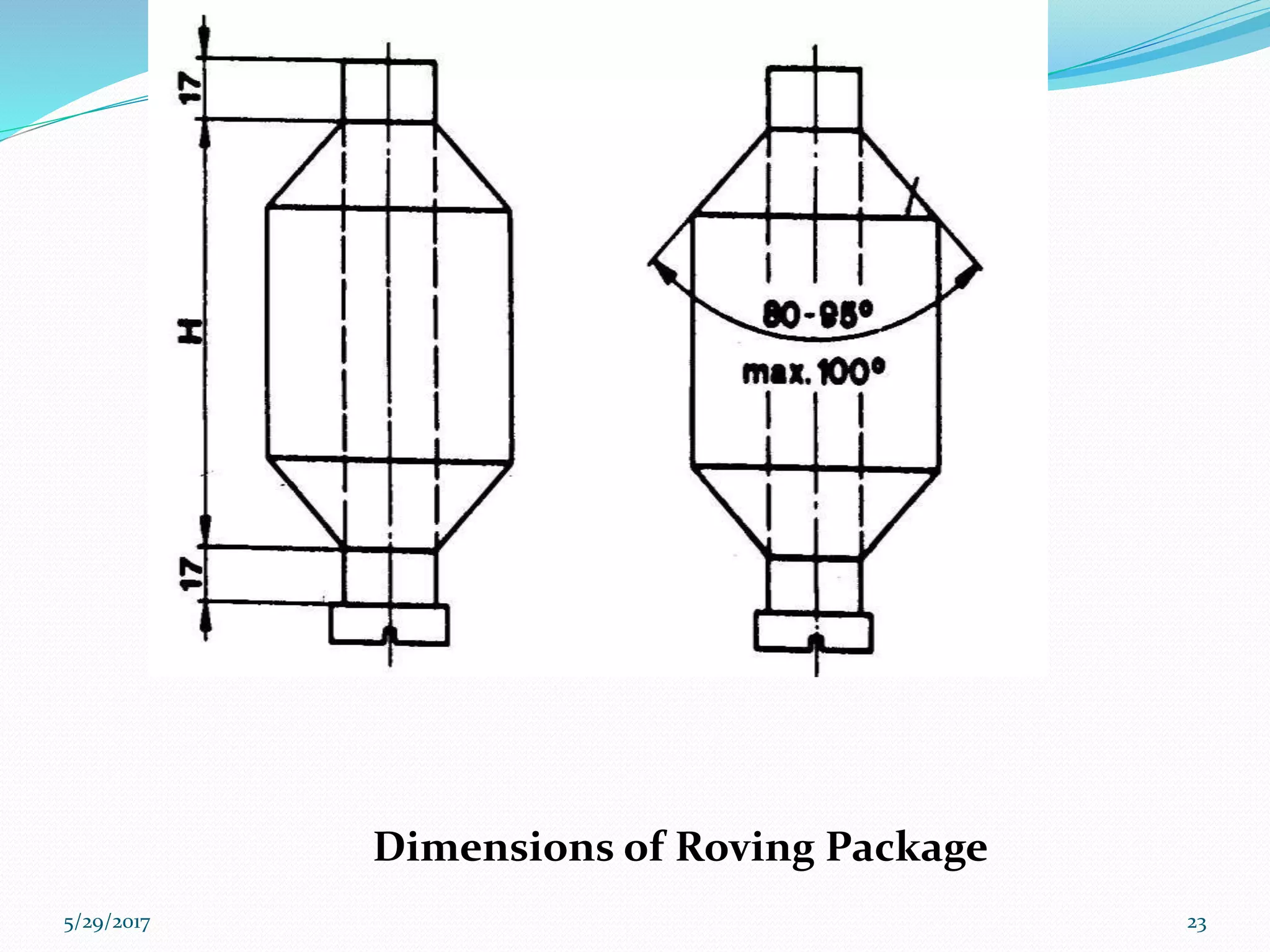
 A roving bobbin is a cylindrical body with tapered ends.
 The angle of taper of the ends normally lies between 80o
and 95o (maximum 100o), and depends upon the adherence
of material.
 The angle is made as large as possible to wound more
roving onto the package.
 However, the angle must be small enough to ensure that the
layers do not slide apart.
5/29/2017 22
Dimensions of Roving Package
5/29/2017 23
 Laying down of roving in the package is effected in parallel
layers, i.e., each wrap is laid on wooden or plastics tubes
closely adjacent to the neighbouring wrap.
 To wind over the whole length of the tube, the winding point
must be continually shifted.
 This is achieved by:
1) Raising and lowering the flyer or
2) Up and down movement of the tube together with
the bobbin rail (by means of racks or lever).
5/29/2017 24
5/29/2017 25
 Variation in bobbin speed originates from the
cone drums.
 When the builder motion shifts the cone belt,
the rotation rate of the lower cone is changed.
 This continuously reducing rotation rate is
transmitted via gearing to the differential and is
there superimposed on the constant speed of
the main shaft.
5/29/2017 26
 Further gearing then transmits the resultant
movement arising in the differential to the
bobbin drive.
 Furthermore, in order to prevent falling away
of individual layers, the bobbin ends are made
conical and consequently the lift of the bobbin
rail has to be reduced after each stroke (layer).
5/29/2017 27
For winding and controlled twisting of the roving to a
selected degree, the flyer and the bobbin must have
the same sense of rotation.
However, the bobbin must rotate faster than the flyer
(leading bobbin) or the flyer faster than the bobbin
(leading spindle).
Advantage of leading spindle:
 With a preset fixed spindle speed, the operation can be run
with lower bobbin speeds – lower than the spindle speed.
5/29/2017 28
Advantages of leading bobbin are:
1. Fewer roving breaks or faultily drafted places at the
winding point because the drive transmission path from the
motor to the spindle is short, whereas that of the bobbin is
long
2. No unwinding of the layers during roving breakage and
3. Speed reduction with increasing package diameter.
 However, with a leading spindle, the bobbin speed must be
gradually increased with increasing package diameter
which demands more power.5/29/2017 29
The builder motion
 It performs three important tasks during a winding
operation:
1. Shifts the cone belt corresponding to an increase in
the bobbin diameter
2. Reverses the direction of movement of the bobbin
rail at the upper and lower ends of the lift stroke,
and
3. Shortens the lift after each layer to form tapered
ends on the bobbins.5/29/2017 30
m
rts
R
T
TNnE
P




39
1060
Production Calculation
The production rate of a speed-frame is dependent
on:
 the spindle speed of the fly,
the number of spindles per machine,
the production efficiency,
the roving count, and
the twist multiplier used.
The following equation gives the calculated
production rate.
5/29/2017 31
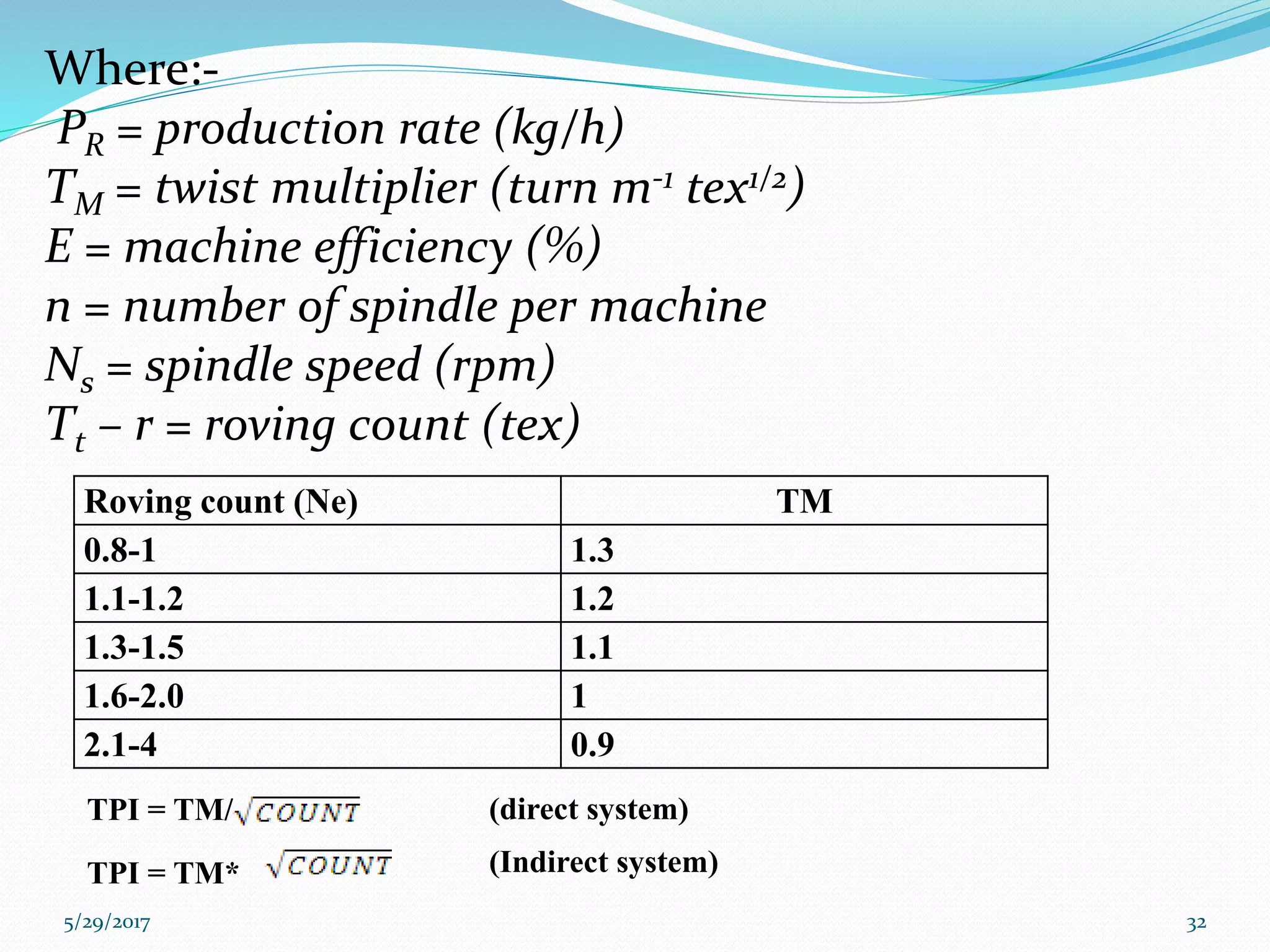
Where:-
PR = production rate (kg/h)
TM = twist multiplier (turn m-1 tex1/2)
E = machine efficiency (%)
n = number of spindle per machine
Ns = spindle speed (rpm)
Tt – r = roving count (tex)
TPI = TM* (Indirect system)
TPI = TM/ (direct system)
Roving count (Ne) TM
0.8-1 1.3
1.1-1.2 1.2
1.3-1.5 1.1
1.6-2.0 1
2.1-4 0.9
5/29/2017 32
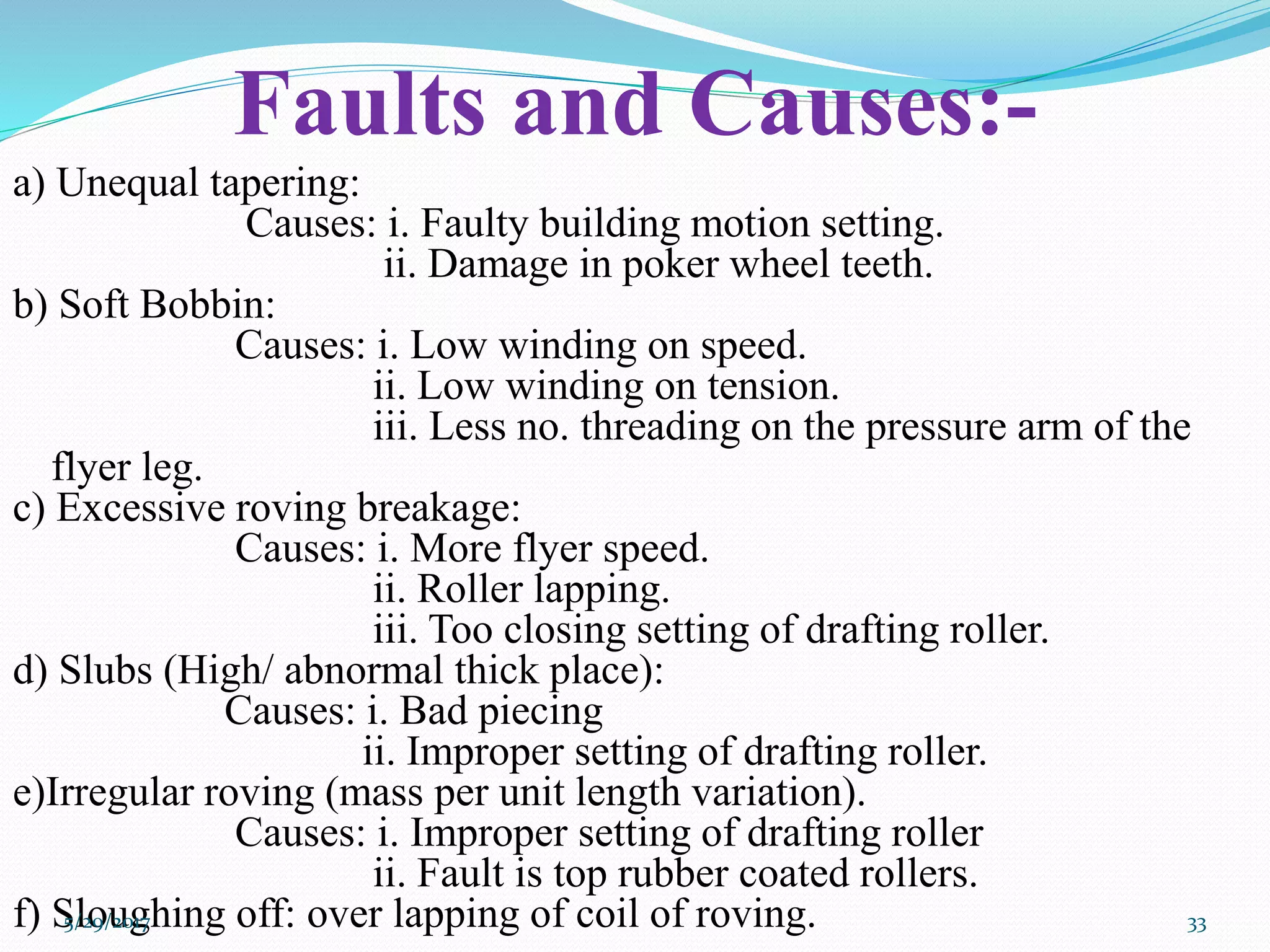
Faults and Causes:-
a) Unequal tapering:
Causes: i. Faulty building motion setting.
ii. Damage in poker wheel teeth.
b) Soft Bobbin:
Causes: i. Low winding on speed.
ii. Low winding on tension.
iii. Less no. threading on the pressure arm of the
flyer leg.
c) Excessive roving breakage:
Causes: i. More flyer speed.
ii. Roller lapping.
iii. Too closing setting of drafting roller.
d) Slubs (High/ abnormal thick place):
Causes: i. Bad piecing
ii. Improper setting of drafting roller.
e)Irregular roving (mass per unit length variation).
Causes: i. Improper setting of drafting roller
ii. Fault is top rubber coated rollers.
f) Sloughing off: over lapping of coil of roving.5/29/2017 33
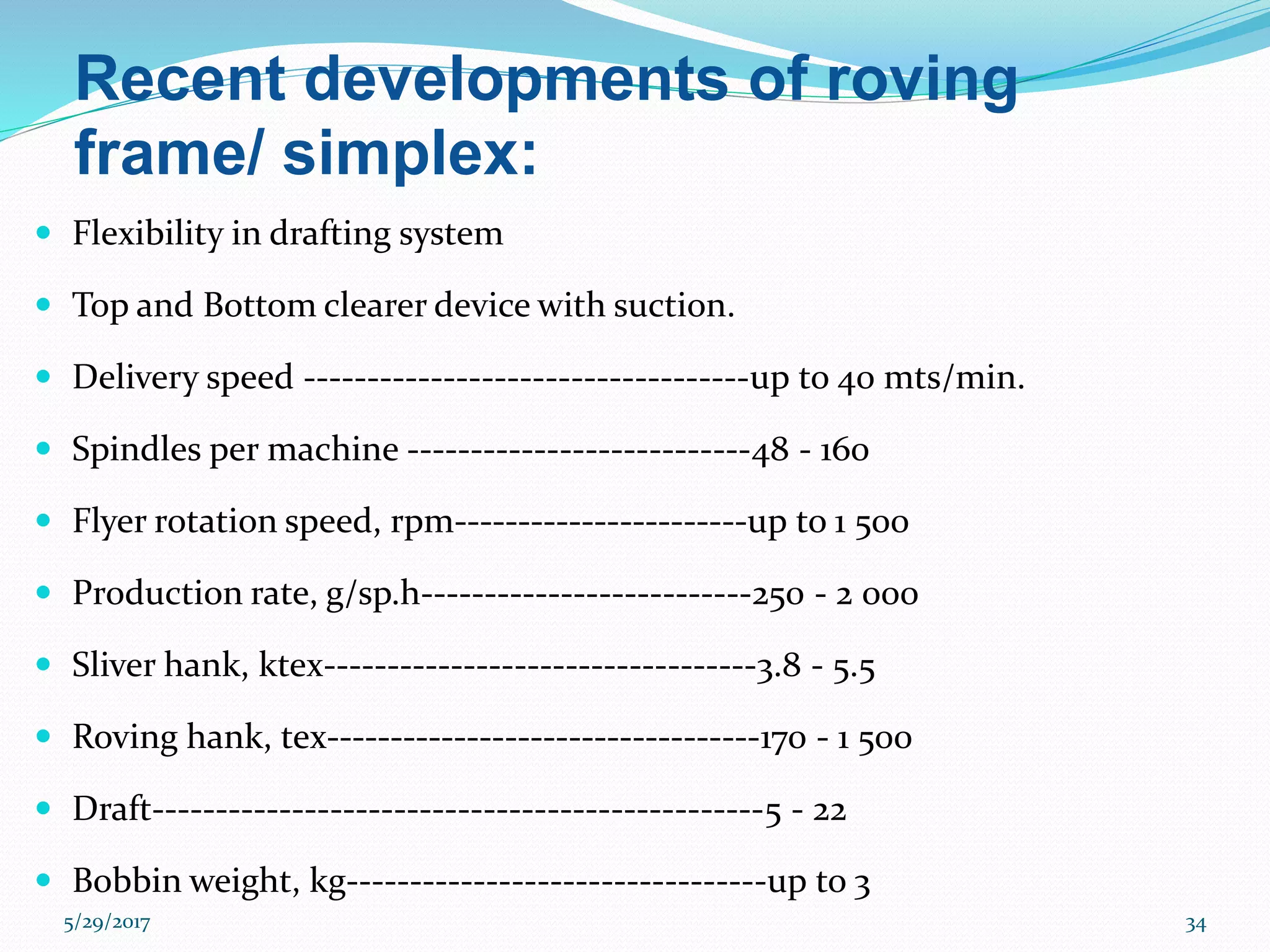
Recent developments of roving
frame/ simplex:
 Flexibility in drafting system
 Top and Bottom clearer device with suction.
 Delivery speed -----------------------------------up to 40 mts/min.
 Spindles per machine ---------------------------48 - 160
 Flyer rotation speed, rpm-----------------------up to 1 500
 Production rate, g/sp.h--------------------------250 - 2 000
 Sliver hank, ktex----------------------------------3.8 - 5.5
 Roving hank, tex----------------------------------170 - 1 500
 Draft------------------------------------------------5 - 22
 Bobbin weight, kg---------------------------------up to 3
5/29/2017 34
5/29/2017 35
5/29/2017 36

Simplex frame

  • 1.
    5/29/2017 1 Department OfTextile Engineering Presentation On: Roving Frame Prepared by: Temesggen Feleke Msc. in Textile Manufacturing Ethiopia
  • 2.
    contents introduction objectives operating sequence operating regionsof roving frame production calculation faults and causes in roving frame recent developments in roving frame 5/29/2017 2
  • 3.
    Introduction  The rovingframe is the machine that comes after the draw frame in short-staple spinning system.  The input is the finisher draw frame sliver in sliver cans and the output of the roving frame is called roving.  The roving frame is called by various names in the industry and in the literature.  The machine is called a fly frame or a flyer frame - as it employs a flyer, simplex, speed frame. 5/29/2017 3
  • 4.
    The draw frameproduces a sliver that already exhibits all the characteristics required for the creation of yarn, Namely an ordered, clean strand of fibers lying parallel to one another.  In fact, the roving machine is :  Liable to faults,  Causes defects,  Adds to production costs and delivers a product that is sensitive both in winding and unwinding. 5/29/2017 4
  • 5.
     Two principalreasons for the use of roving frame are: 1) The required high draft in the ring frame (DT = 300 – 500), and 2) Draw frame cans are not convenient for transport and presentation of feed material to the ring frame. 5/29/2017 5
  • 6.
    Objectives of Rovingframe  To draft the sliver to a thin strand,  To impart to the drafted strand a protective twist and  To wind the drafted and twisted roving material onto a suitable package for further use. 5/29/2017 6
  • 7.
    Operating Sequence The drawframe sliver cans are arranged in 4 or 6 rows in the creel zone and the sliver from each can is fed to the drafting system. The drafting system drafts the sliver to a fine strand of material ready for twisting. The draft usually employed in fly frames ranges from 5 to 20. Coarser roving need less and finer roving need higher drafts. The delivered roving has a hank (or, count) in the range of about 1s to 3s Ne. 5/29/2017 7
  • 8.
  • 9.
    The material deliveredfrom the drafting system is led to the top of the flyer. From the front roller nip to the flyer top, the material remains unsupported.  From the top of the flyer, the material is guided through one of the legs of the flyer; at the bottom of the leg of the flyer, the material is wound on the presser (usually two or three turns around the presser arm).5/29/2017 9
  • 10.
    The material isthen passed through the eye of the presser from which point, it can be wound onto the package. The strand delivered by the drafting system is thin and weak. Therefore, a protective twist - of the order of about 1 to 3 turns per inch is given to the strand before winding it onto a wooden or plastic package. 5/29/2017 10
  • 11.
     The flyerimparts twist to the delivered material by its rotations.  One rotation of flyer imparts one turn of twist to the delivered material.  The flyer is mounted on the top of a spindle.  The spindle and flyer rotate together.5/29/2017 11
  • 12.
    The flyer rotatesat a constant speed. The most common speeds employed range from about 1000 to 1500 revolutions per minute. The twisted roving is wound onto the surface of the bobbin in the form of closely spaced helical coils. Each of the spiral coils is spaced close to each other i.e. the coils touch each other. 5/29/2017 12
  • 13.
    To effect windingin this manner, the roving bobbin is moved up and down. Once a layer of roving has been wound, the direction of movement of the bobbin is reversed and a fresh layer is wound over the previous layer. The process continues till the bobbin is full. 5/29/2017 13
  • 14.
     The bobbinsand the associated driving gears are placed in a bobbin rail; the spindle and the associated driving gears are housed in the spindle rail.  The spindle rail is stationary.  The bobbin rail along with the bobbins moves vertically up and down during the running of the machine to enable winding of the material in traverses. 5/29/2017 14
  • 15.
     To effectwinding of material onto the bobbin, the bobbin has a rotational speed which is equal to flyer speed plus the additional rotations for winding.  As each layer is completed, the diameter of the bobbin increases.  This would mean that the additional rotations required for winding have to be reduced after the completion of each layer.  Note that the delivery rate from the drafting system remains constant. 5/29/2017 15
  • 16.
    Operating regions ofthe roving frame 5/29/2017 16
  • 17.
    The creel  Abovethe cans there are several rows of driven rollers to help the slivers on their way to the drafting arrangement. 5/29/2017 17
  • 18.
    The Drafting Arrangement A.Double apron drafting system with 3/3 or 4/4 (for high drafts) roller arrangements:  Is used in the roving frame since it enables drafts of 20 while holding the fibres more or less under control during their movements. B. 3-over-4 drafting arrangement: used relatively rarely since it gives less drafts.5/29/2017 18
  • 19.
     Maximum TotalDraft = 20  Minimum Total Draft for cotton = 5 and  for synthetic fibers = 6.  Break drafts for cotton = 1.05 – 1.15 (usually 1.1), and for synthetics and strongly compressed cotton sliver delivered from high performance draw frames = 1.3. 5/29/2017 19
  • 20.
    Aprons  They aremade of leather or synthetic rubber.  used to guide and transport fibers during drafting.  They are usually about 1mm thick. 5/29/2017 20
  • 21.
    Spindle and Flyer The spindle is simply a support and drive element for the flyer.  The spindle tip is conical and is provided with a slot.  Functions of the flyer: 1.Inserting twist ,Twist = Flyer rotation rate Delivery speed 2.Leading the very sensitive strand from the flyer top to the package 5/29/2017 21
  • 22.
    Build up ofthe bobbin  A roving bobbin is a cylindrical body with tapered ends.  The angle of taper of the ends normally lies between 80o and 95o (maximum 100o), and depends upon the adherence of material.  The angle is made as large as possible to wound more roving onto the package.  However, the angle must be small enough to ensure that the layers do not slide apart. 5/29/2017 22
  • 23.
    Dimensions of RovingPackage 5/29/2017 23
  • 24.
     Laying downof roving in the package is effected in parallel layers, i.e., each wrap is laid on wooden or plastics tubes closely adjacent to the neighbouring wrap.  To wind over the whole length of the tube, the winding point must be continually shifted.  This is achieved by: 1) Raising and lowering the flyer or 2) Up and down movement of the tube together with the bobbin rail (by means of racks or lever). 5/29/2017 24
  • 25.
  • 26.
     Variation inbobbin speed originates from the cone drums.  When the builder motion shifts the cone belt, the rotation rate of the lower cone is changed.  This continuously reducing rotation rate is transmitted via gearing to the differential and is there superimposed on the constant speed of the main shaft. 5/29/2017 26
  • 27.
     Further gearingthen transmits the resultant movement arising in the differential to the bobbin drive.  Furthermore, in order to prevent falling away of individual layers, the bobbin ends are made conical and consequently the lift of the bobbin rail has to be reduced after each stroke (layer). 5/29/2017 27
  • 28.
    For winding andcontrolled twisting of the roving to a selected degree, the flyer and the bobbin must have the same sense of rotation. However, the bobbin must rotate faster than the flyer (leading bobbin) or the flyer faster than the bobbin (leading spindle). Advantage of leading spindle:  With a preset fixed spindle speed, the operation can be run with lower bobbin speeds – lower than the spindle speed. 5/29/2017 28
  • 29.
    Advantages of leadingbobbin are: 1. Fewer roving breaks or faultily drafted places at the winding point because the drive transmission path from the motor to the spindle is short, whereas that of the bobbin is long 2. No unwinding of the layers during roving breakage and 3. Speed reduction with increasing package diameter.  However, with a leading spindle, the bobbin speed must be gradually increased with increasing package diameter which demands more power.5/29/2017 29
  • 30.
    The builder motion It performs three important tasks during a winding operation: 1. Shifts the cone belt corresponding to an increase in the bobbin diameter 2. Reverses the direction of movement of the bobbin rail at the upper and lower ends of the lift stroke, and 3. Shortens the lift after each layer to form tapered ends on the bobbins.5/29/2017 30
  • 31.
    m rts R T TNnE P     39 1060 Production Calculation The productionrate of a speed-frame is dependent on:  the spindle speed of the fly, the number of spindles per machine, the production efficiency, the roving count, and the twist multiplier used. The following equation gives the calculated production rate. 5/29/2017 31
  • 32.
    Where:- PR = productionrate (kg/h) TM = twist multiplier (turn m-1 tex1/2) E = machine efficiency (%) n = number of spindle per machine Ns = spindle speed (rpm) Tt – r = roving count (tex) TPI = TM* (Indirect system) TPI = TM/ (direct system) Roving count (Ne) TM 0.8-1 1.3 1.1-1.2 1.2 1.3-1.5 1.1 1.6-2.0 1 2.1-4 0.9 5/29/2017 32
  • 33.
    Faults and Causes:- a)Unequal tapering: Causes: i. Faulty building motion setting. ii. Damage in poker wheel teeth. b) Soft Bobbin: Causes: i. Low winding on speed. ii. Low winding on tension. iii. Less no. threading on the pressure arm of the flyer leg. c) Excessive roving breakage: Causes: i. More flyer speed. ii. Roller lapping. iii. Too closing setting of drafting roller. d) Slubs (High/ abnormal thick place): Causes: i. Bad piecing ii. Improper setting of drafting roller. e)Irregular roving (mass per unit length variation). Causes: i. Improper setting of drafting roller ii. Fault is top rubber coated rollers. f) Sloughing off: over lapping of coil of roving.5/29/2017 33
  • 34.
    Recent developments ofroving frame/ simplex:  Flexibility in drafting system  Top and Bottom clearer device with suction.  Delivery speed -----------------------------------up to 40 mts/min.  Spindles per machine ---------------------------48 - 160  Flyer rotation speed, rpm-----------------------up to 1 500  Production rate, g/sp.h--------------------------250 - 2 000  Sliver hank, ktex----------------------------------3.8 - 5.5  Roving hank, tex----------------------------------170 - 1 500  Draft------------------------------------------------5 - 22  Bobbin weight, kg---------------------------------up to 3 5/29/2017 34
  • 35.
  • 36.