Presented by: Akshat Jain
AUTOMATIC BOTTLE FILLING
SYSTEM
Table Of Contents
 Introduction
 Why Automation?
 Layout
 Components
 Design
 Working
 Experimental Results
 Conclusion
 References
Introduction
The current scenario in industries is to embrace new technologies to
proceed towards automation. The same vision is exercised in bottle
filling plants. To meet the customer demands and accelerate the filling
of bottles, all operations are nearly automated. The automation of
bottle filling involves use of PLC for control but it is costly.
Despite of all such advance technologies small industries are still
involved in manual filling of bottles. They might be discouraged to
adapt to new technology due to high cost involved in automation. The
study emphasize on reduction in cost using arduino microcontroller.
The arduino microcontroller is relatively cheap and widely available. In
small industries bottle filling operation is done manually. The manual
filling process has many shortcomings like spilling of water while
filling it in bottle, equal quantity of water may not be filled, delay due to
natural activities of human etc. This work generally emphases on small
industries. It aims to eliminate problem faced by small scale bottle
filling system. . With this system that operates automatically, every
process can be smooth and the process of refilling can reduce the man
power cost and operation time and thus increasing productivity and
profit.
Why automation?
The field of automation has a notable impact in a wide
range of industries beyond manufacturing. Automation
plays an increasingly important role in the world economy.
Filling is a task carried out by a machine that packages liquid
products such as cold drinks or water. In past, humans were the
main method for controlling a system. More recently, electricity
has been used for control and electrical control is based
on microcontrollers for various purposes like medicines,
pharmaceutical plants, chemical plants etc. There
microcontrollers control the complete working of the system. It is
common to use microcontrollers to make simple logical
control decision. The automation in bottle filling industry
comes with increased electrical components. Essential
requirements of each component in the system is
important to be studied in ordered to understand how each part
works in coordination with other parts in the system. This study
mainly includes design, fabrication and control system for
automated bottle filling system. The main part is control
system which includes C programming in Arduino
microcontroller to control various components in system. A
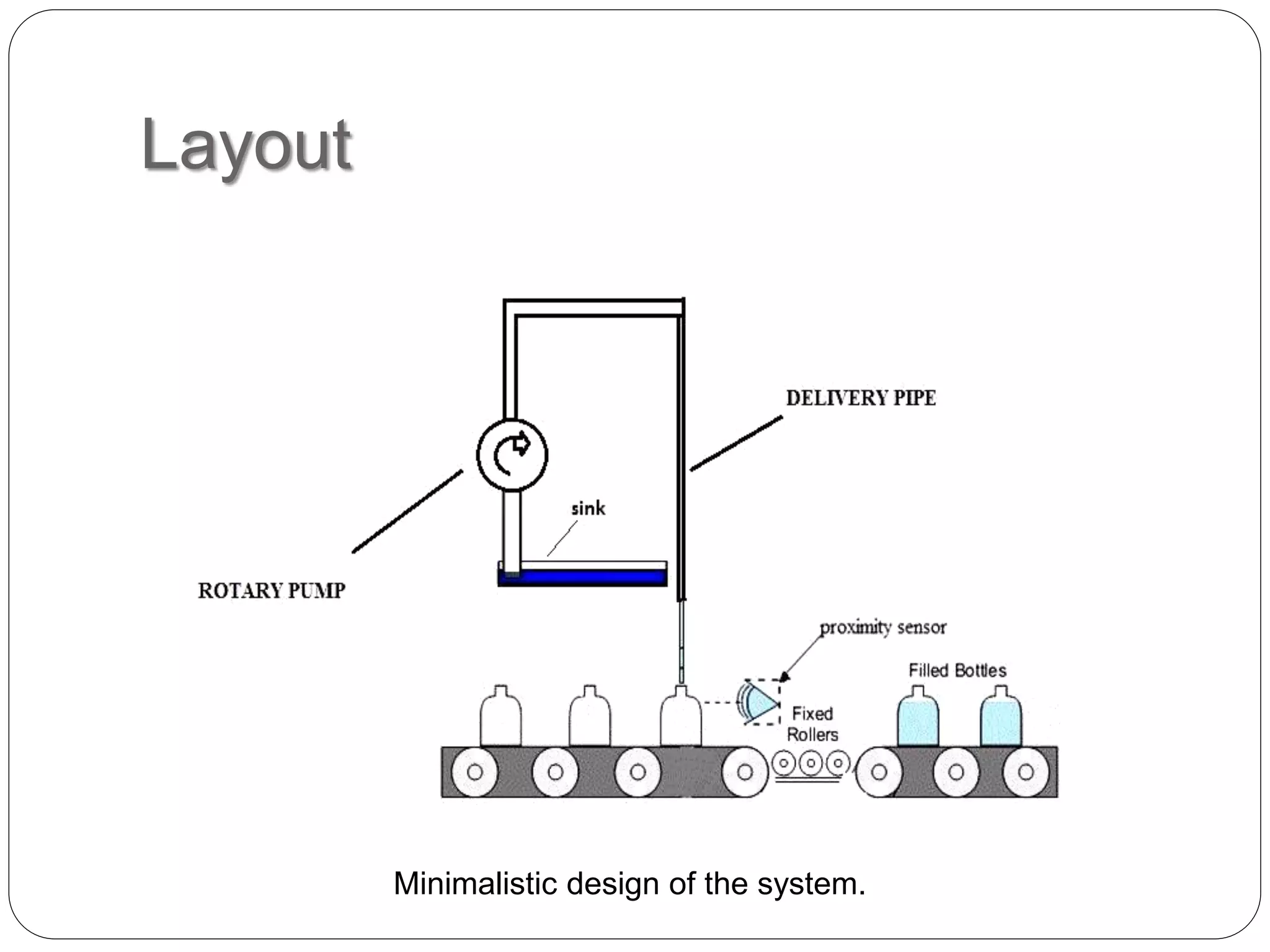
Layout
Minimalistic design of the system.
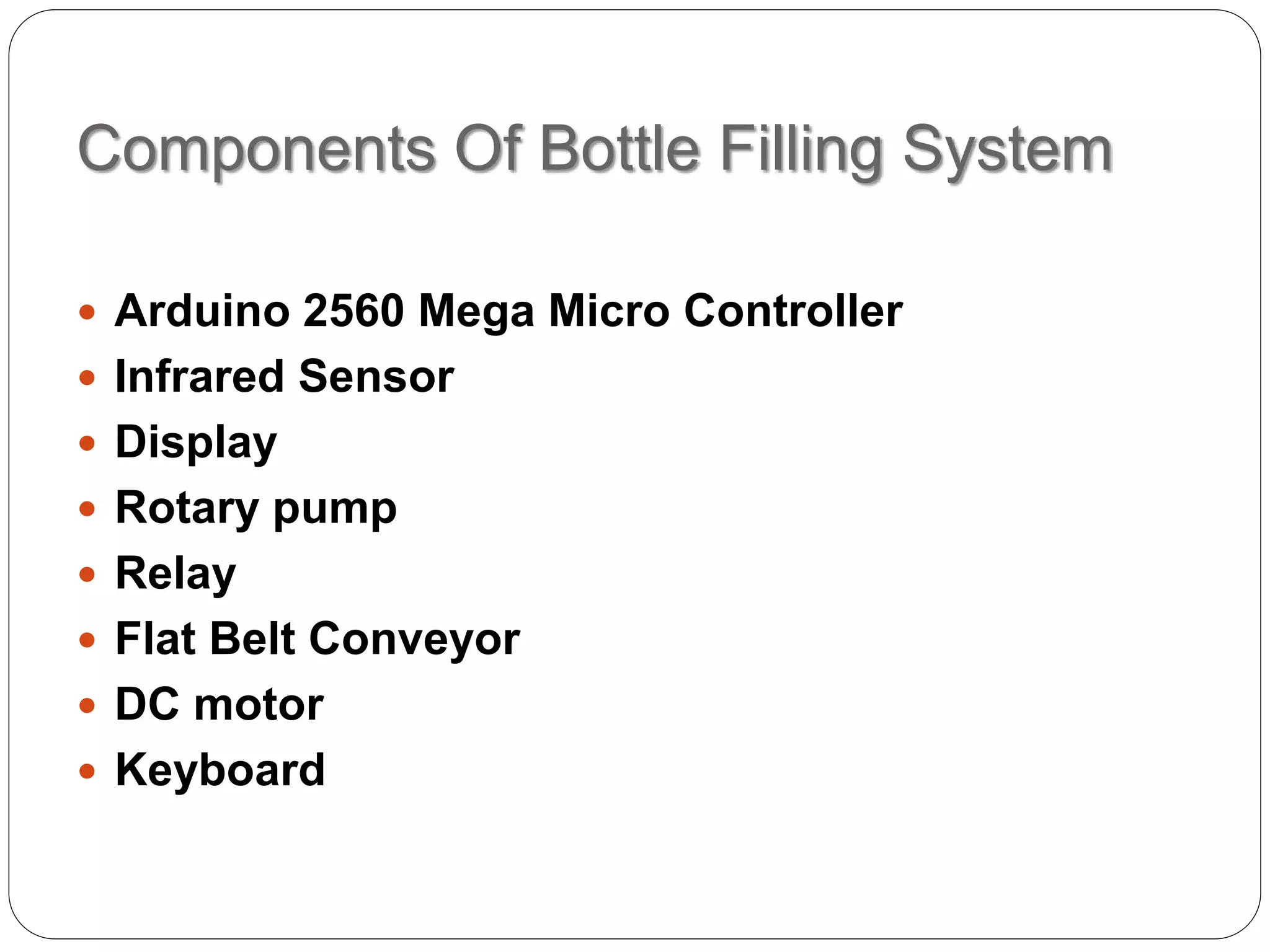
Components Of Bottle Filling System
 Arduino 2560 Mega Micro Controller
 Infrared Sensor
 Display
 Rotary pump
 Relay
 Flat Belt Conveyor
 DC motor
 Keyboard
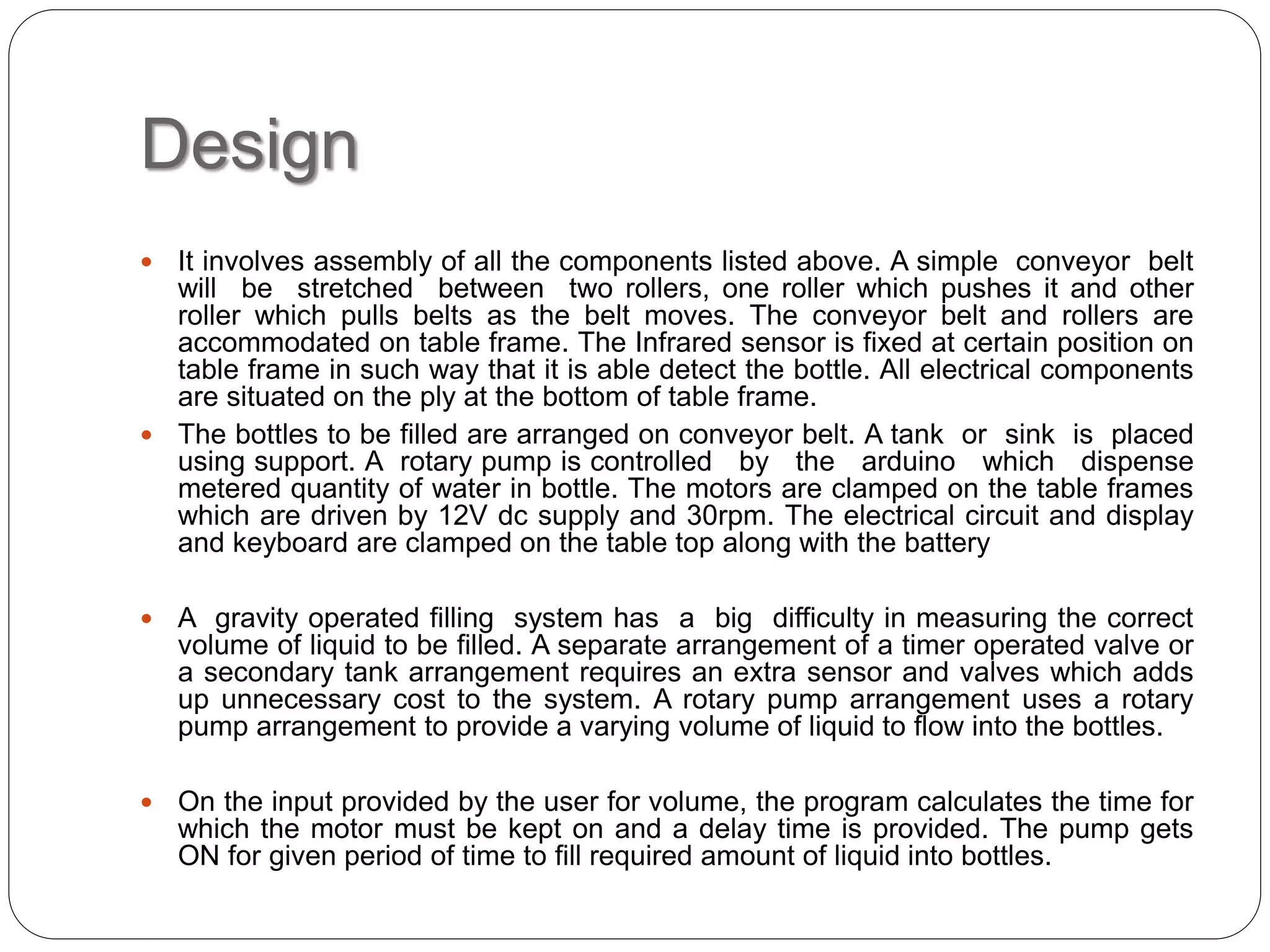
Design
 It involves assembly of all the components listed above. A simple conveyor belt
will be stretched between two rollers, one roller which pushes it and other
roller which pulls belts as the belt moves. The conveyor belt and rollers are
accommodated on table frame. The Infrared sensor is fixed at certain position on
table frame in such way that it is able detect the bottle. All electrical components
are situated on the ply at the bottom of table frame.
 The bottles to be filled are arranged on conveyor belt. A tank or sink is placed
using support. A rotary pump is controlled by the arduino which dispense
metered quantity of water in bottle. The motors are clamped on the table frames
which are driven by 12V dc supply and 30rpm. The electrical circuit and display
and keyboard are clamped on the table top along with the battery
 A gravity operated filling system has a big difficulty in measuring the correct
volume of liquid to be filled. A separate arrangement of a timer operated valve or
a secondary tank arrangement requires an extra sensor and valves which adds
up unnecessary cost to the system. A rotary pump arrangement uses a rotary
pump arrangement to provide a varying volume of liquid to flow into the bottles.
 On the input provided by the user for volume, the program calculates the time for
which the motor must be kept on and a delay time is provided. The pump gets
ON for given period of time to fill required amount of liquid into bottles.
Working
cont..
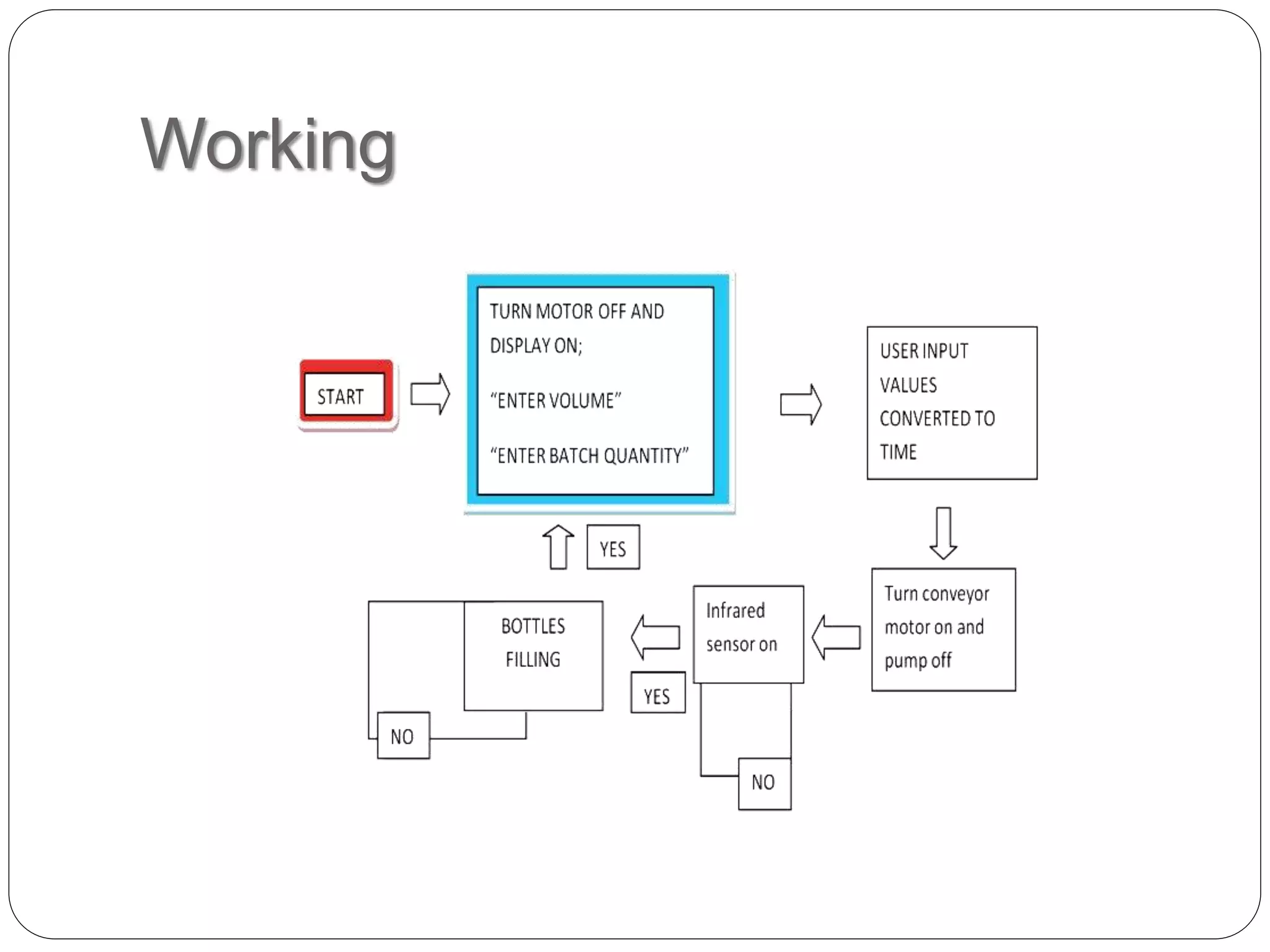
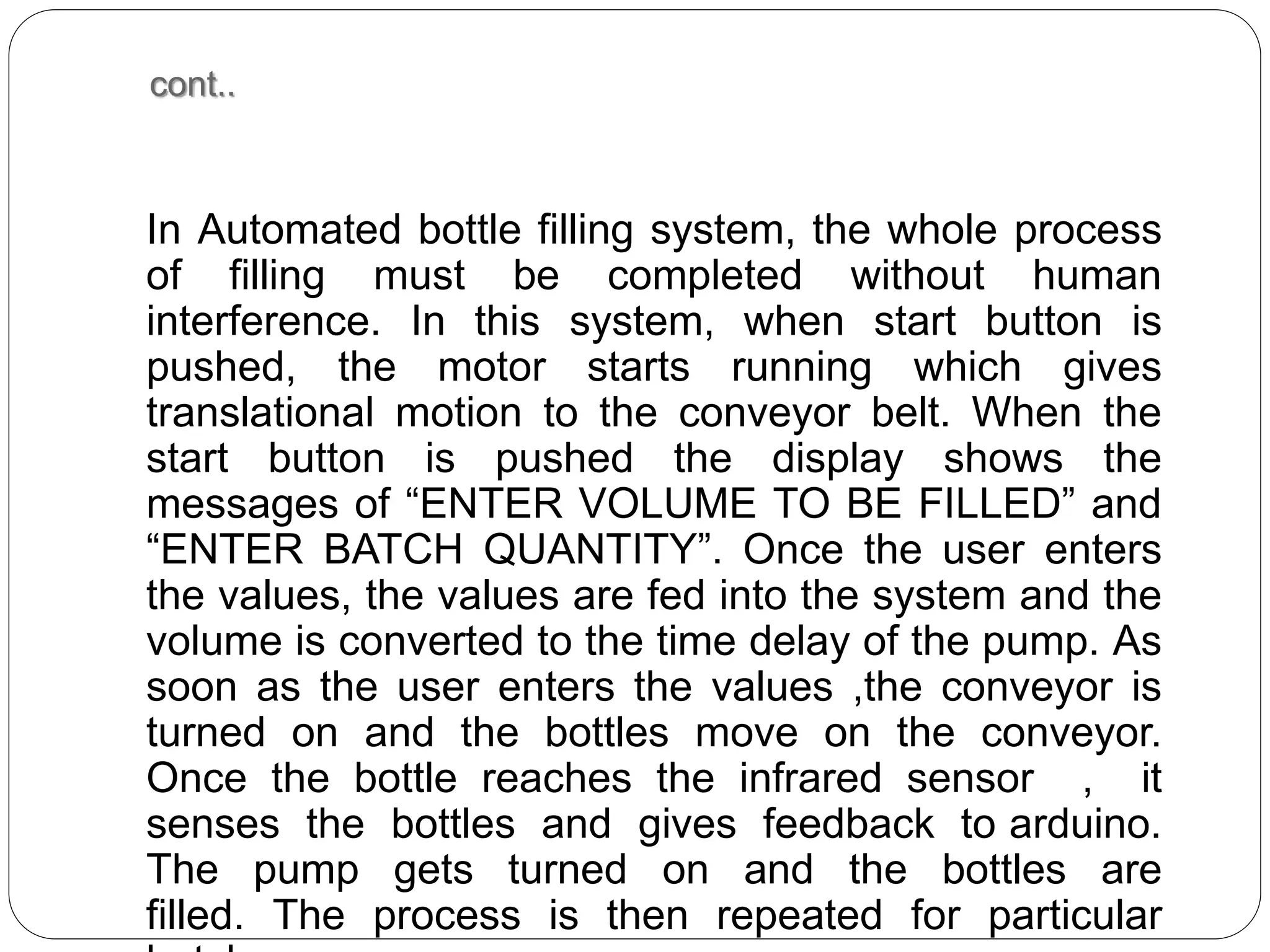
In Automated bottle filling system, the whole process
of filling must be completed without human
interference. In this system, when start button is
pushed, the motor starts running which gives
translational motion to the conveyor belt. When the
start button is pushed the display shows the
messages of “ENTER VOLUME TO BE FILLED” and
“ENTER BATCH QUANTITY”. Once the user enters
the values, the values are fed into the system and the
volume is converted to the time delay of the pump. As
soon as the user enters the values ,the conveyor is
turned on and the bottles move on the conveyor.
Once the bottle reaches the infrared sensor , it
senses the bottles and gives feedback to arduino.
The pump gets turned on and the bottles are
filled. The process is then repeated for particular
Experimental Result
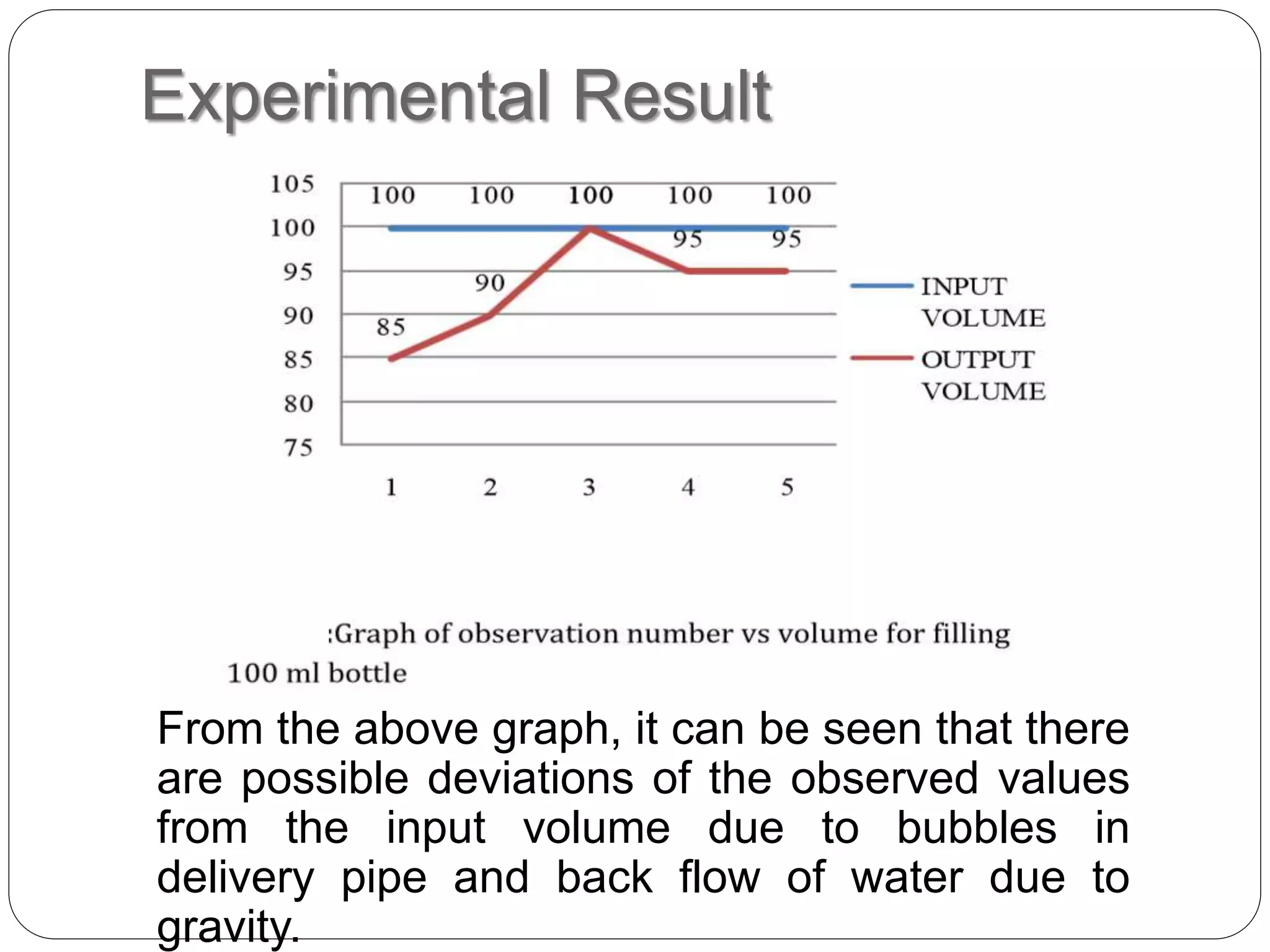
From the above graph, it can be seen that there
are possible deviations of the observed values
from the input volume due to bubbles in
delivery pipe and back flow of water due to
gravity.
Conclusion
The automated bottle filling system was beneficial
in reducing work, time and cost of filling. The
fabricated model of Automated bottle filling
system can be used where high precision is not
necessary and time limits not bound. Hence it
must be used application specific and must not
be used in places where faster and more
accurate methods of filling are available.
References
 http://www.meticamachinery.com/blog/advantage
s-of-automatic-liquid-filling-machine/
 http://www.bottlefillingmachines.com/
 https://www.arduino.cc/en/Main/arduinoBoardMeg
a2560
Automatic Bottling System

Automatic Bottling System

  • 1.
    Presented by: AkshatJain AUTOMATIC BOTTLE FILLING SYSTEM
  • 2.
    Table Of Contents Introduction  Why Automation?  Layout  Components  Design  Working  Experimental Results  Conclusion  References
  • 3.
    Introduction The current scenarioin industries is to embrace new technologies to proceed towards automation. The same vision is exercised in bottle filling plants. To meet the customer demands and accelerate the filling of bottles, all operations are nearly automated. The automation of bottle filling involves use of PLC for control but it is costly. Despite of all such advance technologies small industries are still involved in manual filling of bottles. They might be discouraged to adapt to new technology due to high cost involved in automation. The study emphasize on reduction in cost using arduino microcontroller. The arduino microcontroller is relatively cheap and widely available. In small industries bottle filling operation is done manually. The manual filling process has many shortcomings like spilling of water while filling it in bottle, equal quantity of water may not be filled, delay due to natural activities of human etc. This work generally emphases on small industries. It aims to eliminate problem faced by small scale bottle filling system. . With this system that operates automatically, every process can be smooth and the process of refilling can reduce the man power cost and operation time and thus increasing productivity and profit.
  • 4.
    Why automation? The fieldof automation has a notable impact in a wide range of industries beyond manufacturing. Automation plays an increasingly important role in the world economy. Filling is a task carried out by a machine that packages liquid products such as cold drinks or water. In past, humans were the main method for controlling a system. More recently, electricity has been used for control and electrical control is based on microcontrollers for various purposes like medicines, pharmaceutical plants, chemical plants etc. There microcontrollers control the complete working of the system. It is common to use microcontrollers to make simple logical control decision. The automation in bottle filling industry comes with increased electrical components. Essential requirements of each component in the system is important to be studied in ordered to understand how each part works in coordination with other parts in the system. This study mainly includes design, fabrication and control system for automated bottle filling system. The main part is control system which includes C programming in Arduino microcontroller to control various components in system. A
  • 5.
  • 6.
    Components Of BottleFilling System  Arduino 2560 Mega Micro Controller  Infrared Sensor  Display  Rotary pump  Relay  Flat Belt Conveyor  DC motor  Keyboard
  • 7.
    Design  It involvesassembly of all the components listed above. A simple conveyor belt will be stretched between two rollers, one roller which pushes it and other roller which pulls belts as the belt moves. The conveyor belt and rollers are accommodated on table frame. The Infrared sensor is fixed at certain position on table frame in such way that it is able detect the bottle. All electrical components are situated on the ply at the bottom of table frame.  The bottles to be filled are arranged on conveyor belt. A tank or sink is placed using support. A rotary pump is controlled by the arduino which dispense metered quantity of water in bottle. The motors are clamped on the table frames which are driven by 12V dc supply and 30rpm. The electrical circuit and display and keyboard are clamped on the table top along with the battery  A gravity operated filling system has a big difficulty in measuring the correct volume of liquid to be filled. A separate arrangement of a timer operated valve or a secondary tank arrangement requires an extra sensor and valves which adds up unnecessary cost to the system. A rotary pump arrangement uses a rotary pump arrangement to provide a varying volume of liquid to flow into the bottles.  On the input provided by the user for volume, the program calculates the time for which the motor must be kept on and a delay time is provided. The pump gets ON for given period of time to fill required amount of liquid into bottles.
  • 8.
  • 9.
    cont.. In Automated bottlefilling system, the whole process of filling must be completed without human interference. In this system, when start button is pushed, the motor starts running which gives translational motion to the conveyor belt. When the start button is pushed the display shows the messages of “ENTER VOLUME TO BE FILLED” and “ENTER BATCH QUANTITY”. Once the user enters the values, the values are fed into the system and the volume is converted to the time delay of the pump. As soon as the user enters the values ,the conveyor is turned on and the bottles move on the conveyor. Once the bottle reaches the infrared sensor , it senses the bottles and gives feedback to arduino. The pump gets turned on and the bottles are filled. The process is then repeated for particular
  • 10.
    Experimental Result From theabove graph, it can be seen that there are possible deviations of the observed values from the input volume due to bubbles in delivery pipe and back flow of water due to gravity.
  • 11.
    Conclusion The automated bottlefilling system was beneficial in reducing work, time and cost of filling. The fabricated model of Automated bottle filling system can be used where high precision is not necessary and time limits not bound. Hence it must be used application specific and must not be used in places where faster and more accurate methods of filling are available.
  • 12.