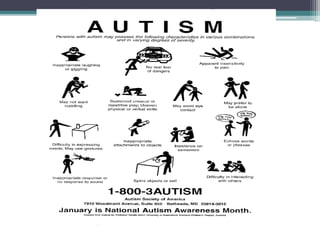
AUTISM
What is autism?
Definition
• Autism is a disorder of neural development characterized by impaired
social interaction and communication, and by restricted and repetitive
behavior.
• Autism affects information processing in the brain by altering how nerve
cells and their synapses connect and organize; how this occurs is not well
understood
• Parents usually notice signs in the first two years of their child's life.
The signs usually develop gradually, but some autistic children first
develop more normally and then regress
• The cause of autism is not known. Autism lasts throughout a
person's lifetime. There is no cure, but treatment can help.
Treatments include behavior and communication therapies and
medicines to control symptoms.
• Autism is just one of five different types of Autism disorders.
What is Autism?
Autism is classified by the American Psychiatric
Association as a Pervasive Developmental Disorder (APA,
1994). It is defined by symptoms appearing before the age
of three, which reflect delayed or abnormal development
in three areas:
• Language Development - doesn’t understand or say many words,
repeats things (“echoes”) or uses the third person.
• Social Skills - not interested in peers, no imitative play, poor eye
contact, doesn’t respond when spoken to, doesn’t show/point to
things.
• Behavioral Repertoire - repetitively plays with objects in a specific
way or insists that things be done the same way or engages in self
stimulatory actions such as hand flapping, staring at hands or
fingers or smelling things.
• Many children with autism are also mentally retarded, but the
presence and severity of specific symptoms and degree of mental
retardation is quite variable. Aside from sharing problems in the
above areas, children with autism are quite different from each
other. Some are affectionate, some do have pretend play, some
speak fairly well, and some do very little self-stimulating.
Types of Autism Disorders
There are in total five different types of autism disorders :
(Retrieved from http://ezinearticles.com/?There-Are-5-Different-
Types-of-Autism-Disorders&id=1592117)
• Classic autism : Develop language late, or not at all;profound lack
of affection or emotional contact with others; an intense wish for
sameness in routines, muteness or abnormality of speech; high
levels of Visio-spatial skills, but major learning difficulties in other
areas.
• Asperger’s syndrome : Deficiencies in social skill ; difficulties
with transitions or changes;cling to rituals and any changes in their
routine can upset them; difficulty reading body language and
determining proper body space; reduced sensitivity to pain ;
increased sensitivity to bright lights and loud noises ;have average
or above-average intelligence.
• Childhood Disintegrative Disorder : Severe regression in
communication skills, social behavior, and all developmental motor
skills;start to regress at between ages 2-4 years;stop socializing, lose
potty-training skills, stop playing, lose motor skills and stop making
friends
• Rett Syndrome :neurological and developmental disorder ;mostly
occurs in females ; marked by poor head growth; Loss of muscle ;
problems crawling or walking ; diminished eye contac;develop
stereotyped hand movements, ;The inability to perform motor
• Pervasive Developmental Disorder-Not Otherwise
Specified : This tends to describe people who have many or all of the
different types of Autism disorders. Children with PDDNOS either do
not fully meet the criteria of symptoms used to diagnose any of the four
specific types above, and/or do not have the degree of impairment
described in any of the above four specific types.
Signs & Symptoms of Autism
Social Development
• Lack the intuition about others that many people take for granted
• Do not understand social conversations / situations
• Infant stage : Autistic infants show less attention to social stimuli,
smile and look at others less often, and respond less to their own
name
• Toddler stage : Autistic toddlers differ more strikingly from social
norms; for example, they have less eye contact and turn taking, and
are more likely to communicate by manipulating another person's
hand
• Children stage : likely to exhibit social understanding, approach
others spontaneously, imitate and respond to emotions,
communicate nonverbally, and take turns with others.Form
attachments to their primary caregivers
• Older children / Adults : Perform worse on tests of face and emotion
recognition.
Communication
• About a third to a half of individuals with autism do not develop
enough natural speech to meet their daily communication needs
• 1st year : Differences in communication may be present from the
first year of life, and may include delayed onset of babbling, unusual
gestures, diminished responsiveness, and vocal patterns that are not
synchronized with the caregiver
• 2nd to 3rd year : Less frequent and less diverse babbling, consonants,
words, and word combinations; their gestures are less often
integrated with words
• Echolalia (repeating others’ words),
• Consistently fail to point at objects in order to comment on or share
an experience
• Perform poorly at complex language tasks such as figurative
language, comprehension and inference.
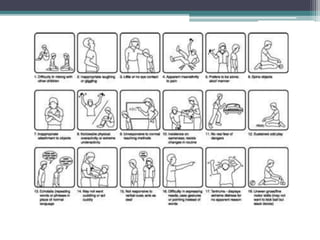
Repetitive Behaviour
Repetitive Behavior Scale-Revised (RBS-R)
• Stereotypy : repetitive movement, such as hand flapping, making
sounds, head rolling, or body rocking.
• Compulsive behavior : intended and appears to follow rules, such as
arranging objects in stacks or lines.
• Sameness : resistance to change; for example, insisting that the
furniture not be moved or refusing to be interrupted.
• Ritualistic behavior : involves an unvarying pattern of daily
activities, such as an unchanging menu or a dressing ritual. This is
closely associated with sameness and an independent validation has
suggested combining the two factors.
• Restricted behavior : limited in focus, interest, or activity, such as
preoccupation with a single television program, toy, or game.
• Self-injury : includes movements that injure or can injure the person,
such as eye poking, skin picking, hand biting, and head banging
Other S&S
• Some show superior skills in perception and attention
• splinter skills such as the memorization of trivia
• under-responsivity (e.g. walking into things)
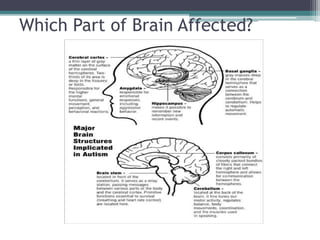
Which Part of Brain Affected?
Management of Autism
Early intervention often can reduce challenges associated
with the disorder, lessen disruptive behavior, and provide
some degree of independence.
• Occupational therapy helps improve independent function and
teaches basic skills (e.g., buttoning a shirt, bathing).
• Physical therapy involves using exercise and other physical
measures (e.g., massage, heat) to help patients control body
movements
• Communication Therapy : Communication therapy is used to
treat autistic patients who are unable to communicate verbally, or to
initiate language development in young children with the disorder.
• Picture exchange communication systems (PECS) enable
autistic patients to communicate using pictures that represent ideas,
activities, or items. The patient is able to convey requests, needs,
and desires to others by simply handing them a picture.
• Speech therapy may be used to help patients gain the ability to
speak
• Sensory integration therapy is a type of behavior modification
that focuses on helping autistic patients cope with sensory
stimulation. Treatment may include having the patient handle
materials with different textures or listen to different sounds
• Behavior modification often involves highly structured, skill-
oriented activities that are based on the patient's needs and
interests. It usually requires intense, one-on-one training with a
therapist and extensive caregiver involvement.
• Play therapy is a type of behavior modification that is used to
improve emotional development, which in turn, improves social
skills and learning. Play therapy involves adult-child interaction that
is controlled by the child.
• Dietary modifications is controversial. Studies have shown that
vitamin B, magnesium (improves the effects of vitamin B), and cod
liver oil supplements (which contain vitamins A and D) may
improve behavior, eye contact, attention span, and learning in
autistic patients. Vitamin C has been shown to improve depression
and lessen the severity of symptoms in patients with autism.
Prognosis of Autism
• No cure is known.
• Children recover occasionally.this occurs sometimes after intensive
treatment and sometimes not.
• It is not known how often recovery happens
• Most children with autism lack social support, meaningful
relationships, future employment opportunities or self-
determination.Although core difficulties tend to persist, symptoms
often become less severe with age
• Acquiring language before age six, having an IQ above 50, and
having a marketable skill all predict better outcomes.
• Independent living is unlikely with severe autistic patients.
• Patients with autism have normal life expectancies. With early
intervention and appropriate treatment, some autistic patients can
function productively and attain some degree of independence.
Most patients require lifelong assistance.

Autism[2]

  • 1.
  • 2.
    Definition • Autism isa disorder of neural development characterized by impaired social interaction and communication, and by restricted and repetitive behavior. • Autism affects information processing in the brain by altering how nerve cells and their synapses connect and organize; how this occurs is not well understood • Parents usually notice signs in the first two years of their child's life. The signs usually develop gradually, but some autistic children first develop more normally and then regress • The cause of autism is not known. Autism lasts throughout a person's lifetime. There is no cure, but treatment can help. Treatments include behavior and communication therapies and medicines to control symptoms. • Autism is just one of five different types of Autism disorders.
  • 3.
    What is Autism? Autismis classified by the American Psychiatric Association as a Pervasive Developmental Disorder (APA, 1994). It is defined by symptoms appearing before the age of three, which reflect delayed or abnormal development in three areas: • Language Development - doesn’t understand or say many words, repeats things (“echoes”) or uses the third person. • Social Skills - not interested in peers, no imitative play, poor eye contact, doesn’t respond when spoken to, doesn’t show/point to things. • Behavioral Repertoire - repetitively plays with objects in a specific way or insists that things be done the same way or engages in self stimulatory actions such as hand flapping, staring at hands or fingers or smelling things. • Many children with autism are also mentally retarded, but the presence and severity of specific symptoms and degree of mental retardation is quite variable. Aside from sharing problems in the above areas, children with autism are quite different from each other. Some are affectionate, some do have pretend play, some speak fairly well, and some do very little self-stimulating.
  • 4.
    Types of AutismDisorders There are in total five different types of autism disorders : (Retrieved from http://ezinearticles.com/?There-Are-5-Different- Types-of-Autism-Disorders&id=1592117) • Classic autism : Develop language late, or not at all;profound lack of affection or emotional contact with others; an intense wish for sameness in routines, muteness or abnormality of speech; high levels of Visio-spatial skills, but major learning difficulties in other areas. • Asperger’s syndrome : Deficiencies in social skill ; difficulties with transitions or changes;cling to rituals and any changes in their routine can upset them; difficulty reading body language and determining proper body space; reduced sensitivity to pain ; increased sensitivity to bright lights and loud noises ;have average or above-average intelligence.
  • 5.
    • Childhood DisintegrativeDisorder : Severe regression in communication skills, social behavior, and all developmental motor skills;start to regress at between ages 2-4 years;stop socializing, lose potty-training skills, stop playing, lose motor skills and stop making friends • Rett Syndrome :neurological and developmental disorder ;mostly occurs in females ; marked by poor head growth; Loss of muscle ; problems crawling or walking ; diminished eye contac;develop stereotyped hand movements, ;The inability to perform motor • Pervasive Developmental Disorder-Not Otherwise Specified : This tends to describe people who have many or all of the different types of Autism disorders. Children with PDDNOS either do not fully meet the criteria of symptoms used to diagnose any of the four specific types above, and/or do not have the degree of impairment described in any of the above four specific types.
  • 6.
  • 7.
    Social Development • Lackthe intuition about others that many people take for granted • Do not understand social conversations / situations • Infant stage : Autistic infants show less attention to social stimuli, smile and look at others less often, and respond less to their own name • Toddler stage : Autistic toddlers differ more strikingly from social norms; for example, they have less eye contact and turn taking, and are more likely to communicate by manipulating another person's hand • Children stage : likely to exhibit social understanding, approach others spontaneously, imitate and respond to emotions, communicate nonverbally, and take turns with others.Form attachments to their primary caregivers • Older children / Adults : Perform worse on tests of face and emotion recognition.
  • 8.
    Communication • About athird to a half of individuals with autism do not develop enough natural speech to meet their daily communication needs • 1st year : Differences in communication may be present from the first year of life, and may include delayed onset of babbling, unusual gestures, diminished responsiveness, and vocal patterns that are not synchronized with the caregiver • 2nd to 3rd year : Less frequent and less diverse babbling, consonants, words, and word combinations; their gestures are less often integrated with words • Echolalia (repeating others’ words), • Consistently fail to point at objects in order to comment on or share an experience • Perform poorly at complex language tasks such as figurative language, comprehension and inference.
  • 9.
    Repetitive Behaviour Repetitive BehaviorScale-Revised (RBS-R) • Stereotypy : repetitive movement, such as hand flapping, making sounds, head rolling, or body rocking. • Compulsive behavior : intended and appears to follow rules, such as arranging objects in stacks or lines. • Sameness : resistance to change; for example, insisting that the furniture not be moved or refusing to be interrupted. • Ritualistic behavior : involves an unvarying pattern of daily activities, such as an unchanging menu or a dressing ritual. This is closely associated with sameness and an independent validation has suggested combining the two factors. • Restricted behavior : limited in focus, interest, or activity, such as preoccupation with a single television program, toy, or game. • Self-injury : includes movements that injure or can injure the person, such as eye poking, skin picking, hand biting, and head banging
  • 10.
    Other S&S • Someshow superior skills in perception and attention • splinter skills such as the memorization of trivia • under-responsivity (e.g. walking into things)
  • 13.
    Which Part ofBrain Affected?
  • 14.
    Management of Autism Earlyintervention often can reduce challenges associated with the disorder, lessen disruptive behavior, and provide some degree of independence. • Occupational therapy helps improve independent function and teaches basic skills (e.g., buttoning a shirt, bathing). • Physical therapy involves using exercise and other physical measures (e.g., massage, heat) to help patients control body movements • Communication Therapy : Communication therapy is used to treat autistic patients who are unable to communicate verbally, or to initiate language development in young children with the disorder. • Picture exchange communication systems (PECS) enable autistic patients to communicate using pictures that represent ideas, activities, or items. The patient is able to convey requests, needs, and desires to others by simply handing them a picture. • Speech therapy may be used to help patients gain the ability to speak
  • 15.
    • Sensory integrationtherapy is a type of behavior modification that focuses on helping autistic patients cope with sensory stimulation. Treatment may include having the patient handle materials with different textures or listen to different sounds • Behavior modification often involves highly structured, skill- oriented activities that are based on the patient's needs and interests. It usually requires intense, one-on-one training with a therapist and extensive caregiver involvement. • Play therapy is a type of behavior modification that is used to improve emotional development, which in turn, improves social skills and learning. Play therapy involves adult-child interaction that is controlled by the child. • Dietary modifications is controversial. Studies have shown that vitamin B, magnesium (improves the effects of vitamin B), and cod liver oil supplements (which contain vitamins A and D) may improve behavior, eye contact, attention span, and learning in autistic patients. Vitamin C has been shown to improve depression and lessen the severity of symptoms in patients with autism.
  • 16.
    Prognosis of Autism •No cure is known. • Children recover occasionally.this occurs sometimes after intensive treatment and sometimes not. • It is not known how often recovery happens • Most children with autism lack social support, meaningful relationships, future employment opportunities or self- determination.Although core difficulties tend to persist, symptoms often become less severe with age • Acquiring language before age six, having an IQ above 50, and having a marketable skill all predict better outcomes. • Independent living is unlikely with severe autistic patients. • Patients with autism have normal life expectancies. With early intervention and appropriate treatment, some autistic patients can function productively and attain some degree of independence. Most patients require lifelong assistance.