A Perspective on Autism   David Daves
Hitting us more and more these days TV/Videos/Books/Movies/Celebrities Children and Newspapers Sacramento Bee Article California regional centers will serving 50,000 people diagnosed with autism this year. If the trend continues the number will grow to 70,000 by June 2012 New Statistic  1/150 The Hidden Society Questions to the class Who has met someone with Autism and interacted with them? What was the biggest thing you noticed? Autism
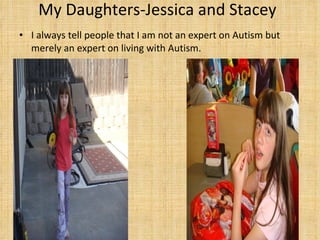
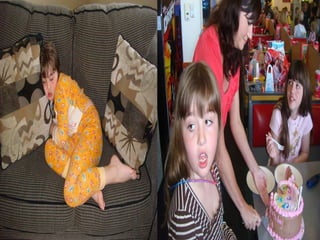
My Daughters-Jessica and Stacey I always tell people that I am not an expert on Autism but merely an expert on living with Autism.
 
Parenting Higher level of supervision required Repetitive eating habits/finger food Difficulty potty training Communication challenges  Family outings require much more preparation, planning, and time Requires assisted hygiene and grooming
Diagnostic Criteria for Autistic Disorder A.  A total of six (or more) items from (1), (2), and (3), with at least two from (1), and one each from (2) and (3): (1) qualitative impairment in social interaction, as manifested by at least two of the following: (a)  marked impairment in the use of multiple nonverbal behaviors such as  eye-to-eye gaze, facial expression, body postures, and gestures to regulate social interaction (b)  failure to develop peer relationships appropriate to developmental level (c)  a lack of spontaneous seeking to share enjoyment, interests, or achievements with other people (e.g., by a lack of showing, bringing, or pointing out objects of interest) (d)  lack of social or emotional reciprocity (2) qualitative impairments in communication as manifested by at least one of the following: (a)  delay in, or total lack of, the development of spoken language (not accompanied by an attempt to compensate through alternative modes of communication such as gesture or mime) (b)  in individuals with adequate speech, marked impairment in the ability to initiate or sustain a conversation with others (c)  stereotyped and repetitive use of language or idiosyncratic language (d)  lack of varied, spontaneous make-believe play or social imitative play appropriate to developmental level (3)  restricted repetitive and stereotyped patterns of behavior, interests, and activities, as manifested by at least one of the following: (a)  encompassing preoccupation with one or more stereotyped and restricted patterns of interest that is abnormal either in intensity or focus (b)  apparently inflexible adherence to specific, nonfunctional routines or rituals (c)  stereotyped and repetitive motor mannerisms (e.g., hand or finger flapping or twisting, or complex whole-body movements) (d)  persistent preoccupation with parts of objects Delays or abnormal functioning in at least one of the following areas, with onset prior to age 3 years: (1) social interaction, (2) language used in social communication, or (3) symbolic or imaginative play. The disturbance is not better accounted for by Rett’s Disorder or Childhood Disintegrative Disorder
Continued (3)  restricted repetitive and stereotyped patterns of behavior, interests, and activities, as manifested by at least one of the following: (a)  encompassing preoccupation with one or more stereotyped and restricted patterns of interest that is abnormal either in intensity or focus (b)  apparently inflexible adherence to specific, nonfunctional routines or rituals (c)  stereotyped and repetitive motor mannerisms (e.g., hand or finger flapping or  t wisting, or complex whole-body movements) (d)  persistent preoccupation with parts of objects Delays or abnormal functioning in at least one of the following areas, with onset prior to age 3 years: (1) social interaction, (2) language used in social communication, or (3) symbolic or imaginative play. The disturbance is not better accounted for by Rett’s Disorder or Childhood Disintegrative Disorder
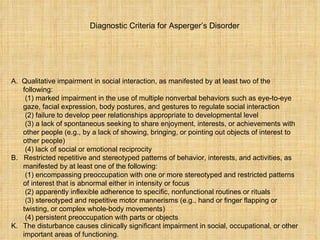
Diagnostic Criteria for Asperger’s Disorder A.  Qualitative impairment in social interaction, as manifested by at least two of the following: (1) marked impairment in the use of multiple nonverbal behaviors such as eye-to-eye gaze, facial expression, body postures, and gestures to regulate social interaction (2) failure to develop peer relationships appropriate to developmental level (3) a lack of spontaneous seeking to share enjoyment, interests, or achievements with other people (e.g., by a lack of showing, bringing, or pointing out objects of interest to other people) (4) lack of social or emotional reciprocity B.  Restricted repetitive and stereotyped patterns of behavior, interests, and activities, as manifested by at least one of the following: (1) encompassing preoccupation with one or more stereotyped and restricted patterns of interest that is abnormal either in intensity or focus (2) apparently inflexible adherence to specific, nonfunctional routines or rituals (3) stereotyped and repetitive motor mannerisms (e.g., hand or finger flapping or twisting, or complex whole-body movements) (4) persistent preoccupation with parts or objects The disturbance causes clinically significant impairment in social, occupational, or other important areas of functioning.  There is no clinically significant general delay in language (e.g.’ single words used by age 2 years, communicative phrases used by age 3 years). There is no clinically significant delay in cognitive development of age appropriate self-help skills, adaptive behavior (other than in social interaction), and curiosity about the environment in childhood. Criteria are not met for another specific Pervasive Developmental Disorder or Schizophrenia. Pervasive Developmental Disorder Not Otherwise Specified (Including Atypical Autism)
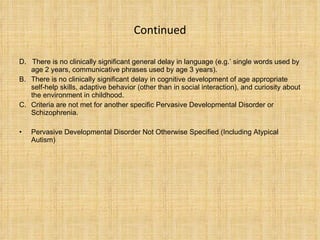
Continued D .  T here is no clinically significant general delay in language (e.g.’ single words used by age 2 years, communicative phrases used by age 3 years). There is no clinically significant delay in cognitive development of age appropriate self-help  s kills, adaptive behavior (other than in social interaction), and curiosity about the environment in childhood. Criteria are not met for another specific Pervasive Developmental Disorder or Schizophrenia. Pervasive Developmental Disorder Not Otherwise Specified (Including Atypical Autism)
Socialism - Children with autism have social impairments. Unusual social development becomes apparent early in childhood. - show less attention - smile and look at others less  often - respond less to their own name
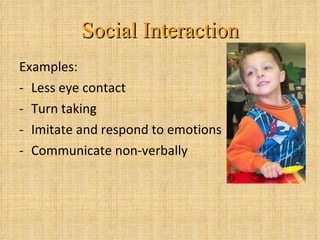
Social Interaction Examples: Less eye contact Turn taking Imitate and respond to emotions Communicate non-verbally
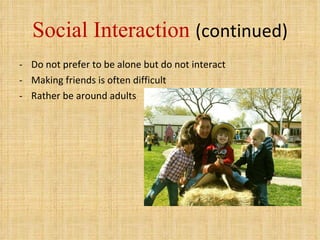
Social Interaction  (continued) Do not prefer to be alone but do not interact Making friends is often difficult Rather be around adults
Social Interaction (continued) Quality of friendship, not number of friends Do not point out what they want Look at the pointing hand instead of the object Can’t remember what happened, if asked
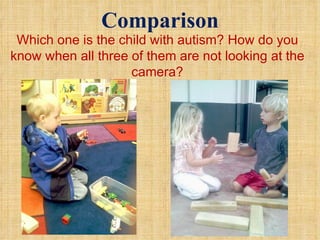
Comparison Which one is the child with autism? How do you know when all three of them are not looking at the camera?
ANSWER: You don’t know until you interact or observed them. You pay attention to the one who doesn’t give you eye contact Responds to name Speech delay However, if someone who knows the children asked you that question then the answer would be the child who is playing alone.
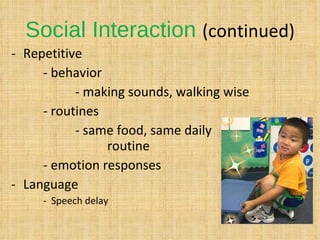
Social Interaction  (continued) Repetitive - behavior - making sounds, walking wise - routines - same food, same daily  routine - emotion responses Language Speech delay
Brief History 1908 Bleuler’s initial identification of autism in adults 1943 Kanner describes 11 children with childhood autism 1944 Asperger describes “little professor” syndrome 1967 Bettelheim’s The Empty Fortress published 1968 DSM(Diagnostic and Statistical Manual of Mental Disorders)-II list autism as type of childhood schizophrenia 1980 Wing conceptualizes triad of autistic symptoms 1987 DSM-IIIR places among personality disorders 1994 DSM-IV places autism among clinical disorders 1999 Federal autism research initiatives launched 2000 DSM-IV-TR clarifies PDD-NOS 2002 Vaccine/MMR controversy
Autism Neurology Grey matter (or gray matter) is a major component of the central nervous system, consisting of neuronal cell bodies. White matter is the second most prevalent component of the central nervous system and consists mostly of myelinated axons. MRI’s have shown that subjects with autism had on average a 25% reduction in Grey matter in 13 three-dimensional clusters. There was a 19% reduction of white matter in two 3d clusters However there were no significant differences in total brain volume between the control group and the autism group.
What these deficits imply Both the Grey and White matter deficits were in regions of the brain believed to be critical for socio-emotional development. Neuroimaging provides evidence of structural dysconnectivity in the social brain in autism. http://www.msnbc.msn.com/id/6827424
Is Autism Genetic? We know for sure that autism runs in families. Siblings of autistic people are more likely to be autistic, and twins are extremely likely to share autistic traits. This means there is almost certainly a genetic component to autism. Most researchers believe that a combination of several genetic differences, PLUS some form of environmental "insult," may lead to autism. FOR EXAMPLE Children who inherit two copies of a mutated form of a single gene on chromosome 12 will be unable to break down the amino acid phenylalanine, a common component of food proteins. If this deficiency, called phenylketonuria (PKU), goes undetected, the child will develop mental retardation, a condition with obvious behavioral consequences. Thus, a single gene can have profound effects on behavior, in this case by disrupting normal behavior.
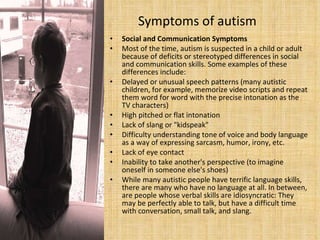
Symptoms of autism Social and Communication Symptoms Most of the time, autism is suspected in a child or adult because of deficits or stereotyped differences in social and communication skills. Some examples of these differences include: Delayed or unusual speech patterns (many autistic children, for example, memorize video scripts and repeat them word for word with the precise intonation as the TV characters)  High pitched or flat intonation  Lack of slang or "kidspeak"  Difficulty understanding tone of voice and body language as a way of expressing sarcasm, humor, irony, etc.  Lack of eye contact  Inability to take another's perspective (to imagine oneself in someone else's shoes)  While many autistic people have terrific language skills, there are many who have no language at all. In between, are people whose verbal skills are idiosyncratic: They may be perfectly able to talk, but have a difficult time with conversation, small talk, and slang.
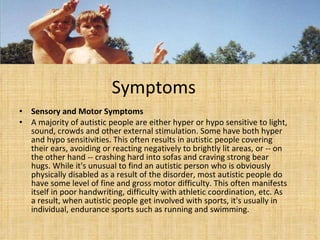
Symptoms  Sensory and Motor Symptoms A majority of autistic people are either hyper or hypo sensitive to light, sound, crowds and other external stimulation. Some have both hyper and hypo sensitivities. This often results in autistic people covering their ears, avoiding or reacting negatively to brightly lit areas, or -- on the other hand -- crashing hard into sofas and craving strong bear hugs. While it's unusual to find an autistic person who is obviously physically disabled as a result of the disorder, most autistic people do have some level of fine and gross motor difficulty. This often manifests itself in poor handwriting, difficulty with athletic coordination, etc. As a result, when autistic people get involved with sports, it's usually in individual, endurance sports such as running and swimming.
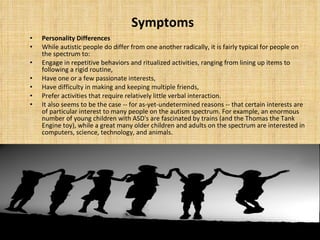
Symptoms Personality Differences While autistic people do differ from one another radically, it is fairly typical for people on the spectrum to:  Engage in repetitive behaviors and ritualized activities, ranging from lining up items to following a rigid routine,  Have one or a few passionate interests,  Have difficulty in making and keeping multiple friends,  Prefer activities that require relatively little verbal interaction. It also seems to be the case -- for as-yet-undetermined reasons -- that certain interests are of particular interest to many people on the autism spectrum. For example, an enormous number of young children with ASD's are fascinated by trains (and the Thomas the Tank Engine toy), while a great many older children and adults on the spectrum are interested in computers, science, technology, and animals.
Treatments?  Applied Behavior Analysis (ABA) This treatment is based on the theory that behavior rewarded is more likely to be repeated than behavior ignored.  Treatment and Education of Autistic and Related Communication Handicapped Children (TEACCH) This is a structured teaching approach based on the idea that the environment should be adapted to the child with autism—not the child to the environment.  Specialized Therapies These include speech, occupational, and physical therapy. These therapies are important of managing autism and should all be included in various aspects of the child’s treatment program.  Medicines Medicines are most commonly used to treat related conditions and problem behaviors, including depression, hyperactivity, and obsessive-compulsive behaviors.
How much money is enough to cover the cost of autism treatment?  The cost of proper treatment for autism can range up to $70,000 per year. At the same time parents of many children with autism have become, in essence, paraprofessional therapists—providing hours of therapeutic play and interaction based on various methods such as floor time, Relationship Development Intervention (RDI) and SonRise.  The state of California spent $320 million last year, up from $50 million a decade earlier. Nationwide, the tab is $90 billion annually—a figure expected to double in a decade.  A family's lifetime costs for caring for a child with autism can reach as high as $5 million, according to the Autism Society of America. Each month, parents report they pay thousands of dollars for treatment and therapy.
Reference  Rudy, Lisa Jo (2009 April 22). Symptoms of Autism.  Health's Disease and Condition  , Retrieved July 26, 2009, from http://autism.about.com/od/whatisautism/a/symptoms.html  Curtis , Jeannette (2009). Autism.  Yahoo Inc. , Retrieved July 26, 2009, from http://health.yahoo.com/nervous-overview/autism-topic-overview/healthwise--hw152186.html  Frances, Allen (2000). Diagnostic and Statistical Manual of Mental Disorders. Fourth Edition;  P. 75-84 Hubert, C. (2009). As Autism Comes of Age, Caregivers are Worried. Retrieved June 28, 2009, The  Sacramento Bee.  www.sacbee.com   Wikipedia.  (2007). Autism. Retrieved June 30, 2009, from http://en.wikipedia.org/wiki/ Autism

Autism27

  • 1.
    A Perspective onAutism David Daves
  • 2.
    Hitting us moreand more these days TV/Videos/Books/Movies/Celebrities Children and Newspapers Sacramento Bee Article California regional centers will serving 50,000 people diagnosed with autism this year. If the trend continues the number will grow to 70,000 by June 2012 New Statistic 1/150 The Hidden Society Questions to the class Who has met someone with Autism and interacted with them? What was the biggest thing you noticed? Autism
  • 3.
    My Daughters-Jessica andStacey I always tell people that I am not an expert on Autism but merely an expert on living with Autism.
  • 4.
  • 5.
    Parenting Higher levelof supervision required Repetitive eating habits/finger food Difficulty potty training Communication challenges Family outings require much more preparation, planning, and time Requires assisted hygiene and grooming
  • 6.
    Diagnostic Criteria forAutistic Disorder A. A total of six (or more) items from (1), (2), and (3), with at least two from (1), and one each from (2) and (3): (1) qualitative impairment in social interaction, as manifested by at least two of the following: (a) marked impairment in the use of multiple nonverbal behaviors such as eye-to-eye gaze, facial expression, body postures, and gestures to regulate social interaction (b) failure to develop peer relationships appropriate to developmental level (c) a lack of spontaneous seeking to share enjoyment, interests, or achievements with other people (e.g., by a lack of showing, bringing, or pointing out objects of interest) (d) lack of social or emotional reciprocity (2) qualitative impairments in communication as manifested by at least one of the following: (a) delay in, or total lack of, the development of spoken language (not accompanied by an attempt to compensate through alternative modes of communication such as gesture or mime) (b) in individuals with adequate speech, marked impairment in the ability to initiate or sustain a conversation with others (c) stereotyped and repetitive use of language or idiosyncratic language (d) lack of varied, spontaneous make-believe play or social imitative play appropriate to developmental level (3) restricted repetitive and stereotyped patterns of behavior, interests, and activities, as manifested by at least one of the following: (a) encompassing preoccupation with one or more stereotyped and restricted patterns of interest that is abnormal either in intensity or focus (b) apparently inflexible adherence to specific, nonfunctional routines or rituals (c) stereotyped and repetitive motor mannerisms (e.g., hand or finger flapping or twisting, or complex whole-body movements) (d) persistent preoccupation with parts of objects Delays or abnormal functioning in at least one of the following areas, with onset prior to age 3 years: (1) social interaction, (2) language used in social communication, or (3) symbolic or imaginative play. The disturbance is not better accounted for by Rett’s Disorder or Childhood Disintegrative Disorder
  • 7.
    Continued (3) restricted repetitive and stereotyped patterns of behavior, interests, and activities, as manifested by at least one of the following: (a) encompassing preoccupation with one or more stereotyped and restricted patterns of interest that is abnormal either in intensity or focus (b) apparently inflexible adherence to specific, nonfunctional routines or rituals (c) stereotyped and repetitive motor mannerisms (e.g., hand or finger flapping or t wisting, or complex whole-body movements) (d) persistent preoccupation with parts of objects Delays or abnormal functioning in at least one of the following areas, with onset prior to age 3 years: (1) social interaction, (2) language used in social communication, or (3) symbolic or imaginative play. The disturbance is not better accounted for by Rett’s Disorder or Childhood Disintegrative Disorder
  • 8.
    Diagnostic Criteria forAsperger’s Disorder A. Qualitative impairment in social interaction, as manifested by at least two of the following: (1) marked impairment in the use of multiple nonverbal behaviors such as eye-to-eye gaze, facial expression, body postures, and gestures to regulate social interaction (2) failure to develop peer relationships appropriate to developmental level (3) a lack of spontaneous seeking to share enjoyment, interests, or achievements with other people (e.g., by a lack of showing, bringing, or pointing out objects of interest to other people) (4) lack of social or emotional reciprocity B. Restricted repetitive and stereotyped patterns of behavior, interests, and activities, as manifested by at least one of the following: (1) encompassing preoccupation with one or more stereotyped and restricted patterns of interest that is abnormal either in intensity or focus (2) apparently inflexible adherence to specific, nonfunctional routines or rituals (3) stereotyped and repetitive motor mannerisms (e.g., hand or finger flapping or twisting, or complex whole-body movements) (4) persistent preoccupation with parts or objects The disturbance causes clinically significant impairment in social, occupational, or other important areas of functioning. There is no clinically significant general delay in language (e.g.’ single words used by age 2 years, communicative phrases used by age 3 years). There is no clinically significant delay in cognitive development of age appropriate self-help skills, adaptive behavior (other than in social interaction), and curiosity about the environment in childhood. Criteria are not met for another specific Pervasive Developmental Disorder or Schizophrenia. Pervasive Developmental Disorder Not Otherwise Specified (Including Atypical Autism)
  • 9.
    Continued D . T here is no clinically significant general delay in language (e.g.’ single words used by age 2 years, communicative phrases used by age 3 years). There is no clinically significant delay in cognitive development of age appropriate self-help s kills, adaptive behavior (other than in social interaction), and curiosity about the environment in childhood. Criteria are not met for another specific Pervasive Developmental Disorder or Schizophrenia. Pervasive Developmental Disorder Not Otherwise Specified (Including Atypical Autism)
  • 10.
    Socialism - Childrenwith autism have social impairments. Unusual social development becomes apparent early in childhood. - show less attention - smile and look at others less often - respond less to their own name
  • 11.
    Social Interaction Examples:Less eye contact Turn taking Imitate and respond to emotions Communicate non-verbally
  • 12.
    Social Interaction (continued) Do not prefer to be alone but do not interact Making friends is often difficult Rather be around adults
  • 13.
    Social Interaction (continued)Quality of friendship, not number of friends Do not point out what they want Look at the pointing hand instead of the object Can’t remember what happened, if asked
  • 14.
    Comparison Which oneis the child with autism? How do you know when all three of them are not looking at the camera?
  • 15.
    ANSWER: You don’tknow until you interact or observed them. You pay attention to the one who doesn’t give you eye contact Responds to name Speech delay However, if someone who knows the children asked you that question then the answer would be the child who is playing alone.
  • 16.
    Social Interaction (continued) Repetitive - behavior - making sounds, walking wise - routines - same food, same daily routine - emotion responses Language Speech delay
  • 17.
    Brief History 1908Bleuler’s initial identification of autism in adults 1943 Kanner describes 11 children with childhood autism 1944 Asperger describes “little professor” syndrome 1967 Bettelheim’s The Empty Fortress published 1968 DSM(Diagnostic and Statistical Manual of Mental Disorders)-II list autism as type of childhood schizophrenia 1980 Wing conceptualizes triad of autistic symptoms 1987 DSM-IIIR places among personality disorders 1994 DSM-IV places autism among clinical disorders 1999 Federal autism research initiatives launched 2000 DSM-IV-TR clarifies PDD-NOS 2002 Vaccine/MMR controversy
  • 18.
    Autism Neurology Greymatter (or gray matter) is a major component of the central nervous system, consisting of neuronal cell bodies. White matter is the second most prevalent component of the central nervous system and consists mostly of myelinated axons. MRI’s have shown that subjects with autism had on average a 25% reduction in Grey matter in 13 three-dimensional clusters. There was a 19% reduction of white matter in two 3d clusters However there were no significant differences in total brain volume between the control group and the autism group.
  • 19.
    What these deficitsimply Both the Grey and White matter deficits were in regions of the brain believed to be critical for socio-emotional development. Neuroimaging provides evidence of structural dysconnectivity in the social brain in autism. http://www.msnbc.msn.com/id/6827424
  • 20.
    Is Autism Genetic?We know for sure that autism runs in families. Siblings of autistic people are more likely to be autistic, and twins are extremely likely to share autistic traits. This means there is almost certainly a genetic component to autism. Most researchers believe that a combination of several genetic differences, PLUS some form of environmental "insult," may lead to autism. FOR EXAMPLE Children who inherit two copies of a mutated form of a single gene on chromosome 12 will be unable to break down the amino acid phenylalanine, a common component of food proteins. If this deficiency, called phenylketonuria (PKU), goes undetected, the child will develop mental retardation, a condition with obvious behavioral consequences. Thus, a single gene can have profound effects on behavior, in this case by disrupting normal behavior.
  • 21.
    Symptoms of autismSocial and Communication Symptoms Most of the time, autism is suspected in a child or adult because of deficits or stereotyped differences in social and communication skills. Some examples of these differences include: Delayed or unusual speech patterns (many autistic children, for example, memorize video scripts and repeat them word for word with the precise intonation as the TV characters) High pitched or flat intonation Lack of slang or "kidspeak" Difficulty understanding tone of voice and body language as a way of expressing sarcasm, humor, irony, etc. Lack of eye contact Inability to take another's perspective (to imagine oneself in someone else's shoes) While many autistic people have terrific language skills, there are many who have no language at all. In between, are people whose verbal skills are idiosyncratic: They may be perfectly able to talk, but have a difficult time with conversation, small talk, and slang.
  • 22.
    Symptoms Sensoryand Motor Symptoms A majority of autistic people are either hyper or hypo sensitive to light, sound, crowds and other external stimulation. Some have both hyper and hypo sensitivities. This often results in autistic people covering their ears, avoiding or reacting negatively to brightly lit areas, or -- on the other hand -- crashing hard into sofas and craving strong bear hugs. While it's unusual to find an autistic person who is obviously physically disabled as a result of the disorder, most autistic people do have some level of fine and gross motor difficulty. This often manifests itself in poor handwriting, difficulty with athletic coordination, etc. As a result, when autistic people get involved with sports, it's usually in individual, endurance sports such as running and swimming.
  • 23.
    Symptoms Personality DifferencesWhile autistic people do differ from one another radically, it is fairly typical for people on the spectrum to: Engage in repetitive behaviors and ritualized activities, ranging from lining up items to following a rigid routine, Have one or a few passionate interests, Have difficulty in making and keeping multiple friends, Prefer activities that require relatively little verbal interaction. It also seems to be the case -- for as-yet-undetermined reasons -- that certain interests are of particular interest to many people on the autism spectrum. For example, an enormous number of young children with ASD's are fascinated by trains (and the Thomas the Tank Engine toy), while a great many older children and adults on the spectrum are interested in computers, science, technology, and animals.
  • 24.
    Treatments? AppliedBehavior Analysis (ABA) This treatment is based on the theory that behavior rewarded is more likely to be repeated than behavior ignored. Treatment and Education of Autistic and Related Communication Handicapped Children (TEACCH) This is a structured teaching approach based on the idea that the environment should be adapted to the child with autism—not the child to the environment. Specialized Therapies These include speech, occupational, and physical therapy. These therapies are important of managing autism and should all be included in various aspects of the child’s treatment program. Medicines Medicines are most commonly used to treat related conditions and problem behaviors, including depression, hyperactivity, and obsessive-compulsive behaviors.
  • 25.
    How much moneyis enough to cover the cost of autism treatment? The cost of proper treatment for autism can range up to $70,000 per year. At the same time parents of many children with autism have become, in essence, paraprofessional therapists—providing hours of therapeutic play and interaction based on various methods such as floor time, Relationship Development Intervention (RDI) and SonRise. The state of California spent $320 million last year, up from $50 million a decade earlier. Nationwide, the tab is $90 billion annually—a figure expected to double in a decade. A family's lifetime costs for caring for a child with autism can reach as high as $5 million, according to the Autism Society of America. Each month, parents report they pay thousands of dollars for treatment and therapy.
  • 26.
    Reference Rudy,Lisa Jo (2009 April 22). Symptoms of Autism. Health's Disease and Condition , Retrieved July 26, 2009, from http://autism.about.com/od/whatisautism/a/symptoms.html Curtis , Jeannette (2009). Autism. Yahoo Inc. , Retrieved July 26, 2009, from http://health.yahoo.com/nervous-overview/autism-topic-overview/healthwise--hw152186.html Frances, Allen (2000). Diagnostic and Statistical Manual of Mental Disorders. Fourth Edition; P. 75-84 Hubert, C. (2009). As Autism Comes of Age, Caregivers are Worried. Retrieved June 28, 2009, The Sacramento Bee. www.sacbee.com Wikipedia. (2007). Autism. Retrieved June 30, 2009, from http://en.wikipedia.org/wiki/ Autism