PRACTICE ECONOMICS…2 Ms Rosmin Bt Iqbal Hussain BOptom (UKM), CMBA (UNIMAS)
Introduction Hi! We continue on to Balance Sheet!!!
BALANCE SHEET
What is a Balance sheet? The balance sheet is a  financial statement It is a list of all the  assets  (what the business owns) and all the  liabilities  (what the business owes) of a business
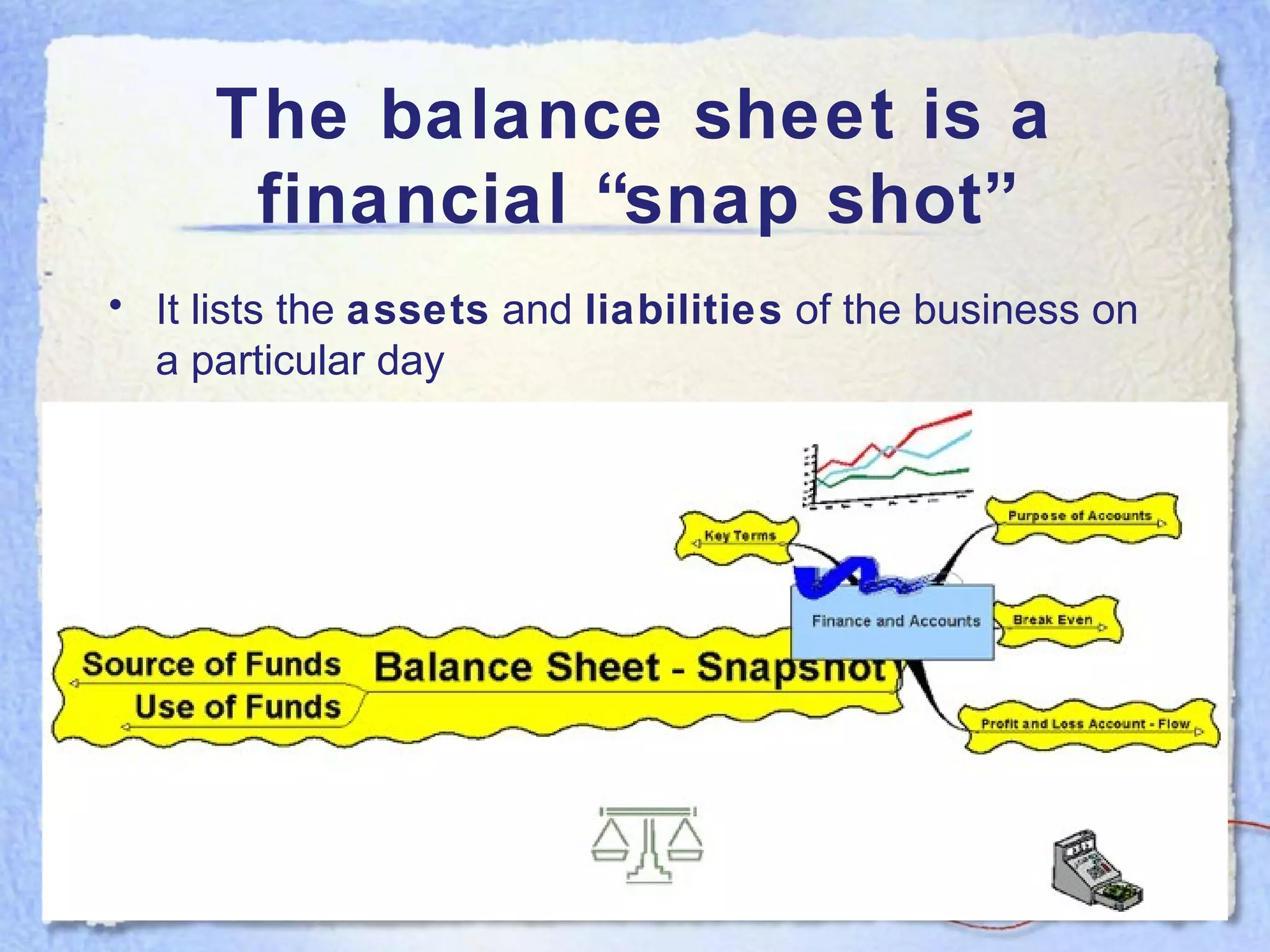
The balance sheet is a financial “snap shot” It lists the  assets  and  liabilities  of the business on a particular day
Balance Sheet A snapshot of the firm’s position  at a point in time Shows what a company owns (assets) and what it owes (liabilities) Balance Sheet shows what assets a company has (use of funds) and where the money came from to acquire those assets (source of funds)
Balance Sheet A guide to the structure of the assets of a company A guide to the level of  gearing  – the ratio of loan to share capital Gives a guide as to the degree of  working capital  – the amount the company has to be able to pay its everyday debts (current assets – current liabilities) Shows the total value of a firm at that moment in time
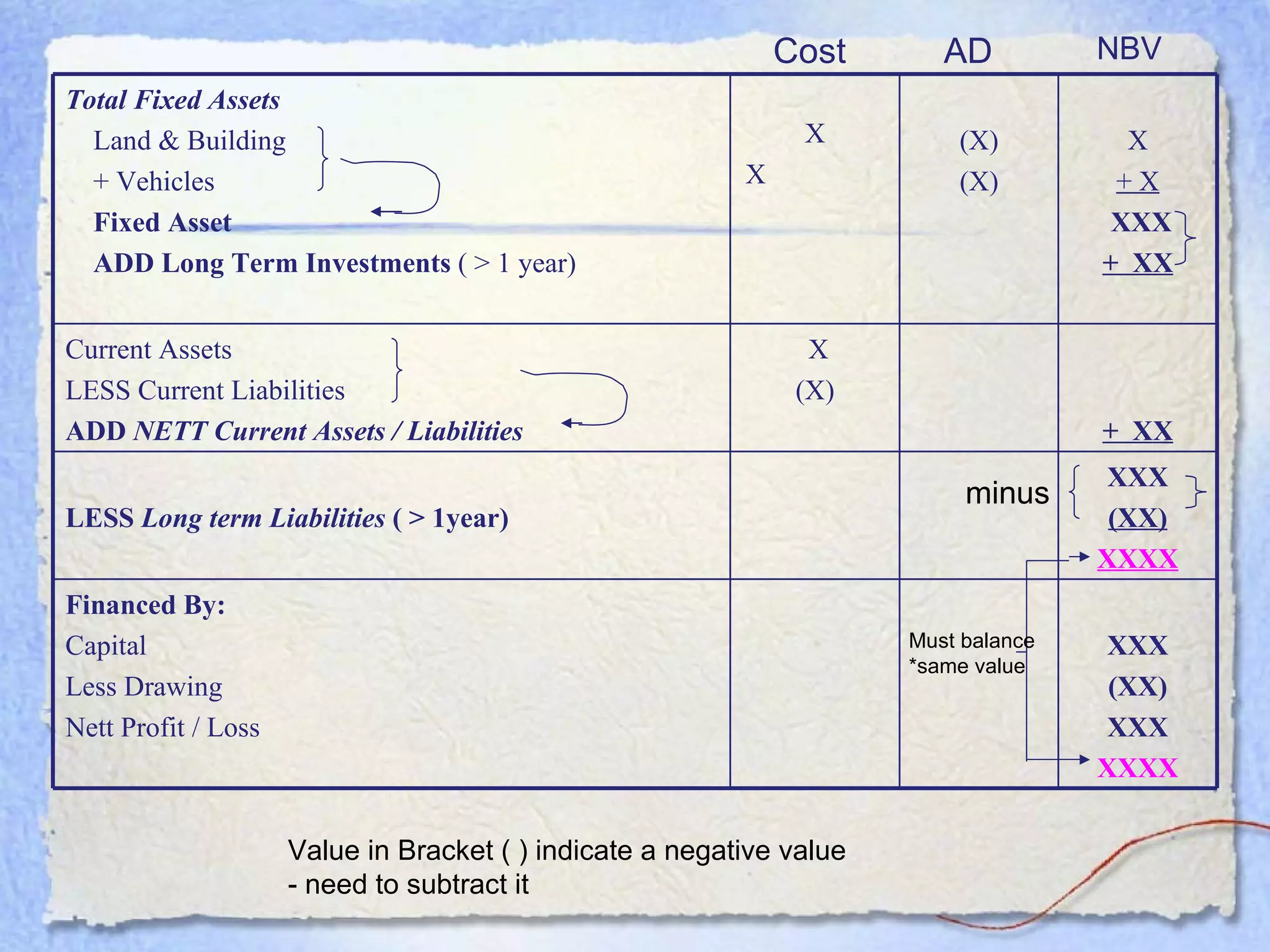
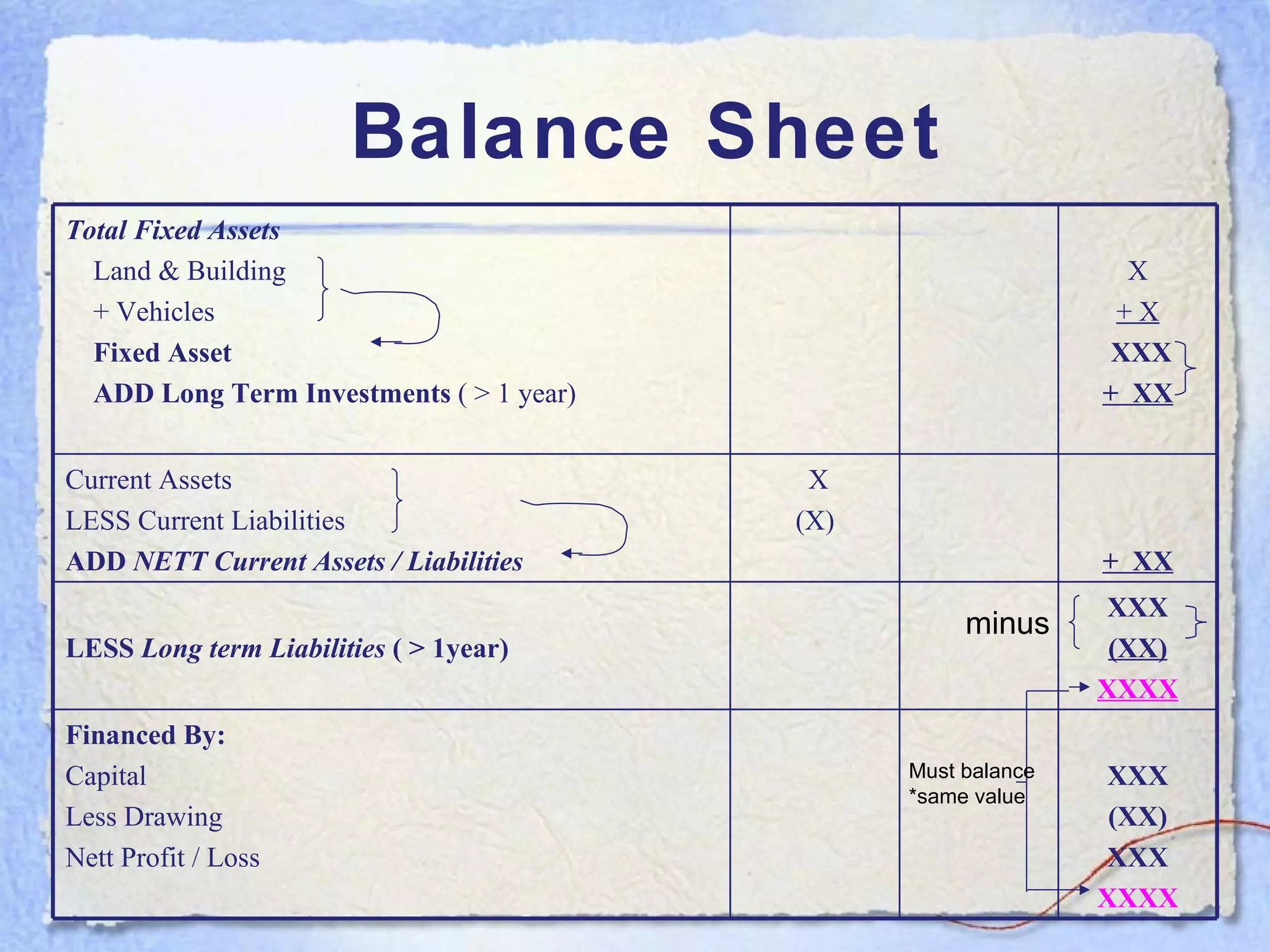
AD NBV minus Cost Value in Bracket ( ) indicate a negative value - need to subtract it Must balance *same value Total Fixed Assets Land & Building + Vehicles Fixed Asset ADD Long Term Investments  ( > 1 year) X X  (X) (X) X + X XXX +  XX Current Assets LESS Current Liabilities ADD  NETT Current Assets / Liabilities X (X) +  XX LESS  Long term Liabilities  ( > 1year) XXX (XX) XXXX Financed By: Capital Less Drawing Nett Profit / Loss XXX (XX) XXX XXXX
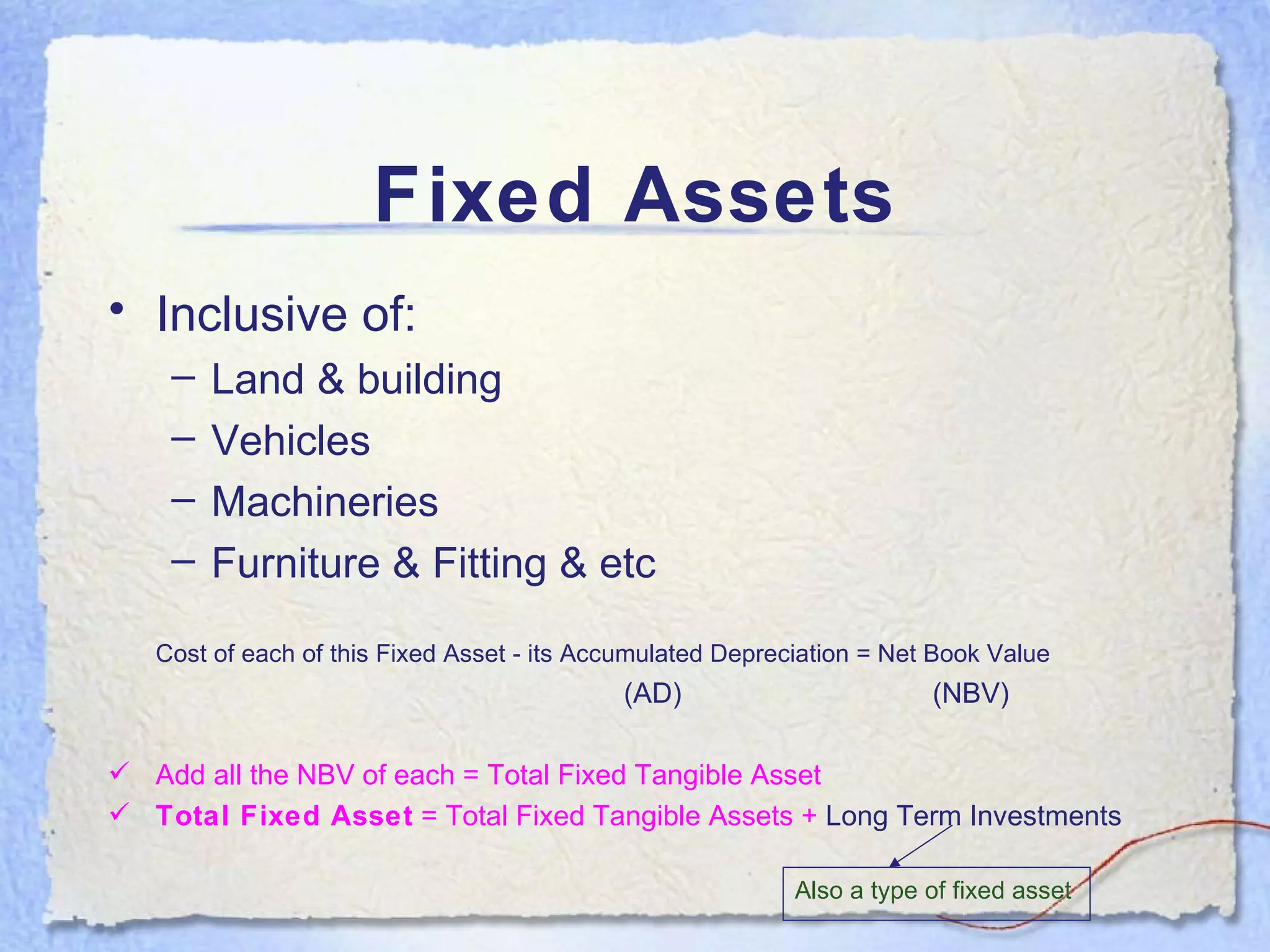
Fixed Assets Inclusive of: Land & building Vehicles Machineries Furniture & Fitting & etc Cost of each of this Fixed Asset - its Accumulated Depreciation = Net Book Value     (AD)    (NBV) Add all the NBV of each = Total Fixed Tangible Asset Total Fixed Asset  = Total Fixed Tangible Assets +  Long Term Investments Also a type of fixed asset
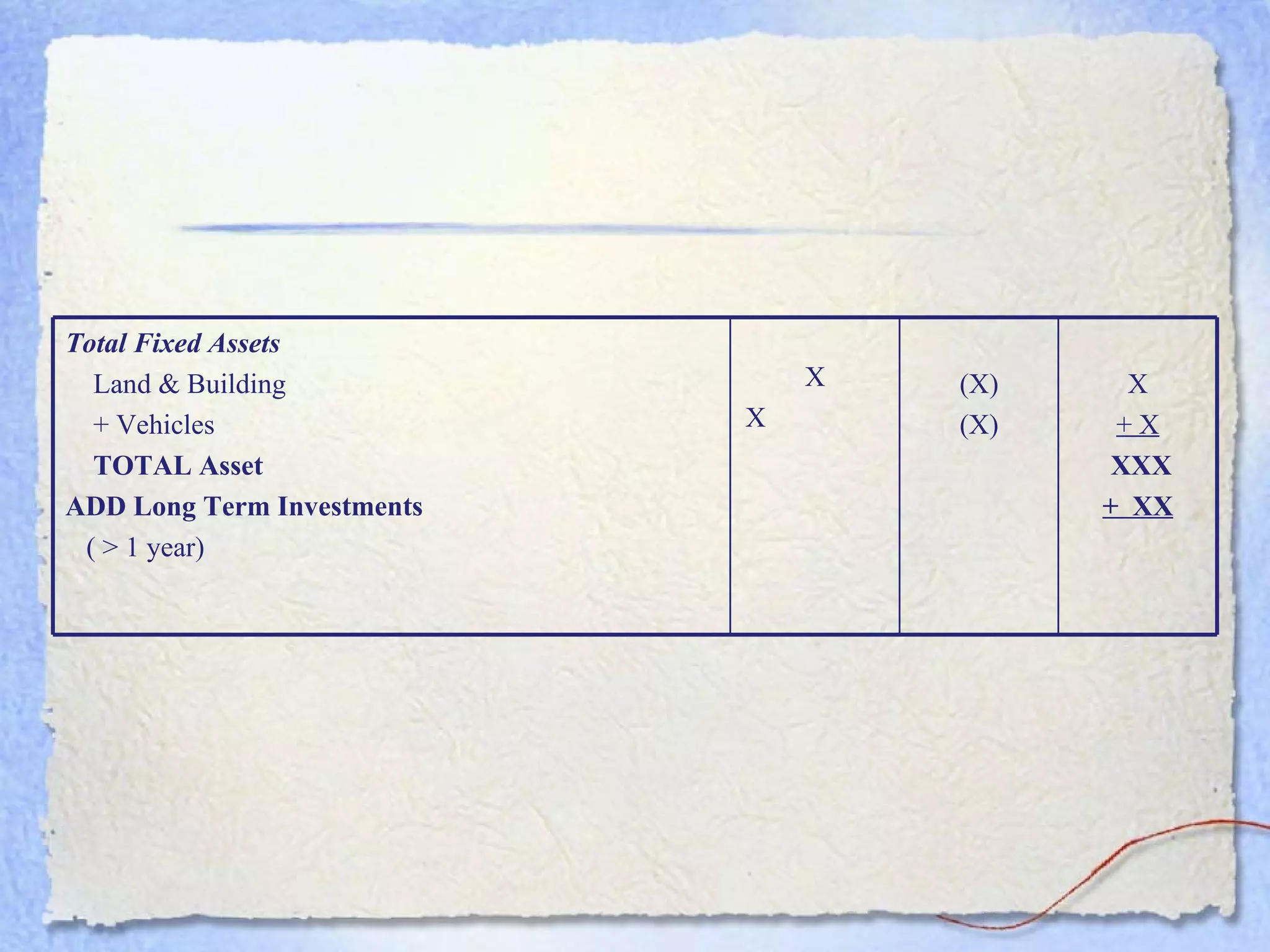
Total Fixed Assets Land & Building + Vehicles TOTAL Asset ADD Long Term Investments ( > 1 year) X X  (X) (X) X + X XXX +  XX
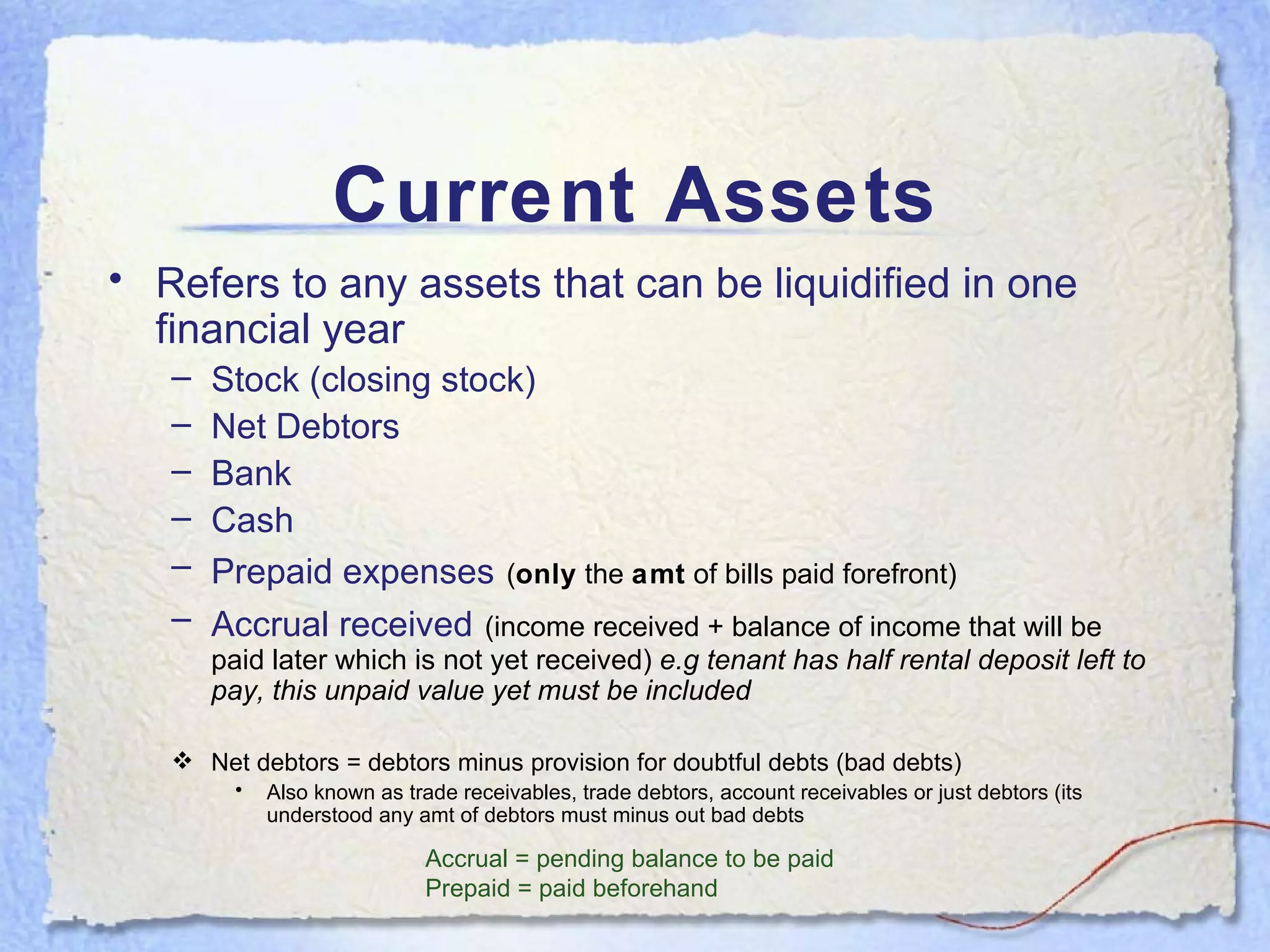
Current Assets Refers to any assets that can be liquidified in one financial year Stock (closing stock) Net Debtors Bank Cash Prepaid expenses   ( only  the  amt  of bills paid forefront) Accrual received   (income received + balance of income that will be paid later which is not yet received)  e.g tenant has half rental deposit left to pay, this unpaid value yet must be included Net debtors = debtors minus provision for doubtful debts (bad debts) Also known as trade receivables, trade debtors, account receivables or just debtors (its understood any amt of debtors must minus out bad debts Accrual = pending balance to be paid Prepaid = paid beforehand
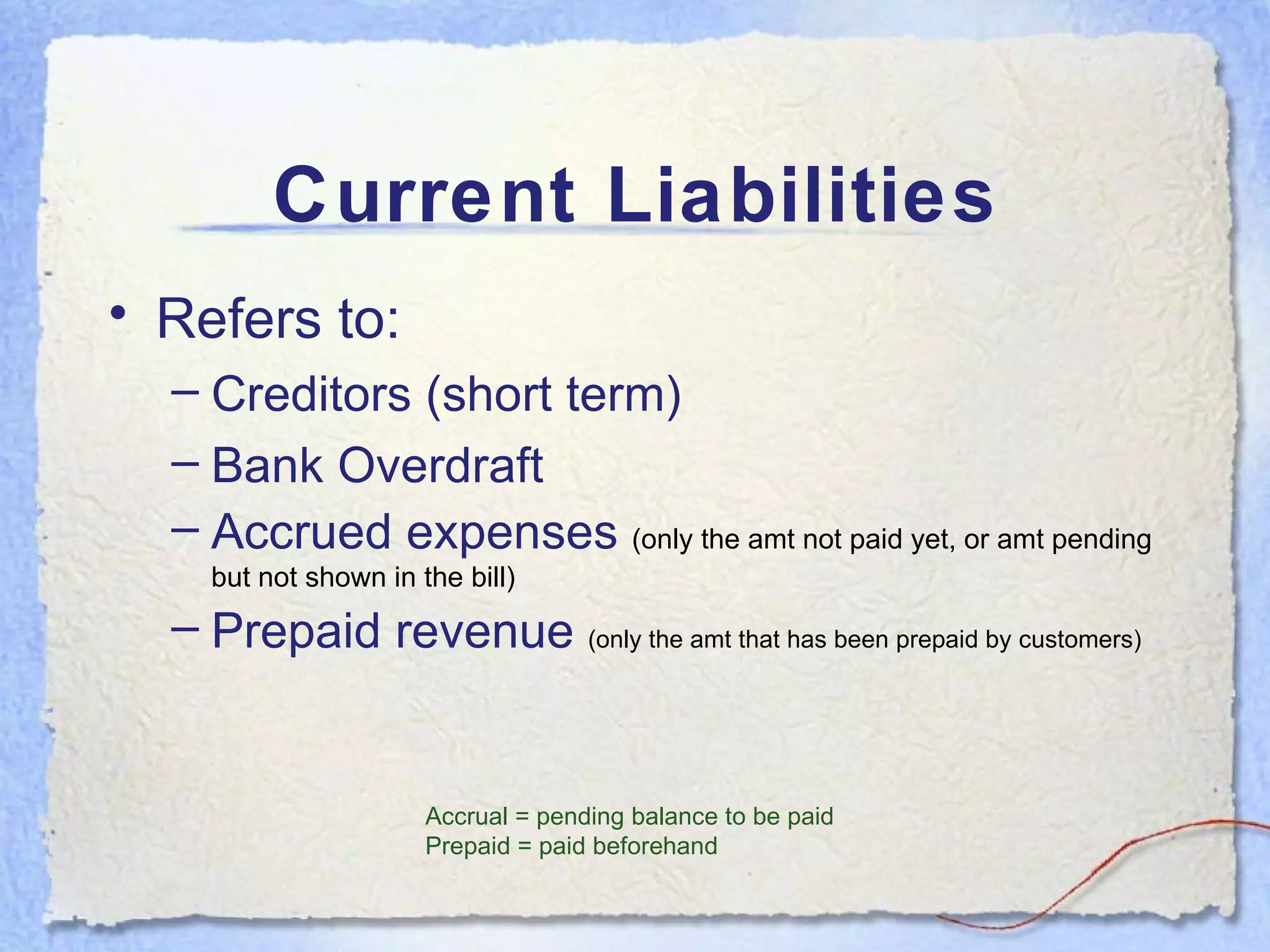
Current Liabilities Refers to: Creditors (short term) Bank Overdraft Accrued expenses  (only the amt not paid yet, or amt pending but not shown in the bill) Prepaid revenue  (only the amt that has been prepaid by customers) Accrual = pending balance to be paid Prepaid = paid beforehand
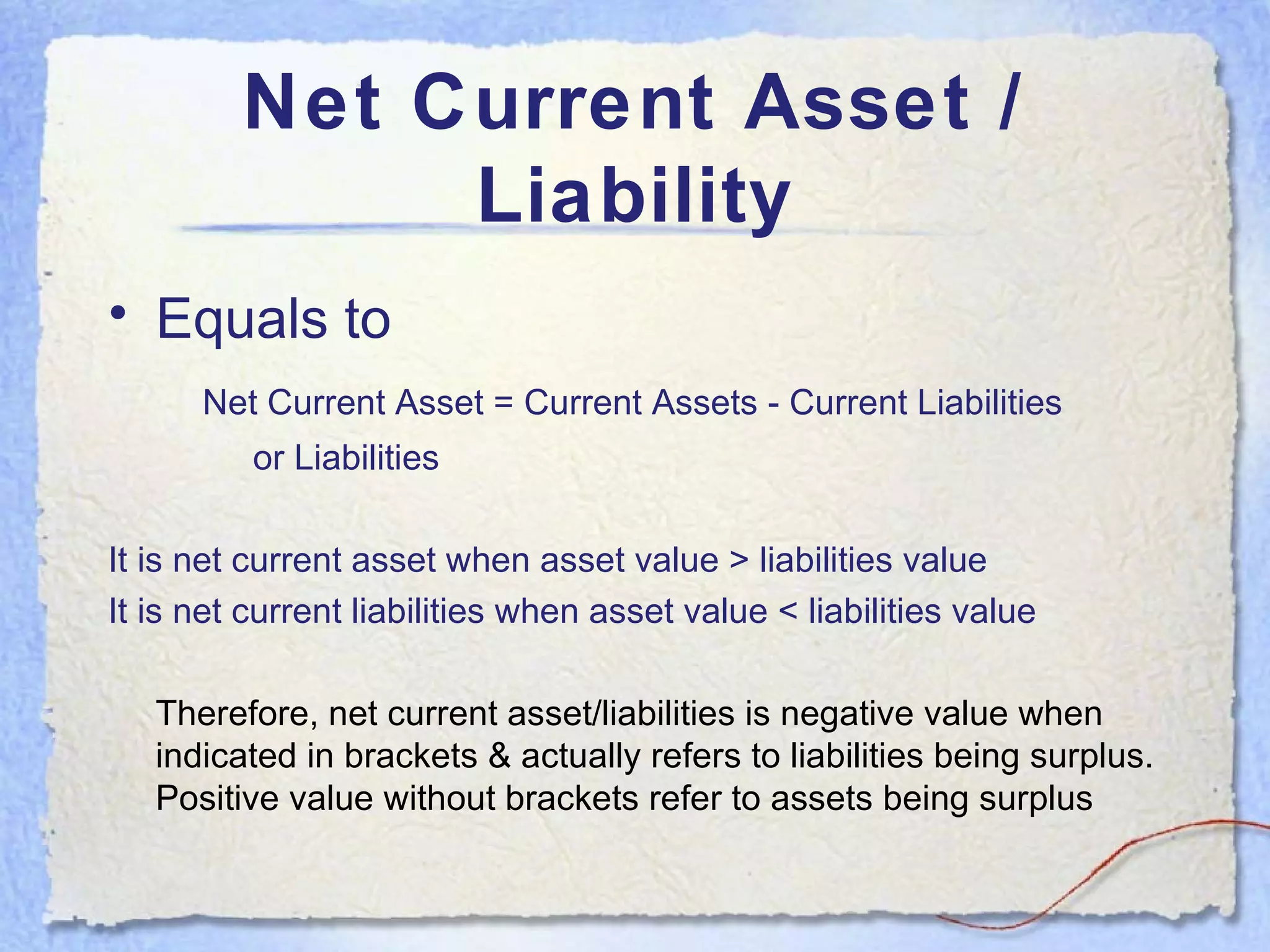
Net Current Asset / Liability Equals to   Net Current Asset = Current Assets - Current Liabilities   or Liabilities It is net current asset when asset value > liabilities value It is net current liabilities when asset value < liabilities value Therefore, net current asset/liabilities is negative value when indicated in brackets & actually refers to liabilities being surplus. Positive value without brackets refer to assets being surplus
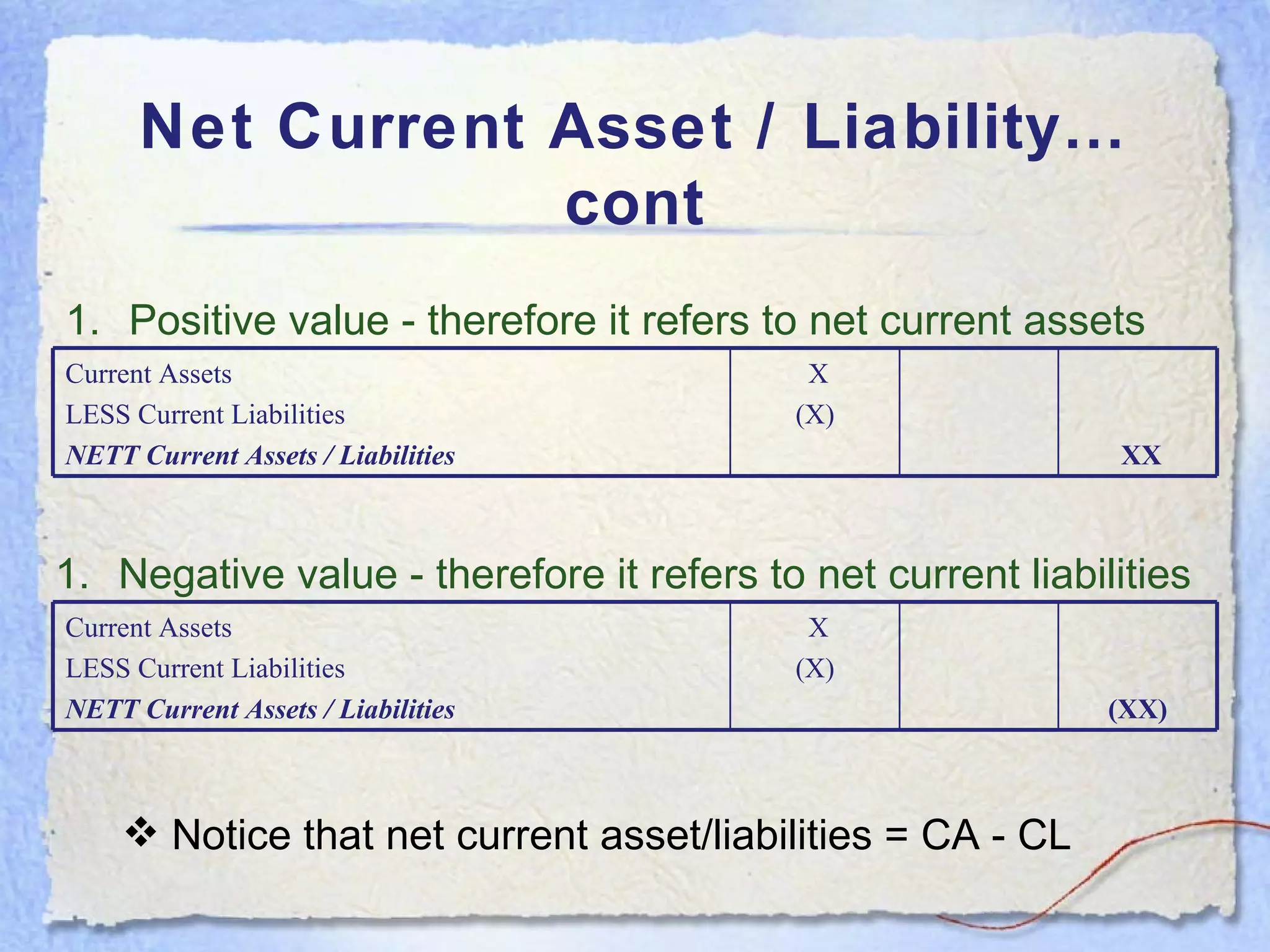
Net Current Asset / Liability… cont Positive value - therefore it refers to net current assets Negative value - therefore it refers to net current liabilities Notice that net current asset/liabilities = CA - CL Current Assets LESS Current Liabilities NETT Current Assets / Liabilities X (X) XX Current Assets LESS Current Liabilities NETT Current Assets / Liabilities X (X) (XX)
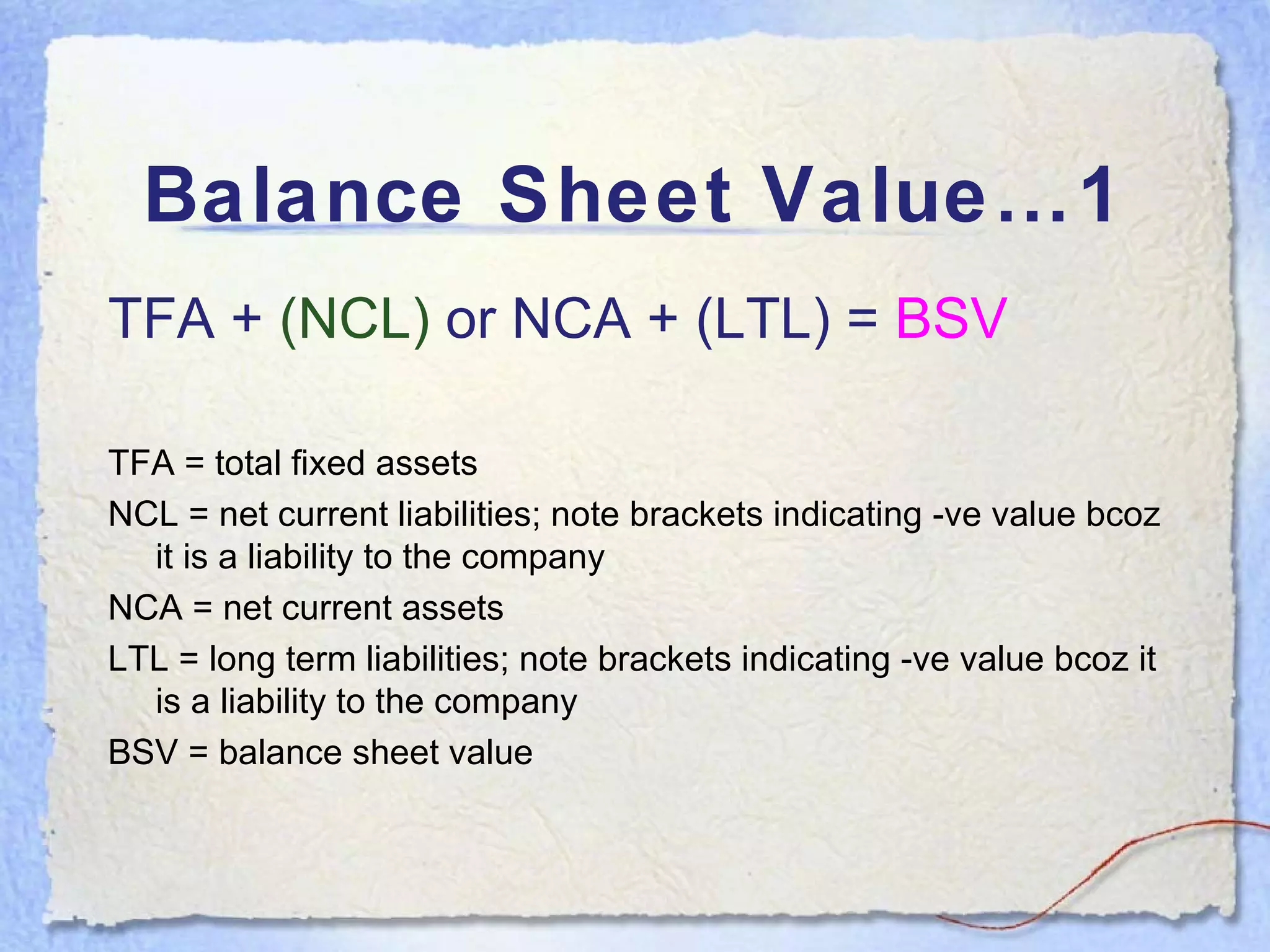
Balance Sheet Value…1 TFA +  (NCL)   or NCA + (LTL) =  BSV TFA = total fixed assets NCL = net current liabilities; note brackets indicating -ve value bcoz it is a liability to the company NCA = net current assets LTL = long term liabilities; note brackets indicating -ve value bcoz it is a liability to the company BSV = balance sheet value
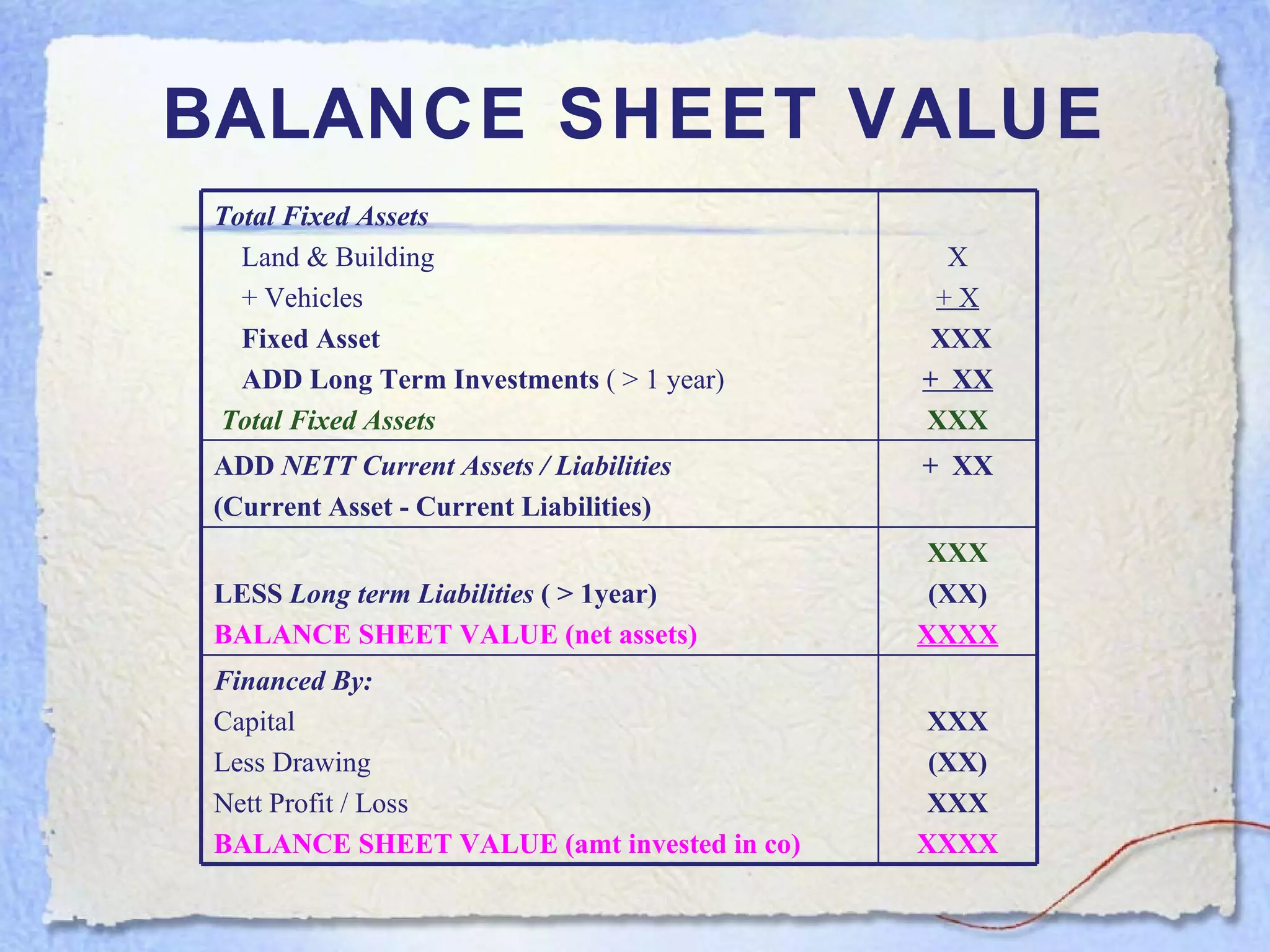
BALANCE SHEET VALUE Total Fixed Assets Land & Building + Vehicles Fixed Asset ADD Long Term Investments  ( > 1 year) Total Fixed Assets X + X XXX +  XX XXX ADD  NETT Current Assets / Liabilities (Current Asset - Current Liabilities) +  XX LESS  Long term Liabilities  ( > 1year) BALANCE SHEET VALUE (net assets) XXX (XX) XXXX Financed By: Capital Less Drawing Nett Profit / Loss BALANCE SHEET VALUE (amt invested in co) XXX (XX) XXX XXXX
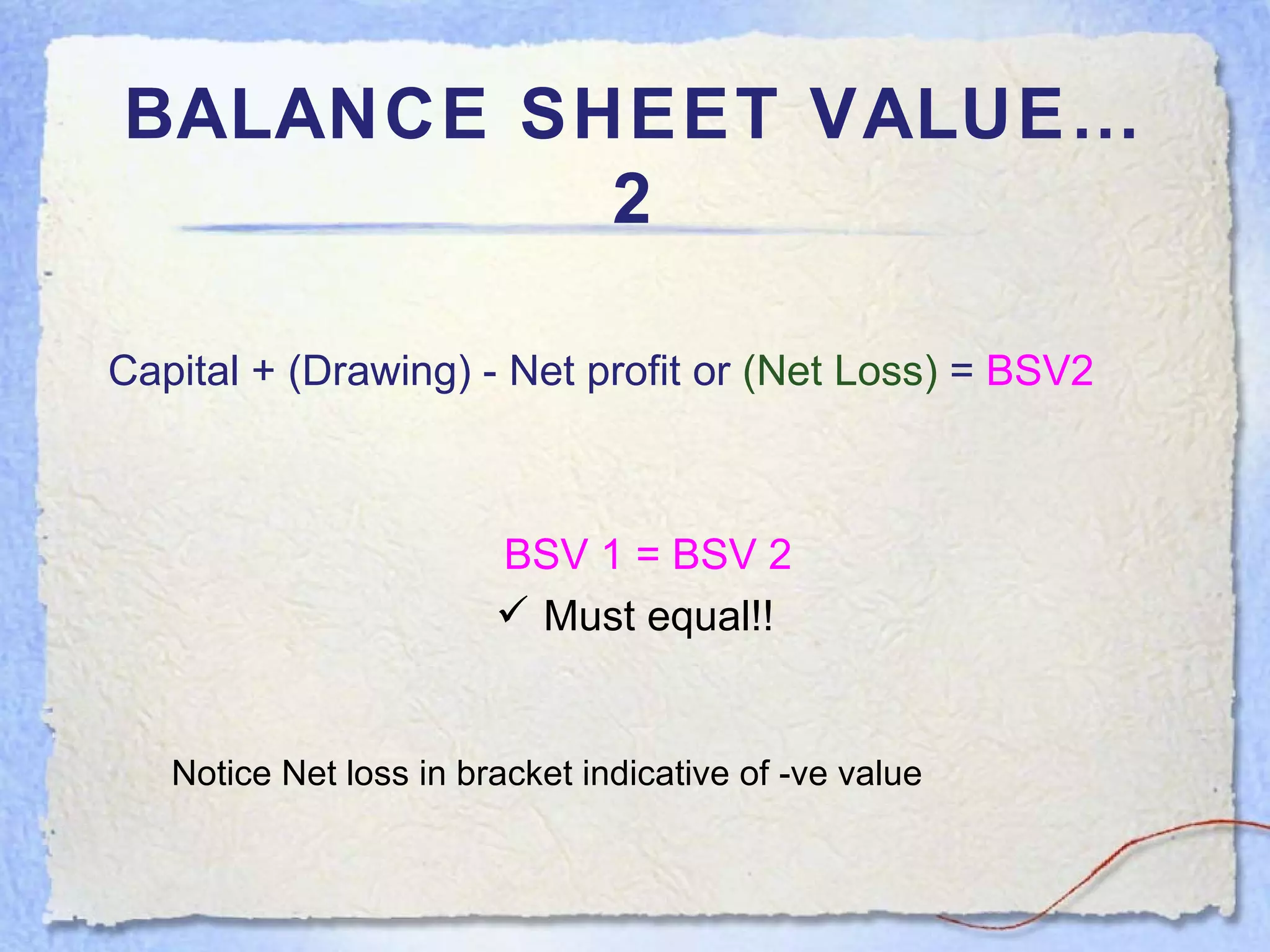
BALANCE SHEET VALUE…2 Capital + (Drawing) - Net profit or  (Net Loss)  =  BSV2   BSV 1 = BSV 2   Must equal!! Notice Net loss in bracket indicative of -ve value
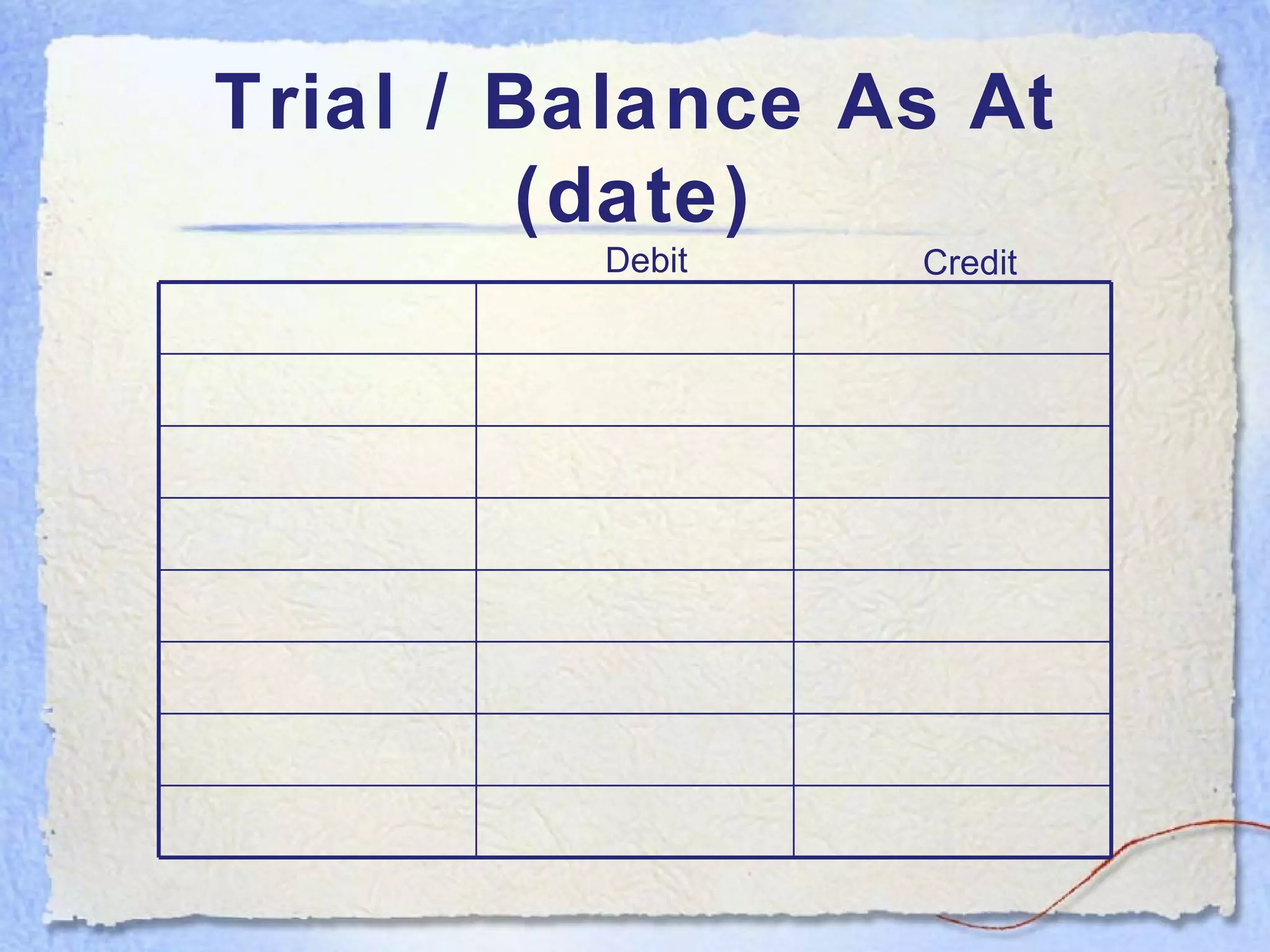
Trial / Balance As At (date) Debit Credit
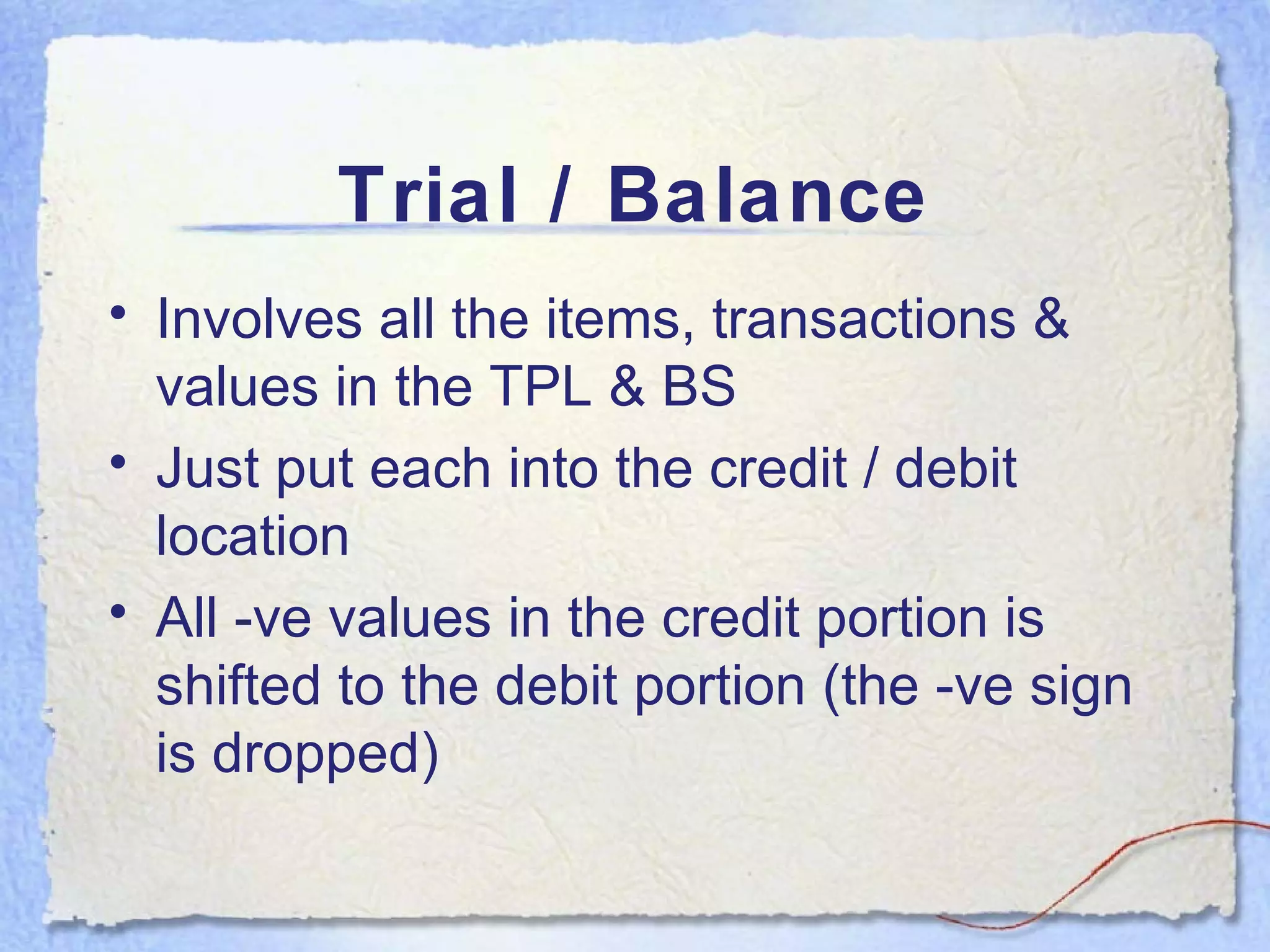
Trial / Balance Involves all the items, transactions & values in the TPL & BS Just put each into the credit / debit location All -ve values in the credit portion is shifted to the debit portion (the -ve sign is dropped)
Balance Sheet minus Must balance *same value Total Fixed Assets Land & Building + Vehicles Fixed Asset ADD Long Term Investments  ( > 1 year) X + X XXX +  XX Current Assets LESS Current Liabilities ADD  NETT Current Assets / Liabilities X (X) +  XX LESS  Long term Liabilities  ( > 1year) XXX (XX) XXXX Financed By: Capital Less Drawing Nett Profit / Loss XXX (XX) XXX XXXX
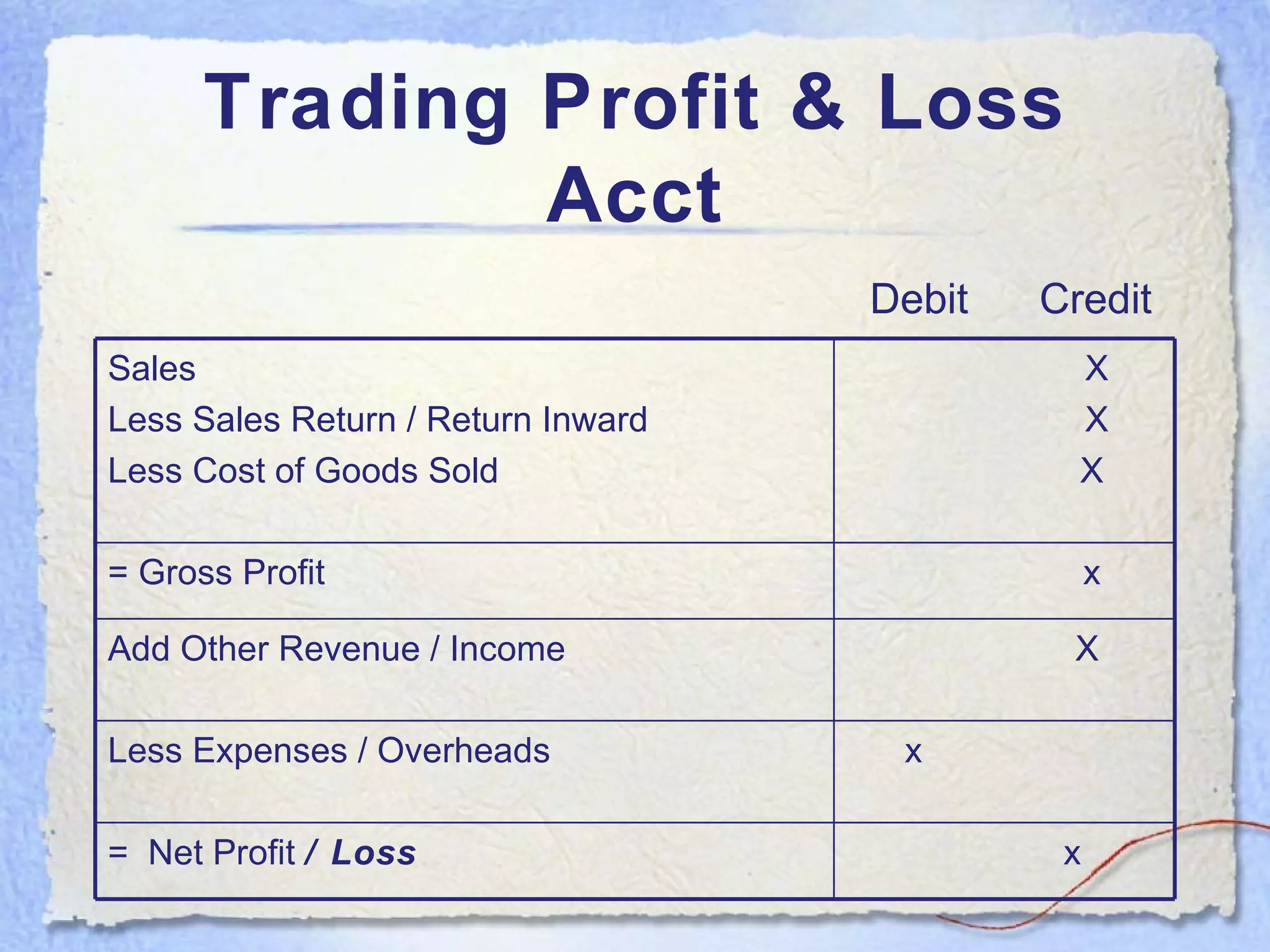
Trading Profit & Loss Acct Debit Credit Sales Less Sales Return / Return Inward  Less Cost of Goods Sold X X X = Gross Profit x Add Other Revenue / Income X Less Expenses / Overheads x =  Net Profit  / Loss x
END This completes my lesson on economics!  I hope you enjoyed the tour.  Economics is an important part of our lives.  Think of all of the ways you use economics everyday!  Goodbye!
NOTES
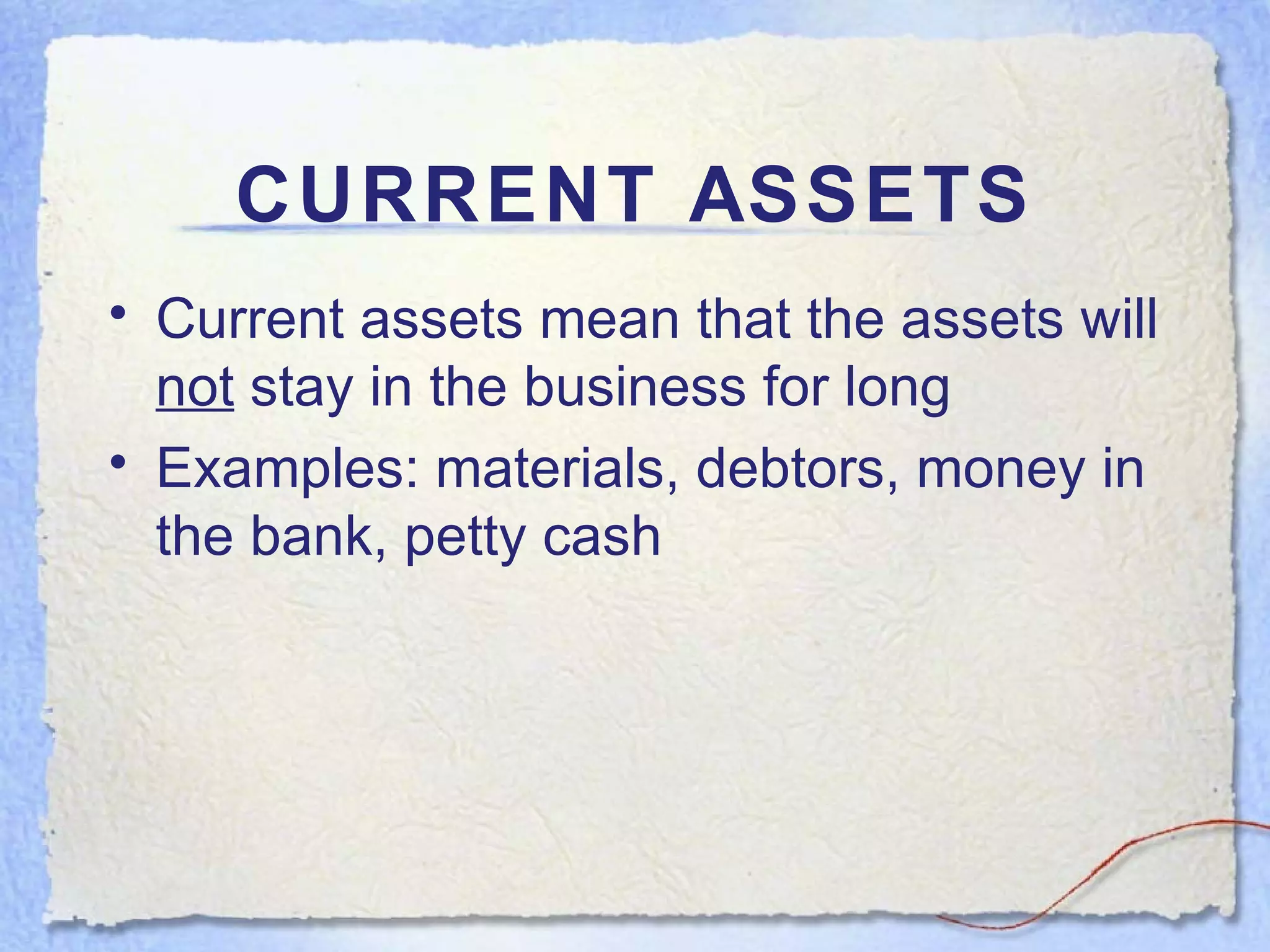
CURRENT ASSETS Current assets mean that the assets will  not  stay in the business for long Examples: materials, debtors, money in the bank, petty cash
CURRENT LIABILITIES The amount of money that a business owes other people and other businesses (creditors) Liabilities are “current” because the amount owed can vary from one day to the next They must be paid back within a year
NET CURRENT ASSETS ASSETS  minus   LIABILITIES  (current & fixed)  (current)
LONG TERM LIABILITIES These are debts need paying back in the future (one year +) Examples: Loans, mortgages
NET ASSETS ASSETS  minus   LIABILITIES  (current & fixed)  (Current & fixed)
The second section of the balance sheet This looks at where the money which was used to buy the long term and short term assets came from
The start up of the business is funded by: CAPITAL & RESERVES SHARE CAPITAL – The amount of money paid by shareholders in return for a share in the business. PROFIT & LOSS ACCOUNT – Net profit from the previous financial year is transferred into the balance sheet. RETAINED PROFIT – businesses do not give all of their profits back to shareholder
NET ASSETS SHOULD  EQUAL  THE AMOUNT OF MONEY THAT HAS BEEN INVESTED IN THE BUSINESS BOTH PARTS OF THE BALANCE SHEET MUST BALANCE
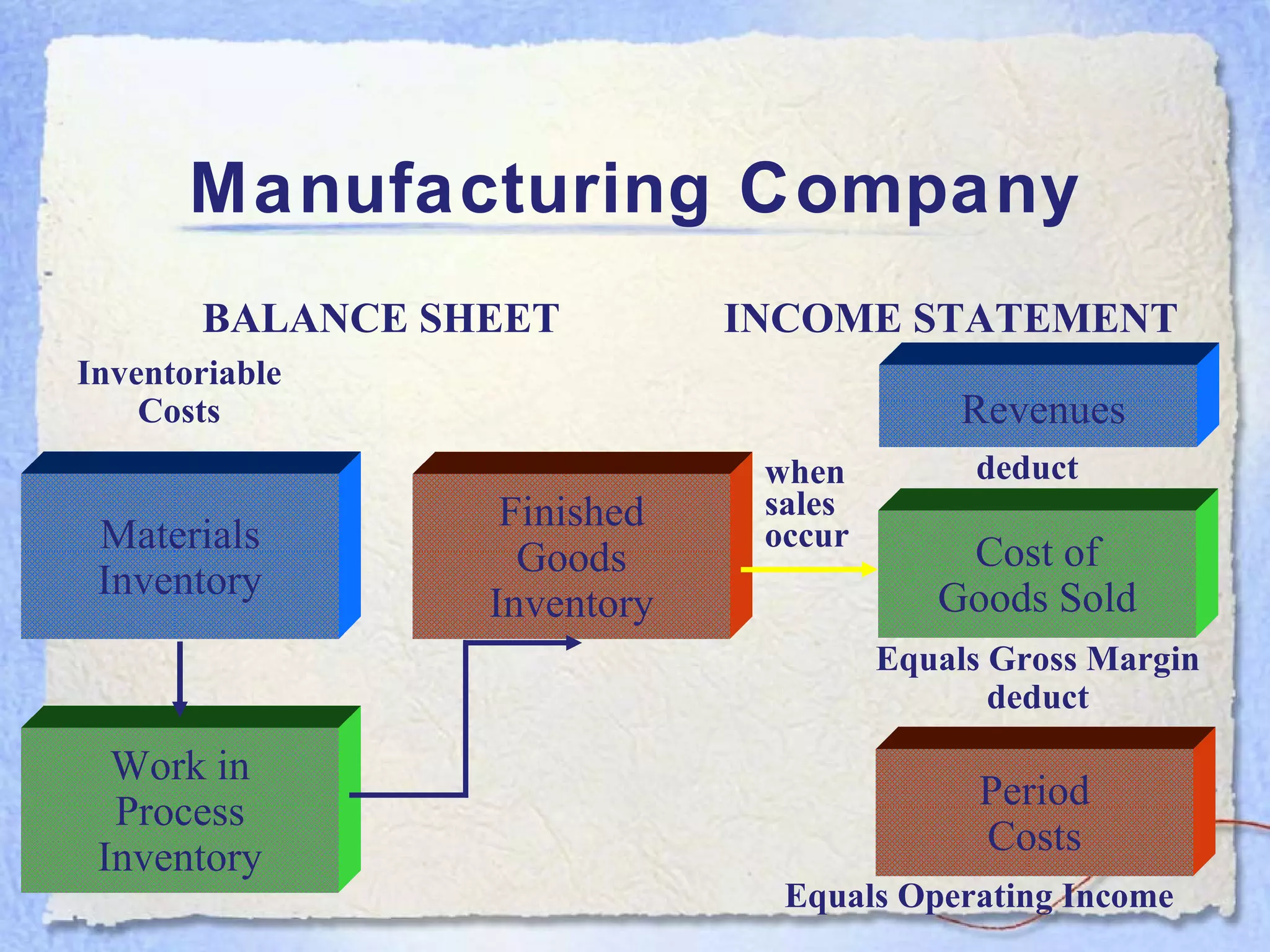
Manufacturing Company Materials Inventory Finished Goods Inventory Revenues Cost of Goods Sold INCOME STATEMENT Period Costs Inventoriable Costs BALANCE SHEET Equals Operating Income when sales occur deduct Equals Gross Margin deduct Work in Process Inventory
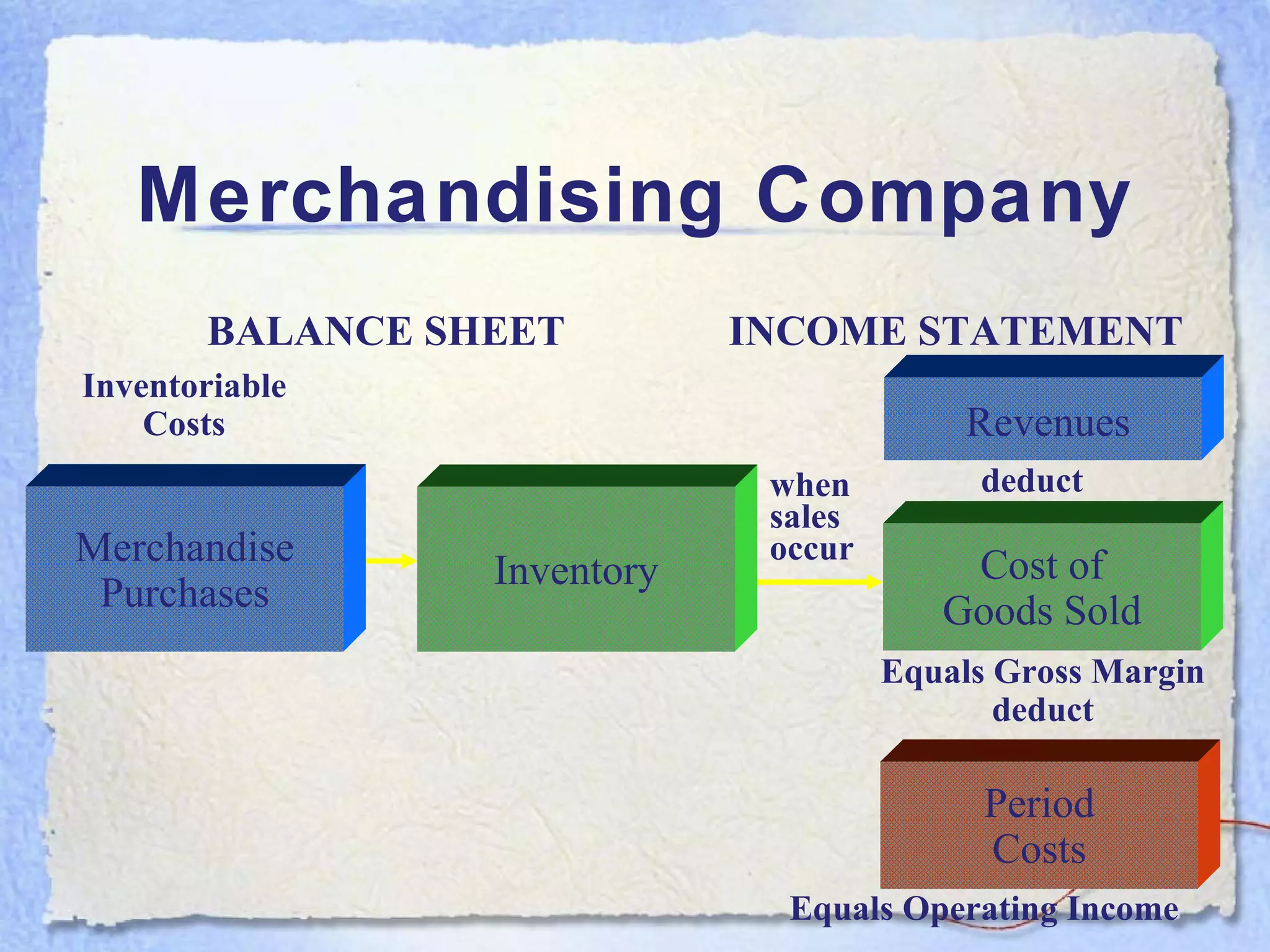
Merchandising Company INCOME STATEMENT BALANCE SHEET when sales occur Inventoriable Costs Merchandise Purchases Inventory Revenues deduct Cost of Goods Sold Equals Gross Margin deduct Period Costs Equals Operating Income
END

Lecture 4 b practice economics

  • 1.
    PRACTICE ECONOMICS…2 MsRosmin Bt Iqbal Hussain BOptom (UKM), CMBA (UNIMAS)
  • 2.
    Introduction Hi! Wecontinue on to Balance Sheet!!!
  • 3.
  • 4.
    What is aBalance sheet? The balance sheet is a financial statement It is a list of all the assets (what the business owns) and all the liabilities (what the business owes) of a business
  • 5.
    The balance sheetis a financial “snap shot” It lists the assets and liabilities of the business on a particular day
  • 6.
    Balance Sheet Asnapshot of the firm’s position at a point in time Shows what a company owns (assets) and what it owes (liabilities) Balance Sheet shows what assets a company has (use of funds) and where the money came from to acquire those assets (source of funds)
  • 7.
    Balance Sheet Aguide to the structure of the assets of a company A guide to the level of gearing – the ratio of loan to share capital Gives a guide as to the degree of working capital – the amount the company has to be able to pay its everyday debts (current assets – current liabilities) Shows the total value of a firm at that moment in time
  • 8.
    AD NBV minusCost Value in Bracket ( ) indicate a negative value - need to subtract it Must balance *same value Total Fixed Assets Land & Building + Vehicles Fixed Asset ADD Long Term Investments ( > 1 year) X X (X) (X) X + X XXX + XX Current Assets LESS Current Liabilities ADD NETT Current Assets / Liabilities X (X) + XX LESS Long term Liabilities ( > 1year) XXX (XX) XXXX Financed By: Capital Less Drawing Nett Profit / Loss XXX (XX) XXX XXXX
  • 9.
    Fixed Assets Inclusiveof: Land & building Vehicles Machineries Furniture & Fitting & etc Cost of each of this Fixed Asset - its Accumulated Depreciation = Net Book Value (AD) (NBV) Add all the NBV of each = Total Fixed Tangible Asset Total Fixed Asset = Total Fixed Tangible Assets + Long Term Investments Also a type of fixed asset
  • 10.
    Total Fixed AssetsLand & Building + Vehicles TOTAL Asset ADD Long Term Investments ( > 1 year) X X (X) (X) X + X XXX + XX
  • 11.
    Current Assets Refersto any assets that can be liquidified in one financial year Stock (closing stock) Net Debtors Bank Cash Prepaid expenses ( only the amt of bills paid forefront) Accrual received (income received + balance of income that will be paid later which is not yet received) e.g tenant has half rental deposit left to pay, this unpaid value yet must be included Net debtors = debtors minus provision for doubtful debts (bad debts) Also known as trade receivables, trade debtors, account receivables or just debtors (its understood any amt of debtors must minus out bad debts Accrual = pending balance to be paid Prepaid = paid beforehand
  • 12.
    Current Liabilities Refersto: Creditors (short term) Bank Overdraft Accrued expenses (only the amt not paid yet, or amt pending but not shown in the bill) Prepaid revenue (only the amt that has been prepaid by customers) Accrual = pending balance to be paid Prepaid = paid beforehand
  • 13.
    Net Current Asset/ Liability Equals to Net Current Asset = Current Assets - Current Liabilities or Liabilities It is net current asset when asset value > liabilities value It is net current liabilities when asset value < liabilities value Therefore, net current asset/liabilities is negative value when indicated in brackets & actually refers to liabilities being surplus. Positive value without brackets refer to assets being surplus
  • 14.
    Net Current Asset/ Liability… cont Positive value - therefore it refers to net current assets Negative value - therefore it refers to net current liabilities Notice that net current asset/liabilities = CA - CL Current Assets LESS Current Liabilities NETT Current Assets / Liabilities X (X) XX Current Assets LESS Current Liabilities NETT Current Assets / Liabilities X (X) (XX)
  • 15.
    Balance Sheet Value…1TFA + (NCL) or NCA + (LTL) = BSV TFA = total fixed assets NCL = net current liabilities; note brackets indicating -ve value bcoz it is a liability to the company NCA = net current assets LTL = long term liabilities; note brackets indicating -ve value bcoz it is a liability to the company BSV = balance sheet value
  • 16.
    BALANCE SHEET VALUETotal Fixed Assets Land & Building + Vehicles Fixed Asset ADD Long Term Investments ( > 1 year) Total Fixed Assets X + X XXX + XX XXX ADD NETT Current Assets / Liabilities (Current Asset - Current Liabilities) + XX LESS Long term Liabilities ( > 1year) BALANCE SHEET VALUE (net assets) XXX (XX) XXXX Financed By: Capital Less Drawing Nett Profit / Loss BALANCE SHEET VALUE (amt invested in co) XXX (XX) XXX XXXX
  • 17.
    BALANCE SHEET VALUE…2Capital + (Drawing) - Net profit or (Net Loss) = BSV2 BSV 1 = BSV 2 Must equal!! Notice Net loss in bracket indicative of -ve value
  • 18.
    Trial / BalanceAs At (date) Debit Credit
  • 19.
    Trial / BalanceInvolves all the items, transactions & values in the TPL & BS Just put each into the credit / debit location All -ve values in the credit portion is shifted to the debit portion (the -ve sign is dropped)
  • 20.
    Balance Sheet minusMust balance *same value Total Fixed Assets Land & Building + Vehicles Fixed Asset ADD Long Term Investments ( > 1 year) X + X XXX + XX Current Assets LESS Current Liabilities ADD NETT Current Assets / Liabilities X (X) + XX LESS Long term Liabilities ( > 1year) XXX (XX) XXXX Financed By: Capital Less Drawing Nett Profit / Loss XXX (XX) XXX XXXX
  • 21.
    Trading Profit &Loss Acct Debit Credit Sales Less Sales Return / Return Inward Less Cost of Goods Sold X X X = Gross Profit x Add Other Revenue / Income X Less Expenses / Overheads x = Net Profit / Loss x
  • 22.
    END This completesmy lesson on economics! I hope you enjoyed the tour. Economics is an important part of our lives. Think of all of the ways you use economics everyday! Goodbye!
  • 23.
  • 24.
    CURRENT ASSETS Currentassets mean that the assets will not stay in the business for long Examples: materials, debtors, money in the bank, petty cash
  • 25.
    CURRENT LIABILITIES Theamount of money that a business owes other people and other businesses (creditors) Liabilities are “current” because the amount owed can vary from one day to the next They must be paid back within a year
  • 26.
    NET CURRENT ASSETSASSETS minus LIABILITIES (current & fixed) (current)
  • 27.
    LONG TERM LIABILITIESThese are debts need paying back in the future (one year +) Examples: Loans, mortgages
  • 28.
    NET ASSETS ASSETS minus LIABILITIES (current & fixed) (Current & fixed)
  • 29.
    The second sectionof the balance sheet This looks at where the money which was used to buy the long term and short term assets came from
  • 30.
    The start upof the business is funded by: CAPITAL & RESERVES SHARE CAPITAL – The amount of money paid by shareholders in return for a share in the business. PROFIT & LOSS ACCOUNT – Net profit from the previous financial year is transferred into the balance sheet. RETAINED PROFIT – businesses do not give all of their profits back to shareholder
  • 31.
    NET ASSETS SHOULD EQUAL THE AMOUNT OF MONEY THAT HAS BEEN INVESTED IN THE BUSINESS BOTH PARTS OF THE BALANCE SHEET MUST BALANCE
  • 32.
    Manufacturing Company MaterialsInventory Finished Goods Inventory Revenues Cost of Goods Sold INCOME STATEMENT Period Costs Inventoriable Costs BALANCE SHEET Equals Operating Income when sales occur deduct Equals Gross Margin deduct Work in Process Inventory
  • 33.
    Merchandising Company INCOMESTATEMENT BALANCE SHEET when sales occur Inventoriable Costs Merchandise Purchases Inventory Revenues deduct Cost of Goods Sold Equals Gross Margin deduct Period Costs Equals Operating Income
  • 34.