The Basics of Autism
Spectrum Disorders
  Training Series

     Regional Autism Advisory Council of

        Southwest Ohio (RAAC-SWO)

    Adults with Autism Spectrum Disorders

                 Task Force
Adult Training Series
         Modules
 Module One: Autism Defined, Autism Prevalence
  and Primary Characteristics
 Module Two: Physical Characteristics of Autism
 Module Three: Cognition and Learning in Autism
 Module Four: Autism and Sensory Differences
 Module Five: Communication and Autism
Adult Training Series
          Modules
 Module Six: Behavior Challenges and Autism
 Module Seven: Understanding Behavior in Persons
  with Autism
 Module Eight: Functional Behavior Assessment
 Module Nine: Autism and Leisure Skills to Teach
 Module Ten: Special Issues of Adolescence and
  Adulthood
 Module Eleven: Safety and Autism
Behavior Characteristics
People with ASD do not all behave the same. They
have differences based on their communication, social
skills, ability to cope, and their environment.

The following slides will describe four categories of
behavior:
   Social Interaction
   Activity Level
   Repetitive Behaviors
   Aggression
Big Idea


The goal is not for us to change the
  person, but to improve their ability
  to interact with and participate in
              their world.
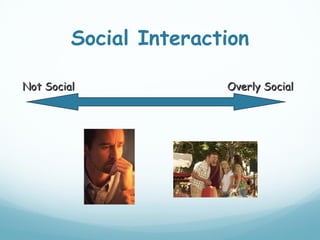
Social Interaction

Not Social              Overly Social
Strategies for Social
         Interaction
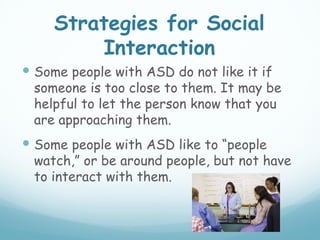
 Some people with ASD do not like it if
 someone is too close to them. It may be
 helpful to let the person know that you
 are approaching them.
 Some people with ASD like to “people
 watch,” or be around people, but not have
 to interact with them.
Strategies for Social
        Interaction
 Some people with ASD do not mind
 others being nearby, they just ignore
 them. You may have to explain this to
 others so that they do not get their
 feelings hurt
 Encourage, but do not force the person
 with ASD to interact.
Strategies for Social
          Interaction
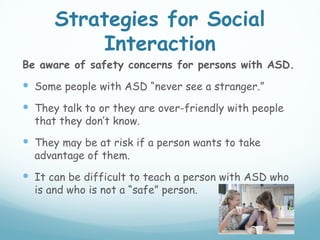
Be aware of safety concerns for persons with ASD.
 Some people with ASD “never see a stranger.”
 They talk to or they are over-friendly with people
  that they don’t know.
 They may be at risk if a person wants to take
  advantage of them.
 It can be difficult to teach a person with ASD who
  is and who is not a “safe” person.
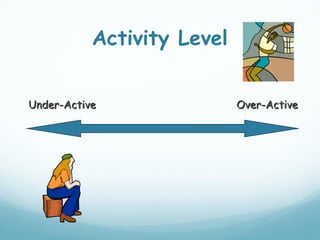
Activity Level


Under-Active                Over-Active
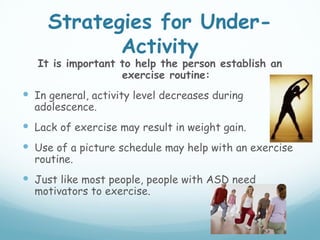
Strategies for Under-
            Activity
   It is important to help the person establish an
                   exercise routine:
 In general, activity level decreases during
  adolescence.
 Lack of exercise may result in weight gain.
 Use of a picture schedule may help with an exercise
  routine.
 Just like most people, people with ASD need
  motivators to exercise.
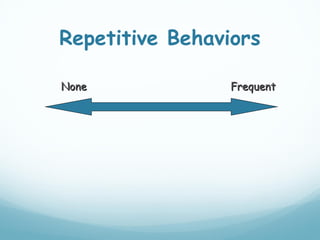
Repetitive Behaviors

None             Frequent
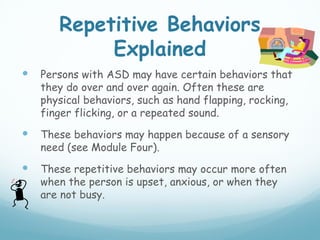
Repetitive Behaviors
            Explained
   Persons with ASD may have certain behaviors that
    they do over and over again. Often these are
    physical behaviors, such as hand flapping, rocking,
    finger flicking, or a repeated sound.
   These behaviors may happen because of a sensory
    need (see Module Four).
   These repetitive behaviors may occur more often
    when the person is upset, anxious, or when they
    are not busy.
Strategies for Addressing
        Repetitive Behaviors
 Be aware that down or free time often leads to the
  person engaging in these behaviors.
 Help the person find things that they can do during
  down time.
 There are times that you may want to give the
  person something else to do that limits their use of
  the repetitive behavior (i.e. if they flap arms, give
  them something to carry when they are out in the
  community).
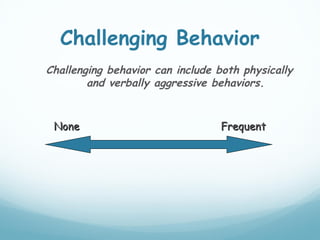
Challenging Behavior
Challenging behavior can include both physically
        and verbally aggressive behaviors.


 None                             Frequent
Challenging Behavior May Be
            the Result Of*……
 Difficulty expressing basic wants, needs and feelings.
 Not knowing how to ask for help or how to get someone’s
  attention.

 Appearing to understand directions even when they don’t.
  We may think they are being uncooperative.

 Difficulty understanding explanations, reassurance or
  instructions.

*Adapted from Nancy Dalrymple’s Helping Children with Autism Learn to
  “Behave”
Challenging Behavior May Be the
          Result of…..
 Difficulty understanding social rules or social interaction.

 Difficulty understanding the viewpoint and motives of others.

 Need for longer than usual time to process, organize, and
  retrieve information.

 Dependence on routines and not coping when events are out of
  order.

 Limited number of interests and activities.

 Sensory overload.
Challenging Behavior May Be the
           Result Of…
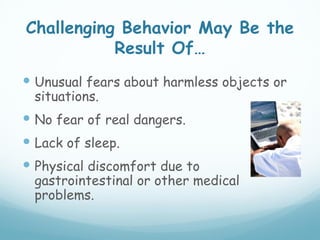
 Unusual fears about harmless objects or
  situations.
 No fear of real dangers.
 Lack of sleep.
 Physical discomfort due to
  gastrointestinal or other medical
  problems.
Strategies for Addressing
    Challenging Behaviors
 We must first understand the reason behind the
  behavior (refer to Module Eight).
 It is very important that the individual with ASD has
  a way to communicate so that others can easily
  understand them.
 Be sure they understand what you are saying. Just
  because the person can talk, they still may not be
  able to understand you.
 Check out, and rule out, any medical reasons for a
  behavior ( i.e. heartburn, localized pain).
More Strategies…..
 The problem could be something in the
  environment (sensory) that needs to be
  changed.
 Give the person time to follow instructions.
 New places and things can be hard.
  Gradually introduce new people, places, and
  things whenever possible.
Even More Strategies….
 Change is very hard. Prepare the person for
  change. Practice change. It helps to break a
  task into small steps.
 Teach new skills or new things in many
  different settings with different people.
 Be aware of your own behavior and how your
  mood or behaviors can influence a person
  with ASD.
Big Idea


We must first understand
 why a behavior happens
 before we can change it.

Behavior Challenges and Autism

  • 1.
    The Basics ofAutism Spectrum Disorders Training Series Regional Autism Advisory Council of Southwest Ohio (RAAC-SWO) Adults with Autism Spectrum Disorders Task Force
  • 2.
    Adult Training Series Modules  Module One: Autism Defined, Autism Prevalence and Primary Characteristics  Module Two: Physical Characteristics of Autism  Module Three: Cognition and Learning in Autism  Module Four: Autism and Sensory Differences  Module Five: Communication and Autism
  • 3.
    Adult Training Series Modules  Module Six: Behavior Challenges and Autism  Module Seven: Understanding Behavior in Persons with Autism  Module Eight: Functional Behavior Assessment  Module Nine: Autism and Leisure Skills to Teach  Module Ten: Special Issues of Adolescence and Adulthood  Module Eleven: Safety and Autism
  • 4.
    Behavior Characteristics People withASD do not all behave the same. They have differences based on their communication, social skills, ability to cope, and their environment. The following slides will describe four categories of behavior:  Social Interaction  Activity Level  Repetitive Behaviors  Aggression
  • 5.
    Big Idea The goalis not for us to change the person, but to improve their ability to interact with and participate in their world.
  • 6.
  • 7.
    Strategies for Social Interaction  Some people with ASD do not like it if someone is too close to them. It may be helpful to let the person know that you are approaching them.  Some people with ASD like to “people watch,” or be around people, but not have to interact with them.
  • 8.
    Strategies for Social Interaction  Some people with ASD do not mind others being nearby, they just ignore them. You may have to explain this to others so that they do not get their feelings hurt  Encourage, but do not force the person with ASD to interact.
  • 9.
    Strategies for Social Interaction Be aware of safety concerns for persons with ASD.  Some people with ASD “never see a stranger.”  They talk to or they are over-friendly with people that they don’t know.  They may be at risk if a person wants to take advantage of them.  It can be difficult to teach a person with ASD who is and who is not a “safe” person.
  • 10.
  • 11.
    Strategies for Under- Activity It is important to help the person establish an exercise routine:  In general, activity level decreases during adolescence.  Lack of exercise may result in weight gain.  Use of a picture schedule may help with an exercise routine.  Just like most people, people with ASD need motivators to exercise.
  • 12.
  • 13.
    Repetitive Behaviors Explained  Persons with ASD may have certain behaviors that they do over and over again. Often these are physical behaviors, such as hand flapping, rocking, finger flicking, or a repeated sound.  These behaviors may happen because of a sensory need (see Module Four).  These repetitive behaviors may occur more often when the person is upset, anxious, or when they are not busy.
  • 14.
    Strategies for Addressing Repetitive Behaviors  Be aware that down or free time often leads to the person engaging in these behaviors.  Help the person find things that they can do during down time.  There are times that you may want to give the person something else to do that limits their use of the repetitive behavior (i.e. if they flap arms, give them something to carry when they are out in the community).
  • 15.
    Challenging Behavior Challenging behaviorcan include both physically and verbally aggressive behaviors. None Frequent
  • 16.
    Challenging Behavior MayBe the Result Of*……  Difficulty expressing basic wants, needs and feelings.  Not knowing how to ask for help or how to get someone’s attention.  Appearing to understand directions even when they don’t. We may think they are being uncooperative.  Difficulty understanding explanations, reassurance or instructions. *Adapted from Nancy Dalrymple’s Helping Children with Autism Learn to “Behave”
  • 17.
    Challenging Behavior MayBe the Result of…..  Difficulty understanding social rules or social interaction.  Difficulty understanding the viewpoint and motives of others.  Need for longer than usual time to process, organize, and retrieve information.  Dependence on routines and not coping when events are out of order.  Limited number of interests and activities.  Sensory overload.
  • 18.
    Challenging Behavior MayBe the Result Of…  Unusual fears about harmless objects or situations.  No fear of real dangers.  Lack of sleep.  Physical discomfort due to gastrointestinal or other medical problems.
  • 19.
    Strategies for Addressing Challenging Behaviors  We must first understand the reason behind the behavior (refer to Module Eight).  It is very important that the individual with ASD has a way to communicate so that others can easily understand them.  Be sure they understand what you are saying. Just because the person can talk, they still may not be able to understand you.  Check out, and rule out, any medical reasons for a behavior ( i.e. heartburn, localized pain).
  • 20.
    More Strategies…..  Theproblem could be something in the environment (sensory) that needs to be changed.  Give the person time to follow instructions.  New places and things can be hard. Gradually introduce new people, places, and things whenever possible.
  • 21.
    Even More Strategies…. Change is very hard. Prepare the person for change. Practice change. It helps to break a task into small steps.  Teach new skills or new things in many different settings with different people.  Be aware of your own behavior and how your mood or behaviors can influence a person with ASD.
  • 22.
    Big Idea We mustfirst understand why a behavior happens before we can change it.

Editor's Notes