Dr.Padmesh. V


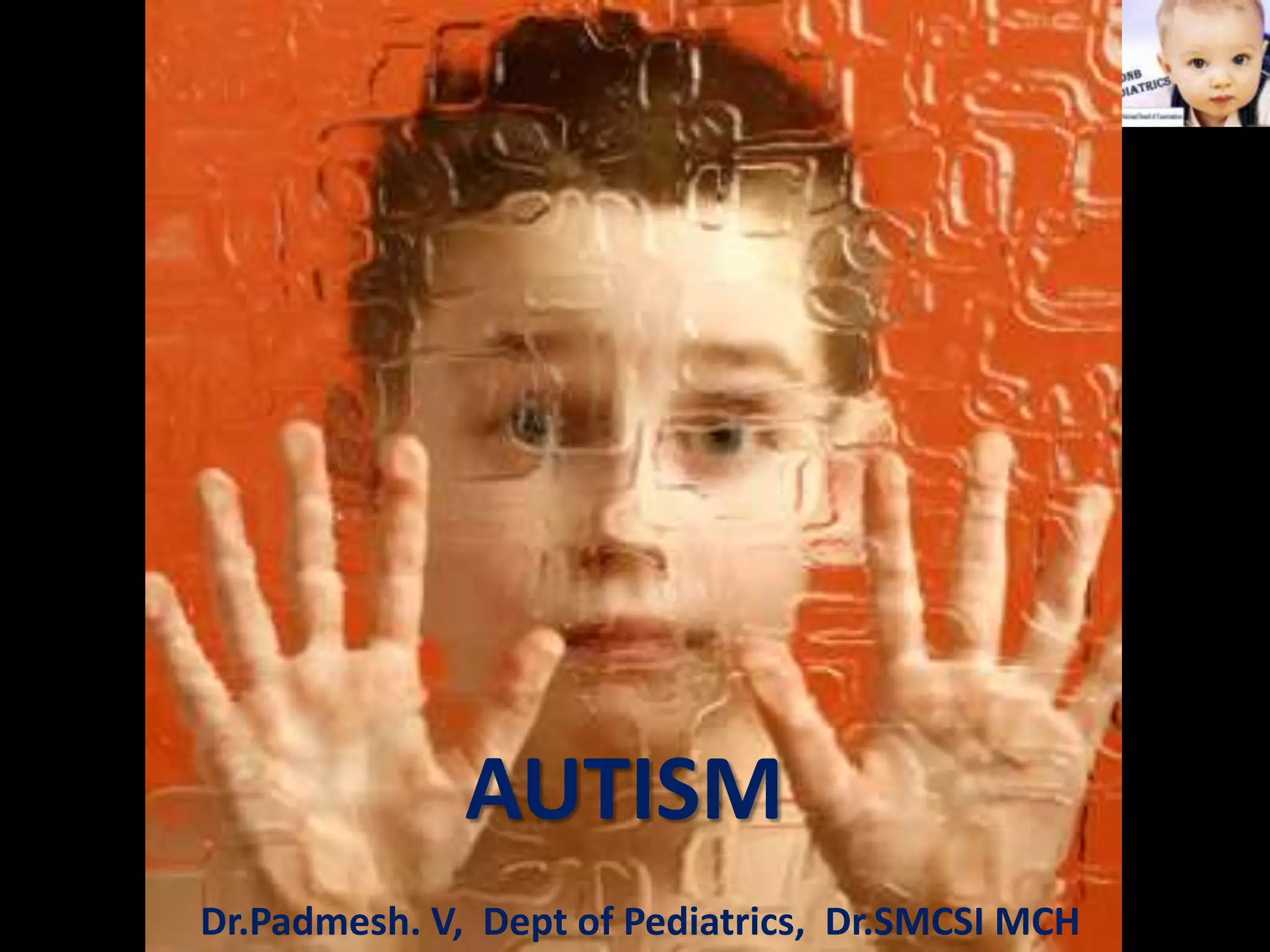
              AUTISM
Dr.Padmesh. V, Dept of Pediatrics, Dr.SMCSI MCH
Dr.Padmesh. V


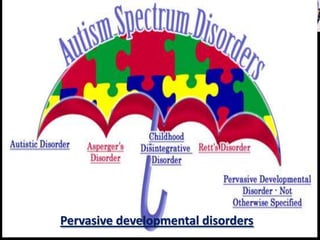
Pervasive developmental disorders
Dr.Padmesh. V

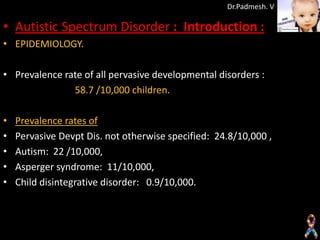
• Autistic Spectrum Disorder : Introduction :
• EPIDEMIOLOGY.

• Prevalence rate of all pervasive developmental disorders :
               58.7 /10,000 children.

•   Prevalence rates of
•   Pervasive Devpt Dis. not otherwise specified: 24.8/10,000 ,
•   Autism: 22 /10,000,
•   Asperger syndrome: 11/10,000,
•   Child disintegrative disorder: 0.9/10,000.
Dr.Padmesh. V


AUTISTIC DISORDER
Dr.Padmesh. V
• Autistic Disorder : Introduction :           Dr.Padmesh. V

• Neurodevelopmental disorder of unknown etiology.

• But with a strong genetic basis.

• Diagnosed before 36 mo of age.

• Qualitative impairment in the areas of
      -Language development or communication skills,
      -Social interactions and reciprocity, and
      -Imagination & play .
• Autistic Disorder : Introduction :                 Dr.Padmesh. V

• ETIOLOGY.
• Unknown.

• Multifactorial, with a strong genetic influence.

• 60–90% concordance rate for monozygotic twins and a 0%
  concordance rate for dizygotic twins.

• 92% concordance rate for monozygotic twins and a 30% concordance
  rate for dizygotic twins for the broader spectrum of social and
  communication difficulties.
• Autistic Disorder : Introduction :                Dr.Padmesh. V

• ETIOLOGY.
• Multiple genes involved.

• Certain genes believed to be more implicated in the heritability of
  autism:
       -Chromosome 7q
       -Chromosome 2q, and
       -Chromosome 15q11–13 (seen in Prader-Willi, Angelman ; both
                                of which manifest traits of rigidity and
                                stereotypical behaviors).
• Autistic Disorder : Introduction :            Dr.Padmesh. V

• ETIOLOGY.
• Autism : M : F = 4 : 1
• Asperger: M : F = 8 : 1


• Autism also asso with other neurodevelopmental disorders:
       -Seizure disorder,
       -Fragile X syndrome, and
       -Tuberous sclerosis.

• Environmental factors.

• No association between MMR vaccine & development of autism.
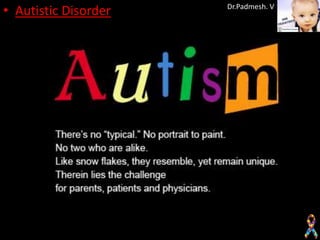
• Autistic Disorder   Dr.Padmesh. V
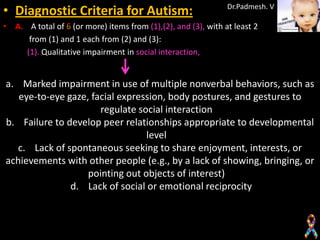
• Diagnostic Criteria for Autism:                              Dr.Padmesh. V

• A. A total of 6 (or more) items from (1),(2), and (3), with at least 2
      from (1) and 1 each from (2) and (3):
     (1). Qualitative impairment in social interaction,
     (2). Qualitative impairments in communication,
     (3). Restricted, repetitive, and stereotyped patterns of behavior,
          interests, and activities

• B. Delay or abnormal functioning in at least 1 of the following areas,
     with onset < age 3 yr:
     (1) social interaction,
     (2) language as used in social communication, or
     (3) symbolic or imaginative play

• C. The disturbance is not better accounted for by Rett disorder or
     childhood disintegrative disorder
• Diagnostic Criteria for Autism:                           Dr.Padmesh. V

• A. A total of 6 (or more) items from (1),(2), and (3), with at least 2
      from (1) and 1 each from (2) and (3):
     (1). Qualitative impairment in social interaction,
     (2). Qualitative impairments in communication,
     (3). Restricted, repetitive, and stereotyped patterns of behavior,
 a. Marked impairment in use of multiple nonverbal behaviors, such as
          interests, and activities
    eye-to-eye gaze, facial expression, body postures, and gestures to
                            regulate social interaction
• B. Delay or abnormal functioning in at least 1 of the following areas,
 b. Failure to develop peer relationships appropriate to developmental
      with onset < age 3 yr:
                                       level
      (1) social interaction,
   c. Lack of spontaneous seeking to share enjoyment, interests, or
      (2) language as used in social communication, or
 achievements with other people (e.g., by a lack of showing, bringing, or
      (3) symbolic or imaginative play
                        pointing out objects of interest)
                   d. Lack of social or emotional reciprocity
• C. The disturbance is not better accounted for by Rett disorder or
     childhood disintegrative disorder
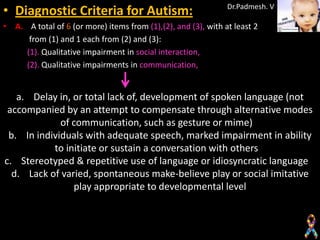
• Diagnostic Criteria for Autism:                              Dr.Padmesh. V

• A. A total of 6 (or more) items from (1),(2), and (3), with at least 2
      from (1) and 1 each from (2) and (3):
     (1). Qualitative impairment in social interaction,
     (2). Qualitative impairments in communication,
     (3). Restricted, repetitive, and stereotyped patterns of behavior,
          interests, and activities
   a. Delay in, or total lack of, development of spoken language (not
 accompanied by an attempt to compensate through alternative modes
• B. Delay or abnormal functioning in at least 1 of the following areas,
                of communication, such as gesture or mime)
      with onset < age 3 yr:
 b. In individuals with adequate speech, marked impairment in ability
      (1) social interaction,
              to initiate or sustain a conversation with others
      (2) language as used in social communication, or
c. Stereotyped & repetitive use of language or idiosyncratic language
      (3) symbolic or imaginative play
  d. Lack of varied, spontaneous make-believe play or social imitative
                    play appropriate to developmental level
• C. The disturbance is not better accounted for by Rett disorder or
     childhood disintegrative disorder
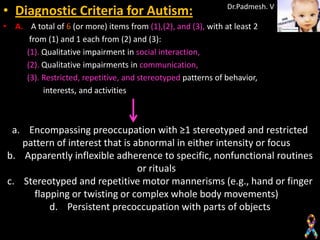
• Diagnostic Criteria for Autism:                              Dr.Padmesh. V

• A. A total of 6 (or more) items from (1),(2), and (3), with at least 2
      from (1) and 1 each from (2) and (3):
     (1). Qualitative impairment in social interaction,
     (2). Qualitative impairments in communication,
     (3). Restricted, repetitive, and stereotyped patterns of behavior,
          interests, and activities

• B. Delay or abnormal functioning in at least 1 of the following areas,
  a. with onset < age 3preoccupation with ≥1 stereotyped and restricted
     Encompassing yr:
     (1) social interaction,
    pattern of interest that is abnormal in either intensity or focus
 b. Apparently inflexiblesocial communication, or nonfunctional routines
     (2) language as used in adherence to specific,
     (3) symbolic or imaginative play rituals
                                   or
 c. Stereotyped and repetitive motor mannerisms (e.g., hand or finger
• C. The disturbance is not better accounted for by Rett disorder or
       flapping or twisting or complex whole body movements)
      childhoodPersistent precoccupation with parts of objects
           d. disintegrative disorder
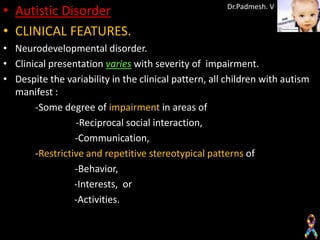
• Autistic Disorder                                   Dr.Padmesh. V


• CLINICAL FEATURES.
• Neurodevelopmental disorder.
• Clinical presentation varies with severity of impairment.
• Despite the variability in the clinical pattern, all children with autism
  manifest :
       -Some degree of impairment in areas of
                 -Reciprocal social interaction,
                 -Communication,
       -Restrictive and repetitive stereotypical patterns of
                 -Behavior,
                 -Interests, or
                 -Activities.
• Autistic Disorder                                 Dr.Padmesh. V


• CLINICAL FEATURES.

• Although no pathognomonic symptom or behavior is seen
  in all children with autism, most children have some impairment
  in ‘joint attention’ or ‘pretend play’.

• Joint attention is
   “ the ability to use eye contact & pointing for the purposes of
     sharing experiences with others ”.
     (Develops by 18 mo)
• Autistic Disorder                                  Dr.Padmesh. V


• CLINICAL FEATURES.
• Other precursor skills to joint attention that are often absent in
  children with autism are
• Protoimperative pointing
        “ Pointing to obtain an object of desire”

                             and
• Protodeclarative pointing
       “ Pointing to an object of interest ,simply to have another
         person share in the interest with him or her).
• Autistic Disorder                            Dr.Padmesh. V


• CLINICAL FEATURES.

                   Some children with autism


 Make no eye contact and        Show intermittent engagement
   seem totally aloof.             with their environment :
                               May make inconsistent eye contact,
                                       smile, and hug.
• Autistic Disorder                                Dr.Padmesh. V


• CLINICAL FEATURES.

                        Varying verbal abilities


            Nonverbal                      Have advanced speech,
                                           imitate songs, rhymes.


 -Most notable is the quality of speech and language.
 -Speech may have an odd intonation.
 -May be characterized by echolalia, pronoun reversal, nonsense
  rhyming, other idiosyncratic language forms.
• Autistic Disorder                              Dr.Padmesh. V


• CLINICAL FEATURES.

                 Intellectual functioning


 Mental retardation             -Superior intellectual functioning in
                                  select areas.
                                -Some show development in certain
                                  skills.
                                -May even show areas of strength in
                                 specific areas. Eg: puzzles,art,music.
• Autistic Disorder                                     Dr.Padmesh. V


• CLINICAL FEATURES.
• Play skills are typically aberrant.

• Characterized by little symbolic play, ritualistic rigidity, and
  preoccupation with parts of objects.

• Stereotypical body movements, a marked need for sameness,
  and a very narrow range of interests.

• Often withdrawn . Spends hours in solitary play.

• Ritualistic behavior prevails, reflecting the child's need to maintain a
  consistent, predictable environment.
• Autistic Disorder                                Dr.Padmesh. V


• CLINICAL FEATURES.
• Disruptions of routine  Tantrum-like rages.
• Eye contact is minimal or absent.

                        Sensitivity to stimuli


      Heightened sensitivity                Lowered sensitivity
       to some stimuli                       to other stimuli.
 (Visual scanning of hand and            (Diminished responses to pain
  finger movements,                       and lack of startle responses
  mouthing of objects,                    to sudden loud noises)
  and rubbing of surfaces)
• Autistic Disorder                              Dr.Padmesh. V


• NEUROANATOMIC FINDINGS.
• Retrospective analysis of Head circumference & MRI studies, have
  shown differences in brain structure in autism.

• Abnormal neurochemical findings also associated; Dopamine,
  catecholamine, and serotonin levels or pathways implicated.

• Head circumference in Autistic children:

• AT BIRTH, UPTO 2 MONTHS AGE: Normal or slightly smaller than
  normal.

• FROM 6-14 MONTHS, UPTO END OF 2ND YEAR: Abnormally rapid
  increase in head circumference.
• Autistic Disorder                                 Dr.Padmesh. V


• NEUROANATOMIC FINDINGS.
• MRI studies in autistic children:
• At 2–4 yr of age: Increased brain volume (increased volume of
  cerebellum, cerebrum, and amygdala.)

• Abnormal growth in first 2 yr is most marked in frontal, temporal,
  cerebellar, and limbic regions of the brain, the areas of brain
  responsible for higher-order cognitive, language, emotional, and
  social functions, which are most impaired in autism.

• This period of early, accelerated brain growth stops early in childhood
  and is followed by abnormally slow or arrested growth

    Areas of underdeveloped & abnormal circuitry in parts of brain.
Dr.Padmesh. V

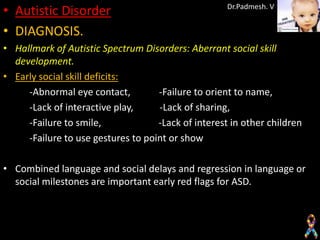
DIAGNOSIS OF AUTISM
• Autistic Disorder                                  Dr.Padmesh. V


• DIAGNOSIS.
• Hallmark of Autistic Spectrum Disorders: Aberrant social skill
  development.
• Early social skill deficits:
     -Abnormal eye contact,         -Failure to orient to name,
     -Lack of interactive play,     -Lack of sharing,
     -Failure to smile,             -Lack of interest in other children
     -Failure to use gestures to point or show

• Combined language and social delays and regression in language or
  social milestones are important early red flags for ASD.
• Autistic Disorder                                   Dr.Padmesh. V


• DIAGNOSIS.
•   Early signs :
•   Unusual use of language or loss of language skills,
•   Nonfunctional rituals,
•   Inability to adapt to new settings,
•   Lack of imitation, and
•   Absence of imaginary play.


• Absence of expected social, communication & play behaviors
                        precedes
    Emergence of odd or stereotypical behaviors or unusual language.
• Autistic Disorder                                  Dr.Padmesh. V


• DIAGNOSIS: Screening tools for early detection.

•   Checklist for Autism in Toddlers (CHAT):
•   Screening tool for 18 mo old children in primary care settings.
•   CHAT combines parent responses + direct observation in Clinic.
•   High positive predictive value, but low sensitivity.

• Modified Checklist for Autism in Toddlers (M-CHAT):
• 23-item parent questionnaire.
• Good sensitivity and specificity (0.87% and 0.99%, respectively).
• Autistic Disorder                                   Dr.Padmesh. V


• DIAGNOSIS: Screening tools for early detection.

• Pervasive Developmental Disorders Screening Test (PDDST):
• Parent-completed survey for children from birth–3 yr of age.

• Incorporates 3-tiered approach:
       -1 for the primary care clinic,
       -1 for the developmental clinic, and
       -1 for the multidisciplinary autism clinic.


• All 3 tiers measure aspects of language, social skills, pretend play,
  attachment, sensory responses, and motor stereotypies.
• Autistic Disorder                                  Dr.Padmesh. V


• DIAGNOSIS.

• Intelligence, as measured by conventional psychologic testing, falls in
  the functionally retarded range;

• Deficits in language and socialization make it difficult to obtain an
  accurate estimate of intellectual potential.

• Some autistic children perform adequately in nonverbal tests.

• Those with developed speech may show adequate intellectual
  capacity.
• Autistic Disorder                                Dr.Padmesh. V


• DIAGNOSIS.
• “Lack of a theory of mind.”
• Autistic children show deficits in understanding what the other
  person might be feeling or thinking:

• “Lack of central coherence”
• On some psychologic tests, they pay more attention to specific
  details, while overlooking the entire gestalt of the object.
• Autistic Disorder                                Dr.Padmesh. V


• DIAGNOSIS.
• Physical examination.
• Head circumference.
• 25% of ASD have macrocephaly, but may not be apparent until after
  2nd yrs age.

• In the absence of dysmorphic features or focal neurologic signs,
  additional neuroimaging for investigation of the macrocephaly is not
  indicated.

• Audiologic evaluation;

• Speech and language evaluation;
• Autistic Disorder                                 Dr.Padmesh. V


• DIAGNOSIS.

• Look for other physical stigmata.

• Examination of skin with a Wood lamp for hypopigmented lesions of
  Tuberous sclerosis.

• Look for dysmorphic features of
      -Fragile X syndrome (long face, large ears, large testes)
      -Angelman syndrome (ataxic gait, broad mouth)
• Autistic Disorder                              Dr.Padmesh. V


• DIAGNOSIS.

• Check Lead level if child shows pica etc.

• Chromosomal analysis if child has mental retardation / dysmorphic
  features;

• EEG in developmental regression or seizures.
Dr.Padmesh. V


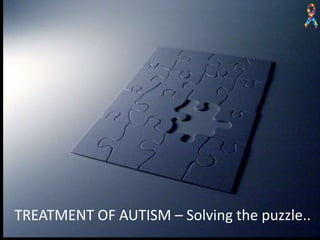
TREATMENT OF AUTISM – Solving the puzzle..
• Autistic Disorder                                Dr.Padmesh. V


• TREATMENT.
• Intensive behavioral therapy
       -beginning before 3 yr of age
       -targeted toward speech & language development

• Eg: Early intensive interventions 40 hr/wk of 1:1 behavioral training
  with young children for 2 yr.
• Autistic Disorder                                Dr.Padmesh. V


• TREATMENT.
• Training focuses on acquisition of compliance behavior, imitation
  activities, language acquisition, and integration with peers.

• Treatment aimed towards individual's particular behavior patterns
  and language function.

• Parent education, training, and support.

• Pharmacotherapy for certain symptoms.
• Autistic Disorder                              Dr.Padmesh. V


• TREATMENT.

• Require alternate educational approaches, even when language
  capacity is near normal.

• A successful educational model is the program for “Treatment and
  Education of Autistic and Related Communication Handicapped
  Children (TEACCH)”.
• Autistic Disorder                                Dr.Padmesh. V


• TREATMENT.
• “TEACCH”
• The following treatment principles are emphasized:
• Use of objective measures like Childhood Autism Rating Scale (CARS),
  to measure behavior and behavioral change;
• Enhancement of skills,
• Use of interventions based on cognitive and behavioral theories;
• Use of visual structures for optimal education,
• Multidisciplinary training for all professionals working with autistic
  children.
• Educational programming should begin as early
  as possible, preferably by age 2–4 yr.
• Autistic Disorder                                  Dr.Padmesh. V


• TREATMENT.
• Older children with relatively higher intelligence, but with poor social
  skills and psychiatric symptoms (depression, anxiety, obsessive-
  compulsive disorder) may require psychotherapy, behavioral or
  cognitive behavioral therapy, and pharmacotherapy.

• Typically, behavior modification is a major part of the overall
  treatment for older children with autism.
• These procedures include enhancement (rewards emphasizing
  appropriate choice) and reduction (extinction, time-out,
  punishment).

• Social skill training.
• Autistic Disorder                                  Dr.Padmesh. V


• TREATMENT.
• For psychiatric symptoms: Pharmacotherapy to ameliorate target
  behaviors like hyperactivity, tantrums, physical aggression, self-
  injurious behavior, stereotypies, and anxiety symptoms, especially
  obsessive-compulsive behaviors.

• Older neuroleptics: Extrapyramidal symptoms, tardive dyskinesia.

• Atypical neuroleptics (risperidone, olanzapine): Effective.
• Autistic Disorder                                 Dr.Padmesh. V


• TREATMENT.
• Clomipramine (TCA) reduces compulsions and stereotypies.
• However, it
      -lowers seizure threshold,
      -can cause agranulocytosis, and
      -has cardiotoxic and behavior toxicity effects.

• Other medications:
• Stimulants,
• Selective serotonin reuptake inhibitors (SSRIs)
  (may diminish agitation, OCD, hyperactivity)
• Clonidine.
• Autistic Disorder                               Dr.Padmesh. V

• PROGNOSIS.
• Better prognosis:

• Higher intelligence, functional speech, and less bizarre symptoms and
  behavior  better prognosis. [may grow up to live self-sufficient,
  employed life in community.(though isolated) ]

• Early intensive therapy

• Bad prognosis:
• Many have bad prognosis, & remain dependent on family for their
  everyday needs.
• Delayed diagnosis leads to poor outcome.
• Autistic Disorder                             Dr.Padmesh. V

• PROGNOSIS.
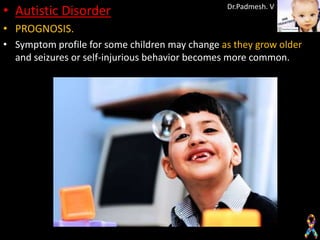
• Symptom profile for some children may change as they grow older
  and seizures or self-injurious behavior becomes more common.
Dr.Padmesh. V
Dr.Padmesh. V
Dr.Padmesh. V

Autism.. Dr.Padmesh

  • 1.
    Dr.Padmesh. V AUTISM Dr.Padmesh. V, Dept of Pediatrics, Dr.SMCSI MCH
  • 2.
  • 3.
    Dr.Padmesh. V • AutisticSpectrum Disorder : Introduction : • EPIDEMIOLOGY. • Prevalence rate of all pervasive developmental disorders : 58.7 /10,000 children. • Prevalence rates of • Pervasive Devpt Dis. not otherwise specified: 24.8/10,000 , • Autism: 22 /10,000, • Asperger syndrome: 11/10,000, • Child disintegrative disorder: 0.9/10,000.
  • 4.
  • 5.
  • 6.
    • Autistic Disorder: Introduction : Dr.Padmesh. V • Neurodevelopmental disorder of unknown etiology. • But with a strong genetic basis. • Diagnosed before 36 mo of age. • Qualitative impairment in the areas of -Language development or communication skills, -Social interactions and reciprocity, and -Imagination & play .
  • 7.
    • Autistic Disorder: Introduction : Dr.Padmesh. V • ETIOLOGY. • Unknown. • Multifactorial, with a strong genetic influence. • 60–90% concordance rate for monozygotic twins and a 0% concordance rate for dizygotic twins. • 92% concordance rate for monozygotic twins and a 30% concordance rate for dizygotic twins for the broader spectrum of social and communication difficulties.
  • 8.
    • Autistic Disorder: Introduction : Dr.Padmesh. V • ETIOLOGY. • Multiple genes involved. • Certain genes believed to be more implicated in the heritability of autism: -Chromosome 7q -Chromosome 2q, and -Chromosome 15q11–13 (seen in Prader-Willi, Angelman ; both of which manifest traits of rigidity and stereotypical behaviors).
  • 9.
    • Autistic Disorder: Introduction : Dr.Padmesh. V • ETIOLOGY. • Autism : M : F = 4 : 1 • Asperger: M : F = 8 : 1 • Autism also asso with other neurodevelopmental disorders: -Seizure disorder, -Fragile X syndrome, and -Tuberous sclerosis. • Environmental factors. • No association between MMR vaccine & development of autism.
  • 10.
    • Autistic Disorder Dr.Padmesh. V
  • 11.
    • Diagnostic Criteriafor Autism: Dr.Padmesh. V • A. A total of 6 (or more) items from (1),(2), and (3), with at least 2 from (1) and 1 each from (2) and (3): (1). Qualitative impairment in social interaction, (2). Qualitative impairments in communication, (3). Restricted, repetitive, and stereotyped patterns of behavior, interests, and activities • B. Delay or abnormal functioning in at least 1 of the following areas, with onset < age 3 yr: (1) social interaction, (2) language as used in social communication, or (3) symbolic or imaginative play • C. The disturbance is not better accounted for by Rett disorder or childhood disintegrative disorder
  • 12.
    • Diagnostic Criteriafor Autism: Dr.Padmesh. V • A. A total of 6 (or more) items from (1),(2), and (3), with at least 2 from (1) and 1 each from (2) and (3): (1). Qualitative impairment in social interaction, (2). Qualitative impairments in communication, (3). Restricted, repetitive, and stereotyped patterns of behavior, a. Marked impairment in use of multiple nonverbal behaviors, such as interests, and activities eye-to-eye gaze, facial expression, body postures, and gestures to regulate social interaction • B. Delay or abnormal functioning in at least 1 of the following areas, b. Failure to develop peer relationships appropriate to developmental with onset < age 3 yr: level (1) social interaction, c. Lack of spontaneous seeking to share enjoyment, interests, or (2) language as used in social communication, or achievements with other people (e.g., by a lack of showing, bringing, or (3) symbolic or imaginative play pointing out objects of interest) d. Lack of social or emotional reciprocity • C. The disturbance is not better accounted for by Rett disorder or childhood disintegrative disorder
  • 13.
    • Diagnostic Criteriafor Autism: Dr.Padmesh. V • A. A total of 6 (or more) items from (1),(2), and (3), with at least 2 from (1) and 1 each from (2) and (3): (1). Qualitative impairment in social interaction, (2). Qualitative impairments in communication, (3). Restricted, repetitive, and stereotyped patterns of behavior, interests, and activities a. Delay in, or total lack of, development of spoken language (not accompanied by an attempt to compensate through alternative modes • B. Delay or abnormal functioning in at least 1 of the following areas, of communication, such as gesture or mime) with onset < age 3 yr: b. In individuals with adequate speech, marked impairment in ability (1) social interaction, to initiate or sustain a conversation with others (2) language as used in social communication, or c. Stereotyped & repetitive use of language or idiosyncratic language (3) symbolic or imaginative play d. Lack of varied, spontaneous make-believe play or social imitative play appropriate to developmental level • C. The disturbance is not better accounted for by Rett disorder or childhood disintegrative disorder
  • 14.
    • Diagnostic Criteriafor Autism: Dr.Padmesh. V • A. A total of 6 (or more) items from (1),(2), and (3), with at least 2 from (1) and 1 each from (2) and (3): (1). Qualitative impairment in social interaction, (2). Qualitative impairments in communication, (3). Restricted, repetitive, and stereotyped patterns of behavior, interests, and activities • B. Delay or abnormal functioning in at least 1 of the following areas, a. with onset < age 3preoccupation with ≥1 stereotyped and restricted Encompassing yr: (1) social interaction, pattern of interest that is abnormal in either intensity or focus b. Apparently inflexiblesocial communication, or nonfunctional routines (2) language as used in adherence to specific, (3) symbolic or imaginative play rituals or c. Stereotyped and repetitive motor mannerisms (e.g., hand or finger • C. The disturbance is not better accounted for by Rett disorder or flapping or twisting or complex whole body movements) childhoodPersistent precoccupation with parts of objects d. disintegrative disorder
  • 15.
    • Autistic Disorder Dr.Padmesh. V • CLINICAL FEATURES. • Neurodevelopmental disorder. • Clinical presentation varies with severity of impairment. • Despite the variability in the clinical pattern, all children with autism manifest : -Some degree of impairment in areas of -Reciprocal social interaction, -Communication, -Restrictive and repetitive stereotypical patterns of -Behavior, -Interests, or -Activities.
  • 16.
    • Autistic Disorder Dr.Padmesh. V • CLINICAL FEATURES. • Although no pathognomonic symptom or behavior is seen in all children with autism, most children have some impairment in ‘joint attention’ or ‘pretend play’. • Joint attention is “ the ability to use eye contact & pointing for the purposes of sharing experiences with others ”. (Develops by 18 mo)
  • 17.
    • Autistic Disorder Dr.Padmesh. V • CLINICAL FEATURES. • Other precursor skills to joint attention that are often absent in children with autism are • Protoimperative pointing “ Pointing to obtain an object of desire” and • Protodeclarative pointing “ Pointing to an object of interest ,simply to have another person share in the interest with him or her).
  • 18.
    • Autistic Disorder Dr.Padmesh. V • CLINICAL FEATURES. Some children with autism Make no eye contact and Show intermittent engagement seem totally aloof. with their environment : May make inconsistent eye contact, smile, and hug.
  • 19.
    • Autistic Disorder Dr.Padmesh. V • CLINICAL FEATURES. Varying verbal abilities Nonverbal Have advanced speech, imitate songs, rhymes. -Most notable is the quality of speech and language. -Speech may have an odd intonation. -May be characterized by echolalia, pronoun reversal, nonsense rhyming, other idiosyncratic language forms.
  • 20.
    • Autistic Disorder Dr.Padmesh. V • CLINICAL FEATURES. Intellectual functioning Mental retardation -Superior intellectual functioning in select areas. -Some show development in certain skills. -May even show areas of strength in specific areas. Eg: puzzles,art,music.
  • 21.
    • Autistic Disorder Dr.Padmesh. V • CLINICAL FEATURES. • Play skills are typically aberrant. • Characterized by little symbolic play, ritualistic rigidity, and preoccupation with parts of objects. • Stereotypical body movements, a marked need for sameness, and a very narrow range of interests. • Often withdrawn . Spends hours in solitary play. • Ritualistic behavior prevails, reflecting the child's need to maintain a consistent, predictable environment.
  • 22.
    • Autistic Disorder Dr.Padmesh. V • CLINICAL FEATURES. • Disruptions of routine  Tantrum-like rages. • Eye contact is minimal or absent. Sensitivity to stimuli Heightened sensitivity Lowered sensitivity to some stimuli to other stimuli. (Visual scanning of hand and (Diminished responses to pain finger movements, and lack of startle responses mouthing of objects, to sudden loud noises) and rubbing of surfaces)
  • 23.
    • Autistic Disorder Dr.Padmesh. V • NEUROANATOMIC FINDINGS. • Retrospective analysis of Head circumference & MRI studies, have shown differences in brain structure in autism. • Abnormal neurochemical findings also associated; Dopamine, catecholamine, and serotonin levels or pathways implicated. • Head circumference in Autistic children: • AT BIRTH, UPTO 2 MONTHS AGE: Normal or slightly smaller than normal. • FROM 6-14 MONTHS, UPTO END OF 2ND YEAR: Abnormally rapid increase in head circumference.
  • 24.
    • Autistic Disorder Dr.Padmesh. V • NEUROANATOMIC FINDINGS. • MRI studies in autistic children: • At 2–4 yr of age: Increased brain volume (increased volume of cerebellum, cerebrum, and amygdala.) • Abnormal growth in first 2 yr is most marked in frontal, temporal, cerebellar, and limbic regions of the brain, the areas of brain responsible for higher-order cognitive, language, emotional, and social functions, which are most impaired in autism. • This period of early, accelerated brain growth stops early in childhood and is followed by abnormally slow or arrested growth Areas of underdeveloped & abnormal circuitry in parts of brain.
  • 25.
  • 26.
    • Autistic Disorder Dr.Padmesh. V • DIAGNOSIS. • Hallmark of Autistic Spectrum Disorders: Aberrant social skill development. • Early social skill deficits: -Abnormal eye contact, -Failure to orient to name, -Lack of interactive play, -Lack of sharing, -Failure to smile, -Lack of interest in other children -Failure to use gestures to point or show • Combined language and social delays and regression in language or social milestones are important early red flags for ASD.
  • 27.
    • Autistic Disorder Dr.Padmesh. V • DIAGNOSIS. • Early signs : • Unusual use of language or loss of language skills, • Nonfunctional rituals, • Inability to adapt to new settings, • Lack of imitation, and • Absence of imaginary play. • Absence of expected social, communication & play behaviors precedes Emergence of odd or stereotypical behaviors or unusual language.
  • 28.
    • Autistic Disorder Dr.Padmesh. V • DIAGNOSIS: Screening tools for early detection. • Checklist for Autism in Toddlers (CHAT): • Screening tool for 18 mo old children in primary care settings. • CHAT combines parent responses + direct observation in Clinic. • High positive predictive value, but low sensitivity. • Modified Checklist for Autism in Toddlers (M-CHAT): • 23-item parent questionnaire. • Good sensitivity and specificity (0.87% and 0.99%, respectively).
  • 29.
    • Autistic Disorder Dr.Padmesh. V • DIAGNOSIS: Screening tools for early detection. • Pervasive Developmental Disorders Screening Test (PDDST): • Parent-completed survey for children from birth–3 yr of age. • Incorporates 3-tiered approach: -1 for the primary care clinic, -1 for the developmental clinic, and -1 for the multidisciplinary autism clinic. • All 3 tiers measure aspects of language, social skills, pretend play, attachment, sensory responses, and motor stereotypies.
  • 30.
    • Autistic Disorder Dr.Padmesh. V • DIAGNOSIS. • Intelligence, as measured by conventional psychologic testing, falls in the functionally retarded range; • Deficits in language and socialization make it difficult to obtain an accurate estimate of intellectual potential. • Some autistic children perform adequately in nonverbal tests. • Those with developed speech may show adequate intellectual capacity.
  • 31.
    • Autistic Disorder Dr.Padmesh. V • DIAGNOSIS. • “Lack of a theory of mind.” • Autistic children show deficits in understanding what the other person might be feeling or thinking: • “Lack of central coherence” • On some psychologic tests, they pay more attention to specific details, while overlooking the entire gestalt of the object.
  • 32.
    • Autistic Disorder Dr.Padmesh. V • DIAGNOSIS. • Physical examination. • Head circumference. • 25% of ASD have macrocephaly, but may not be apparent until after 2nd yrs age. • In the absence of dysmorphic features or focal neurologic signs, additional neuroimaging for investigation of the macrocephaly is not indicated. • Audiologic evaluation; • Speech and language evaluation;
  • 33.
    • Autistic Disorder Dr.Padmesh. V • DIAGNOSIS. • Look for other physical stigmata. • Examination of skin with a Wood lamp for hypopigmented lesions of Tuberous sclerosis. • Look for dysmorphic features of -Fragile X syndrome (long face, large ears, large testes) -Angelman syndrome (ataxic gait, broad mouth)
  • 34.
    • Autistic Disorder Dr.Padmesh. V • DIAGNOSIS. • Check Lead level if child shows pica etc. • Chromosomal analysis if child has mental retardation / dysmorphic features; • EEG in developmental regression or seizures.
  • 35.
    Dr.Padmesh. V TREATMENT OFAUTISM – Solving the puzzle..
  • 36.
    • Autistic Disorder Dr.Padmesh. V • TREATMENT. • Intensive behavioral therapy -beginning before 3 yr of age -targeted toward speech & language development • Eg: Early intensive interventions 40 hr/wk of 1:1 behavioral training with young children for 2 yr.
  • 37.
    • Autistic Disorder Dr.Padmesh. V • TREATMENT. • Training focuses on acquisition of compliance behavior, imitation activities, language acquisition, and integration with peers. • Treatment aimed towards individual's particular behavior patterns and language function. • Parent education, training, and support. • Pharmacotherapy for certain symptoms.
  • 38.
    • Autistic Disorder Dr.Padmesh. V • TREATMENT. • Require alternate educational approaches, even when language capacity is near normal. • A successful educational model is the program for “Treatment and Education of Autistic and Related Communication Handicapped Children (TEACCH)”.
  • 39.
    • Autistic Disorder Dr.Padmesh. V • TREATMENT. • “TEACCH” • The following treatment principles are emphasized: • Use of objective measures like Childhood Autism Rating Scale (CARS), to measure behavior and behavioral change; • Enhancement of skills, • Use of interventions based on cognitive and behavioral theories; • Use of visual structures for optimal education, • Multidisciplinary training for all professionals working with autistic children. • Educational programming should begin as early as possible, preferably by age 2–4 yr.
  • 40.
    • Autistic Disorder Dr.Padmesh. V • TREATMENT. • Older children with relatively higher intelligence, but with poor social skills and psychiatric symptoms (depression, anxiety, obsessive- compulsive disorder) may require psychotherapy, behavioral or cognitive behavioral therapy, and pharmacotherapy. • Typically, behavior modification is a major part of the overall treatment for older children with autism. • These procedures include enhancement (rewards emphasizing appropriate choice) and reduction (extinction, time-out, punishment). • Social skill training.
  • 41.
    • Autistic Disorder Dr.Padmesh. V • TREATMENT. • For psychiatric symptoms: Pharmacotherapy to ameliorate target behaviors like hyperactivity, tantrums, physical aggression, self- injurious behavior, stereotypies, and anxiety symptoms, especially obsessive-compulsive behaviors. • Older neuroleptics: Extrapyramidal symptoms, tardive dyskinesia. • Atypical neuroleptics (risperidone, olanzapine): Effective.
  • 42.
    • Autistic Disorder Dr.Padmesh. V • TREATMENT. • Clomipramine (TCA) reduces compulsions and stereotypies. • However, it -lowers seizure threshold, -can cause agranulocytosis, and -has cardiotoxic and behavior toxicity effects. • Other medications: • Stimulants, • Selective serotonin reuptake inhibitors (SSRIs) (may diminish agitation, OCD, hyperactivity) • Clonidine.
  • 43.
    • Autistic Disorder Dr.Padmesh. V • PROGNOSIS. • Better prognosis: • Higher intelligence, functional speech, and less bizarre symptoms and behavior  better prognosis. [may grow up to live self-sufficient, employed life in community.(though isolated) ] • Early intensive therapy • Bad prognosis: • Many have bad prognosis, & remain dependent on family for their everyday needs. • Delayed diagnosis leads to poor outcome.
  • 44.
    • Autistic Disorder Dr.Padmesh. V • PROGNOSIS. • Symptom profile for some children may change as they grow older and seizures or self-injurious behavior becomes more common.
  • 45.
  • 46.
  • 47.