HON 272-01
Spring 2016
INSTRUCTIONS
You are a new dictator of an established country.
How would you gain and maintain your power?
Would your actions change
in the threat of a populist uprising?
You will discuss your thoughts with a partner and the class.
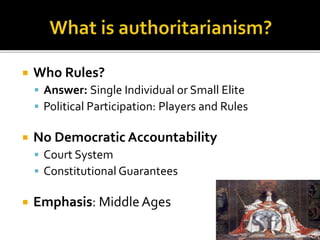
 Who Rules?
 Answer: Single Individual or Small Elite
 Political Participation: Players and Rules
 No Democratic Accountability
 Court System
 Constitutional Guarantees
 Emphasis: MiddleAges
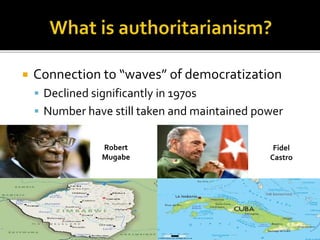
 Connection to “waves” of democratization
 Declined significantly in 1970s
 Number have still taken and maintained power
Robert
Mugabe
Fidel
Castro
 #1: Problem of Authoritarian Power-Sharing
 #2: Problem of Authoritarian Control
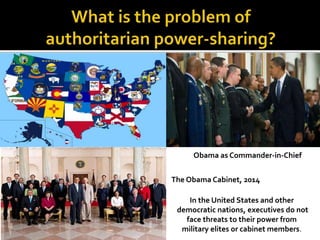
In the United States and other
democratic nations, executives do not
face threats to their power from
military elites or cabinet members.
Obama as Commander-in-Chief
The Obama Cabinet, 2014
 Removing leaders is usually not possible
 Challenge: Countering challenges from
masses while keeping them submissive
 What is the “dictator’s dilemma?”
 What strategies do leaders use to maintain
control?
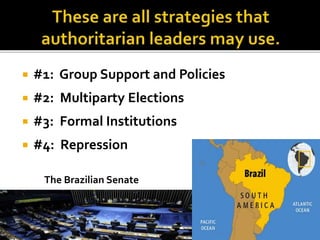
 #1: Group Support and Policies
 #2: Multiparty Elections
 #3: Formal Institutions
 #4: Repression
The Brazilian Senate
 Socialist Economy + Authoritarian Politics
 Common Features:
 Encompassing Ideology
 Single Political Party led by Dominant Leader
 Mobilization of Support for Party and Leader
 State Ownership of Media
 Use ofTerror andViolence
 Centralized Direction / Control of Economy
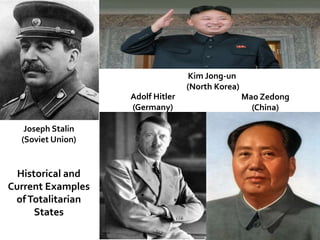
Historical and
Current Examples
ofTotalitarian
States
Joseph Stalin
(Soviet Union)
Adolf Hitler
(Germany)
Mao Zedong
(China)
Kim Jong-un
(North Korea)
 #1: Role of Legitimacy
 #2: Control of Citizen Behavior
 #3: Active or Passive Citizenry
 #4: Personality of Leader
 #5: Use ofViolence
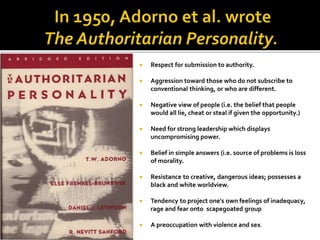
 Respect for submission to authority.
 Aggression toward those who do not subscribe to
conventional thinking, or who are different.
 Negative view of people (i.e. the belief that people
would all lie, cheat or steal if given the opportunity.)
 Need for strong leadership which displays
uncompromising power.
 Belief in simple answers (i.e. source of problems is loss
of morality.
 Resistance to creative, dangerous ideas; possesses a
black and white worldview.
 Tendency to project one's own feelings of inadequacy,
rage and fear onto scapegoated group
 A preoccupation with violence and sex.
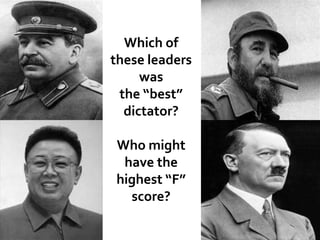
Which of
these leaders
was
the “best”
dictator?
Who might
have the
highest “F”
score?
 Monarchies
 Military Regimes
 Civilian Regimes
 Who Rules?
 Emphasis on Royal Descent
 CommonTypes of Monarchies:
 Ceremonial Monarchies
 Ruling Monarchies
 Dynastic Monarchies
 Challenge is asserting political legitimacy
 Without election, how do you make citizens happy?
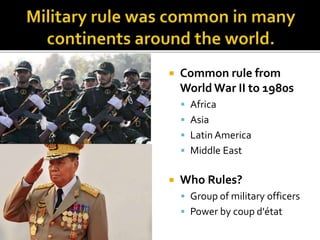
 Common rule from
World War II to 1980s
 Africa
 Asia
 Latin America
 Middle East
 Who Rules?
 Group of military officers
 Power by coup d'état
 #1: Breakthrough Coup
-Traditional elite overthrown by military
 #2:Veto Coup
- High-ranking officers order repression of mass movement
 #3: Guardian Coup (“Musical Chairs” Coup)
- Power seized for efficiency, national security, or corruption
- Leadership shifts between military and citizens
 #4: Bloodless Coup
- Threat of violence enough to defer coup from happening
 #5: Self Coup
- Assumption of power through co-opting institutions
- Declaration of “emergency” powers
 How does military consolidate power?
 Cannot use violence
 Convince citizens of legitimacy / right to rule
 Three Responses:
 Return to Democratic Rule…eventually…
 Hold Elections…but military party has advantages
 Defend Nation Against Internal/ExternalThreats
 1) Martial Law
 Curfews, Banning Protests/Demonstrations
 2) Use of Spies/Informants
 Mission: Find and Kill Dissidents
 3) Ban Opposition Media Outlets
 Dominant Party
 Personalistic
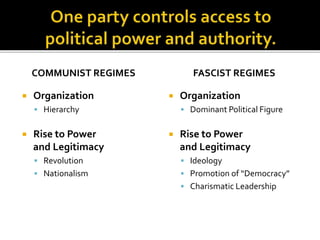
COMMUNIST REGIMES
 Organization
 Hierarchy
 Rise to Power
and Legitimacy
 Revolution
 Nationalism
FASCIST REGIMES
 Organization
 Dominant Political Figure
 Rise to Power
and Legitimacy
 Ideology
 Promotion of “Democracy”
 Charismatic Leadership
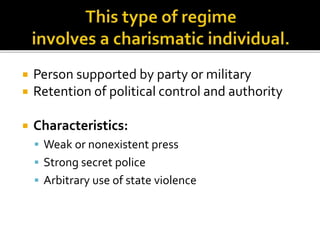
 Person supported by party or military
 Retention of political control and authority
 Characteristics:
 Weak or nonexistent press
 Strong secret police
 Arbitrary use of state violence
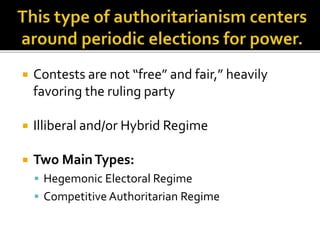
 Contests are not “free” and fair,” heavily
favoring the ruling party
 Illiberal and/or Hybrid Regime
 Two MainTypes:
 Hegemonic Electoral Regime
 Competitive Authoritarian Regime
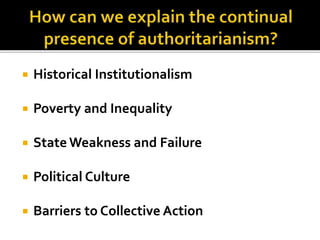
 Historical Institutionalism
 Poverty and Inequality
 State Weakness and Failure
 Political Culture
 Barriers to Collective Action
Authoritarian Regimes

Authoritarian Regimes

  • 1.
  • 3.
    INSTRUCTIONS You are anew dictator of an established country. How would you gain and maintain your power? Would your actions change in the threat of a populist uprising? You will discuss your thoughts with a partner and the class.
  • 6.
     Who Rules? Answer: Single Individual or Small Elite  Political Participation: Players and Rules  No Democratic Accountability  Court System  Constitutional Guarantees  Emphasis: MiddleAges
  • 7.
     Connection to“waves” of democratization  Declined significantly in 1970s  Number have still taken and maintained power Robert Mugabe Fidel Castro
  • 10.
     #1: Problemof Authoritarian Power-Sharing  #2: Problem of Authoritarian Control
  • 11.
    In the UnitedStates and other democratic nations, executives do not face threats to their power from military elites or cabinet members. Obama as Commander-in-Chief The Obama Cabinet, 2014
  • 13.
     Removing leadersis usually not possible  Challenge: Countering challenges from masses while keeping them submissive  What is the “dictator’s dilemma?”  What strategies do leaders use to maintain control?
  • 14.
     #1: GroupSupport and Policies  #2: Multiparty Elections  #3: Formal Institutions  #4: Repression The Brazilian Senate
  • 16.
     Socialist Economy+ Authoritarian Politics  Common Features:  Encompassing Ideology  Single Political Party led by Dominant Leader  Mobilization of Support for Party and Leader  State Ownership of Media  Use ofTerror andViolence  Centralized Direction / Control of Economy
  • 17.
    Historical and Current Examples ofTotalitarian States JosephStalin (Soviet Union) Adolf Hitler (Germany) Mao Zedong (China) Kim Jong-un (North Korea)
  • 19.
     #1: Roleof Legitimacy  #2: Control of Citizen Behavior  #3: Active or Passive Citizenry  #4: Personality of Leader  #5: Use ofViolence
  • 24.
     Respect forsubmission to authority.  Aggression toward those who do not subscribe to conventional thinking, or who are different.  Negative view of people (i.e. the belief that people would all lie, cheat or steal if given the opportunity.)  Need for strong leadership which displays uncompromising power.  Belief in simple answers (i.e. source of problems is loss of morality.  Resistance to creative, dangerous ideas; possesses a black and white worldview.  Tendency to project one's own feelings of inadequacy, rage and fear onto scapegoated group  A preoccupation with violence and sex.
  • 25.
    Which of these leaders was the“best” dictator? Who might have the highest “F” score?
  • 27.
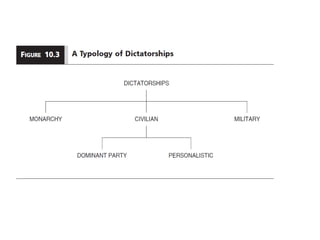
     Monarchies  MilitaryRegimes  Civilian Regimes
  • 33.
     Who Rules? Emphasis on Royal Descent  CommonTypes of Monarchies:  Ceremonial Monarchies  Ruling Monarchies  Dynastic Monarchies  Challenge is asserting political legitimacy  Without election, how do you make citizens happy?
  • 35.
     Common rulefrom World War II to 1980s  Africa  Asia  Latin America  Middle East  Who Rules?  Group of military officers  Power by coup d'état
  • 36.
     #1: BreakthroughCoup -Traditional elite overthrown by military  #2:Veto Coup - High-ranking officers order repression of mass movement  #3: Guardian Coup (“Musical Chairs” Coup) - Power seized for efficiency, national security, or corruption - Leadership shifts between military and citizens  #4: Bloodless Coup - Threat of violence enough to defer coup from happening  #5: Self Coup - Assumption of power through co-opting institutions - Declaration of “emergency” powers
  • 37.
     How doesmilitary consolidate power?  Cannot use violence  Convince citizens of legitimacy / right to rule  Three Responses:  Return to Democratic Rule…eventually…  Hold Elections…but military party has advantages  Defend Nation Against Internal/ExternalThreats
  • 38.
     1) MartialLaw  Curfews, Banning Protests/Demonstrations  2) Use of Spies/Informants  Mission: Find and Kill Dissidents  3) Ban Opposition Media Outlets
  • 40.
  • 42.
    COMMUNIST REGIMES  Organization Hierarchy  Rise to Power and Legitimacy  Revolution  Nationalism FASCIST REGIMES  Organization  Dominant Political Figure  Rise to Power and Legitimacy  Ideology  Promotion of “Democracy”  Charismatic Leadership
  • 44.
     Person supportedby party or military  Retention of political control and authority  Characteristics:  Weak or nonexistent press  Strong secret police  Arbitrary use of state violence
  • 47.
     Contests arenot “free” and fair,” heavily favoring the ruling party  Illiberal and/or Hybrid Regime  Two MainTypes:  Hegemonic Electoral Regime  Competitive Authoritarian Regime
  • 49.
     Historical Institutionalism Poverty and Inequality  State Weakness and Failure  Political Culture  Barriers to Collective Action

Editor's Notes

  • #2 The following lecture slides and notes are the sole materials of Austin Trantham. You may NOT copy or reproduce this material in any form without express permission from the author.
  • #3 Our next topic for the course deals with the presence of authoritarian regimes. These “governments” develop, thrive, and survive due to democratic breakdown. How does this occur? The rest of this lecture provides some answers.
  • #5 We need to first consider how to define and conceptualize the idea of authoritarianism.
  • #7 Authoritarianism is a political system where a single individual or small elite rules without constitutional or democratic checks on their use of power. This elite decide who gets to participate in politics and then can change the rules at their disposal. They decide incentives for following the rules, as well as create and enforce penalties for breaking the rules. There is no sense of democratic accountability by citizens (or anyone else) under authoritarian rule. There is no court system to rule leaders’ decrees partially or wholly unconstitutional. There is no constitutional guarantees about separation of powers, regular elections, etc.   Authoritarianism has been the main form of government through most of history. Czars, emperors, kings, and sultans have assumed legitimacy or the right to rule without restraints of their power from ordinary citizens. Example: “Divine Right of Kings” in Middle Ages
  • #8 The extent of authoritarianism has ebbed and flowed with Huntington’s “waves” of democratization. Authoritarian governments declined significantly beginning in the 1970s. After the Soviet Union collapsed, many heralded the beginning of new a democratic era around the globe. This notion, however, was short-lived. A number of authoritarian regimes have taken and maintained power. No single Arab country can be classified as a democracy, but authoritarianism present in Africa and Asia as well. Example: Africa with Zimbabwe under Robert Mugabe Example: Americas with Cuba under Fidel Castro
  • #9 There is a handout on Canvas regarding authoritarian rule. Please review this.
  • #10 We next need to discuss how to conceptualize authoritarianism.
  • #11 A political scientist once wrote that, “authoritarian politics has always been a ruthless and treacherous business.” As an example, there is no independent authority to enforce agreements made among key political players, so leaders can struggle to maintain power. These and related issues create two significant problems for authoritarian leaders: #1: Problem of Authoritarian Power-Sharing #2: Problem of Authoritarian Control
  • #12 Chief executives in democratic nations do not have to worry about military officers and cabinet members seizing power through violent or non-constitutional means. An classic example is the United States Our current president, Barack Obama, is the Commander-in-Chief of the U.S. armed forces. This being the case, he already has authority over this potential threat sources. Cabinet members, including those in the Obama administration, serve “at the pleasure of the president. “ Since they can be dismissed at will, this eliminates another threat to the executive’s power. Authoritarian leaders have lost power and authority more often through internal coups rather than mass uprisings in the post-World War II period.
  • #13 The answer to this question includes winning support by including other in decision-making process, making them heads of state agencies, and giving them opportunities to enrich themselves. If leaders cannot trust others, then the next best thing is to eliminate them through dismissal from leadership, arrest, or execution/death.
  • #14 In most authoritarian states, simply removing leaders is not possible for ordinary citizens—without a mass populist uprising. The threat of large-scale mass discontent against their rule leads to the second problem of authoritarian control. The question, then becomes, “How to counter challenges from masses while keeping them subservient and submissive to elites? “ This is tied to the idea of the dictator’s dilemma, first advocated by political economist Ronald Wintrobe. He argues that the basic repressive nature of an authoritarian regime breeds fear, and in turn, misinformation and uncertainty. The greater the repression, the greater the dilemma for a given dictator. Because they lack accurate information about on degree of political support, the ruler ends up spending more resources than is rational to co-opt opposition. What strategies do leaders use to maintain control?
  • #15 #1: Win Support of Groups in Society with Favorable Policies: Regimes may simply give different groups (e.g. poorer classes) assistance by passing policies favorable to their station in life (e.g. raising minimum wage). #2: Hold Multiparty Elections: This allows the opposition party to enter a political race and run candidates for office. However, the ruling regime controls all of the significant aspects of the electoral process. The incumbent party eventually wins and can now claim to rule with “popular support.”   #3: Creation of Formal Institutions: Legislatures, etc. allow leaders of various societal interests (religious leaders, business and labor groups, etc.) to express popular sentiments that do not come directly from the public in the form of resistance efforts (e.g. protests) The ruling regime uses institutions to control dissent while making concessions and still appearing strong. Example: Brazil: Military in power during 60s/70s set up elected legislature with one party supporting and one party opposing it. The opposition party, however, was restricted in what it could actually say or do. The ruling regime allowed opposition to voice its views to an extent and regime seemed more open .   #4: Repression: Repressions by an authoritarian government limit civil and political liberties of citizens and/or target leaders of protests, etc. with arrest, torture, etc.  
  • #16 This section discusses how authoritarianism relates to a more extreme form of popular repression by elites known as totalitarianism.
  • #17 Totalitarianism combines a socialist economy with an authoritarian political system. Totalitarian regimes have a few common features: 1) Centers on an encompassing ideology, which offers: a) A critique of existing society b) A vision for a radically different and supposedly better society c) A program for realizing this vision   2) A single political party usually led by one dominant leader 3) Continuous efforts to mobilize support for dominant leader and party through media, rallies, and propaganda. 4) State control of media sources, including newspapers, radio, TV, and book publishing. All of these efforts serve as a way to promote views and stifle opposition.   5) Use of terror and violence on massive scale to intimidate or destroy political opponents and entire races of people
  • #18 These are a few examples of totalitarian states in modern history. Historical Examples: The Soviet Union under Joseph Stalin China under Mao Zedong Germany under Adolf Hitler   Current Examples: North Korea under Kim Jong-un
  • #19 Authoritarian regimes different from totalitarian governments in important ways: 1) Legitimacy (“the right to rule”) is still justified by an extreme ideology, but they are not as ambitious or elaborate as under totalitarian governments .   2) Authoritarian states do not seek total control over citizens’ behavior Sometimes allow limited freedom of the press, just as long as the media does not criticize the regime’s leadership   3) Authoritarian governments prefer a passive, apathetic citizenry—people who obey the regime and do not challenge it—and so they do not try and galvanize mass support. Authoritarian leaders may be bland and unpopular due to their techniques, while those leading totalitarian governments develop a personality cult involving charisma and the creation of a prophetic image, etc. 4) Authoritarians view themselves as individual beings largely content to control, and often maintain, the status quo. Totalitarian self-conceptions are largely tyrannical. The tyrant is less of a person than an indispensable “force” to guide and reshape the universe. 5) While torture, violence, and murder are used to eliminate threats to status quo, they are not used with same intensity as totalitarian governments.
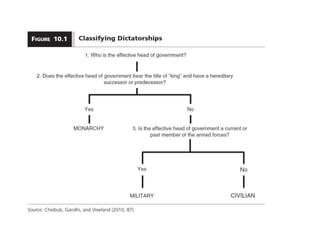
  • #28 We can classify authoritarian regimes into three types: 1) Monarchies 2) Military Regimes 3) Civilian Regimes The next slides will discuss all three types in detail.
  • #29 This chart classifies the three main types of dictatorships. Please review it.
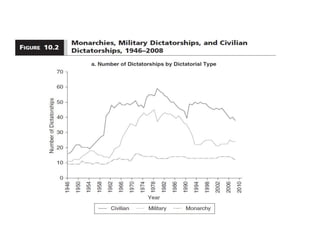
  • #30 This graph gives the extent of the three types of dictatorships during the twentieth century. Please review it. The top line represents civilian regimes, the middle line represents military regimes, and the bottom line represents monarchies. Which type of authoritarian regime has been most utilized over time?
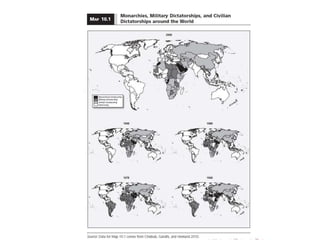
  • #31 This graph shows the extent of monarchies, military dictatorships, and civilian dictatorships around the world.
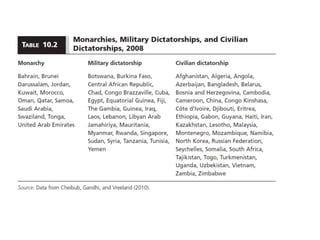
  • #32 This slide gives you a list of where monarchies, military dictatorships, and civilian dictatorships exist around the world as of 2008. Please review it.
  • #34 Monarchies are measured by actual length of time in office, monarchies have been the most successful of all authoritarian regime types. In a monarchy, the answer to the question of “Who Rules?” is someone of royal descent who inherits the Head of State position Common Types of Monarchies: 1) Ceremonial Monarchies: Serve symbolic function and do not actually have governing authority (e.g. Great Britain)   2) Ruling Monarchies: Elite serve as leaders of their countries. They appoint government ministries and make policy decisions. This type of monarchy is common in Middle Eastern countries, including Saudi Arabia, Oman, Jordan.   3) Dynastic Monarchies: Monarch is selected by leading members of the royal family and is accountable to them. Challenge to all monarchies is asserting political legitimacy. If you are not elected, how do you lessen dissatisfaction and/or the probability of revolt? One solution is to base legitimacy in long-standing tradition. Example: Theocracies use religion / religious tenets
  • #36 Common form of rule from end of World War II to 1980s. The military was present in political events in lesser developed nations within Africa, Asia, Latin America, and the Middle East. In military regimes, a group of military officers decides who will rule and exercises some influence over policymaking (junta) Power is taken by force and held, sometimes through a coup d’etat. French for “stroke of the state” Event where a civilian president is overthrown in some way   A coup is a destructive political act, impacting political legitimacy, affecting the fabric of a given society—while potentially leading to actions in other nations. Argument can be made that coups are necessary evil to remove a tyrannical figure from power. Counter is that, by staging coup, one is admitting their incompetence by being unable to remove tyrant by other means. Coups are the single most common form of regime change in the world. No known form of government is completely immune to a coup.
  • #37 In Political Order in Changing Societies, Samuel Huntington classified military coup activity into three major types: #1: Breakthrough Coup Traditional elite overthrown by military Progressive regime forms, centers around ending corruption, etc. Soldiers overthrow government and create a new bureaucratic elite; senior officers might be relieved of command by juniors   #2: Veto Coup High-ranking military officers order violent repression of a mob or mass movement that is attempting to take power. In the process, they take over the government themselves. May be most violent type of coup   #3: Guardian or “Musical Chairs” Coup One high-ranking officer seizes power from another high-ranking officer, citing the need for efficiency, national security, or to eliminate corruption. Actions argued to be temporary. A game of musical chairs results, with political leadership shifting back and forth between military and civilian rule. Power structures remain intact, but players change.    
  • #38 After a successful coup, the question becomes: How does military consolidate power? Cannot use violence, because this is what got them to power in the first place—must convince citizens they have right to rule. What are their options? 1) Promise return to democratic rule after they clean up problems made by civilian leaders. 2) Holding elections—but military-backed party has major advantages over others. 3) Claiming to defend nation from domestic/foreign threats  
  • #39 Suppose these tactics don’t work….then what? Protests start from ousted government and concerned citizens. 1) Military government can control this through martial law, which includes setting curfews, banning protests/assemblies. 2) Use of spies and informants to find and arrest dissidents, who are then tortured and killed. 3) Ban opposition newspapers and journals Military regimes also try and build support by implementing policies that benefit particular groups or society . Might benefit large section of population or small number of cronies
  • #41 This slide lists the two main types of civilian regimes. They will be discussed in detail on the following slides.
  • #43 In dominant-party regimes, one political party controls access to offices and policy-making. Main Types of Dominant-Party Regimes: Communist Regimes Organization: Organized by Hierarchy; Power in hands of small elite. They are “elected” by those in lower party organizations Rise to Power/Legitimacy – Occurs in two ways: Revolution – Examples are Soviet Union (Lenin); Cuba (Castro) Nationalism – Leading country through war while protecting internal/external sovereignty of State. Example: Soviets Defeated Hitler / Nazis Superpower during Cold War Example: Chinese Came from poverty to be an economic and military power
  • #45 Personalistic regimes center on a charismatic individual, while supported by a party or the military, retains political control and authority . Characterized by: 1) Weak or nonexistent press 2) Strong secret police 3) Arbitrary use of state violence
  • #46 This slide depicts an overview of the types of dictatorships we have discussed in this lecture. Please review it.
  • #48 In electoral authoritarian regimes, leaders hold periodic elections and allow multiple political parties to compete for political power. These contests are certainly not “free” and fair,” heavily favoring the ruling party. Winning leadership positions requires being member of ruling party Example of an illiberal or hybrid regime Regime is “democratic” in theory, not so in practice (illiberal) Contains democratic and authoritarian elements (hybrid)   Two Main Types: Hegemonic Electoral Regime Leader’s party routinely wins with overwhelming majorities 2) Competitive Authoritarian Regime Opposition parties win substantial minorities in presidential/ legislative elections.
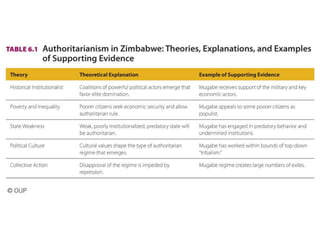
  • #50 Historical Institutionalism Tries to explain institutional patterns Political development is consequence of institutional pattern 2) Poverty and Inequality Worrying about basic economic needs (e.g. making money with a job to support your family) might lead you to support authoritarian regime who promises jobs. Not going to spend time on voting, protesting, etc.   3) State Weakness and Failure Weak or failed states are more likely to yield to authoritarianism Tied to economic and social issues Low economic development  Weak state  Authoritarianism Class volatility  Weak state  authoritarianism   4) Political Culture Some parts of the world may just be “predisposed” to authoritarianism   5) Barriers to Collective Action Ousting an authoritarian government requires massive mobilization effort, which is hard to accomplish in face of citizen repression, control of media, etc.
  • #51 This table (on p. 162 in your textbook) provides a way to understand how the five main explanations for authoritarian persistence have worked in practice through the African country of Zimbabwe. Please review it.