Traditional and
Authentic
Assessment
Prepared by: Dimog, Tracey Loraine
Valdes, Vanessa
Madam-ot, Janice
What is Traditional
Assessment?
• A type of assessment in which the
students choose their answer from a given
list of choices. Examples of this type of
assessment are multiple – choice test,
standard true/false test, matching type
test, and fill- in – the blank test.
Traditional Assessment Tools
• True/false tests
• Multiple choice tests
• Essays and short answer test
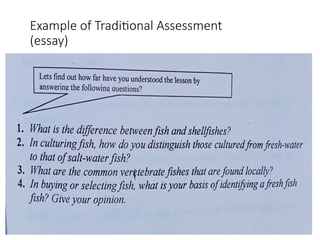
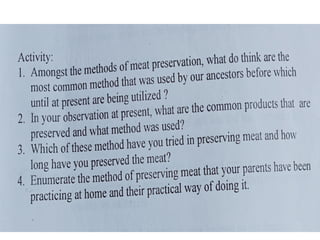
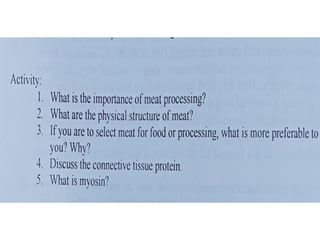
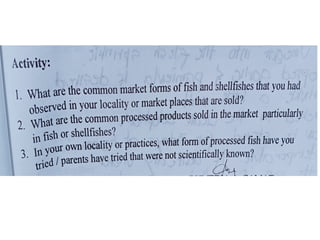
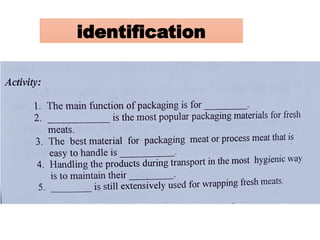
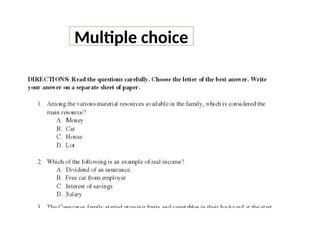
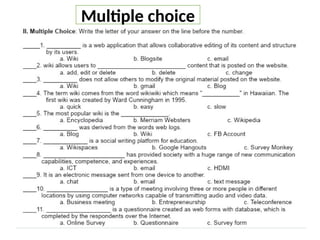
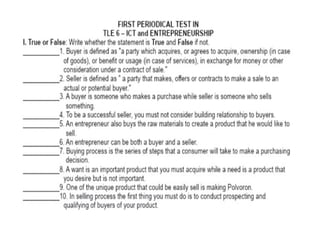
Example of Traditional Assessment
(essay)
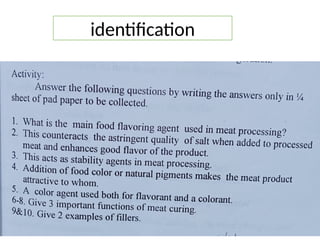
identification
identification
Multiple choice
Multiple choice
Strengths of Traditional
Assessment
• Reliability
• Validity
• Easy to administer
• Uses a checking key
• Uses low-level thinking
Weaknesses of Traditional
Assessment
• Individualist
• Competition
Purpose of Traditional
Assessment
• Evaluate students
• Rank students
• Assign final grade
Authentic Assessment
• An assessment that is performance-oriented,
the thinking goes, with the assessment that
aims to measure not only the correctness of
the response, but also the thought process
involved in arriving at the response, and that
encourage students to reflect their own
learning in both depth and breadth, the
belief is that instruction will be pushed into a
more thoughtful, more reflexive, richer
mode as well
Authentic Assessment:
Authentic Assessment (AA)
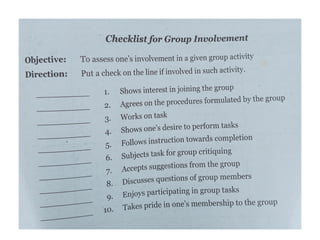
Inventories
Peer rating / Self rating
Journals
Portfolios
Discussions
Interviews
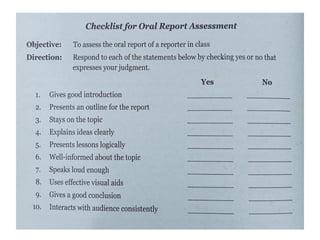
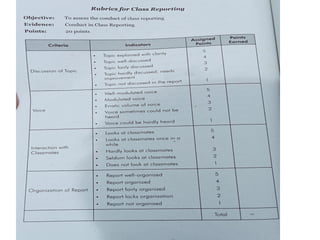
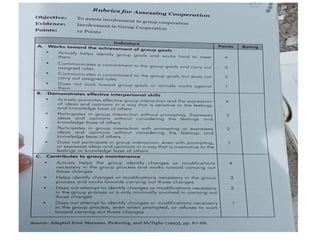
Class reporting
2 types of authentic Assessment
1. Performance Assessment
2. Portfolio Assessment
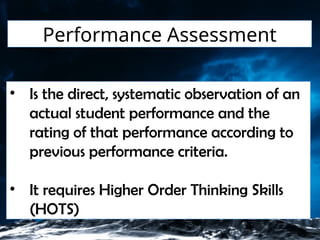
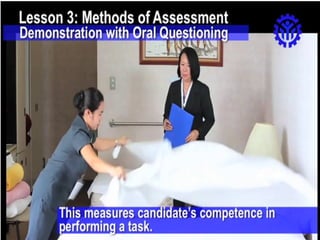
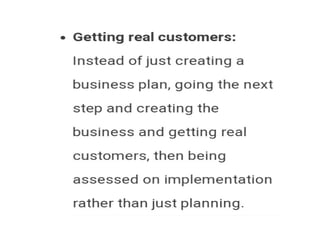
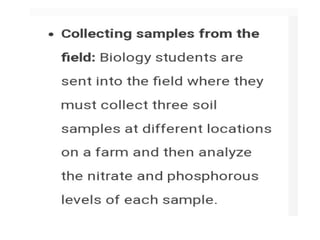
Performance Assessment
• Is the direct, systematic observation of an
actual student performance and the
rating of that performance according to
previous performance criteria.
• It requires Higher Order Thinking Skills
(HOTS)
Portfolio Assessment
• Portfolio assessment is a purposeful
collection of student work designed to
showcase a student’s progress toward,
and achievement of, course – specific
learning objectives. This provide evidence
of what student can actually do.
Contents of Portfolio
1.Best work of students
•Example: The students won 1st
prize in the local, regional and
national invertigatory projects.
2. Individual student’s work
•Example: The student is the
President in the class and the
Supreme Student Council.
•At home, the student help her
mother at with washing clothes
and cooking.
3. Group work activities
•Example: The group work activity is
Income Generating Project on Seaweed
Muffins as a requirement fro thier
interprenueral project.
4. Extracurricular activities
•This serves as bases for the
future teachers of the learner
to indentify the specific extra
curricular activities he
participated in and exelled.
5. Religious Activities
• It’s important especially when a
student enrolls in a religious
institution.
• It serves as bases for being active
spiritually.
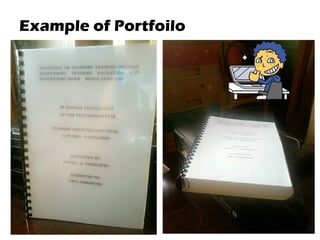
Example of Portfoilo
Comparison of Traditional
Assessment and
Authentic Assessment
Traditional Assessment Authentic Assessment
Generally relies on forced – choice
written measures
Promotes integration of various written
and performance measures
Relies on proxy measures of student
learning to represent target skills
Relies on direct measures of target skills
Encourages memorization of correct
answers
Encourages divergent thinking in
generation possible answers
Goal is to measure acquisition of
knowledge
Goal is to enhance development of
meaningful skills
Curriculum directs assessment Assessment directs curriculum
Emphasis on developing a body of
knowledge
Emphasis on ensuring proficiency at real –
world tasks
Promotes “what” knowledge Promotes “how” knowledge
Emphasizes competition Emphasizes cooperation
Targets simplistic skills or tasks in a
concrete, singular fashion
Prepares students for ambiguities and
exceptions that are found in realistic
problem settings
Priority on summative outcomes or
product
Priority on the learning sequence or
process
Traditional Assessment Authentic Assessment
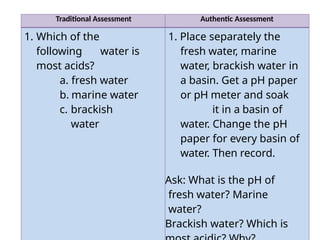
1. Which of the
following water is
most acids?
a. fresh water
b. marine water
c. brackish
water
1. Place separately the
fresh water, marine
water, brackish water in
a basin. Get a pH paper
or pH meter and soak
it in a basin of
water. Change the pH
paper for every basin of
water. Then record.
Ask: What is the pH of
fresh water? Marine
water?
Brackish water? Which is
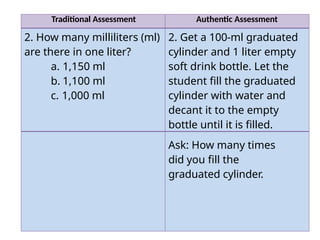
Traditional Assessment Authentic Assessment
2. How many milliliters (ml)
are there in one liter?
a. 1,150 ml
b. 1,100 ml
c. 1,000 ml
2. Get a 100-ml graduated
cylinder and 1 liter empty
soft drink bottle. Let the
student fill the graduated
cylinder with water and
decant it to the empty
bottle until it is filled.
Ask: How many times
did you fill the
graduated cylinder.
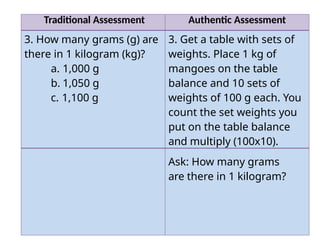
Traditional Assessment Authentic Assessment
3. How many grams (g) are
there in 1 kilogram (kg)?
a. 1,000 g
b. 1,050 g
c. 1,100 g
3. Get a table with sets of
weights. Place 1 kg of
mangoes on the table
balance and 10 sets of
weights of 100 g each. You
count the set weights you
put on the table balance
and multiply (100x10).
Ask: How many grams
are there in 1 kilogram?
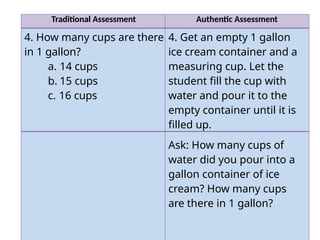
Traditional Assessment Authentic Assessment
4. How many cups are there
in 1 gallon?
a. 14 cups
b. 15 cups
c. 16 cups
4. Get an empty 1 gallon
ice cream container and a
measuring cup. Let the
student fill the cup with
water and pour it to the
empty container until it is
filled up.
Ask: How many cups of
water did you pour into a
gallon container of ice
cream? How many cups
are there in 1 gallon?
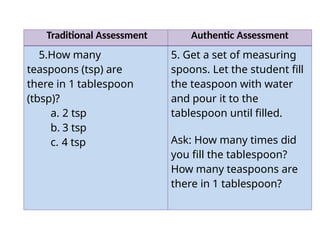
Traditional Assessment Authentic Assessment
5.How many
teaspoons (tsp) are
there in 1 tablespoon
(tbsp)?
a. 2 tsp
b. 3 tsp
c. 4 tsp
5. Get a set of measuring
spoons. Let the student fill
the teaspoon with water
and pour it to the
tablespoon until filled.
Ask: How many times did
you fill the tablespoon?
How many teaspoons are
there in 1 tablespoon?
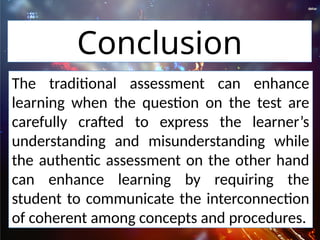
Conclusion
The traditional assessment can enhance
learning when the question on the test are
carefully crafted to express the learner’s
understanding and misunderstanding while
the authentic assessment on the other hand
can enhance learning by requiring the
student to communicate the interconnection
of coherent among concepts and procedures.
References:
-tesda.gov.ph
-Y.A. Gabuyo, ASSESSMENT OF LEARNING 1
-R.L. NAVARRO, R.G. SANTOS, Assessment of
learning outcomes(assessment 1)

authentic-vs-traditional-assesmentt.pptx

  • 1.
    Traditional and Authentic Assessment Prepared by:Dimog, Tracey Loraine Valdes, Vanessa Madam-ot, Janice
  • 2.
    What is Traditional Assessment? •A type of assessment in which the students choose their answer from a given list of choices. Examples of this type of assessment are multiple – choice test, standard true/false test, matching type test, and fill- in – the blank test.
  • 3.
    Traditional Assessment Tools •True/false tests • Multiple choice tests • Essays and short answer test
  • 4.
    Example of TraditionalAssessment (essay)
  • 8.
  • 9.
  • 10.
  • 11.
  • 14.
    Strengths of Traditional Assessment •Reliability • Validity • Easy to administer • Uses a checking key • Uses low-level thinking
  • 15.
    Weaknesses of Traditional Assessment •Individualist • Competition
  • 16.
    Purpose of Traditional Assessment •Evaluate students • Rank students • Assign final grade
  • 17.
    Authentic Assessment • Anassessment that is performance-oriented, the thinking goes, with the assessment that aims to measure not only the correctness of the response, but also the thought process involved in arriving at the response, and that encourage students to reflect their own learning in both depth and breadth, the belief is that instruction will be pushed into a more thoughtful, more reflexive, richer mode as well
  • 18.
    Authentic Assessment: Authentic Assessment(AA) Inventories Peer rating / Self rating Journals Portfolios Discussions Interviews Class reporting
  • 24.
    2 types ofauthentic Assessment 1. Performance Assessment 2. Portfolio Assessment
  • 25.
    Performance Assessment • Isthe direct, systematic observation of an actual student performance and the rating of that performance according to previous performance criteria. • It requires Higher Order Thinking Skills (HOTS)
  • 30.
    Portfolio Assessment • Portfolioassessment is a purposeful collection of student work designed to showcase a student’s progress toward, and achievement of, course – specific learning objectives. This provide evidence of what student can actually do.
  • 31.
    Contents of Portfolio 1.Bestwork of students •Example: The students won 1st prize in the local, regional and national invertigatory projects.
  • 32.
    2. Individual student’swork •Example: The student is the President in the class and the Supreme Student Council. •At home, the student help her mother at with washing clothes and cooking.
  • 33.
    3. Group workactivities •Example: The group work activity is Income Generating Project on Seaweed Muffins as a requirement fro thier interprenueral project.
  • 34.
    4. Extracurricular activities •Thisserves as bases for the future teachers of the learner to indentify the specific extra curricular activities he participated in and exelled.
  • 35.
    5. Religious Activities •It’s important especially when a student enrolls in a religious institution. • It serves as bases for being active spiritually.
  • 36.
  • 37.
    Comparison of Traditional Assessmentand Authentic Assessment
  • 38.
    Traditional Assessment AuthenticAssessment Generally relies on forced – choice written measures Promotes integration of various written and performance measures Relies on proxy measures of student learning to represent target skills Relies on direct measures of target skills Encourages memorization of correct answers Encourages divergent thinking in generation possible answers Goal is to measure acquisition of knowledge Goal is to enhance development of meaningful skills Curriculum directs assessment Assessment directs curriculum Emphasis on developing a body of knowledge Emphasis on ensuring proficiency at real – world tasks Promotes “what” knowledge Promotes “how” knowledge Emphasizes competition Emphasizes cooperation Targets simplistic skills or tasks in a concrete, singular fashion Prepares students for ambiguities and exceptions that are found in realistic problem settings Priority on summative outcomes or product Priority on the learning sequence or process
  • 39.
    Traditional Assessment AuthenticAssessment 1. Which of the following water is most acids? a. fresh water b. marine water c. brackish water 1. Place separately the fresh water, marine water, brackish water in a basin. Get a pH paper or pH meter and soak it in a basin of water. Change the pH paper for every basin of water. Then record. Ask: What is the pH of fresh water? Marine water? Brackish water? Which is
  • 40.
    Traditional Assessment AuthenticAssessment 2. How many milliliters (ml) are there in one liter? a. 1,150 ml b. 1,100 ml c. 1,000 ml 2. Get a 100-ml graduated cylinder and 1 liter empty soft drink bottle. Let the student fill the graduated cylinder with water and decant it to the empty bottle until it is filled. Ask: How many times did you fill the graduated cylinder.
  • 41.
    Traditional Assessment AuthenticAssessment 3. How many grams (g) are there in 1 kilogram (kg)? a. 1,000 g b. 1,050 g c. 1,100 g 3. Get a table with sets of weights. Place 1 kg of mangoes on the table balance and 10 sets of weights of 100 g each. You count the set weights you put on the table balance and multiply (100x10). Ask: How many grams are there in 1 kilogram?
  • 42.
    Traditional Assessment AuthenticAssessment 4. How many cups are there in 1 gallon? a. 14 cups b. 15 cups c. 16 cups 4. Get an empty 1 gallon ice cream container and a measuring cup. Let the student fill the cup with water and pour it to the empty container until it is filled up. Ask: How many cups of water did you pour into a gallon container of ice cream? How many cups are there in 1 gallon?
  • 43.
    Traditional Assessment AuthenticAssessment 5.How many teaspoons (tsp) are there in 1 tablespoon (tbsp)? a. 2 tsp b. 3 tsp c. 4 tsp 5. Get a set of measuring spoons. Let the student fill the teaspoon with water and pour it to the tablespoon until filled. Ask: How many times did you fill the tablespoon? How many teaspoons are there in 1 tablespoon?
  • 44.
    Conclusion The traditional assessmentcan enhance learning when the question on the test are carefully crafted to express the learner’s understanding and misunderstanding while the authentic assessment on the other hand can enhance learning by requiring the student to communicate the interconnection of coherent among concepts and procedures.
  • 45.
    References: -tesda.gov.ph -Y.A. Gabuyo, ASSESSMENTOF LEARNING 1 -R.L. NAVARRO, R.G. SANTOS, Assessment of learning outcomes(assessment 1)