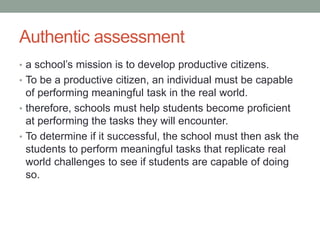
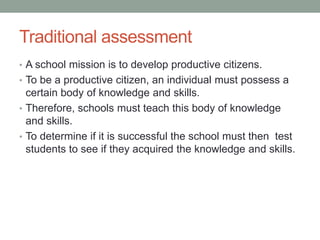
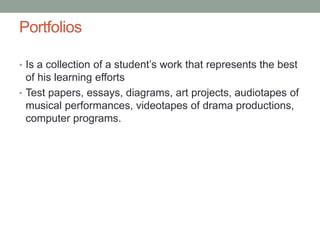
This document discusses authentic assessment and how it differs from traditional assessment. Authentic assessment aims to holistically evaluate students' knowledge, understanding, and skills through engaging tasks that replicate real-world challenges. It focuses on applying knowledge rather than just memorization. Traditional assessment primarily tests to see if students have acquired a body of knowledge and skills. The document provides examples of different forms of authentic assessment like portfolios, journals, and rubrics. It emphasizes that authentic assessment allows for measuring meaningful tasks, learner-specific evaluation, and self-assessment.