TEACHING MULTIGRADE CLASS
At the end of the lesson, the students should
be able to:
• a. describe what is Multigrade Program in Philippine Education
(MPPE)
• b. describe the different components and features of MG class
• c. relate the benefits of MG class for pupils and MG Teachers
• d. identify the quality principles of learning (how we learn best)
• relate the principles to effective classroom practice
What is MPPPE?
• Education is overseen by the Department of Education, which
continues to hold multigrade courses to ensure that learners from the
Philippines studying in rural areas complete their basic education.
• Since 1993, the Multigrade Program in Philippine Education (MPPE)
has helped the Department of Education (DepEd) meet its goal of
democratizing access to education while maintaining its quality in
roughly 19 percent of public elementary schools in remote,
underserved, and sparsely inhabited areas.
What is MPPPE?
• Multigrade Program in Philippine Education(MPPE) is an
education delivery system to democratize access to and improve
the quality of elementary education through completion of
incomplete schools and the organization of multigrade classes
Why MPPPE was conceptualized?
•To maintain educational services in barangays with
decreasing enrolment. MPPE provides a complete
education cycle or expand access in sparsely
populated remote, isolated areas and to maximize
the use of thin resources like lack of classrooms
and other resources and teachers.
What is Multigrade Class?
• The class consists of 2 or more grades handled by one teacher.
• It is found located in distant and sparsely rural populated areas.
• Is usually opened in areas where the number of enrollees for each grade level
does not warrant the opening of single grade class.
• This can be called a “combination class” (if there are only two grades)in the
Philippines. In other countries multigrade classes can be also called
• Vertically grouped or
• Family grouped or
• Multiaged class or
• An ungraded class (when there are three or more grade levels
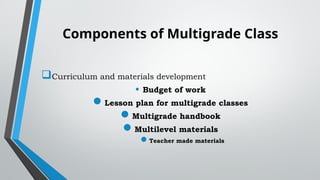
Components of Multigrade Class
Curriculum and materials development
• Budget of work
Lesson plan for multigrade classes
Multigrade handbook
Multilevel materials
Teacher made materials
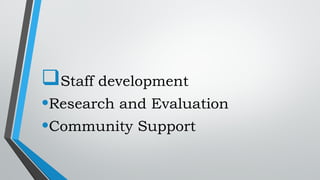
Staff development
•Research and Evaluation
•Community Support
Monitoring and supervision
•Physical facilities
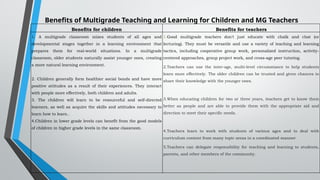
Benefits of Multigrade Teaching and Learning for Children and MG Teachers
Benefits for children Benefits for teachers
1. A multigrade classroom mixes students of all ages and
developmental stages together in a learning environment that
prepares them for real-world situations. In a multigrade
classroom, older students naturally assist younger ones, creating
a more natural learning environment.
2. Children generally form healthier social bonds and have more
positive attitudes as a result of their experiences. They interact
with people more effectively, both children and adults.
3. The children will learn to be resourceful and self-directed
learners, as well as acquire the skills and attitudes necessary to
learn how to learn..
4.Children in lower grade levels can benefit from the good models
of children in higher grade levels in the same classroom.
1.Good multigrade teachers don't just educate with chalk and chat (or
lecturing). They must be versatile and use a variety of teaching and learning
tactics, including cooperative group work, personalized instruction, activity-
centered approaches, group project work, and cross-age peer tutoring.
2.Teachers can use the inter-age, multi-level circumstance to help students
learn more effectively. The older children can be trusted and given chances to
share their knowledge with the younger ones.
3.When educating children for two or three years, teachers get to know them
better as people and are able to provide them with the appropriate aid and
direction to meet their specific needs.
4.Teachers learn to work with students of various ages and to deal with
curriculum content from many topic areas in a coordinated manner
5.Teachers can delegate responsibility for teaching and learning to students,
parents, and other members of the community.
Features of MG Classroom
Environment
In a suitable learning setting, effective multigrade
teaching-learning is more easily accomplished. The
physical layout/or organization of the classroom has a
significant impact on how students do their activities.
Some essential aspects to consider while developing
the layout of a multigrade classroom/environment are
listed below.
Features of MG Classroom
Environment
Learning
Corners/centers/
Areas
Classroom
furnitures
Display
boards/sh
elves
Outdoor
space
Ventilation and lightning-.
Blackboard
Principles and Conditions of Learning
• As future teachers, we are always on the lookout for fresh
strategies to motivate our students to learn. Both our teaching
and our personal learning are best informed by what we know
about how we learn. We may utilize the principles and conditions
of successful learning to guide us as we create learning programs
for our students and for our own personal development once we
understand them.
Quality Principle of Learning
• SUPPORTIVE LEARNING ENVIRONMENT
We feel appreciated and challenged. We are capable of taking risks
in a safe manner and working collaboratively with others. When our
emotions are positive, we learn.
• CONNECTION AND CHALLENGE
Learning connects to our existing knowledge and skills while also
challenging us to create new knowledge beyond what we know and
what we can do. We construct our knowledge by building on what
we already know.
Quality Principle of Learning
• OPPORTUNITY TO LEARN
We are actively involved in our learning, with opportunity to
observe, practice, develop, and apply new skills, information, and
attitudes.
• ACTION AND REFLECTION
We experience learning as an active process and use language as a
tool for learning. We get opportunities to reflect on and make sense
of the action
Quality Principle of Learning
• MOTIVATION AND PURPOSE
Learning experiences focus on achieving clear relevant outcomes that
make sense to us. We learn when we want to or need to.
• INCLUSIVITY AND DIFFERENCE
We engage with experiences that reflect and respect differences between
other learners.
• INDEPENDENCE AND COLLABORATION
We work together and also individually to gain personal and collective
understanding of ideas.
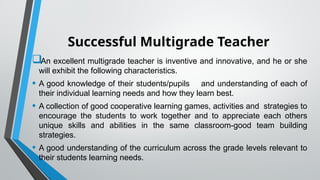
Successful Multigrade Teacher
An excellent multigrade teacher is inventive and innovative, and he or she
will exhibit the following characteristics.
• A good knowledge of their students/pupils and understanding of each of
their individual learning needs and how they learn best.
• A collection of good cooperative learning games, activities and strategies to
encourage the students to work together and to appreciate each others
unique skills and abilities in the same classroom-good team building
strategies.
• A good understanding of the curriculum across the grade levels relevant to
their students learning needs.
Successful Multigrade Teacher
• Time efficient planning techniques which may include working collaboratively
with other teachers in small teaching and learning teams, if possible, to share
planning .activity ideas and resources.
• Flexible time management when integrating learning activities across the
subjects.
• A variety of teaching and learning strategies to use in the classroom to
challenge the students at different levels and encourage them to take more
responsibility for their own learning.

Multi grade classes lecture and itsC.pptx

  • 1.
  • 2.
    At the endof the lesson, the students should be able to: • a. describe what is Multigrade Program in Philippine Education (MPPE) • b. describe the different components and features of MG class • c. relate the benefits of MG class for pupils and MG Teachers • d. identify the quality principles of learning (how we learn best) • relate the principles to effective classroom practice
  • 3.
    What is MPPPE? •Education is overseen by the Department of Education, which continues to hold multigrade courses to ensure that learners from the Philippines studying in rural areas complete their basic education. • Since 1993, the Multigrade Program in Philippine Education (MPPE) has helped the Department of Education (DepEd) meet its goal of democratizing access to education while maintaining its quality in roughly 19 percent of public elementary schools in remote, underserved, and sparsely inhabited areas.
  • 4.
    What is MPPPE? •Multigrade Program in Philippine Education(MPPE) is an education delivery system to democratize access to and improve the quality of elementary education through completion of incomplete schools and the organization of multigrade classes
  • 5.
    Why MPPPE wasconceptualized? •To maintain educational services in barangays with decreasing enrolment. MPPE provides a complete education cycle or expand access in sparsely populated remote, isolated areas and to maximize the use of thin resources like lack of classrooms and other resources and teachers.
  • 6.
    What is MultigradeClass? • The class consists of 2 or more grades handled by one teacher. • It is found located in distant and sparsely rural populated areas. • Is usually opened in areas where the number of enrollees for each grade level does not warrant the opening of single grade class. • This can be called a “combination class” (if there are only two grades)in the Philippines. In other countries multigrade classes can be also called • Vertically grouped or • Family grouped or • Multiaged class or • An ungraded class (when there are three or more grade levels
  • 7.
    Components of MultigradeClass Curriculum and materials development • Budget of work Lesson plan for multigrade classes Multigrade handbook Multilevel materials Teacher made materials
  • 8.
    Staff development •Research andEvaluation •Community Support
  • 9.
  • 10.
    Benefits of MultigradeTeaching and Learning for Children and MG Teachers Benefits for children Benefits for teachers 1. A multigrade classroom mixes students of all ages and developmental stages together in a learning environment that prepares them for real-world situations. In a multigrade classroom, older students naturally assist younger ones, creating a more natural learning environment. 2. Children generally form healthier social bonds and have more positive attitudes as a result of their experiences. They interact with people more effectively, both children and adults. 3. The children will learn to be resourceful and self-directed learners, as well as acquire the skills and attitudes necessary to learn how to learn.. 4.Children in lower grade levels can benefit from the good models of children in higher grade levels in the same classroom. 1.Good multigrade teachers don't just educate with chalk and chat (or lecturing). They must be versatile and use a variety of teaching and learning tactics, including cooperative group work, personalized instruction, activity- centered approaches, group project work, and cross-age peer tutoring. 2.Teachers can use the inter-age, multi-level circumstance to help students learn more effectively. The older children can be trusted and given chances to share their knowledge with the younger ones. 3.When educating children for two or three years, teachers get to know them better as people and are able to provide them with the appropriate aid and direction to meet their specific needs. 4.Teachers learn to work with students of various ages and to deal with curriculum content from many topic areas in a coordinated manner 5.Teachers can delegate responsibility for teaching and learning to students, parents, and other members of the community.
  • 11.
    Features of MGClassroom Environment In a suitable learning setting, effective multigrade teaching-learning is more easily accomplished. The physical layout/or organization of the classroom has a significant impact on how students do their activities. Some essential aspects to consider while developing the layout of a multigrade classroom/environment are listed below.
  • 12.
    Features of MGClassroom Environment Learning Corners/centers/ Areas Classroom furnitures Display boards/sh elves Outdoor space Ventilation and lightning-. Blackboard
  • 13.
    Principles and Conditionsof Learning • As future teachers, we are always on the lookout for fresh strategies to motivate our students to learn. Both our teaching and our personal learning are best informed by what we know about how we learn. We may utilize the principles and conditions of successful learning to guide us as we create learning programs for our students and for our own personal development once we understand them.
  • 14.
    Quality Principle ofLearning • SUPPORTIVE LEARNING ENVIRONMENT We feel appreciated and challenged. We are capable of taking risks in a safe manner and working collaboratively with others. When our emotions are positive, we learn. • CONNECTION AND CHALLENGE Learning connects to our existing knowledge and skills while also challenging us to create new knowledge beyond what we know and what we can do. We construct our knowledge by building on what we already know.
  • 15.
    Quality Principle ofLearning • OPPORTUNITY TO LEARN We are actively involved in our learning, with opportunity to observe, practice, develop, and apply new skills, information, and attitudes. • ACTION AND REFLECTION We experience learning as an active process and use language as a tool for learning. We get opportunities to reflect on and make sense of the action
  • 16.
    Quality Principle ofLearning • MOTIVATION AND PURPOSE Learning experiences focus on achieving clear relevant outcomes that make sense to us. We learn when we want to or need to. • INCLUSIVITY AND DIFFERENCE We engage with experiences that reflect and respect differences between other learners. • INDEPENDENCE AND COLLABORATION We work together and also individually to gain personal and collective understanding of ideas.
  • 17.
    Successful Multigrade Teacher Anexcellent multigrade teacher is inventive and innovative, and he or she will exhibit the following characteristics. • A good knowledge of their students/pupils and understanding of each of their individual learning needs and how they learn best. • A collection of good cooperative learning games, activities and strategies to encourage the students to work together and to appreciate each others unique skills and abilities in the same classroom-good team building strategies. • A good understanding of the curriculum across the grade levels relevant to their students learning needs.
  • 18.
    Successful Multigrade Teacher •Time efficient planning techniques which may include working collaboratively with other teachers in small teaching and learning teams, if possible, to share planning .activity ideas and resources. • Flexible time management when integrating learning activities across the subjects. • A variety of teaching and learning strategies to use in the classroom to challenge the students at different levels and encourage them to take more responsibility for their own learning.