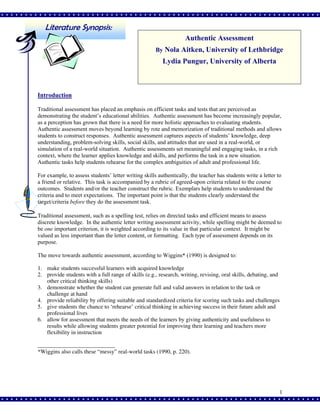
This document discusses authentic assessment and its advantages over traditional assessment. It defines authentic assessment as evaluating students on meaningful tasks that simulate real-world situations. Some key points made include:
1) Authentic assessment allows students to demonstrate deep understanding and problem-solving skills through tasks like writing letters or conducting experiments, rather than just memorization.
2) It provides criteria-referenced evaluations rather than just norm-referenced comparisons to other students.
3) When done well, authentic assessment engages students more and provides valid inferences about their skills.
4) Both authentic and traditional assessments have roles to play in a balanced assessment program.


![Alberta Assessment Consortium. (2003). Refocusing: Looking at assessment for learning. Edmonton,
AB: Author.
Black,P. & Wiliam, D. (1998). Inside the Black Box: Raising Standards through Classroom Assessment.
Retrieved Oct. 21,2005, from http://www.pdkintl.org/kappan/kbla9810.htm
Black, P., Harrison, C., Marshall, B., Wiliam, D. (2003). Assessment for learning. New York: Open
University Press.
Burke, K. (1999). The mindful school: How to assess authentic learning (3rd
ed.). Arlington Heights,
IL: Skylight Training and Publishing.
Campbell, D. (2000). Authentic assessment and authentic standards [Electronic version]. Phi Delta
Kappan, 81, 405-407.
Cumming, J, J, & Maxwell, G. S. (1999). Contextualizing authentic assessment [Electronic version].
Assessment in Education, 6, 177-194.
Davies, A. (2000). Making classroom assessment work. Merville, BC: Connections.
Ewing, S. C. (1998). Alternative assessment: popularity, pitfalls, and potential [Electronic version].
Assessment Update, 10, 1-2, 11-12.
Gronlund, N. E., & Cameron, I. J. (2004). Assessment of student achievement. Toronto, ON: Pearson
Education Canada.
Guskey, T. R. (2003). How classroom assessments improve learning. Educational Leadership, 60(5), 6-
11.
Karge, B. (1998). Knowing what to teach: Using authentic assessment to improve classroom
instruction. Reading & Writing Quarterly, 14, 319-331. Retrieved May 19, 2004 from EBSCO
database.
McMillan, J. H. (2001). Classroom assessment: Principles and practice for effective instruction (2nd
ed.). Toronto, ON: Allyn & Bacon.
McTighe, J., & Wiggins, G. (1998). Understanding by design. Alexandria, VA: Association for
Supervision and Curriculum Development.
McTighe, J., & Wiggins, G. (1999). Understanding by design: Handbook. Alexandria, VA:
Association for Supervision and Curriculum Development.
McTighe, J., & Wiggins, G. (2004). Understanding by design: Professional development workbook.
Alexandria, VA: Association for Supervision and Curriculum Development.
Moore, R. A. (1998). Helping teachers define and develop authentic assessment and evaluation practices
[Electronic version]. Assessment Update, 10, 3-5.
Morris, R. V. (2001). Drama and authentic assessment in a social studies classroom. Social Studies, 92,
41-44. Retrieved May 19, 2004 from EBSCO database.
7
Oosterhof, A. (2003). Developing and using classroom assessments (3rd
ed.). Toronto, ON: Prentice-
Hall.](https://image.slidesharecdn.com/authenticassessment2-150805102757-lva1-app6891/85/Authentic-assessment-2-7-320.jpg)
![Paris, S. G., & Ayres, L. R. (1994). Becoming reflective students and teachers with portfolios and
authentic assessment. Washington, DC: American Psychology Association.
Popham, W. J. (2002). Classroom assessment: What teachers need to know (3rd
ed.). Boston: Allyn and
Bacon.
Prestidge, L. K. & Williams Glaser, C. H. (2000). Authentic assessment: Employing appropriate tools
for evaluating students' work in 21st-century classrooms [Electronic version]. Intervention in School
& Clinic, 35, 178-182.
Stiggins, R. (2001). Student-centered classroom assessment (3rd
ed.). Upper Saddle River, NJ: Merrill
Prentice Hall.
Tanner, D. E. (2001). Authentic assessment: A solution, or part of the problem? High School Journal,
85, 24-29. Retrieved May 19, 2004 from EBSCO database.
Tombari, M., & Borich, G. (1999). Authentic assessment in the classroom: Applications and practice.
Toronto, ON: Prentice-Hall.
Weber, E. (1999). Student assessment that works: A practical approach. Boston: Allyn and Bacon.
Wiggins, G. P. (1993). Assessing student performance: Exploring the purpose and limits of testing. San
Francisco: Jossey-Bass.
Some Useful Internet Sites
Canadian
http://www.aac.ab.ca/home.html
http://www.2learn.ca
United States
http://www.ncrel.org/sdrs/areas/as0cont.html
http://jonathan.mueller.faculty.noctrl.edu/toolbox/whatisit.html
8](https://image.slidesharecdn.com/authenticassessment2-150805102757-lva1-app6891/85/Authentic-assessment-2-8-320.jpg)


![Customer service training[1]](https://cdn.slidesharecdn.com/ss_thumbnails/customerservicetraining1-120818024251-phpapp02-thumbnail.jpg?width=640&height=640&fit=bounds)


