IFUGAO STATE
UNIVERSITY
What is Authentic Assessment?
Jean N. Calingayan
Lesson 2
Authentic assessment
➢ A form of assessment in which students are asked to perform
real-world tasks that demonstrate meaningful application of
essential knowledge and skills. (Jon Mueller)
➢ Performance assessment calls upon the examinee to
demonstrate specific skills and competencies, that is, to apply
the skills and knowledge they have mastered. (Richard J.
Stiggins)
IFUGAO STATE
UNIVERSITY
What is Authentic Assessment?
Jean N. Calingayan
Lesson 2
What does Authentic assessment look like?
➢ An authentic assessment usually includes a task for students to
perform and a rubric by which their performance on the task
will be evaluated.
IFUGAO STATE
UNIVERSITY
Characteristics of Authentic Assessment?
Jean N. Calingayan
Lesson 2
1. AA starts with clear and definite criteria of performance made
known to the students.
➢ Authentic assessment provides students with explicit
expectations and clear rubrics for evaluation.
2. AA is criterion-referenced rather than norm-referenced and so it
identifies strengths and weaknesses but does not compare
students nor rank their level of performance.
➢ It identifies individual strengths and areas for improvement
without ranking or competition.
What is Authentic Assessment?
IFUGAO STATE
UNIVERSITY
Jean N. Calingayan
Lesson 2
3. AA requires students to make their answers to questions rather than
select from given options as in multiple-choice items and
requires them to use a range of higher-order thinking
skills(HOTS).
➢ Authentic assessment tasks involve open-ended questions
that encourage creativity, critical thinking, and problem-
solving rather than simple recall of facts.
Characteristics of Authentic Assessment?
What is Authentic Assessment?
IFUGAO STATE
UNIVERSITY
Jean N. Calingayan
Lesson 2
4. AA often emphasizes performance and therefore students are
required to demonstrate their knowledge, skills, and
competencies in appropriate situations.
➢ Students are asked to apply their learning in realistic
contexts or perform tasks that showcase their abilities.
5. AA does not rely on the ability to recall facts or memorize details,
instead students are asked to demonstrate skills and concepts
they have learned.
➢ Instead of testing a student’s memory, authentic assessment
measures their understanding and ability to use what they
have learned in practical ways.
Characteristics of Authentic Assessment?
What is Authentic Assessment?
IFUGAO STATE
UNIVERSITY
Jean N. Calingayan
Lesson 2
6. AA encourages both teacher and students to determine their rate of
progress in cooperatively attaining the desired student learning
outcomes.
➢ Both teachers and students actively participate in
monitoring progress and addressing challenges together.
7. A change role of students as passive test takers into becoming active
and involved participants in assessment activities that
emphasize what they are capable of doing.
➢ Students are engaged in meaningful activities where they
can showcase their abilities and what they are capable of
doing.
Characteristics of Authentic Assessment?
What is Authentic Assessment?
IFUGAO STATE
UNIVERSITY
Jean N. Calingayan
Lesson 2
8. AA does not encourage rote learning and passive taking of tests;
instead, students are required to demonstrate analytical skills,
ability to integrate what they learn, creativity and ability to
work in a group, and skills in oral and written communications.
AA values not only the finished products which are the learning
outcomes, but also the process of learning.
➢ Both the process and the product are valued, meaning
students’ efforts and learning journey are as important as
the final outcome.
Characteristics of Authentic Assessment?
What is Authentic Assessment?
IFUGAO STATE
UNIVERSITY
Jean N. Calingayan
Lesson 2
➢ refers to conventional methods of evaluating students'
knowledge and skills, typically through standardized tests,
quizzes, multiple-choice questions, true-or-false items, and
similar formats. These assessments often focus on
measuring factual recall or understanding of concepts in a
structured and objective manner.
Traditional Assessment
What is Authentic Assessment?
IFUGAO STATE
UNIVERSITY
Jean N. Calingayan
Lesson 2
Characteristics of Traditional Assessment
What is Authentic Assessment?
.
• Usually paper-and-pencil-based or online.
• Focuses on knowledge recall and comprehension.
• Often includes closed-ended questions (e.g., multiple-
choice, true/false, matching).
• Standardized, making it easy to compare results across
students.
• Emphasizes summative evaluation over formative
feedback.
IFUGAO STATE
UNIVERSITY
Jean N. Calingayan
Lesson 2
Limitations of Traditional Assessment
What is Authentic Assessment?
.
• Does not always measure higher-order thinking or real-
world application.
• Limited scope for creativity or demonstrating practical
skills.
• May encourage rote memorization rather than deeper
understanding.
IFUGAO STATE
UNIVERSITY
Jean N. Calingayan
Lesson 2
1. Performance Assessment
➢ requires students to actively demonstrate their knowledge,
skills, and competencies by performing a task or creating a
product. The focus is on applying what they have learned in
real or simulated scenarios.
Related Terms
What is Authentic Assessment?
IFUGAO STATE
UNIVERSITY
Jean N. Calingayan
Lesson 2
2. Alternative Assessment
➢ refers to non-traditional methods of evaluation that focus
on open-ended tasks, allowing students to showcase their
learning through creative and practical approaches. It
contrasts with standardized tests and includes options like
portfolios, self-assessments, and peer reviews.
Related Terms
What is Authentic Assessment?
IFUGAO STATE
UNIVERSITY
Jean N. Calingayan
Lesson 2
3. Direct Assessment
➢ evaluates learning by examining actual student work or
performance that demonstrates specific skills, knowledge,
or competencies. It directly measures the outcome without
relying on secondary data like surveys or self-reports.
Related Terms
What is Authentic Assessment?
IFUGAO STATE
UNIVERSITY
Jean N. Calingayan
Lesson 3
1. Realistic
➢ involve tasks that simulate real-world scenarios or
challenges students are likely to encounter outside the
classroom. They help learners see the practical value of
their knowledge and skills.
2. Engaging
➢ are designed to capture the interest and motivation of
students. They often allow students to express creativity,
make choices, or solve meaningful problems.
Principles of Authentic Assessment
Why Use Authentic Assessment?
IFUGAO STATE
UNIVERSITY
Jean N. Calingayan
Lesson 3
3. Integrated
➢ connect multiple subject areas or skills, reflecting how tasks
in the real world often require interdisciplinary knowledge.
4. Continuous
➢ evaluates learning progress over time, using multiple
opportunities for feedback and improvement rather than a
single test or task.
Principles of Authentic Assessment
Why Use Authentic Assessment?
IFUGAO STATE
UNIVERSITY
Jean N. Calingayan
Lesson 3
5. Clear
➢ provide students with explicit instructions, criteria, and
expectations. This ensures that they understand what is
required and how their work will be evaluated.
6. Performance-Based
➢ require students to demonstrate their knowledge and skills
through practical tasks or performances, rather than
answering traditional test questions.
Principles of Authentic Assessment
Why Use Authentic Assessment?
IFUGAO STATE
UNIVERSITY
Jean N. Calingayan
Lesson 3
7. Contextual
➢ are tailored to the specific cultural, social, or professional
backgrounds of the students, making the tasks more
relevant and meaningful to their lives.
Principles of Authentic Assessment
Why Use Authentic Assessment?
IFUGAO STATE
UNIVERSITY
Jean N. Calingayan
Lesson 3
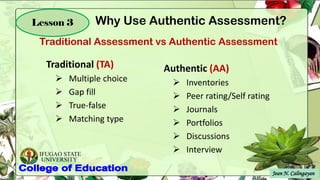
Traditional (TA)
➢ Multiple choice
➢ Gap fill
➢ True-false
➢ Matching type
Traditional Assessment vs Authentic Assessment
Why Use Authentic Assessment?
Authentic (AA)
➢ Inventories
➢ Peer rating/Self rating
➢ Journals
➢ Portfolios
➢ Discussions
➢ Interview
IFUGAO STATE
UNIVERSITY
Jean N. Calingayan
Lesson 3
Traditional Assessment vs Authentic Assessment
Why Use Authentic Assessment?
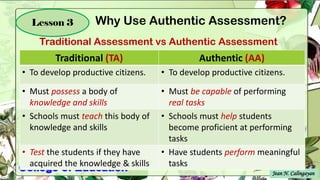
Traditional (TA) Authentic (AA)
• To develop productive citizens. • To develop productive citizens.
• Must possess a body of
knowledge and skills
• Must be capable of performing
real tasks
• Schools must teach this body of
knowledge and skills
• Schools must help students
become proficient at performing
tasks
• Test the students if they have
acquired the knowledge & skills
• Have students perform meaningful
tasks
IFUGAO STATE
UNIVERSITY
Jean N. Calingayan
Lesson 3
Traditional Assessment vs Authentic Assessment
Why Use Authentic Assessment?
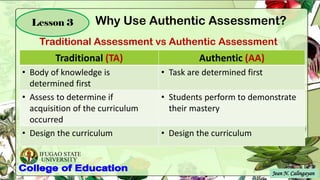
Traditional (TA) Authentic (AA)
• Body of knowledge is
determined first
• Task are determined first
• Assess to determine if
acquisition of the curriculum
occurred
• Students perform to demonstrate
their mastery
• Design the curriculum • Design the curriculum
IFUGAO STATE
UNIVERSITY
Jean N. Calingayan
Lesson 3
Why Use Authentic Assessment
Why Use Authentic Assessment?
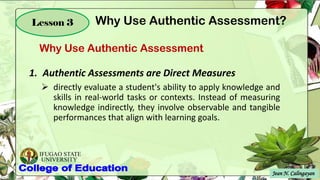
1. Authentic Assessments are Direct Measures
➢ directly evaluate a student's ability to apply knowledge and
skills in real-world tasks or contexts. Instead of measuring
knowledge indirectly, they involve observable and tangible
performances that align with learning goals.
IFUGAO STATE
UNIVERSITY
Jean N. Calingayan
Lesson 3
Why Use Authentic Assessment
Why Use Authentic Assessment?
2. Authentic Assessments Capture the Constructive Nature of
Learning
➢ students build new understanding by integrating prior
knowledge, experiences, and reflection. These assessments
provide opportunities for students to engage in meaningful,
real-world problem-solving.
IFUGAO STATE
UNIVERSITY
Jean N. Calingayan
Lesson 3
Why Use Authentic Assessment
Why Use Authentic Assessment?
3. Authentic Assessments Integrate Teaching, Learning, and
Assessment
➢ This means students are assessed while they are actively
engaged in learning and applying concepts, making the
experience more cohesive and meaningful.
IFUGAO STATE
UNIVERSITY
Jean N. Calingayan
Lesson 3
Why Use Authentic Assessment
Why Use Authentic Assessment?
4. Authentic Assessments Provide Multiple Paths to
Demonstration
➢ This inclusivity ensures that students can choose
approaches that best align with their abilities.

Authentic assessment UNIT LESSON-2-3.pdf

  • 1.
    IFUGAO STATE UNIVERSITY What isAuthentic Assessment? Jean N. Calingayan Lesson 2 Authentic assessment ➢ A form of assessment in which students are asked to perform real-world tasks that demonstrate meaningful application of essential knowledge and skills. (Jon Mueller) ➢ Performance assessment calls upon the examinee to demonstrate specific skills and competencies, that is, to apply the skills and knowledge they have mastered. (Richard J. Stiggins)
  • 2.
    IFUGAO STATE UNIVERSITY What isAuthentic Assessment? Jean N. Calingayan Lesson 2 What does Authentic assessment look like? ➢ An authentic assessment usually includes a task for students to perform and a rubric by which their performance on the task will be evaluated.
  • 3.
    IFUGAO STATE UNIVERSITY Characteristics ofAuthentic Assessment? Jean N. Calingayan Lesson 2 1. AA starts with clear and definite criteria of performance made known to the students. ➢ Authentic assessment provides students with explicit expectations and clear rubrics for evaluation. 2. AA is criterion-referenced rather than norm-referenced and so it identifies strengths and weaknesses but does not compare students nor rank their level of performance. ➢ It identifies individual strengths and areas for improvement without ranking or competition. What is Authentic Assessment?
  • 4.
    IFUGAO STATE UNIVERSITY Jean N.Calingayan Lesson 2 3. AA requires students to make their answers to questions rather than select from given options as in multiple-choice items and requires them to use a range of higher-order thinking skills(HOTS). ➢ Authentic assessment tasks involve open-ended questions that encourage creativity, critical thinking, and problem- solving rather than simple recall of facts. Characteristics of Authentic Assessment? What is Authentic Assessment?
  • 5.
    IFUGAO STATE UNIVERSITY Jean N.Calingayan Lesson 2 4. AA often emphasizes performance and therefore students are required to demonstrate their knowledge, skills, and competencies in appropriate situations. ➢ Students are asked to apply their learning in realistic contexts or perform tasks that showcase their abilities. 5. AA does not rely on the ability to recall facts or memorize details, instead students are asked to demonstrate skills and concepts they have learned. ➢ Instead of testing a student’s memory, authentic assessment measures their understanding and ability to use what they have learned in practical ways. Characteristics of Authentic Assessment? What is Authentic Assessment?
  • 6.
    IFUGAO STATE UNIVERSITY Jean N.Calingayan Lesson 2 6. AA encourages both teacher and students to determine their rate of progress in cooperatively attaining the desired student learning outcomes. ➢ Both teachers and students actively participate in monitoring progress and addressing challenges together. 7. A change role of students as passive test takers into becoming active and involved participants in assessment activities that emphasize what they are capable of doing. ➢ Students are engaged in meaningful activities where they can showcase their abilities and what they are capable of doing. Characteristics of Authentic Assessment? What is Authentic Assessment?
  • 7.
    IFUGAO STATE UNIVERSITY Jean N.Calingayan Lesson 2 8. AA does not encourage rote learning and passive taking of tests; instead, students are required to demonstrate analytical skills, ability to integrate what they learn, creativity and ability to work in a group, and skills in oral and written communications. AA values not only the finished products which are the learning outcomes, but also the process of learning. ➢ Both the process and the product are valued, meaning students’ efforts and learning journey are as important as the final outcome. Characteristics of Authentic Assessment? What is Authentic Assessment?
  • 8.
    IFUGAO STATE UNIVERSITY Jean N.Calingayan Lesson 2 ➢ refers to conventional methods of evaluating students' knowledge and skills, typically through standardized tests, quizzes, multiple-choice questions, true-or-false items, and similar formats. These assessments often focus on measuring factual recall or understanding of concepts in a structured and objective manner. Traditional Assessment What is Authentic Assessment?
  • 9.
    IFUGAO STATE UNIVERSITY Jean N.Calingayan Lesson 2 Characteristics of Traditional Assessment What is Authentic Assessment? . • Usually paper-and-pencil-based or online. • Focuses on knowledge recall and comprehension. • Often includes closed-ended questions (e.g., multiple- choice, true/false, matching). • Standardized, making it easy to compare results across students. • Emphasizes summative evaluation over formative feedback.
  • 10.
    IFUGAO STATE UNIVERSITY Jean N.Calingayan Lesson 2 Limitations of Traditional Assessment What is Authentic Assessment? . • Does not always measure higher-order thinking or real- world application. • Limited scope for creativity or demonstrating practical skills. • May encourage rote memorization rather than deeper understanding.
  • 11.
    IFUGAO STATE UNIVERSITY Jean N.Calingayan Lesson 2 1. Performance Assessment ➢ requires students to actively demonstrate their knowledge, skills, and competencies by performing a task or creating a product. The focus is on applying what they have learned in real or simulated scenarios. Related Terms What is Authentic Assessment?
  • 12.
    IFUGAO STATE UNIVERSITY Jean N.Calingayan Lesson 2 2. Alternative Assessment ➢ refers to non-traditional methods of evaluation that focus on open-ended tasks, allowing students to showcase their learning through creative and practical approaches. It contrasts with standardized tests and includes options like portfolios, self-assessments, and peer reviews. Related Terms What is Authentic Assessment?
  • 13.
    IFUGAO STATE UNIVERSITY Jean N.Calingayan Lesson 2 3. Direct Assessment ➢ evaluates learning by examining actual student work or performance that demonstrates specific skills, knowledge, or competencies. It directly measures the outcome without relying on secondary data like surveys or self-reports. Related Terms What is Authentic Assessment?
  • 14.
    IFUGAO STATE UNIVERSITY Jean N.Calingayan Lesson 3 1. Realistic ➢ involve tasks that simulate real-world scenarios or challenges students are likely to encounter outside the classroom. They help learners see the practical value of their knowledge and skills. 2. Engaging ➢ are designed to capture the interest and motivation of students. They often allow students to express creativity, make choices, or solve meaningful problems. Principles of Authentic Assessment Why Use Authentic Assessment?
  • 15.
    IFUGAO STATE UNIVERSITY Jean N.Calingayan Lesson 3 3. Integrated ➢ connect multiple subject areas or skills, reflecting how tasks in the real world often require interdisciplinary knowledge. 4. Continuous ➢ evaluates learning progress over time, using multiple opportunities for feedback and improvement rather than a single test or task. Principles of Authentic Assessment Why Use Authentic Assessment?
  • 16.
    IFUGAO STATE UNIVERSITY Jean N.Calingayan Lesson 3 5. Clear ➢ provide students with explicit instructions, criteria, and expectations. This ensures that they understand what is required and how their work will be evaluated. 6. Performance-Based ➢ require students to demonstrate their knowledge and skills through practical tasks or performances, rather than answering traditional test questions. Principles of Authentic Assessment Why Use Authentic Assessment?
  • 17.
    IFUGAO STATE UNIVERSITY Jean N.Calingayan Lesson 3 7. Contextual ➢ are tailored to the specific cultural, social, or professional backgrounds of the students, making the tasks more relevant and meaningful to their lives. Principles of Authentic Assessment Why Use Authentic Assessment?
  • 18.
    IFUGAO STATE UNIVERSITY Jean N.Calingayan Lesson 3 Traditional (TA) ➢ Multiple choice ➢ Gap fill ➢ True-false ➢ Matching type Traditional Assessment vs Authentic Assessment Why Use Authentic Assessment? Authentic (AA) ➢ Inventories ➢ Peer rating/Self rating ➢ Journals ➢ Portfolios ➢ Discussions ➢ Interview
  • 19.
    IFUGAO STATE UNIVERSITY Jean N.Calingayan Lesson 3 Traditional Assessment vs Authentic Assessment Why Use Authentic Assessment? Traditional (TA) Authentic (AA) • To develop productive citizens. • To develop productive citizens. • Must possess a body of knowledge and skills • Must be capable of performing real tasks • Schools must teach this body of knowledge and skills • Schools must help students become proficient at performing tasks • Test the students if they have acquired the knowledge & skills • Have students perform meaningful tasks
  • 20.
    IFUGAO STATE UNIVERSITY Jean N.Calingayan Lesson 3 Traditional Assessment vs Authentic Assessment Why Use Authentic Assessment? Traditional (TA) Authentic (AA) • Body of knowledge is determined first • Task are determined first • Assess to determine if acquisition of the curriculum occurred • Students perform to demonstrate their mastery • Design the curriculum • Design the curriculum
  • 21.
    IFUGAO STATE UNIVERSITY Jean N.Calingayan Lesson 3 Why Use Authentic Assessment Why Use Authentic Assessment? 1. Authentic Assessments are Direct Measures ➢ directly evaluate a student's ability to apply knowledge and skills in real-world tasks or contexts. Instead of measuring knowledge indirectly, they involve observable and tangible performances that align with learning goals.
  • 22.
    IFUGAO STATE UNIVERSITY Jean N.Calingayan Lesson 3 Why Use Authentic Assessment Why Use Authentic Assessment? 2. Authentic Assessments Capture the Constructive Nature of Learning ➢ students build new understanding by integrating prior knowledge, experiences, and reflection. These assessments provide opportunities for students to engage in meaningful, real-world problem-solving.
  • 23.
    IFUGAO STATE UNIVERSITY Jean N.Calingayan Lesson 3 Why Use Authentic Assessment Why Use Authentic Assessment? 3. Authentic Assessments Integrate Teaching, Learning, and Assessment ➢ This means students are assessed while they are actively engaged in learning and applying concepts, making the experience more cohesive and meaningful.
  • 24.
    IFUGAO STATE UNIVERSITY Jean N.Calingayan Lesson 3 Why Use Authentic Assessment Why Use Authentic Assessment? 4. Authentic Assessments Provide Multiple Paths to Demonstration ➢ This inclusivity ensures that students can choose approaches that best align with their abilities.