Image: Bailey & Muppet


                                      Hanna Teräs
  Authentic e-Learning   University of Wollongong
  What, why and how?                 April 11 2013
Thursday, April 11, 13
Q1: What is authentic e-learning?


                                                image: neilalderney123

Thursday, April 11, 13
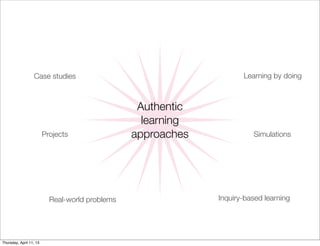
Case studies                                       Learning by doing


                                                  Authentic
                                                   learning
                         Projects                approaches             Simulations


                           Real-world problems                Inquiry-based learning


Thursday, April 11, 13
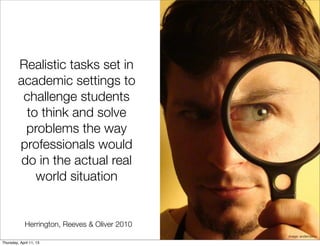
Realistic tasks set in
         academic settings to
          challenge students
          to think and solve
          problems the way
         professionals would
         do in the actual real
            world situation


             Herrington, Reeves & Oliver 2010
                                                image: andercismo
Thursday, April 11, 13
Q2: Why use authentic e-learning?


                                             image: neilalderney123

Thursday, April 11, 13
Johnson, L., Smith, R., Willis, H., Levine, A., and Haywood, K.,
                                       (2011). The 2011 Horizon Report.
                                  Austin, Texas: The New Media Consortium.
Thursday, April 11, 13
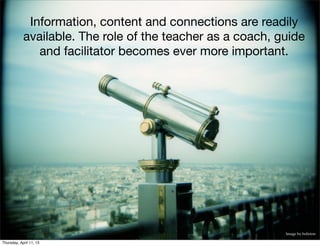
Information, content and connections are readily
            available. The role of the teacher as a coach, guide
               and facilitator becomes ever more important.


                                                            Image by boliston

Thursday, April 11, 13
We expect to be
                able to learn, work
                    and study
                    wherever,
                    whenever.


                                      Image by jakebouma

Thursday, April 11, 13
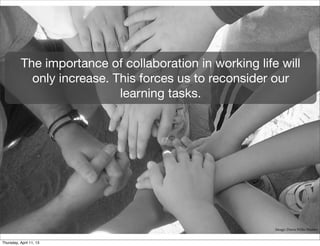
The importance of collaboration in working life will
             only increase. This forces us to reconsider our
                             learning tasks.


                                                          Image: Dawn Willis Manser


Thursday, April 11, 13
Information society:     (Technical Research Centre of Finland)


            Producing, handling
              and transmitting
             information has a
               central role in
                 economy.            Knowledge society:
                                    Innovations, renewal,
                                         technological
                                       development and
                                       openness to new
                                     ideas are in key role.

Thursday, April 11, 13
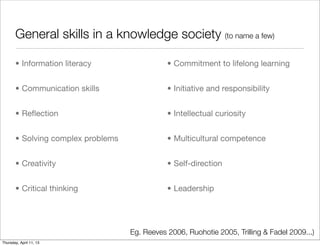
General skills in a knowledge society (to name a few)

       • Information literacy                  • Commitment to lifelong learning


       • Communication skills                  • Initiative and responsibility


       • Reflection                             • Intellectual curiosity


       • Solving complex problems              • Multicultural competence


       • Creativity                            • Self-direction


       • Critical thinking                     • Leadership


                                    Eg. Reeves 2006, Ruohotie 2005, Trilling & Fadel 2009...)
Thursday, April 11, 13
WHOA! Hold on a
       second...

       How can these be
       taught?


Thursday, April 11, 13
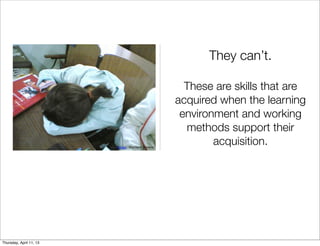
They can’t.

                                                    These are skills that are
                                                  acquired when the learning
                                                   environment and working
                                                    methods support their
                         Image: Matthew Stinson
                                                          acquisition.


Thursday, April 11, 13
Q3: How might I build such a
                            learning environment?


                                                        image: neilalderney123

Thursday, April 11, 13
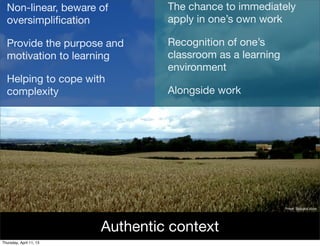
Non-linear, beware of           The chance to immediately
  oversimplification               apply in one’s own work

  Provide the purpose and         Recognition of one’s
  motivation to learning          classroom as a learning
                                  environment
  Helping to cope with
  complexity                      Alongside work


                                                            Image: Rain and shine


                         Authentic context
Thursday, April 11, 13
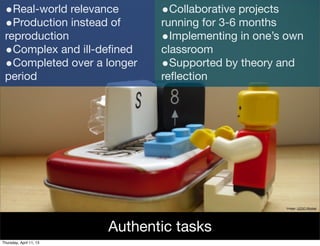
•Real-world relevance          •Collaborative projects
 •Production instead of         running for 3-6 months
 reproduction                   •Implementing in one’s own
 •Complex and ill-defined        classroom
 •Completed over a longer       •Supported by theory and
 period                         reflection


                                                          Image: LEGO Worker


                         Authentic tasks
Thursday, April 11, 13
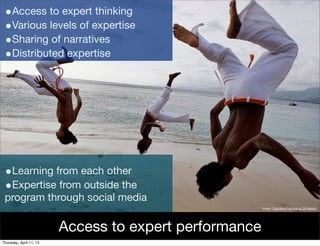
•Access to expert thinking
 •Various levels of expertise
 •Sharing of narratives
 •Distributed expertise


 •Learning from each other
 •Expertise from outside the
 program through social media
                                                        Image: Capoeira Practice on Dili Beach


                         Access to expert performance
Thursday, April 11, 13
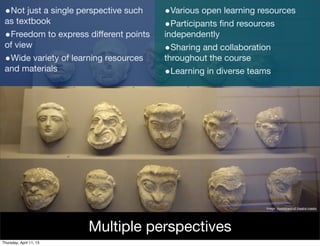
•Not just a single perspective such    •Various open learning resources
 as textbook                            •Participants find resources
 •Freedom to express different points   independently
 of view                                •Sharing and collaboration
 •Wide variety of learning resources    throughout the course
 and materials                          •Learning in diverse teams


                                                                Image: Assortment of theatre masks


                         Multiple perspectives
Thursday, April 11, 13
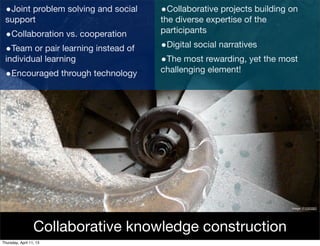
•Joint problem solving and social   •Collaborative projects building on
 support                             the diverse expertise of the
                                     participants
 •Collaboration vs. cooperation
 •Team or pair learning instead of   •Digital social narratives
 individual learning                 •The most rewarding, yet the most
                                     challenging element!
 •Encouraged through technology


                                                                      Image: P1000283


                  Collaborative knowledge construction
Thursday, April 11, 13
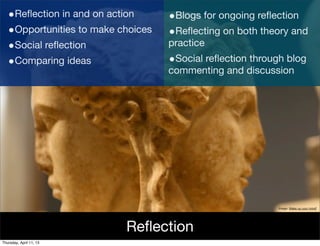
•Reflection in and on action      •Blogs for ongoing reflection
   •Opportunities to make choices   •Reflecting on both theory and
   •Social reflection                practice
   •Comparing ideas                 •Social reflection through blog
                                    commenting and discussion


                                                           Image: Make up your mind!


                           Reflection
Thursday, April 11, 13
•Speaking and
writing about
one’s growing
understanding

•Presenting
arguments,
defending ideas
                                        •Blogs: writing
                                        to a real
                                        audience, not
                                        just the teacher

                                        •Awareness of
                                        one’s learning
                                        process

                                                    Image: Blå


                         Articulation
Thursday, April 11, 13
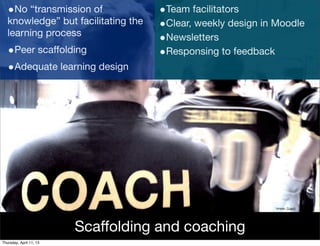
•No “transmission of              •Team facilitators
   knowledge” but facilitating the   •Clear, weekly design in Moodle
   learning process
                                     •Newsletters
   •Peer scaffolding                 •Responsing to feedback
   •Adequate learning design


                                                             Image: Coach


                         Scaffolding and coaching
Thursday, April 11, 13
•Seamless integration with task
      •Polished products
      •Multiple measures


                                •Assessing the process and the
                                product
                                •Assessing collaborative tasks
                                •Portfolio
                         Authentic assessment
Thursday, April 11, 13
Discussion & Conclusions

                                                    Rewarding


       Boredom


                                                Discomfort
                                                             Image: Balancing Act

Thursday, April 11, 13
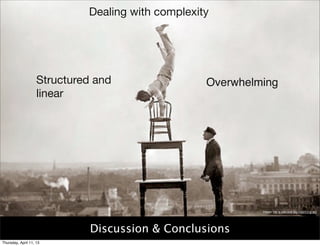
Dealing with complexity


                    Structured and                 Overwhelming
                    linear


                                                            Image: life is just one big balancing act


                              Discussion & Conclusions
Thursday, April 11, 13
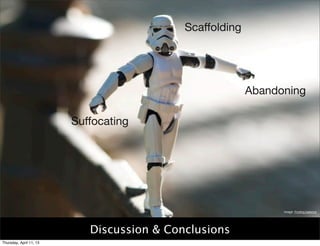
Scaffolding


                                                          Abandoning

                         Suffocating


                                                                Image: Finding balance


                            Discussion & Conclusions
Thursday, April 11, 13
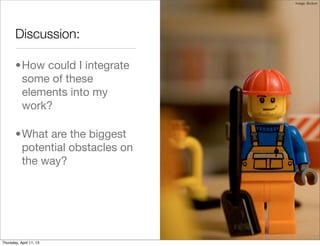
Image: Bodum


       Discussion:

       •How could I integrate
        some of these
        elements into my
        work?

       •What are the biggest
        potential obstacles on
        the way?


Thursday, April 11, 13
More information:
                         authenticlearning.info


Thursday, April 11, 13
Thank you!
                  hteras@uow.edu.au


Thursday, April 11, 13

Authentic eLearning: What, Why and How?

  • 1.
    Image: Bailey &Muppet Hanna Teräs Authentic e-Learning University of Wollongong What, why and how? April 11 2013 Thursday, April 11, 13
  • 2.
    Q1: What isauthentic e-learning? image: neilalderney123 Thursday, April 11, 13
  • 3.
    Case studies Learning by doing Authentic learning Projects approaches Simulations Real-world problems Inquiry-based learning Thursday, April 11, 13
  • 4.
    Realistic tasks setin academic settings to challenge students to think and solve problems the way professionals would do in the actual real world situation Herrington, Reeves & Oliver 2010 image: andercismo Thursday, April 11, 13
  • 5.
    Q2: Why useauthentic e-learning? image: neilalderney123 Thursday, April 11, 13
  • 6.
    Johnson, L., Smith,R., Willis, H., Levine, A., and Haywood, K., (2011). The 2011 Horizon Report. Austin, Texas: The New Media Consortium. Thursday, April 11, 13
  • 7.
    Information, content andconnections are readily available. The role of the teacher as a coach, guide and facilitator becomes ever more important. Image by boliston Thursday, April 11, 13
  • 8.
    We expect tobe able to learn, work and study wherever, whenever. Image by jakebouma Thursday, April 11, 13
  • 9.
    The importance ofcollaboration in working life will only increase. This forces us to reconsider our learning tasks. Image: Dawn Willis Manser Thursday, April 11, 13
  • 10.
    Information society: (Technical Research Centre of Finland) Producing, handling and transmitting information has a central role in economy. Knowledge society: Innovations, renewal, technological development and openness to new ideas are in key role. Thursday, April 11, 13
  • 11.
    General skills ina knowledge society (to name a few) • Information literacy • Commitment to lifelong learning • Communication skills • Initiative and responsibility • Reflection • Intellectual curiosity • Solving complex problems • Multicultural competence • Creativity • Self-direction • Critical thinking • Leadership Eg. Reeves 2006, Ruohotie 2005, Trilling & Fadel 2009...) Thursday, April 11, 13
  • 12.
    WHOA! Hold ona second... How can these be taught? Thursday, April 11, 13
  • 13.
    They can’t. These are skills that are acquired when the learning environment and working methods support their Image: Matthew Stinson acquisition. Thursday, April 11, 13
  • 14.
    Q3: How mightI build such a learning environment? image: neilalderney123 Thursday, April 11, 13
  • 15.
    Non-linear, beware of The chance to immediately oversimplification apply in one’s own work Provide the purpose and Recognition of one’s motivation to learning classroom as a learning environment Helping to cope with complexity Alongside work Image: Rain and shine Authentic context Thursday, April 11, 13
  • 16.
    •Real-world relevance •Collaborative projects •Production instead of running for 3-6 months reproduction •Implementing in one’s own •Complex and ill-defined classroom •Completed over a longer •Supported by theory and period reflection Image: LEGO Worker Authentic tasks Thursday, April 11, 13
  • 17.
    •Access to expertthinking •Various levels of expertise •Sharing of narratives •Distributed expertise •Learning from each other •Expertise from outside the program through social media Image: Capoeira Practice on Dili Beach Access to expert performance Thursday, April 11, 13
  • 18.
    •Not just asingle perspective such •Various open learning resources as textbook •Participants find resources •Freedom to express different points independently of view •Sharing and collaboration •Wide variety of learning resources throughout the course and materials •Learning in diverse teams Image: Assortment of theatre masks Multiple perspectives Thursday, April 11, 13
  • 19.
    •Joint problem solvingand social •Collaborative projects building on support the diverse expertise of the participants •Collaboration vs. cooperation •Team or pair learning instead of •Digital social narratives individual learning •The most rewarding, yet the most challenging element! •Encouraged through technology Image: P1000283 Collaborative knowledge construction Thursday, April 11, 13
  • 20.
    •Reflection in andon action •Blogs for ongoing reflection •Opportunities to make choices •Reflecting on both theory and •Social reflection practice •Comparing ideas •Social reflection through blog commenting and discussion Image: Make up your mind! Reflection Thursday, April 11, 13
  • 21.
    •Speaking and writing about one’sgrowing understanding •Presenting arguments, defending ideas •Blogs: writing to a real audience, not just the teacher •Awareness of one’s learning process Image: Blå Articulation Thursday, April 11, 13
  • 22.
    •No “transmission of •Team facilitators knowledge” but facilitating the •Clear, weekly design in Moodle learning process •Newsletters •Peer scaffolding •Responsing to feedback •Adequate learning design Image: Coach Scaffolding and coaching Thursday, April 11, 13
  • 23.
    •Seamless integration withtask •Polished products •Multiple measures •Assessing the process and the product •Assessing collaborative tasks •Portfolio Authentic assessment Thursday, April 11, 13
  • 24.
    Discussion & Conclusions Rewarding Boredom Discomfort Image: Balancing Act Thursday, April 11, 13
  • 25.
    Dealing with complexity Structured and Overwhelming linear Image: life is just one big balancing act Discussion & Conclusions Thursday, April 11, 13
  • 26.
    Scaffolding Abandoning Suffocating Image: Finding balance Discussion & Conclusions Thursday, April 11, 13
  • 27.
    Image: Bodum Discussion: •How could I integrate some of these elements into my work? •What are the biggest potential obstacles on the way? Thursday, April 11, 13
  • 28.
    More information: authenticlearning.info Thursday, April 11, 13
  • 29.
    Thank you! hteras@uow.edu.au Thursday, April 11, 13