Diverse Perspectives for Global Impact


Opening Content for Deeper Inquiry
                   Jon Mason
              Charles Darwin University
               jon.mason@cdu.edu.au
Two Themes

             • Openness


             • Inquiry


                          2
What is “openness”?


                      3
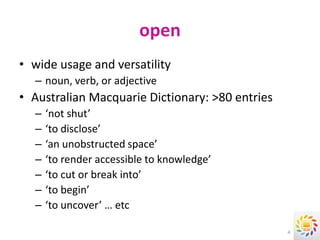
open
• wide usage and versatility
  – noun, verb, or adjective
• Australian Macquarie Dictionary: >80 entries
  –   ‘not shut’
  –   ‘to disclose’
  –   ‘an unobstructed space’
  –   ‘to render accessible to knowledge’
  –   ‘to cut or break into’
  –   ‘to begin’
  –   ‘to uncover’ … etc

                                                 4
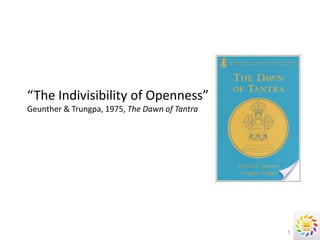
“The Indivisibility of Openness”
Geunther & Trungpa, 1975, The Dawn of Tantra


                                               5
6
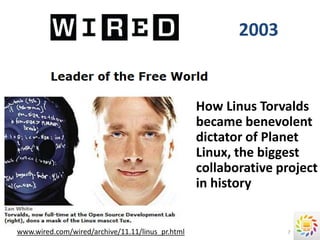
2003


                                                  How Linus Torvalds
                                                  became benevolent
                                                  dictator of Planet
                                                  Linux, the biggest
                                                  collaborative project
                                                  in history


www.wired.com/wired/archive/11.11/linus_pr.html                  7
8
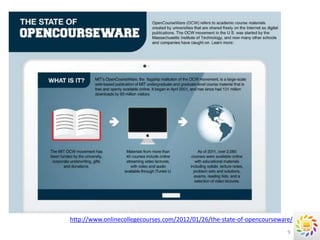
http://www.onlinecollegecourses.com/2012/01/26/the-state-of-opencourseware/
                                                                         9
10
opensource.com

                 11
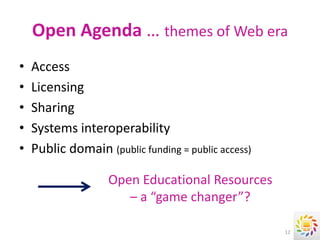
Open Agenda … themes of Web era
•   Access
•   Licensing
•   Sharing
•   Systems interoperability
•   Public domain (public funding = public access)

                    Open Educational Resources
                       – a “game changer”?

                                                     12
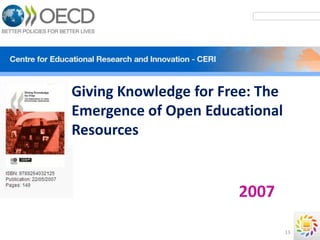
Giving Knowledge for Free: The
Emergence of Open Educational
Resources


                       2007

                                 13
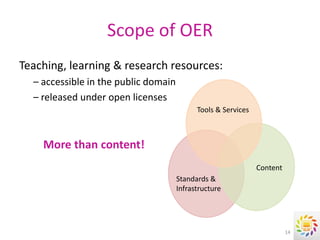
Scope of OER
Teaching, learning & research resources:
  – accessible in the public domain
  – released under open licenses
                                            Tools & Services


    More than content!
                                                               Content
                                      Standards &
                                      Infrastructure


                                                                         14
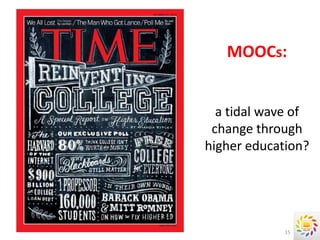
MOOCs:


  a tidal wave of
 change through
higher education?


             15
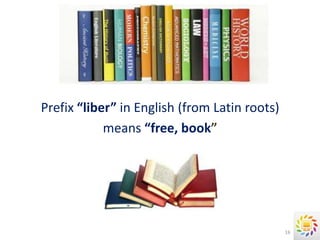
Prefix “liber” in English (from Latin roots)
            means “free, book”


                                               16
Is content still “king”?

Openness a prominent driver of change
      – but not the only one!


                                        17
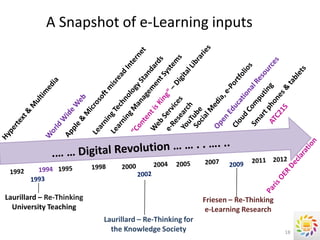
A Snapshot of e-Learning inputs


Laurillard – Re-Thinking                                  Friesen – Re-Thinking
  University Teaching                                      e-Learning Research
                           Laurillard – Re-Thinking for
                             the Knowledge Society                                18
Numerous narratives on the
     evolution of e-learning


& the impact of the Information Age


                                 19
• Assessment and Teaching of 21st Century Skills:
  “learning to collaborate with others and connect
  through technology are essential skills in a
  knowledge-based economy” (ATC21S, 2011)


        essential skills also include:
             • critical thinking   Inquiry, analysis, reflection, …
             • ICT literacy
             • problem solving
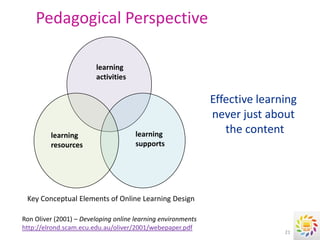
Pedagogical Perspective

                         learning
                         activities

                                                              Effective learning
                                                              never just about
         learning                     learning                   the content
         resources                    supports


 Key Conceptual Elements of Online Learning Design
Ron Oliver (2001) – Developing online learning environments
http://elrond.scam.ecu.edu.au/oliver/2001/webepaper.pdf
                                                                             21
Inquiry


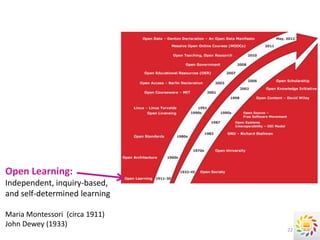
Open Learning:
Independent, inquiry-based,
and self-determined learning

Maria Montessori (circa 1911)
John Dewey (1933)
                                          22
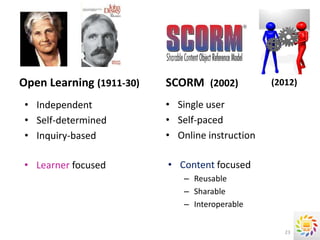
Open Learning (1911-30)   SCORM (2002)           (2012)

 • Independent            • Single user
 • Self-determined        • Self-paced
 • Inquiry-based          • Online instruction
• Learner focused         • Content focused
                              – Reusable
                              – Sharable
                              – Interoperable


                                                    23
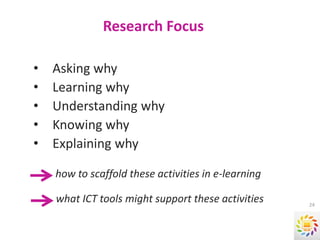
Research Focus

•   Asking why
•   Learning why
•   Understanding why
•   Knowing why
•   Explaining why

    how to scaffold these activities in e-learning

    what ICT tools might support these activities    24
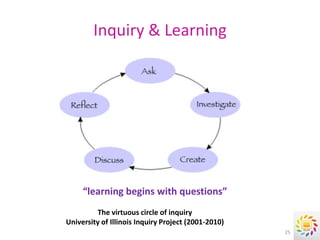
Inquiry & Learning


     “learning begins with questions”
         The virtuous circle of inquiry
University of Illinois Inquiry Project (2001-2010)
                                                     25
Inquiry & Learning
• “why” questions prominent during early
  development of children & an important
  foundation for learning (Dewey, Piaget, Schank)

• “Inquiry-based learning” evolved out of “critical
  thinking” movement

• Impasses & conundrums important for learning

• “Thinking is not driven by answers but by
  questions” Paul & Elder, (1999). Critical Thinking Handbook
                                                                26
Inquiry & Learning

My mother made me a scientist without ever
intending it. Every other Jewish mother in Brooklyn
would ask her child after school, ‘So? Did you learn
anything today?’ But not my mother. She always
asked a different question, ‘Izzy,’ she would
say, ‘Did you ask a good question today?’ That
difference – asking good questions – made me a
scientist.

1944 Nobel Laureate in Physics, Isidor Rabi


                                                   27
Inquiry & Learning

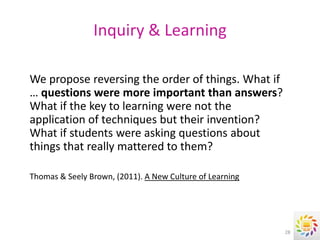
We propose reversing the order of things. What if
… questions were more important than answers?
What if the key to learning were not the
application of techniques but their invention?
What if students were asking questions about
things that really mattered to them?

Thomas & Seely Brown, (2011). A New Culture of Learning


                                                          28
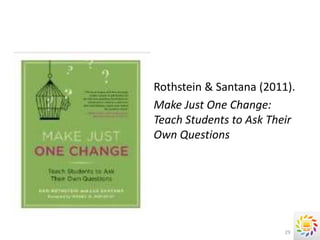
Rothstein & Santana (2011).
Make Just One Change:
Teach Students to Ask Their
Own Questions


                         29
Inquiry & Learning
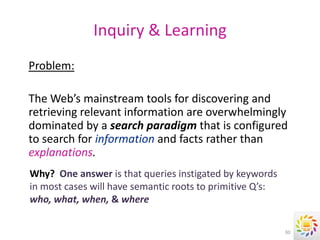
Problem:

The Web’s mainstream tools for discovering and
retrieving relevant information are overwhelmingly
dominated by a search paradigm that is configured
to search for information and facts rather than
explanations.
Why? One answer is that queries instigated by keywords
in most cases will have semantic roots to primitive Q’s:
who, what, when, & where

                                                           30
Three perspectives on IT


• information technology
• interruption technology
• intellectual technology


                  N. Carr, (2010). The Shallows
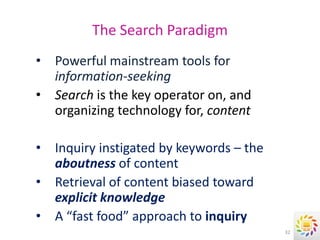
The Search Paradigm
• Powerful mainstream tools for
  information-seeking
• Search is the key operator on, and
  organizing technology for, content

• Inquiry instigated by keywords – the
  aboutness of content
• Retrieval of content biased toward
  explicit knowledge
• A “fast food” approach to inquiry
                                         32
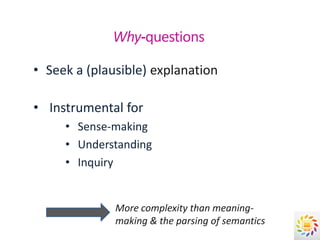
Why-questions

• Seek a (plausible) explanation

• Instrumental for
     • Sense-making
     • Understanding
     • Inquiry


              More complexity than meaning-
              making & the parsing of semantics
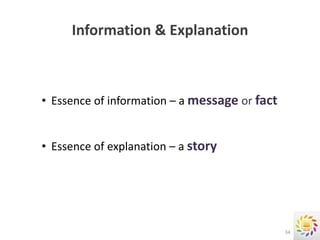
Information & Explanation


• Essence of information – a message or fact


• Essence of explanation – a story


                                               34
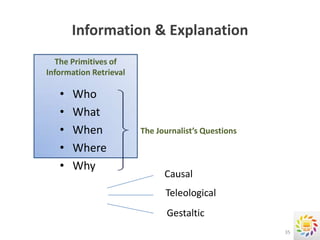
Information & Explanation
  The Primitives of
Information Retrieval

   •   Who
   •   What
   •   When             The Journalist’s Questions

   •   Where
   •   Why
                              Causal
                              Teleological
                               Gestaltic
                                                     35
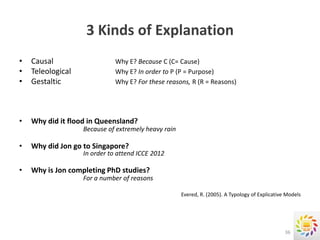
3 Kinds of Explanation
•   Causal                    Why E? Because C (C= Cause)
•   Teleological              Why E? In order to P (P = Purpose)
•   Gestaltic                 Why E? For these reasons, R (R = Reasons)


•   Why did it flood in Queensland?
                   Because of extremely heavy rain

•   Why did Jon go to Singapore?
                   In order to attend ICCE 2012

•   Why is Jon completing PhD studies?
                   For a number of reasons

                                                     Evered, R. (2005). A Typology of Explicative Models


                                                                                                 36
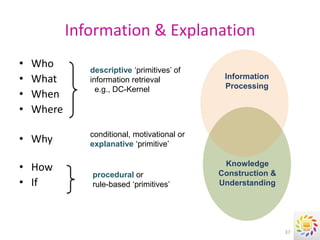
Information & Explanation
•   Who        descriptive ‘primitives’ of
•   What       information retrieval           Information
                 e.g., DC-Kernel               Processing
•   When
•   Where

               conditional, motivational or
• Why          explanative ‘primitive’


• How                                          Knowledge
                                              Construction &
               procedural or
• If           rule-based ‘primitives’        Understanding


                                                               37
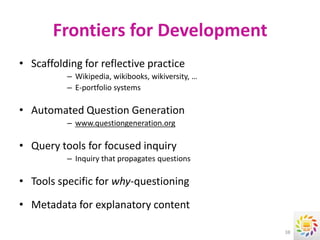
Frontiers for Development
• Scaffolding for reflective practice
          – Wikipedia, wikibooks, wikiversity, …
          – E-portfolio systems

• Automated Question Generation
          – www.questiongeneration.org

• Query tools for focused inquiry
          – Inquiry that propagates questions

• Tools specific for why-questioning

• Metadata for explanatory content

                                                   38
Questions?

Papers available at: cdu.academia.edu/JonMason


                                                 39

Opening Content for Deeper Inquiry

  • 1.
    Diverse Perspectives forGlobal Impact Opening Content for Deeper Inquiry Jon Mason Charles Darwin University jon.mason@cdu.edu.au
  • 2.
    Two Themes • Openness • Inquiry 2
  • 3.
  • 4.
    open • wide usageand versatility – noun, verb, or adjective • Australian Macquarie Dictionary: >80 entries – ‘not shut’ – ‘to disclose’ – ‘an unobstructed space’ – ‘to render accessible to knowledge’ – ‘to cut or break into’ – ‘to begin’ – ‘to uncover’ … etc 4
  • 5.
    “The Indivisibility ofOpenness” Geunther & Trungpa, 1975, The Dawn of Tantra 5
  • 6.
  • 7.
    2003 How Linus Torvalds became benevolent dictator of Planet Linux, the biggest collaborative project in history www.wired.com/wired/archive/11.11/linus_pr.html 7
  • 8.
  • 9.
  • 10.
  • 11.
  • 12.
    Open Agenda …themes of Web era • Access • Licensing • Sharing • Systems interoperability • Public domain (public funding = public access) Open Educational Resources – a “game changer”? 12
  • 13.
    Giving Knowledge forFree: The Emergence of Open Educational Resources 2007 13
  • 14.
    Scope of OER Teaching,learning & research resources: – accessible in the public domain – released under open licenses Tools & Services More than content! Content Standards & Infrastructure 14
  • 15.
    MOOCs: atidal wave of change through higher education? 15
  • 16.
    Prefix “liber” inEnglish (from Latin roots) means “free, book” 16
  • 17.
    Is content still“king”? Openness a prominent driver of change – but not the only one! 17
  • 18.
    A Snapshot ofe-Learning inputs Laurillard – Re-Thinking Friesen – Re-Thinking University Teaching e-Learning Research Laurillard – Re-Thinking for the Knowledge Society 18
  • 19.
    Numerous narratives onthe evolution of e-learning & the impact of the Information Age 19
  • 20.
    • Assessment andTeaching of 21st Century Skills: “learning to collaborate with others and connect through technology are essential skills in a knowledge-based economy” (ATC21S, 2011)  essential skills also include: • critical thinking Inquiry, analysis, reflection, … • ICT literacy • problem solving
  • 21.
    Pedagogical Perspective learning activities Effective learning never just about learning learning the content resources supports Key Conceptual Elements of Online Learning Design Ron Oliver (2001) – Developing online learning environments http://elrond.scam.ecu.edu.au/oliver/2001/webepaper.pdf 21
  • 22.
    Inquiry Open Learning: Independent, inquiry-based, andself-determined learning Maria Montessori (circa 1911) John Dewey (1933) 22
  • 23.
    Open Learning (1911-30) SCORM (2002) (2012) • Independent • Single user • Self-determined • Self-paced • Inquiry-based • Online instruction • Learner focused • Content focused – Reusable – Sharable – Interoperable 23
  • 24.
    Research Focus • Asking why • Learning why • Understanding why • Knowing why • Explaining why how to scaffold these activities in e-learning what ICT tools might support these activities 24
  • 25.
    Inquiry & Learning “learning begins with questions” The virtuous circle of inquiry University of Illinois Inquiry Project (2001-2010) 25
  • 26.
    Inquiry & Learning •“why” questions prominent during early development of children & an important foundation for learning (Dewey, Piaget, Schank) • “Inquiry-based learning” evolved out of “critical thinking” movement • Impasses & conundrums important for learning • “Thinking is not driven by answers but by questions” Paul & Elder, (1999). Critical Thinking Handbook 26
  • 27.
    Inquiry & Learning Mymother made me a scientist without ever intending it. Every other Jewish mother in Brooklyn would ask her child after school, ‘So? Did you learn anything today?’ But not my mother. She always asked a different question, ‘Izzy,’ she would say, ‘Did you ask a good question today?’ That difference – asking good questions – made me a scientist. 1944 Nobel Laureate in Physics, Isidor Rabi 27
  • 28.
    Inquiry & Learning Wepropose reversing the order of things. What if … questions were more important than answers? What if the key to learning were not the application of techniques but their invention? What if students were asking questions about things that really mattered to them? Thomas & Seely Brown, (2011). A New Culture of Learning 28
  • 29.
    Rothstein & Santana(2011). Make Just One Change: Teach Students to Ask Their Own Questions 29
  • 30.
    Inquiry & Learning Problem: TheWeb’s mainstream tools for discovering and retrieving relevant information are overwhelmingly dominated by a search paradigm that is configured to search for information and facts rather than explanations. Why? One answer is that queries instigated by keywords in most cases will have semantic roots to primitive Q’s: who, what, when, & where 30
  • 31.
    Three perspectives onIT • information technology • interruption technology • intellectual technology N. Carr, (2010). The Shallows
  • 32.
    The Search Paradigm •Powerful mainstream tools for information-seeking • Search is the key operator on, and organizing technology for, content • Inquiry instigated by keywords – the aboutness of content • Retrieval of content biased toward explicit knowledge • A “fast food” approach to inquiry 32
  • 33.
    Why-questions • Seek a(plausible) explanation • Instrumental for • Sense-making • Understanding • Inquiry More complexity than meaning- making & the parsing of semantics
  • 34.
    Information & Explanation •Essence of information – a message or fact • Essence of explanation – a story 34
  • 35.
    Information & Explanation The Primitives of Information Retrieval • Who • What • When The Journalist’s Questions • Where • Why Causal Teleological Gestaltic 35
  • 36.
    3 Kinds ofExplanation • Causal Why E? Because C (C= Cause) • Teleological Why E? In order to P (P = Purpose) • Gestaltic Why E? For these reasons, R (R = Reasons) • Why did it flood in Queensland? Because of extremely heavy rain • Why did Jon go to Singapore? In order to attend ICCE 2012 • Why is Jon completing PhD studies? For a number of reasons Evered, R. (2005). A Typology of Explicative Models 36
  • 37.
    Information & Explanation • Who descriptive ‘primitives’ of • What information retrieval Information e.g., DC-Kernel Processing • When • Where conditional, motivational or • Why explanative ‘primitive’ • How Knowledge Construction & procedural or • If rule-based ‘primitives’ Understanding 37
  • 38.
    Frontiers for Development •Scaffolding for reflective practice – Wikipedia, wikibooks, wikiversity, … – E-portfolio systems • Automated Question Generation – www.questiongeneration.org • Query tools for focused inquiry – Inquiry that propagates questions • Tools specific for why-questioning • Metadata for explanatory content 38
  • 39.
    Questions? Papers available at:cdu.academia.edu/JonMason 39

Editor's Notes

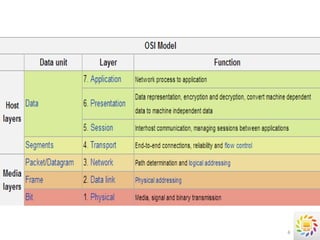
  • #5 The English language is so flexible that we can also describe warfare as an extreme example of “open conflict”
  • #9 But digital content now involves many formats & it is interesting to note that prominent initiatives for sharing open content (CXN & OU) have created different technical specifications & protocols! Interoperability is always a challenge
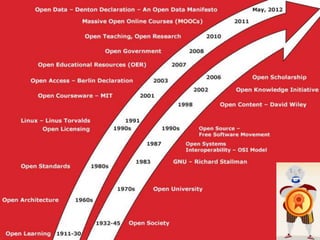
  • #11 But within this picture of evolving “openness” also lies a lot of tribalism around whose version of openness is more open (or more important)
  • #12 Note the irony – openness here is not “indivisible” at all. It is licensed & is promoted from a dotcom domain
  • #16 October 2012
  • #24 Similarities but key differences