Valerie Hill, PhD
TWU School of Library and Information Studies
Adjunct Instructor
LISD Librarian


  Librarianship Embraces Virtual Media
     Based on Adult Learning Theory
After the Digital Revolution:
Emerging Trends and Changing Formats


•   Apps & mobile devices
•   MOOCs
•   AR & Virtual Worlds
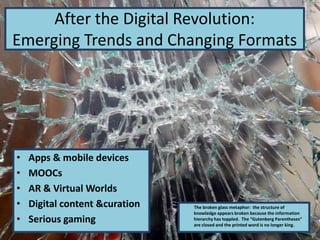
•   Digital content &curation   The broken glass metaphor: the structure of
                                knowledge appears broken because the information
•   Serious gaming              hierarchy has toppled. The “Gutenberg Parentheses”
                                are closed and the printed word is no longer king.
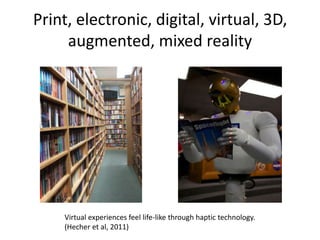
Print, electronic, digital, virtual, 3D,
     augmented, mixed reality


    Virtual experiences feel life-like through haptic technology.
    (Hecher et al, 2011)
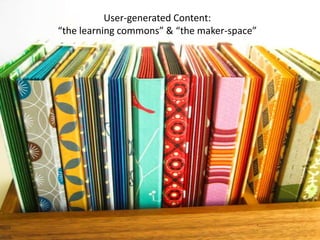
User-generated Content:
“the learning commons” & “the maker-space”
Do you have an online identity?
• Have you uploaded user-generated content
  (Flickr, Youtube, blog, other)?
• Do you separate your personal/professional
  identity online?
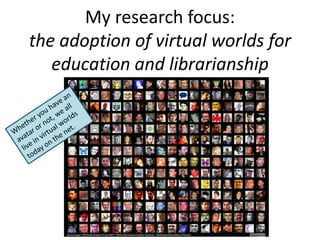
My research focus:
the adoption of virtual worlds for
   education and librarianship
Are you comfortable with Web 3.0?


• Do you have an avatar (or does your
  colleague, friend, child)?
• Have you visited a virtual world?
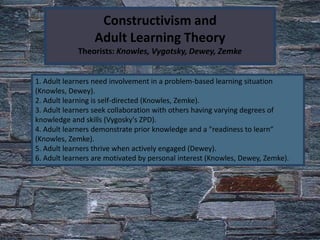
Constructivism and
                  Adult Learning Theory
             Theorists: Knowles, Vygotsky, Dewey, Zemke


1. Adult learners need involvement in a problem-based learning situation
(Knowles, Dewey).
2. Adult learning is self-directed (Knowles, Zemke).
3. Adult learners seek collaboration with others having varying degrees of
knowledge and skills (Vygosky's ZPD).
4. Adult learners demonstrate prior knowledge and a "readiness to learn“
(Knowles, Zemke).
5. Adult learners thrive when actively engaged (Dewey).
6. Adult learners are motivated by personal interest (Knowles, Dewey, Zemke).
Lev Vygotsky
• Emphasized the social context of learning
• Critical importance of interaction with people,
  including other learners and teachers, in
  cognitive development, his theory is called
  “social constructivism”
• Zone of proximal development (ZPD)
Malcolm Knowles
Knowles 6 principles ofAndrogogy
1. Adults are self directed and self motivated.
2. Adults bring life experiences and knowledge
   to learning.
3. Adults are goal oriented.
4. Adults are relevancy oriented.
5. Adults are practical.
6. Adult learners like to be respected.
John Dewey       “father of experiential education”


•   Emphasized active engagement
•   Personal interest in real life problems
•   Creative interaction (teacher as a guide or
     facilitator)
Ron & Susan Zemke
• Building on Knowles' Androgogy and the
  theoretical framework of constructivism
• “Window of opportunity" when adults are
  motivated to learn
• Motivated by personal growth or gain;
  increased by curiosity
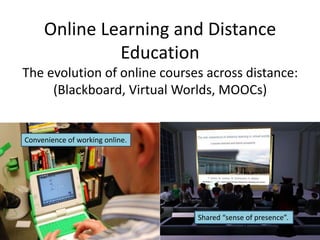
Online Learning and Distance

              Education
The evolution of online courses across distance:
     (Blackboard, Virtual Worlds, MOOCs)


Convenience of working online.


                                 Shared “sense of presence”.
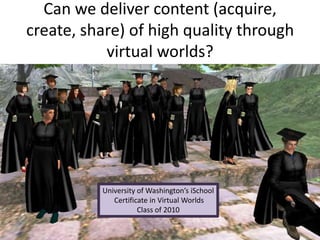
Can we deliver content (acquire,
create, share) of high quality through
           virtual worlds?


          University of Washington’s iSchool
             Certificate in Virtual Worlds
                     Class of 2010
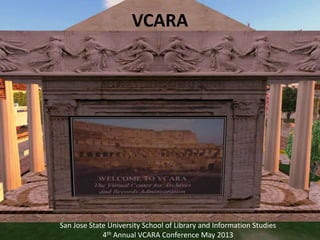
VCARA


San Jose State University School of Library and Information Studies
             4th Annual VCARA Conference May 2013
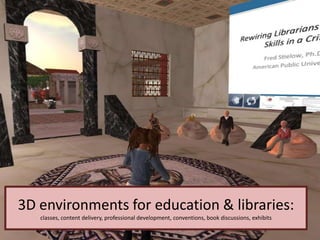
3D environments for education & libraries:
   classes, content delivery, professional development, conventions, book discussions, exhibits
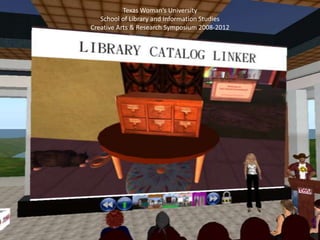
Texas Woman’s University
   School of Library and Information Studies
Creative Arts & Research Symposium 2008-2012
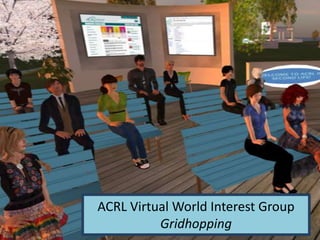
ACRL Virtual World Interest Group
          Gridhopping
3D Exhibit Examples
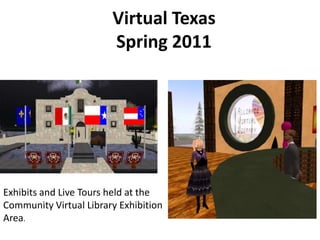
Virtual Texas
                        Spring 2011


Exhibits and Live Tours held at the
Community Virtual Library Exhibition
Area.
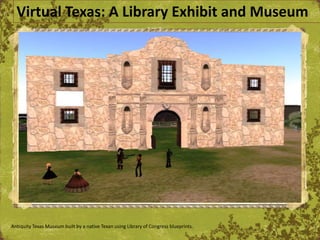
Virtual Texas: A Library Exhibit and Museum


Antiquity Texas Museum built by a native Texan using Library of Congress blueprints.
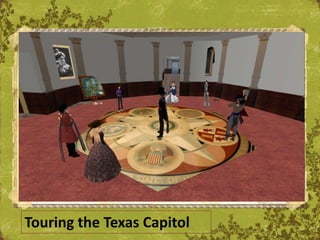
Touring the Texas Capitol
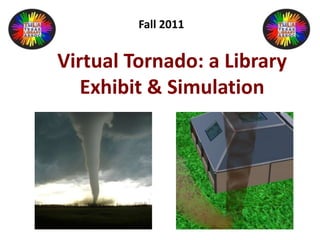
Fall 2011


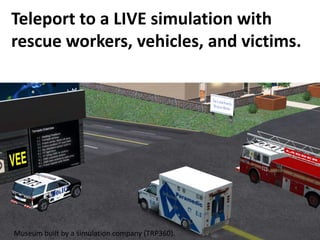
Virtual Tornado: a Library
   Exhibit & Simulation
Teleport to a LIVE simulation with
rescue workers, vehicles, and victims.


Museum built by a simulation company (TRP360).
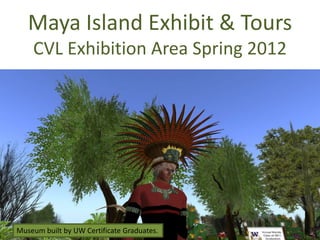
Maya Island Exhibit & Tours
    CVL Exhibition Area Spring 2012


Museum built by UW Certificate Graduates.
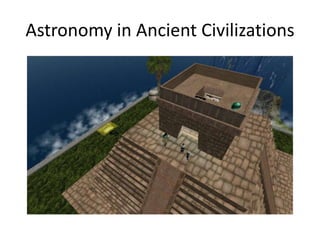
Astronomy in Ancient Civilizations
Summer 2012
Museum built by Jo Teeuwisse, an historical consultant in Amsterdam.
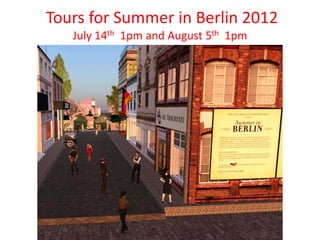
Tours for Summer in Berlin 2012
   July 14th 1pm and August 5th 1pm
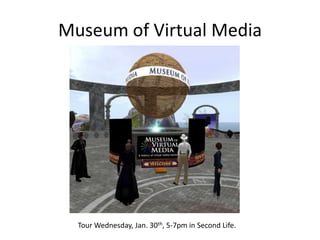
Museum of Virtual Media


  Tour Wednesday, Jan. 30th, 5-7pm in Second Life.
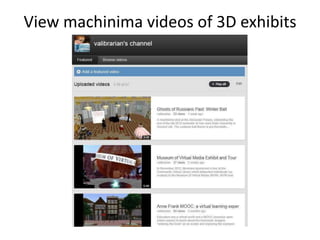
View machinima videos of 3D exhibits
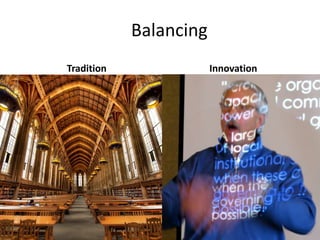
Balancing
Tradition               Innovation
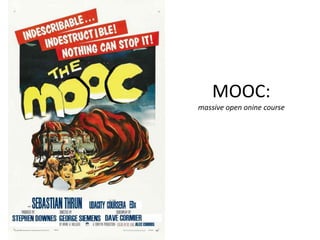
MOOC:
massive open onine course
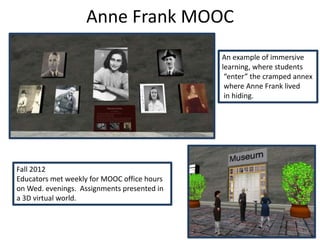
Anne Frank MOOC
                                             An example of immersive
                                             learning, where students
                                              “enter” the cramped annex
                                              where Anne Frank lived
                                              in hiding.


Fall 2012
Educators met weekly for MOOC office hours
on Wed. evenings. Assignments presented in
a 3D virtual world.
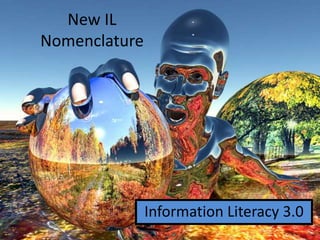
New IL
Nomenclature


               Information Literacy 3.0
Valuing our Physical World
The beautiful question may be addressed
     in numerous formats: physical,
   electronic, virtual, or augmented.

   “It may be that the great age of libraries is waning,
      but I am here to tell you that the great age of
      librarians is just beginning. It’s up to you to
      decide if you want to be a part of it.”
     ~T. Scott Plutchak
Discussion
   Q&A
Bibliography


Antiquity Texas. (2010). http://antiquitytexas.wordpress.com/about-2/ [accessed December 15, 2012]
Dalgarno, Barney, and Mark J. W. Lee. (2010). What are the learning affordances of 3-D virtual environments? British Journal of Educational
       Technology 41, (1) (01): 10-32.
Dewey, John. (1916). Democracy and education. The Free Press, New York.
Dresang, Eliza T. (2005). The information-seeking behavior of youth in the digital environment. Library Trends 54, (2): 178-196.
Farley, Kathryn, Michael Nitsche, Jay Bolter and Blair MacIntyre. (2009). Augmenting Creative Realities: The Second Life Performance Project.
       Leonardo 42, no. 1: 96-7.
Hecher, M. M., Möstl, R. R., Eggeling, E. E., Derler, C. C., &Fellner, D. W. (2011). 'Tangible Culture' - Designing virtual exhibitions on multi-
       touch devices. Information Services & Use, 31(3/4), 199-208.
Hew, KheFoon, and Wing Sum Cheung. (2010). Use of three-dimensional (3-D) immersive virtual worlds in K-12 and higher education settings:
       A review of the research. British Journal of Educational Technology 41, (1) (01): 33-55.
Hill, Valerie, and Hyuk-Jin Lee. (2009). Libraries and immersive learning environments unite in second life. Library Hi Tech 27, (3): 338-56.
Hill, Valerie. (2011) “Virtual tornado hits the library”, Learning Technology IEEE, 13 (4), 42-45.
Huang, H. (2002). Toward constructivism for adult learners in online learning environments. British Journal Of Educational Technology, 33(1),
       27.
Jamaludin, Azilawati, Yam San Chee, and Caroline Mei Lin Ho. (2009). Fostering argumentative knowledge construction through enactive role
       play in second life. Computers & Education 53, (2) (9): 317-29.
Klomp, R. W., Spitalnick, J. S., &Reissman, D. B. (2011).Virtual Classroom Immersion Training.T+D, 65(1), 38-43.
Malcom Knowles. (2007). Adult Learning Theory and Principles.
      http://www.qotfc.edu.au/resource/index.html?page=65375 [accessed December 15, 2012]
Lateef, F. (2010). Simulation-based learning: Just like the real thing. Journal Of Emergencies, Trauma & Shock, 3(4), 348-352.
Plutchak, T. Scott. (2007). The Librarian: Fantastic Adventures in the Digital World. Serials, 20(2), 87-91.
Slone, Debra. (2009). A Methodology for Measuring Usability Evaluation Skills Using the Constructivist Theory and the Second Life Virtual
       World. Journal of Usability Studies, 4 (4) 178-188.
Stanziola, J. (2008). What will be the needs of library, museum and archives users in the next 10 years? research implications. Library &
       Information Research, 32(100), 13-19.
SylaiouStyliani, LiarokapisFotis, Kotsakis Kostas, PatiasPetros, (2009). Virtual museums, a survey and some issues for consideration. Journal of
       Cultural Heritage, 10 (4): 520-528.
Taouabit Boland, I. (2009). Efficacy of the 3D Multi-User Virtual Environment (MUVE) Second Life for learning in cognitive constructivist and
       social constructivist activities. Ph.D. diss., Capella University.
Teeuwisse, Jo. (2012). http://www.ghostsofhistory.co.uk/who-are-we/bio/ [accessed December 15, 2012]
TRP360. (2012). http://www.trp360.com/ [accessed December 15, 2012]
Vygotsky, Lev. (1978). Mind in society Harvard University Press, Cambridge.
Webber, Sheila and Diane Nahl. (2011). Sustaining Learning for LIS through use of a Virtual World. IFLA Journal (37)(1): 5-15.
Zemke , Ron and Susan. (1995). http://setur.khi.is/fullordinsfraedsla/NoN/Itarefni/Zemke_WhatDoWeKnow.pdf [accessed December 15,
       2012]
Photo Credits


Creative Commons photos from:
    http://photopin.com/
    http://www.bigfoto.com/
    http://www.flickr.com/photos/luc/1824234195/ (avatar photo by the hundreds)
    http://www.flickr.com/photos/ipalatin/2921557412/ (bookshelf photo)
    http://photopin.com/search/distance-education (VWdistanceed)
    http://www.flickr.com/photos/daves-f-stop/7255333900/ (librarytradition)
    http://www.flickr.com/photos/5tein/2176406692/ (distanceed)
    http://www.flickr.com/photos/jurvetson/2537873504/ (innovation)
    http://www.flickr.com/photos/gforsythe/8028605773/ (moocblob)
    http://www.flickr.com/photos/visualpanic/2271636207/ (windowsandlight)
    http://www.flickr.com/photos/viamoi/2937397649/ (robotwaterleaves)
    http://www.flickr.com/photos/ecstaticist/3134361265/ (timeflowsriverleaf)

Librarianship Embraces Virtual Media

  • 1.
    Valerie Hill, PhD TWUSchool of Library and Information Studies Adjunct Instructor LISD Librarian Librarianship Embraces Virtual Media Based on Adult Learning Theory
  • 2.
    After the DigitalRevolution: Emerging Trends and Changing Formats • Apps & mobile devices • MOOCs • AR & Virtual Worlds • Digital content &curation The broken glass metaphor: the structure of knowledge appears broken because the information • Serious gaming hierarchy has toppled. The “Gutenberg Parentheses” are closed and the printed word is no longer king.
  • 3.
    Print, electronic, digital,virtual, 3D, augmented, mixed reality Virtual experiences feel life-like through haptic technology. (Hecher et al, 2011)
  • 4.
    User-generated Content: “the learningcommons” & “the maker-space”
  • 5.
    Do you havean online identity? • Have you uploaded user-generated content (Flickr, Youtube, blog, other)? • Do you separate your personal/professional identity online?
  • 6.
    My research focus: theadoption of virtual worlds for education and librarianship
  • 7.
    Are you comfortablewith Web 3.0? • Do you have an avatar (or does your colleague, friend, child)? • Have you visited a virtual world?
  • 8.
    Constructivism and Adult Learning Theory Theorists: Knowles, Vygotsky, Dewey, Zemke 1. Adult learners need involvement in a problem-based learning situation (Knowles, Dewey). 2. Adult learning is self-directed (Knowles, Zemke). 3. Adult learners seek collaboration with others having varying degrees of knowledge and skills (Vygosky's ZPD). 4. Adult learners demonstrate prior knowledge and a "readiness to learn“ (Knowles, Zemke). 5. Adult learners thrive when actively engaged (Dewey). 6. Adult learners are motivated by personal interest (Knowles, Dewey, Zemke).
  • 9.
    Lev Vygotsky • Emphasizedthe social context of learning • Critical importance of interaction with people, including other learners and teachers, in cognitive development, his theory is called “social constructivism” • Zone of proximal development (ZPD)
  • 10.
    Malcolm Knowles Knowles 6principles ofAndrogogy 1. Adults are self directed and self motivated. 2. Adults bring life experiences and knowledge to learning. 3. Adults are goal oriented. 4. Adults are relevancy oriented. 5. Adults are practical. 6. Adult learners like to be respected.
  • 11.
    John Dewey “father of experiential education” • Emphasized active engagement • Personal interest in real life problems • Creative interaction (teacher as a guide or facilitator)
  • 12.
    Ron & SusanZemke • Building on Knowles' Androgogy and the theoretical framework of constructivism • “Window of opportunity" when adults are motivated to learn • Motivated by personal growth or gain; increased by curiosity
  • 13.
    Online Learning andDistance Education The evolution of online courses across distance: (Blackboard, Virtual Worlds, MOOCs) Convenience of working online. Shared “sense of presence”.
  • 14.
    Can we delivercontent (acquire, create, share) of high quality through virtual worlds? University of Washington’s iSchool Certificate in Virtual Worlds Class of 2010
  • 15.
    VCARA San Jose StateUniversity School of Library and Information Studies 4th Annual VCARA Conference May 2013
  • 16.
    3D environments foreducation & libraries: classes, content delivery, professional development, conventions, book discussions, exhibits
  • 17.
    Texas Woman’s University School of Library and Information Studies Creative Arts & Research Symposium 2008-2012
  • 18.
    ACRL Virtual WorldInterest Group Gridhopping
  • 19.
  • 20.
    Virtual Texas Spring 2011 Exhibits and Live Tours held at the Community Virtual Library Exhibition Area.
  • 21.
    Virtual Texas: ALibrary Exhibit and Museum Antiquity Texas Museum built by a native Texan using Library of Congress blueprints.
  • 22.
  • 23.
    Fall 2011 Virtual Tornado:a Library Exhibit & Simulation
  • 24.
    Teleport to aLIVE simulation with rescue workers, vehicles, and victims. Museum built by a simulation company (TRP360).
  • 25.
    Maya Island Exhibit& Tours CVL Exhibition Area Spring 2012 Museum built by UW Certificate Graduates.
  • 26.
    Astronomy in AncientCivilizations
  • 27.
    Summer 2012 Museum builtby Jo Teeuwisse, an historical consultant in Amsterdam.
  • 28.
    Tours for Summerin Berlin 2012 July 14th 1pm and August 5th 1pm
  • 29.
    Museum of VirtualMedia Tour Wednesday, Jan. 30th, 5-7pm in Second Life.
  • 30.
    View machinima videosof 3D exhibits
  • 31.
  • 32.
  • 34.
    Anne Frank MOOC An example of immersive learning, where students “enter” the cramped annex where Anne Frank lived in hiding. Fall 2012 Educators met weekly for MOOC office hours on Wed. evenings. Assignments presented in a 3D virtual world.
  • 35.
    New IL Nomenclature Information Literacy 3.0
  • 36.
  • 37.
    The beautiful questionmay be addressed in numerous formats: physical, electronic, virtual, or augmented. “It may be that the great age of libraries is waning, but I am here to tell you that the great age of librarians is just beginning. It’s up to you to decide if you want to be a part of it.” ~T. Scott Plutchak
  • 38.
  • 39.
    Bibliography Antiquity Texas. (2010).http://antiquitytexas.wordpress.com/about-2/ [accessed December 15, 2012] Dalgarno, Barney, and Mark J. W. Lee. (2010). What are the learning affordances of 3-D virtual environments? British Journal of Educational Technology 41, (1) (01): 10-32. Dewey, John. (1916). Democracy and education. The Free Press, New York. Dresang, Eliza T. (2005). The information-seeking behavior of youth in the digital environment. Library Trends 54, (2): 178-196. Farley, Kathryn, Michael Nitsche, Jay Bolter and Blair MacIntyre. (2009). Augmenting Creative Realities: The Second Life Performance Project. Leonardo 42, no. 1: 96-7. Hecher, M. M., Möstl, R. R., Eggeling, E. E., Derler, C. C., &Fellner, D. W. (2011). 'Tangible Culture' - Designing virtual exhibitions on multi- touch devices. Information Services & Use, 31(3/4), 199-208. Hew, KheFoon, and Wing Sum Cheung. (2010). Use of three-dimensional (3-D) immersive virtual worlds in K-12 and higher education settings: A review of the research. British Journal of Educational Technology 41, (1) (01): 33-55. Hill, Valerie, and Hyuk-Jin Lee. (2009). Libraries and immersive learning environments unite in second life. Library Hi Tech 27, (3): 338-56. Hill, Valerie. (2011) “Virtual tornado hits the library”, Learning Technology IEEE, 13 (4), 42-45. Huang, H. (2002). Toward constructivism for adult learners in online learning environments. British Journal Of Educational Technology, 33(1), 27. Jamaludin, Azilawati, Yam San Chee, and Caroline Mei Lin Ho. (2009). Fostering argumentative knowledge construction through enactive role play in second life. Computers & Education 53, (2) (9): 317-29. Klomp, R. W., Spitalnick, J. S., &Reissman, D. B. (2011).Virtual Classroom Immersion Training.T+D, 65(1), 38-43. Malcom Knowles. (2007). Adult Learning Theory and Principles. http://www.qotfc.edu.au/resource/index.html?page=65375 [accessed December 15, 2012] Lateef, F. (2010). Simulation-based learning: Just like the real thing. Journal Of Emergencies, Trauma & Shock, 3(4), 348-352. Plutchak, T. Scott. (2007). The Librarian: Fantastic Adventures in the Digital World. Serials, 20(2), 87-91. Slone, Debra. (2009). A Methodology for Measuring Usability Evaluation Skills Using the Constructivist Theory and the Second Life Virtual World. Journal of Usability Studies, 4 (4) 178-188. Stanziola, J. (2008). What will be the needs of library, museum and archives users in the next 10 years? research implications. Library & Information Research, 32(100), 13-19. SylaiouStyliani, LiarokapisFotis, Kotsakis Kostas, PatiasPetros, (2009). Virtual museums, a survey and some issues for consideration. Journal of Cultural Heritage, 10 (4): 520-528. Taouabit Boland, I. (2009). Efficacy of the 3D Multi-User Virtual Environment (MUVE) Second Life for learning in cognitive constructivist and social constructivist activities. Ph.D. diss., Capella University. Teeuwisse, Jo. (2012). http://www.ghostsofhistory.co.uk/who-are-we/bio/ [accessed December 15, 2012] TRP360. (2012). http://www.trp360.com/ [accessed December 15, 2012] Vygotsky, Lev. (1978). Mind in society Harvard University Press, Cambridge. Webber, Sheila and Diane Nahl. (2011). Sustaining Learning for LIS through use of a Virtual World. IFLA Journal (37)(1): 5-15. Zemke , Ron and Susan. (1995). http://setur.khi.is/fullordinsfraedsla/NoN/Itarefni/Zemke_WhatDoWeKnow.pdf [accessed December 15, 2012]
  • 40.
    Photo Credits Creative Commonsphotos from: http://photopin.com/ http://www.bigfoto.com/ http://www.flickr.com/photos/luc/1824234195/ (avatar photo by the hundreds) http://www.flickr.com/photos/ipalatin/2921557412/ (bookshelf photo) http://photopin.com/search/distance-education (VWdistanceed) http://www.flickr.com/photos/daves-f-stop/7255333900/ (librarytradition) http://www.flickr.com/photos/5tein/2176406692/ (distanceed) http://www.flickr.com/photos/jurvetson/2537873504/ (innovation) http://www.flickr.com/photos/gforsythe/8028605773/ (moocblob) http://www.flickr.com/photos/visualpanic/2271636207/ (windowsandlight) http://www.flickr.com/photos/viamoi/2937397649/ (robotwaterleaves) http://www.flickr.com/photos/ecstaticist/3134361265/ (timeflowsriverleaf)

Editor's Notes

  • #2 Intro Dr. Valerie Hill- What is virtual media? I use the term virtual content in the context of the evolution from Web 2.0 (user-generated content) to Web 3.0 (the semantic web & shareed, interconnected pervasive media. We now live in a networked society and delivery of media & instruction is rapidly changing.
  • #3 Does it seem to you that the hierarchy has toppled? Some emerging trends: gamification/ badges
  • #4 Balancing traditional information sources & innovative new media
  • #5 User-generated content has overtaken traditional publishing (youtube, blogs, crowd-sourcing) - new ways to view libraries
  • #7 Virtual worlds are only one emerging trend- but we need to be aware (not everyone can be an expert)
  • #14 Balance of physical and virtual (face-to-face courses and online)- both are important. Virtual and augmented may provide “sense of co-presence)
  • #15 Some universities are offering virtual world coursework. Each individual is represented as an avatar in a virtual world. I graduated in 2010.
  • #16 Conferences and workshops provide the opportunity to present across distance. I have presented for 4 years.
  • #17 A sense of shared space is an advantage over “viewing a webinar”
  • #18 Research symposiums can be experienced virtually. I presented my research for 5 yrs 2008-2012.
  • #19 Groups can meet virtually (SL is not the only world). Jumping to other worlds is called gridhopping. As convener, I will report at ALA midwinter on Sat.
  • #20 Next: examples of my research in virtual media through providing 5 vw exhibits (with librarians from TLA SL group)
  • #30 Final tour will be on Jan. 30th 5-7pm
  • #32 Emphasize again the importance of balance
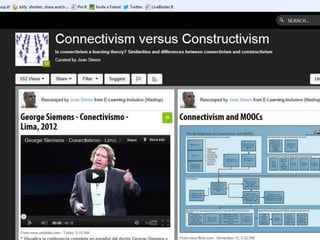
  • #34 Learning about MOOCs through content curation (scoopit & twitter)
  • #35 Show livebinder or the google hangout