A Scoping Review of
PhD-candidates’ Information Use
in Knowledge Creation


by
Gunhild Austrheim, Hege
Folkestad, Susanne Mikki, and
Therese Skagen
Background:
• The scoping review was undertaken as part of the project
  Information Management for Knowledge Creation
• The project is a collaboration between five Nordic
  libraries:
  ▫ Bergen University Library
  ▫ Oslo University Library
  ▫ Aalborg University Library
  ▫ Norwegian School of Economics and Business
    Administration
  ▫ Bergen University College Library
• The project has received funding from the Norwegian
  Archive, Library and Museum Authority
Aims:
• The literature review was undertaken to improve
  our understanding of PhD students’ information
  behaviour and their information use
• We chose to do a scoping review as this is a
  broad field of enquiry and with a varied corpus
  of literature
• A scoping review can be used to determine core
  issues and research gaps
Research question
• What are the information needs of PhD
  students, what information behaviour do they
  display, and are there variations between
  disciplines?
• How do PhD students publish and cite?
• What services and training do libraries offer
  PhD students?
• Is plagiarism a problem at this level?
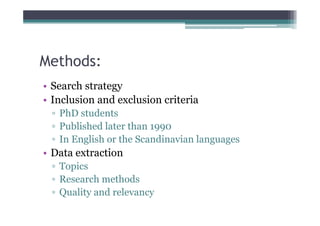
Methods:
• Search strategy
• Inclusion and exclusion criteria
 ▫ PhD students
 ▫ Published later than 1990
 ▫ In English or the Scandinavian languages
• Data extraction
 ▫ Topics
 ▫ Research methods
 ▫ Quality and relevancy
b1


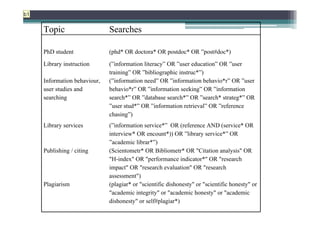
     Topic                    Searches

     PhD student              (phd* OR doctora* OR postdoc* OR ”post#doc*)

     Library instruction      (”information literacy” OR ”user education” OR ”user
                              training” OR ”bibliographic instruc*”)
     Information behaviour,   (”information need” OR ”information behavio*r” OR ”user
     user studies and         behavio*r” OR ”information seeking” OR ”information
     searching                search*” OR ”database search*” OR ”search* strateg*” OR
                              ”user stud*” OR ”information retrieval” OR ”reference
                              chasing”)
     Library services         (”information service*” OR (reference AND (service* OR
                              interview* OR encount*)) OR ”library service*” OR
                              ”academic librar*”)
     Publishing / citing      (Scientometr* OR Bibliometr* OR "Citation analysis" OR
                              "H-index" OR "performance indicator*" OR "research
                              impact" OR "research evaluation" OR "research
                              assessment")
     Plagiarism               (plagiar* or "scientific dishonesty" or "scientific honesty" or
                              "academic integrity" or "academic honesty" or "academic
                              dishonesty" or self#plagiar*)
Slide 6

b1        Her burde vi vel ha teksten på engelsk?
          bubhf, 11/04/2011
Search results
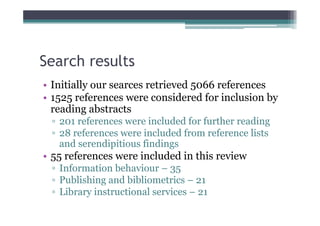
• Initially our searces retrieved 5066 references
• 1525 references were considered for inclusion by
  reading abstracts
 ▫ 201 references were included for further reading
 ▫ 28 references were included from reference lists
   and serendipitious findings
• 55 references were included in this review
 ▫ Information behaviour – 35
 ▫ Publishing and bibliometrics – 21
 ▫ Library instructional services – 21
General results:
• PhD studens are often grouped with others, ie
  researchers or MA students
• Studies are conducted within sciences and social
  sciences more often than in the humanities
• User surveys was the dominant form of enquiry
 ▫   Case studies
 ▫   Statistical analysis
 ▫   Interviews
 ▫   Literature reviews
Publication and bibliometric analysis
• Bibliometry measures researcher visibility
  through publications and citations
• The status of a research field, collaborators and
  publication channels influece the choices of PhD
  students
• Impact or visibility increases through
  ▫ Participation in research networks
  ▫ Collaboration and co-authorship
  ▫ Publishing in open access sources
Publication and bibliometric analysis 2
• A conscious attitude towards ethical behaviour
  and copyright issues is important in co-
  authorship and citation practice
• Improved knowledge of databases and the use of
  analytical functions would improve information
  handling
• Better understanding of how to evaluate
  information would contribute to better quality,
  especially in the PhD students’ literature review
Information behaviour
• Disciplinary differences in information
  searching
• Research questions decide the number of
  sources needed
• Multi-disciplinary research questions require
  better information skills
• PhD students feel confident in information
  searching
  ▫ Difficult to display lack of confidence
Information behaviour 2
• Citation practice show preference for digital
  material and reduced use of print sources
  ▫ Inaccuracies in citations and reference lists
• The use of digital sources leads to a wider array
  of sources being used
• PhD students obtain an overview of their field by
  reference chasing
Library instructional services
• The library must have an understanding of the
  research process, research methods, and
  research tools
• A common attitude among librarians is that
  everyone needs guidance from the library to
  become information literate
• PhD students’ literature review
 ▫ suitable for library interventions
Library instructional services
• PhD students are independent information users
  and rarely ask for help
 ▫ should be available when and where they need it
• PhD students are not aware of the services
  offered by the library
• Services must be relevant and tailored
 ▫ Timing
 ▫ Content
 ▫ Disciplin specific
Conclusions
• Our scoping review has given us an overview and
  will help us in developing our project
• 55 studies in a broad field of enquiry – too few?
• Our research questions in the literature
 ▫ Information behaviour 
 ▫ Publishing and citing 
 ▫ Instructional services 
• Research gaps
 ▫ Plagiarism
 ▫ Copyright issues
Please visit us at http://inma.b.uib.no

Austrheim, Folkestad, Mikki & Skagen - A scoping review of PhD-candidates’ information use in knowledge creation

  • 1.
    A Scoping Reviewof PhD-candidates’ Information Use in Knowledge Creation by Gunhild Austrheim, Hege Folkestad, Susanne Mikki, and Therese Skagen
  • 2.
    Background: • The scopingreview was undertaken as part of the project Information Management for Knowledge Creation • The project is a collaboration between five Nordic libraries: ▫ Bergen University Library ▫ Oslo University Library ▫ Aalborg University Library ▫ Norwegian School of Economics and Business Administration ▫ Bergen University College Library • The project has received funding from the Norwegian Archive, Library and Museum Authority
  • 3.
    Aims: • The literaturereview was undertaken to improve our understanding of PhD students’ information behaviour and their information use • We chose to do a scoping review as this is a broad field of enquiry and with a varied corpus of literature • A scoping review can be used to determine core issues and research gaps
  • 4.
    Research question • Whatare the information needs of PhD students, what information behaviour do they display, and are there variations between disciplines? • How do PhD students publish and cite? • What services and training do libraries offer PhD students? • Is plagiarism a problem at this level?
  • 5.
    Methods: • Search strategy •Inclusion and exclusion criteria ▫ PhD students ▫ Published later than 1990 ▫ In English or the Scandinavian languages • Data extraction ▫ Topics ▫ Research methods ▫ Quality and relevancy
  • 6.
    b1 Topic Searches PhD student (phd* OR doctora* OR postdoc* OR ”post#doc*) Library instruction (”information literacy” OR ”user education” OR ”user training” OR ”bibliographic instruc*”) Information behaviour, (”information need” OR ”information behavio*r” OR ”user user studies and behavio*r” OR ”information seeking” OR ”information searching search*” OR ”database search*” OR ”search* strateg*” OR ”user stud*” OR ”information retrieval” OR ”reference chasing”) Library services (”information service*” OR (reference AND (service* OR interview* OR encount*)) OR ”library service*” OR ”academic librar*”) Publishing / citing (Scientometr* OR Bibliometr* OR "Citation analysis" OR "H-index" OR "performance indicator*" OR "research impact" OR "research evaluation" OR "research assessment") Plagiarism (plagiar* or "scientific dishonesty" or "scientific honesty" or "academic integrity" or "academic honesty" or "academic dishonesty" or self#plagiar*)
  • 7.
    Slide 6 b1 Her burde vi vel ha teksten på engelsk? bubhf, 11/04/2011
  • 8.
    Search results • Initiallyour searces retrieved 5066 references • 1525 references were considered for inclusion by reading abstracts ▫ 201 references were included for further reading ▫ 28 references were included from reference lists and serendipitious findings • 55 references were included in this review ▫ Information behaviour – 35 ▫ Publishing and bibliometrics – 21 ▫ Library instructional services – 21
  • 9.
    General results: • PhDstudens are often grouped with others, ie researchers or MA students • Studies are conducted within sciences and social sciences more often than in the humanities • User surveys was the dominant form of enquiry ▫ Case studies ▫ Statistical analysis ▫ Interviews ▫ Literature reviews
  • 10.
    Publication and bibliometricanalysis • Bibliometry measures researcher visibility through publications and citations • The status of a research field, collaborators and publication channels influece the choices of PhD students • Impact or visibility increases through ▫ Participation in research networks ▫ Collaboration and co-authorship ▫ Publishing in open access sources
  • 11.
    Publication and bibliometricanalysis 2 • A conscious attitude towards ethical behaviour and copyright issues is important in co- authorship and citation practice • Improved knowledge of databases and the use of analytical functions would improve information handling • Better understanding of how to evaluate information would contribute to better quality, especially in the PhD students’ literature review
  • 12.
    Information behaviour • Disciplinarydifferences in information searching • Research questions decide the number of sources needed • Multi-disciplinary research questions require better information skills • PhD students feel confident in information searching ▫ Difficult to display lack of confidence
  • 13.
    Information behaviour 2 •Citation practice show preference for digital material and reduced use of print sources ▫ Inaccuracies in citations and reference lists • The use of digital sources leads to a wider array of sources being used • PhD students obtain an overview of their field by reference chasing
  • 14.
    Library instructional services •The library must have an understanding of the research process, research methods, and research tools • A common attitude among librarians is that everyone needs guidance from the library to become information literate • PhD students’ literature review ▫ suitable for library interventions
  • 15.
    Library instructional services •PhD students are independent information users and rarely ask for help ▫ should be available when and where they need it • PhD students are not aware of the services offered by the library • Services must be relevant and tailored ▫ Timing ▫ Content ▫ Disciplin specific
  • 16.
    Conclusions • Our scopingreview has given us an overview and will help us in developing our project • 55 studies in a broad field of enquiry – too few? • Our research questions in the literature ▫ Information behaviour  ▫ Publishing and citing  ▫ Instructional services  • Research gaps ▫ Plagiarism ▫ Copyright issues
  • 17.
    Please visit usat http://inma.b.uib.no