Genetics PG:
Library Basics and Literature
Reviews
ElizabethMoll-Willard
FacultyLibrarian:AgriSciences
emw@sun.ac.za
Outcomes
• Library basics &
resources
• Off campus access
• Library services during
COVID
Basics
• Select a topic
• Search the literature
• Evaluate the literature
• Critique the literature
• Write the review
Literature
Review Steps
Get to know the
library resources
Your library website
Each menu deals
with relevant
information –
looking for
something? Use the
“find” option,
curious about how
long you get your
books for? “using the
library” can answer
that!
SunSearch: look
for books, articles,
and more!
Library guides:
your how-to
mecca of
information
Quick links are
there to help
you find what
you need fast
Got a question? Just ask a
librarian!
5
Off campus
access
Getting off campus access to
resources – Library links
7
Because the library purchases a lot of the material, you will need to "prove"
to the database you are a student. Most databases might ask you for a
password.
Do not put in your own credentials unless there's a specific instruction.
The library automatically "fills" in the password through IP authentication. If
your IP address reads that you are on an internet connection that is linked
to Stellenbosch University, then the database will give you access. This
means that when you are off-campus, you need to use a proxy to tell the
database you are from Stellenbosch.
This proxy is automatically contained in all the links on the library's page
and your library how-to guide's page.
So the simplest way to get access, is to simply use the library website
and your library how-to guide.
Getting off campus access to
resources
8
Google Scholar
• You can set
up your
Google
Scholar to
link into the
library’s
resources
Library
catalogue
• You can
follow a
reference
using the
library
catalogue
Library guide
• Your library
guide already
has the links
to the
databases
ready to go!
How-to
literature
review
What is a literature review?
A literature review is a critical
evaluation, summary and explanation
of the complete and current state of
knowledge on a limited topic.
Steps of a literature review
Select a topic
Search the
literature
Evaluate the
literature
Critique the
literature
Write the review
Step 1:
Select a
topic
Step 2:
Search the
literature
Step 1:
Select a
topic
2. Search the literature
i. Finding the literature
◦ Search strategies
ii. Manage your literature
◦ Literature synthesis table: inclusion / exclusion criteria of literature
◦ Using Reference Managers
◦ Skim reading
Search strategies
Creating search strategies combines your keywords with using advanced
search options or operators that speak directly to the database
To get tips on how to create search strategies:
◦ Use the ‘search help’ on the database
◦ Use the specific advanced searches on the database
◦ OR consult a librarian on how to use Boolean operators
Step 1: Identify your keywords
16
Write down your topic:
Gene expression of sugarcane in
response to drought
Main Concepts Alternative
Gene expression
Sugarcan Saccharum sp.
Drought Abiotic stress
Step 2: Combine Keywords to make a
search strategy
17
Boolean Operators - AND / OR / NOT
AND – returns results with both keywords
OR – returns results with one or the other keyword
NOT – returns results excluding specific keywords
Step 2: Combine Keywords to make a
search strategy
18
Boolean Operators - AND / OR / NOT
Step 2: Combine Keywords to make a
search strategy
19
Boolean Operators - AND / OR / NOT
Quotation Marks “ ” – keep keywords together, for exact
phrase searching eg. “abiotic stress”
Brackets ( ) – keep concepts together, used for synonyms
eg. (sugarcane OR saccharum)
Step 2: Combine Keywords to make a
search strategy
20
“gene expression”
AND
(sugarcane OR saccharum)
AND
(“abiotic stress” OR drought)
21
Step 3: Identify your database
Databases Basics
A database is an electronic index to journal or
magazine articles, containing citations, abstracts
and often either the full text of the articles, or links
to the full text.
It allows you to search for information using:
Keywords
Titles
Authors
Abstracts
Using search engines (Databases or
Google) effectively
Keep in mind that Google is a good starting point, but that it isn’t able to
access most of our resources!
◦ For example – Scopus results are not are available via Google
Every database has a search engine like Google – but they are not always as
intuitive as Google
◦ Keep in mind that Google saves searches and uses specific algorithms to adapt to
your previous searches – this gives the efficient impression
When using any search engine – be more specific and keep in mind how to
evaluate information
◦ The more specific you are, the more relevant results it will give
Remember you are looking for PEER REVIEWED CREDIBLE ACADEMIC
INFORMATION
22
23
Step 4: Perform your search
Here are a couple of databases to use:
Scopus
Web of Science
Google Scholar
CAB Abstracts
ii. Manage your literature
Collect and select the literature
◦ Use the inclusion / exclusion table to help manage your literature
Reference managers
◦ Collate your literature and make referencing easy
Skimming
◦ Learn to skim read your literature!
Literature Synthesis table
AUTHOR (S) (YEAR)
TITLE
PURPOSE OF THE
STUDY
METHOD /
EXPERIMENT
SAMPLE /
DESIGN
FINDINGS THEMES
Mather, C. and Greenberg,
S., 2003. Market
Liberalisation in Post-
Apartheid South Africa: the
Restructuring of Citrus
Exports after 'Deregulation'.
Explores the impact of
market liberalisation on
South Africa’s citrus export
Industry, specifically from
a grower’s perspective
Literature review
conducted
Qualitative data collected
from interviews
Growers from 4
co-operatives
within 4 specific
geographical
areas
Former cooperatives have
faced
problems in using the
resources they inherited
from the past, increasing
differentiation between
those who are able to take
advantage of deregulation
and those who are not.
Deregulation has affected
labour on farms and in
packhouses but could be as
a result of liberalisation of
the economy having
intensified structural
changes in the
agricultural labour market
that have been present for
some time.
The literature review synthesis table
Reference management tools
Programs that assist you in storing your
citations, managing your citations and then
inserting citations in a specific citation style
while you write your assignment
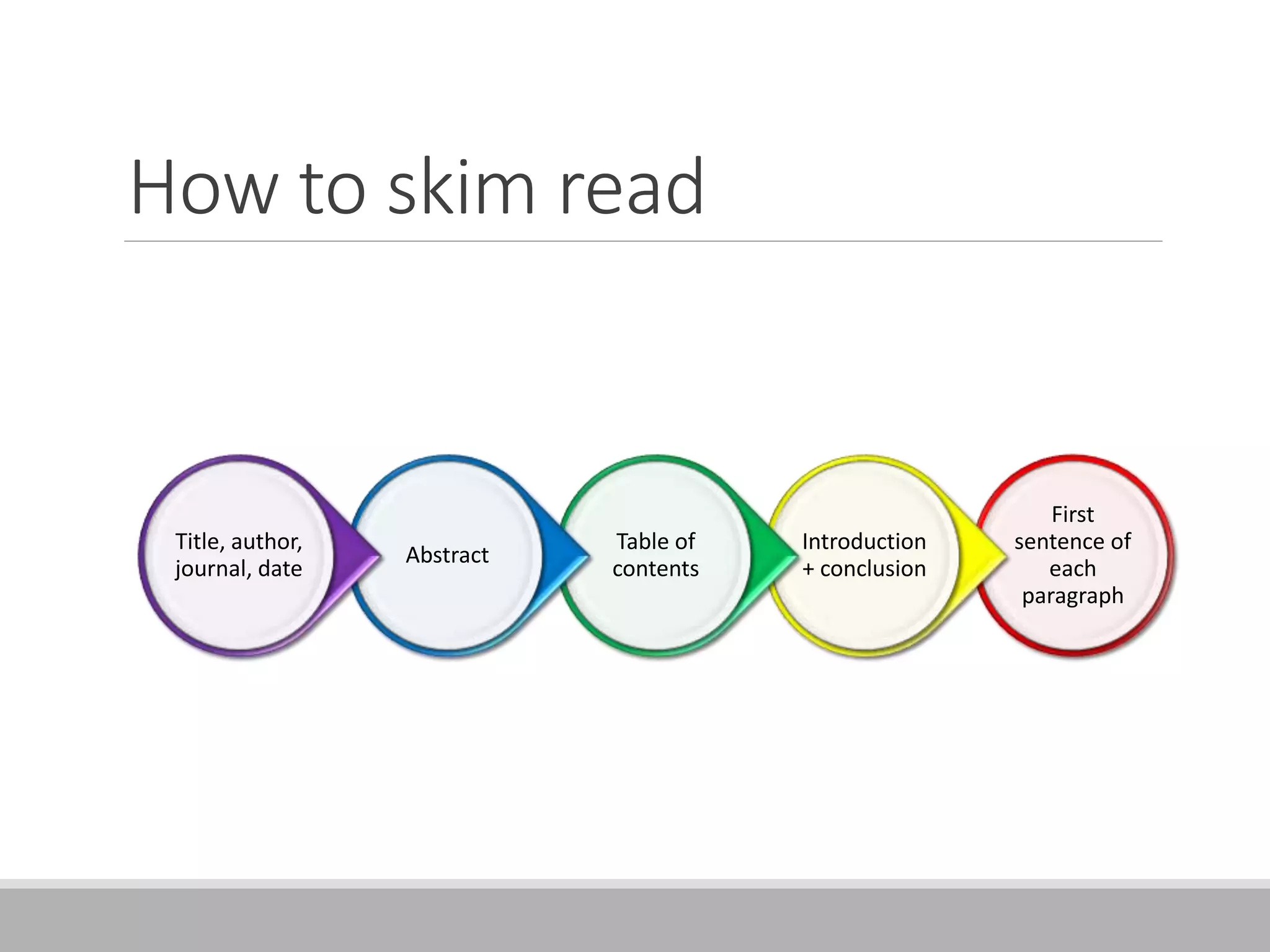
How to skim read
First
sentence of
each
paragraph
Introduction
+ conclusion
Table of
contents
Abstract
Title, author,
journal, date
Step 3:
Evaluate the
literature
Step 2:
Search the
literature
Step 1:
Select a
topic
3. Evaluating the Literature
Through evaluating your literature, you can start to group it by theme,
and develop your “argument” or golden thread
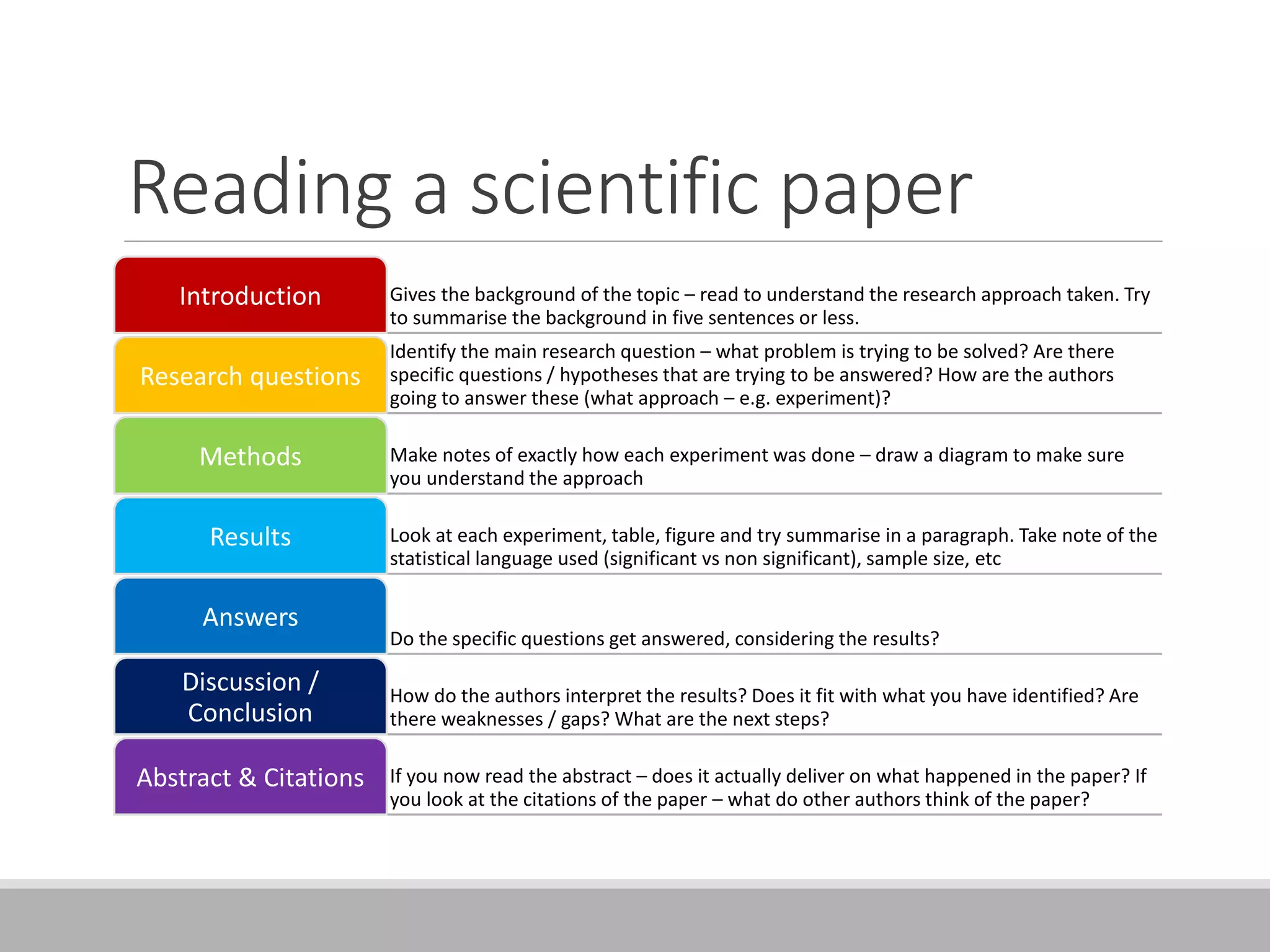
Reading a scientific paper
Gives the background of the topic – read to understand the research approach taken. Try
to summarise the background in five sentences or less.
Introduction
Identify the main research question – what problem is trying to be solved? Are there
specific questions / hypotheses that are trying to be answered? How are the authors
going to answer these (what approach – e.g. experiment)?
Research questions
Make notes of exactly how each experiment was done – draw a diagram to make sure
you understand the approach
Methods
Look at each experiment, table, figure and try summarise in a paragraph. Take note of the
statistical language used (significant vs non significant), sample size, etc
Results
Do the specific questions get answered, considering the results?
Answers
How do the authors interpret the results? Does it fit with what you have identified? Are
there weaknesses / gaps? What are the next steps?
Discussion /
Conclusion
If you now read the abstract – does it actually deliver on what happened in the paper? If
you look at the citations of the paper – what do other authors think of the paper?
Abstract & Citations
Mapping core ideas
PEST analysis
Export of
citrus
Market
Regulations Export
Citrus
South Africa
PEST Analysis
• You can use a mindmap style
to map out your themes /
ideas and structure your
research
• There are tools that let you do
this – such as CMAP tools, or
powerpoint (used here), or
just a simple piece of pen and
paper
Surveying the literature
This just means you look at an overview of all the literature you have
collected
◦ You can use the literature synthesis table to help here.
Synthesize the information
◦ Complete your table and analyse it
Literature Synthesis table
AUTHOR (S) (YEAR)
TITLE
PURPOSE OF THE
STUDY
METHOD /
EXPERIMENT
SAMPLE /
DESIGN
FINDINGS THEMES
Mather, C. and Greenberg,
S., 2003. Market
Liberalisation in Post-
Apartheid South Africa: the
Restructuring of Citrus
Exports after 'Deregulation'.
Explores the impact of
market liberalisation on
South Africa’s citrus export
Industry, specifically from
a grower’s perspective
Literature review
conducted
Qualitative data collected
from interviews
Growers from 4
co-operatives
within 4 specific
geographical
areas
Former cooperatives have
faced
problems in using the
resources they inherited
from the past, increasing
differentiation between
those who are able to take
advantage of deregulation
and those who are not.
Deregulation has affected
labour on farms and in
packhouses but could be as
a result of liberalisation of
the economy having
intensified structural
changes in the
agricultural labour market
that have been present for
some time.
Market regulation
Step 4:
Critique
the
literature
Step 3:
Evaluate
the
literature
Step 2:
Search the
literature
Step 1:
Select a
topic
4. Critique the literature
Two steps:
◦ Interpret the current understanding about the topic of research and
◦ Determine how this knowledge answers your research topic
What is the answer to the research question that you have posed given
what you know about the subject?
◦ Make sure your literature covers all aspects of your “research question”
sufficiently
Use your evaluation of literature and mapping to also build into the
critiquing
Step 5:
Write the
review
Step 4:
Critique
the
literature
Step 3:
Evaluate
the
literature
Step 2:
Search the
literature
Step 1:
Select a
topic
5. Write the review
Write to understand
◦ Act of learning and owning the subject matter
Write to be understood
◦ Somebody else needs to understand what you’ve written
◦ Make sure to edit with “fresh eyes” or get help editing
Write early and write often
◦ The more you write, the easier it becomes and it becomes a habit – try to
aim for a paragraph a day
Don’t get it right, get it written
◦ Drafting helps you to clarify your thoughts, start by writing the parts you are clear on,
this identifies the bits that need more work. Nobody will see this until you’ve edited it
properly, so even if all you jot down are bullet points, get the thoughts on paper
Write
Evaluate
Edit
Topic
Sentence
• Summarises argument
• Indicates approach
Elaboration
• May provide additional information or restate the
topic sentence in a more extended way.
Evidence
• Maybe be literature, quantitative or qualitative data,
or analysis of data.
Link
• This makes the connection to the next paragraph
explicit.
Paragraph structure
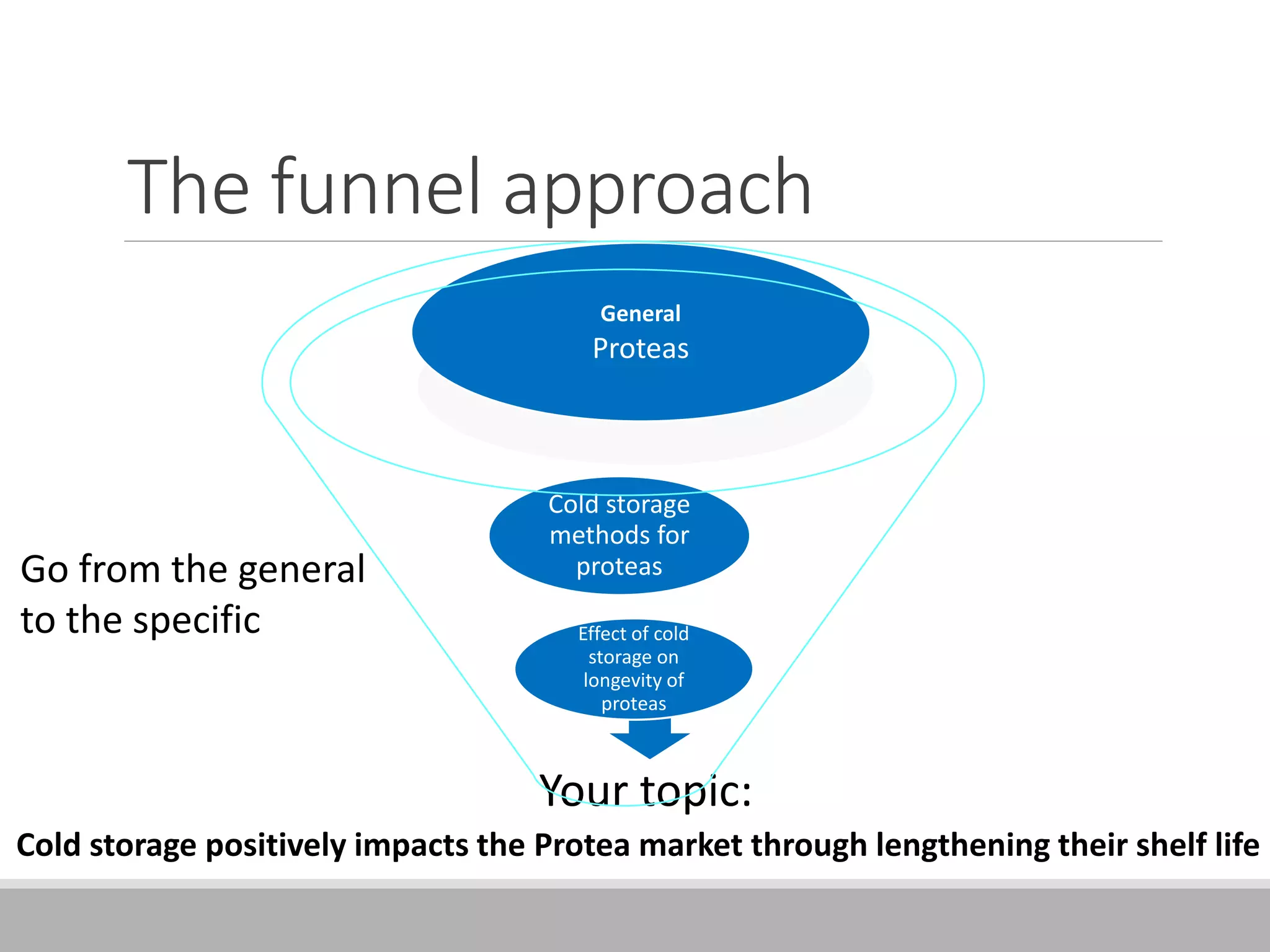
The funnel approach
Your topic:
Effect of cold
storage on
longevity of
proteas
General
Proteas
Cold storage
methods for
proteas
Go from the general
to the specific
Cold storage positively impacts the Protea market through lengthening their shelf life
Referencing
Mendeley
Referencing
41
Know the Referencing Style that you are using
Make sure what you are referencing, different material
types are displayed differently in the bibliography
Makes sure that your in-text citations match your
bibliography
Most important, be CONSISTENT
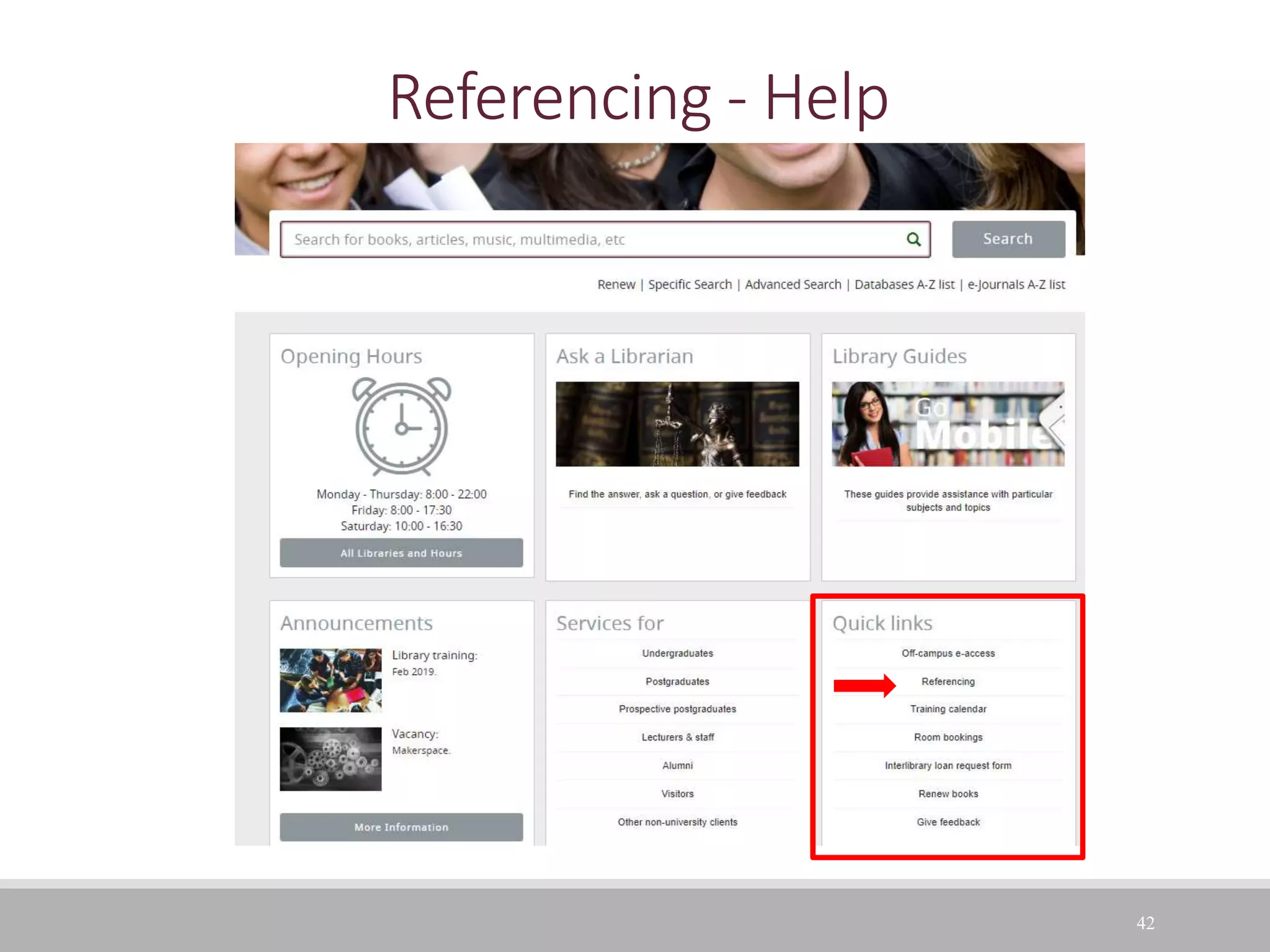
Referencing - Help
42
Using Mendeley
Using a tool like
Mendeley will
help automate
your referencing
– we hold
workshops
throughout the
year and every
Monday have a
“Mendeley hour”
Contacting me
45
Social Media channels
What you will find on our pages
◦ Relevant scientific research in
the world
◦ Library news: tips, workshops
and more
Published a paper? Doing
something interesting in the lab?
Tag me or email me so I can share
it! Get your research heard!
Thank you
46
Email: emw@sun.ac.za
Library Guides:
http://libguides.sun.ac.za/genetics
Please take a moment to fill out the evaluation form on the
front page of the library guide:
https://forms.office.com/r/8EdbTPz5Pc

Genetics PG Literature Review

  • 1.
    Genetics PG: Library Basicsand Literature Reviews ElizabethMoll-Willard FacultyLibrarian:AgriSciences emw@sun.ac.za
  • 2.
    Outcomes • Library basics& resources • Off campus access • Library services during COVID Basics • Select a topic • Search the literature • Evaluate the literature • Critique the literature • Write the review Literature Review Steps
  • 3.
    Get to knowthe library resources
  • 4.
    Your library website Eachmenu deals with relevant information – looking for something? Use the “find” option, curious about how long you get your books for? “using the library” can answer that! SunSearch: look for books, articles, and more! Library guides: your how-to mecca of information Quick links are there to help you find what you need fast Got a question? Just ask a librarian!
  • 5.
  • 6.
  • 7.
    Getting off campusaccess to resources – Library links 7 Because the library purchases a lot of the material, you will need to "prove" to the database you are a student. Most databases might ask you for a password. Do not put in your own credentials unless there's a specific instruction. The library automatically "fills" in the password through IP authentication. If your IP address reads that you are on an internet connection that is linked to Stellenbosch University, then the database will give you access. This means that when you are off-campus, you need to use a proxy to tell the database you are from Stellenbosch. This proxy is automatically contained in all the links on the library's page and your library how-to guide's page. So the simplest way to get access, is to simply use the library website and your library how-to guide.
  • 8.
    Getting off campusaccess to resources 8 Google Scholar • You can set up your Google Scholar to link into the library’s resources Library catalogue • You can follow a reference using the library catalogue Library guide • Your library guide already has the links to the databases ready to go!
  • 9.
  • 10.
    What is aliterature review? A literature review is a critical evaluation, summary and explanation of the complete and current state of knowledge on a limited topic.
  • 11.
    Steps of aliterature review Select a topic Search the literature Evaluate the literature Critique the literature Write the review
  • 12.
  • 13.
  • 14.
    2. Search theliterature i. Finding the literature ◦ Search strategies ii. Manage your literature ◦ Literature synthesis table: inclusion / exclusion criteria of literature ◦ Using Reference Managers ◦ Skim reading
  • 15.
    Search strategies Creating searchstrategies combines your keywords with using advanced search options or operators that speak directly to the database To get tips on how to create search strategies: ◦ Use the ‘search help’ on the database ◦ Use the specific advanced searches on the database ◦ OR consult a librarian on how to use Boolean operators
  • 16.
    Step 1: Identifyyour keywords 16 Write down your topic: Gene expression of sugarcane in response to drought Main Concepts Alternative Gene expression Sugarcan Saccharum sp. Drought Abiotic stress
  • 17.
    Step 2: CombineKeywords to make a search strategy 17 Boolean Operators - AND / OR / NOT AND – returns results with both keywords OR – returns results with one or the other keyword NOT – returns results excluding specific keywords
  • 18.
    Step 2: CombineKeywords to make a search strategy 18 Boolean Operators - AND / OR / NOT
  • 19.
    Step 2: CombineKeywords to make a search strategy 19 Boolean Operators - AND / OR / NOT Quotation Marks “ ” – keep keywords together, for exact phrase searching eg. “abiotic stress” Brackets ( ) – keep concepts together, used for synonyms eg. (sugarcane OR saccharum)
  • 20.
    Step 2: CombineKeywords to make a search strategy 20 “gene expression” AND (sugarcane OR saccharum) AND (“abiotic stress” OR drought)
  • 21.
    21 Step 3: Identifyyour database Databases Basics A database is an electronic index to journal or magazine articles, containing citations, abstracts and often either the full text of the articles, or links to the full text. It allows you to search for information using: Keywords Titles Authors Abstracts
  • 22.
    Using search engines(Databases or Google) effectively Keep in mind that Google is a good starting point, but that it isn’t able to access most of our resources! ◦ For example – Scopus results are not are available via Google Every database has a search engine like Google – but they are not always as intuitive as Google ◦ Keep in mind that Google saves searches and uses specific algorithms to adapt to your previous searches – this gives the efficient impression When using any search engine – be more specific and keep in mind how to evaluate information ◦ The more specific you are, the more relevant results it will give Remember you are looking for PEER REVIEWED CREDIBLE ACADEMIC INFORMATION 22
  • 23.
    23 Step 4: Performyour search Here are a couple of databases to use: Scopus Web of Science Google Scholar CAB Abstracts
  • 24.
    ii. Manage yourliterature Collect and select the literature ◦ Use the inclusion / exclusion table to help manage your literature Reference managers ◦ Collate your literature and make referencing easy Skimming ◦ Learn to skim read your literature!
  • 25.
    Literature Synthesis table AUTHOR(S) (YEAR) TITLE PURPOSE OF THE STUDY METHOD / EXPERIMENT SAMPLE / DESIGN FINDINGS THEMES Mather, C. and Greenberg, S., 2003. Market Liberalisation in Post- Apartheid South Africa: the Restructuring of Citrus Exports after 'Deregulation'. Explores the impact of market liberalisation on South Africa’s citrus export Industry, specifically from a grower’s perspective Literature review conducted Qualitative data collected from interviews Growers from 4 co-operatives within 4 specific geographical areas Former cooperatives have faced problems in using the resources they inherited from the past, increasing differentiation between those who are able to take advantage of deregulation and those who are not. Deregulation has affected labour on farms and in packhouses but could be as a result of liberalisation of the economy having intensified structural changes in the agricultural labour market that have been present for some time. The literature review synthesis table
  • 26.
    Reference management tools Programsthat assist you in storing your citations, managing your citations and then inserting citations in a specific citation style while you write your assignment
  • 27.
    How to skimread First sentence of each paragraph Introduction + conclusion Table of contents Abstract Title, author, journal, date
  • 28.
    Step 3: Evaluate the literature Step2: Search the literature Step 1: Select a topic
  • 29.
    3. Evaluating theLiterature Through evaluating your literature, you can start to group it by theme, and develop your “argument” or golden thread
  • 30.
    Reading a scientificpaper Gives the background of the topic – read to understand the research approach taken. Try to summarise the background in five sentences or less. Introduction Identify the main research question – what problem is trying to be solved? Are there specific questions / hypotheses that are trying to be answered? How are the authors going to answer these (what approach – e.g. experiment)? Research questions Make notes of exactly how each experiment was done – draw a diagram to make sure you understand the approach Methods Look at each experiment, table, figure and try summarise in a paragraph. Take note of the statistical language used (significant vs non significant), sample size, etc Results Do the specific questions get answered, considering the results? Answers How do the authors interpret the results? Does it fit with what you have identified? Are there weaknesses / gaps? What are the next steps? Discussion / Conclusion If you now read the abstract – does it actually deliver on what happened in the paper? If you look at the citations of the paper – what do other authors think of the paper? Abstract & Citations
  • 31.
    Mapping core ideas PESTanalysis Export of citrus Market Regulations Export Citrus South Africa PEST Analysis • You can use a mindmap style to map out your themes / ideas and structure your research • There are tools that let you do this – such as CMAP tools, or powerpoint (used here), or just a simple piece of pen and paper
  • 32.
    Surveying the literature Thisjust means you look at an overview of all the literature you have collected ◦ You can use the literature synthesis table to help here. Synthesize the information ◦ Complete your table and analyse it
  • 33.
    Literature Synthesis table AUTHOR(S) (YEAR) TITLE PURPOSE OF THE STUDY METHOD / EXPERIMENT SAMPLE / DESIGN FINDINGS THEMES Mather, C. and Greenberg, S., 2003. Market Liberalisation in Post- Apartheid South Africa: the Restructuring of Citrus Exports after 'Deregulation'. Explores the impact of market liberalisation on South Africa’s citrus export Industry, specifically from a grower’s perspective Literature review conducted Qualitative data collected from interviews Growers from 4 co-operatives within 4 specific geographical areas Former cooperatives have faced problems in using the resources they inherited from the past, increasing differentiation between those who are able to take advantage of deregulation and those who are not. Deregulation has affected labour on farms and in packhouses but could be as a result of liberalisation of the economy having intensified structural changes in the agricultural labour market that have been present for some time. Market regulation
  • 34.
    Step 4: Critique the literature Step 3: Evaluate the literature Step2: Search the literature Step 1: Select a topic
  • 35.
    4. Critique theliterature Two steps: ◦ Interpret the current understanding about the topic of research and ◦ Determine how this knowledge answers your research topic What is the answer to the research question that you have posed given what you know about the subject? ◦ Make sure your literature covers all aspects of your “research question” sufficiently Use your evaluation of literature and mapping to also build into the critiquing
  • 36.
    Step 5: Write the review Step4: Critique the literature Step 3: Evaluate the literature Step 2: Search the literature Step 1: Select a topic
  • 37.
    5. Write thereview Write to understand ◦ Act of learning and owning the subject matter Write to be understood ◦ Somebody else needs to understand what you’ve written ◦ Make sure to edit with “fresh eyes” or get help editing Write early and write often ◦ The more you write, the easier it becomes and it becomes a habit – try to aim for a paragraph a day Don’t get it right, get it written ◦ Drafting helps you to clarify your thoughts, start by writing the parts you are clear on, this identifies the bits that need more work. Nobody will see this until you’ve edited it properly, so even if all you jot down are bullet points, get the thoughts on paper Write Evaluate Edit
  • 38.
    Topic Sentence • Summarises argument •Indicates approach Elaboration • May provide additional information or restate the topic sentence in a more extended way. Evidence • Maybe be literature, quantitative or qualitative data, or analysis of data. Link • This makes the connection to the next paragraph explicit. Paragraph structure
  • 39.
    The funnel approach Yourtopic: Effect of cold storage on longevity of proteas General Proteas Cold storage methods for proteas Go from the general to the specific Cold storage positively impacts the Protea market through lengthening their shelf life
  • 40.
  • 41.
    Referencing 41 Know the ReferencingStyle that you are using Make sure what you are referencing, different material types are displayed differently in the bibliography Makes sure that your in-text citations match your bibliography Most important, be CONSISTENT
  • 42.
  • 43.
    Using Mendeley Using atool like Mendeley will help automate your referencing – we hold workshops throughout the year and every Monday have a “Mendeley hour”
  • 44.
  • 45.
    45 Social Media channels Whatyou will find on our pages ◦ Relevant scientific research in the world ◦ Library news: tips, workshops and more Published a paper? Doing something interesting in the lab? Tag me or email me so I can share it! Get your research heard!
  • 46.
    Thank you 46 Email: emw@sun.ac.za LibraryGuides: http://libguides.sun.ac.za/genetics Please take a moment to fill out the evaluation form on the front page of the library guide: https://forms.office.com/r/8EdbTPz5Pc