



Literature Review ‫ادب‬‫کا‬‫جائزہ‬
Muhammad Saleem
Department of Pakistani Languages
Allama Iqbal Open University Islamabad
February 3, 2016
Plan
 Lecture
 Feedback
 Discussion
 Short Break
 Lecture
 Summary
 Question and Answer Session
Outline
 What is a literature review?
 Why to conduct it?
 When to conduct it?
 How to conduct it?
 How to present it?
 Don’ts of Literature Review
 Resources
What is literature review?
What is Literature Review?
 Literature review is ‘an interpretation and synthesis of published
work’ (Merriam, 1988).
 You need to be actively involved in interpreting the literature that you are
reviewing, and in explaining that interpretation to the reader, rather than just
listing what others have written.
 The term ‘synthesis’ refers to the bringing together of material from different
sources, and the creation of an integrated whole.
“A body of text and its main goal is to bring the reader up to date
with current literature on a topic and forms the basis for another
goal, such as the justification for future research in the area.
It seeks to
describe,
summarize,
evaluate,
clarify and/or integrate the content of previous researches".
Chris Hart (p.27)
..literature review
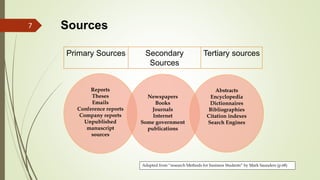
7 Sources
Reports
Theses
Emails
Conference reports
Company reports
Unpublished
manuscript
sources
Newspapers
Books
Journals
Internet
Some government
publications
Abstracts
Encyclopedia
Dictionnaires
Bibliographies
Citation indexes
Search Engines
Primary Sources Secondary
Sources
Tertiary sources
Adapted from “research Methods for business Students” by Mark Saunders (p.68)
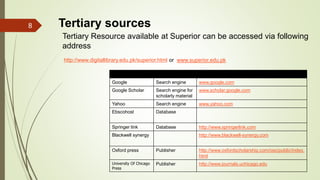
8 Tertiary sources
Tertiary Resource available at Superior can be accessed via following
address
http://www.digitallibrary.edu.pk/superior.html or www.superior.edu.pk
Name Type Internet address
Google Search engine www.google.com
Google Scholar Search engine for
scholarly material
www.scholar.google.com
Yahoo Search engine www.yahoo.com
Ebscohost Database
Springer link Database http://www.springerlink.com
Blackwell synergy http://www.blackwell-synergy.com
Oxford press Publisher http://www.oxfordscholarship.com/oso/public/index.
html
University Of Chicago
Press
Publisher http://www.journals.uchicago.edu
Why Literature Review?
 To find a worth reasearching problem
 To contextualize your research
 Opportunity to persuade your reader (and examiner) that your
work is relevant and that it was worth doing!
 Use literature review to learn about research design for your
project – build on work of previous scholars
 If there is no previous published research look for empirical work
from related areas
Why write LR?
In a broader context Hart (1998) lists the following
purposes of a review:
Distinguishing what has been done from what needs to be done;
Discovering important variables relevant to the topic;
Identifying relationships between ideas and practice;
Establishing the context of the topic or problem;
When to Conduct Literature Review?
 An early review is needed to establish the context and rationale
for your study and to confirm your choice of research
focus/question;
 As the study period gets longer, you need to make sure that you
keep in touch with current, relevant research in your field, which
is published during the period of your research.
Questions while reviewing literature
 What research question(s) are you asking? Why?
 Has anything similar been done in this area before?
 What is already known/understood about this topic?
 How might your project challenge existing beliefs or add to this
understanding?
How to conduct it?
How to conduct literature review
1. Identify the topic
2. Locate sources of literature
3. Read the literature
4. Analyze the literature
5. Assembling and organizing
6. Writing the literature
- Process of Reviewing
Book/Article Review
I. Introduction
II. Summary
III.Analysis
A. Strengths
B. Weaknesses
IV.Conclusion
Sample Outline
How to present it?
Presenting Literature Review
 Write up your review part way through your reading in order to
identify gaps/weaknesses
 Keep the focus on your study and not the literature
 Make sure the structure leads the reader through the key
issues
 Make sure that the literature review is framed by your research
questions
 Where possible, use original sources rather than other people’s
review of literature(s)
…Presenting Literature Review
 There is not one ‘ideal’ structure for your literature review
 Topical Order—organize by main topics or issues; emphasize the
relationship of the issues to the main “problem”
 Chronological Order
 Problem-Cause-Solution Order
 General-to-Specific Order—(Also called the funnel approach)
 Specific-to-General Order
What did you learn ..?
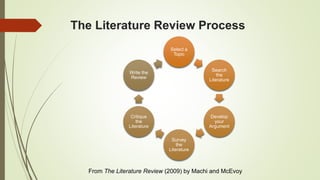
The Literature Review Process
Select a
Topic
Search
the
Literature
Develop
your
Argument
Survey
the
Literature
Critique
the
Literature
Write the
Review
From The Literature Review (2009) by Machi and McEvoy
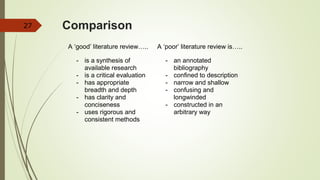
Comparison
A ‘good’ literature review…..
- is a synthesis of
available research
- is a critical evaluation
- has appropriate
breadth and depth
- has clarity and
conciseness
- uses rigorous and
consistent methods
A ‘poor’ literature review is…..
- an annotated
bibliography
- confined to description
- narrow and shallow
- confusing and
longwinded
- constructed in an
arbitrary way
27
Final checklist
 Have I fulfilled the purpose of the literature review?
 Is it written at a level appropriate to its audience?
 Are its facts correct?
 Is all the information included relevant?
 Are the layout and presentation easy on the eye?
 Is the language clear, concise and academic?
 Does the abstract summarise the entire review?
 Does the introduction adequately introduce the topic?
 Is the body organised logically?
 Does the conclusion interpret, analyse and evaluate?
 Are the recommendations reasonable?
 Does the table of contents correspond with the actual contents? Are page numbers correct?
 Have I acknowledged all sources of information through correct referencing?
 Have I checked spelling, grammar and punctuation?
 Have I carefully proof-read the final draft?
28
The Writing Process
 Rough Draft
 Final Draft
 Edit
 Edit Again
29
Show others
Have someone else look at your literature review for
 Clarity
 Can they understand what you’re trying to say?
 Flow
 Does the organization make sense?
 Completeness
 Are there areas left out?
 Questions left unanswered?
 Statements without citations?
30
Lit. Rev. should not be….
 Too global (for example, discussing the history of education when
the topic is on specific instructional strategy)
 An attempt to cover everything written on your topic
 A descriptive list of papers or summaries of research
 Organised around the sources with each described in great detail
should not be….
 An argument for the importance of what you are researching with
no contextualisation of key issues
 Review doesn’t relate literature to the study
 Too few references or outdated references cited
 Review isn’t written in author’s own words
 Review reads like a series of disjointed summaries
Instead, your literature review must be organised around ideas with
an assessment of previous studies (including their strengths
and weaknesses).
A Good Literature Review is:
 Focused - The topic should be narrow. You should only present ideas and only
report on studies that are closely related to topic.
 Concise - Ideas should be presented economically. Don’t take any more space
than you need to present your ideas.
 Logical - The flow within and among paragraphs should be a smooth, logical
progression from one idea to the next
 Developed - Don’t leave the story half told.
 Integrative - Your paper should stress how the ideas in the studies are related.
Focus on the big picture. What commonality do all the studies share? How are
some studies different than others? Your paper should stress how all the studies
reviewed contribute to your topic.
 Current - Your review should focus on work being done on the cutting edge of
your topic.
33
Example -1
Until recently many researchers have shown interest in the field of coastal erosion and the resulting
beach profiles. They have carried out numerous laboratory experiments and field observations to
illuminate the darkness of this field. Their findings and suggestions are reviewed here.
JACHOWSKI (1964) developed a model investigation conducted on the interlocking precast
concrete block seawall. After a result of a survey of damages caused by the severe storm at the
coast of USA, a new and especially shaped concrete block was developed for use in shore
protection. This block was designed to be used in a revetment type seawall that would be both
durable and economical as well as reduce wave run-up and overtopping, and scour at its base or
toe. It was proved that effective shore protection could be designed utilizing these units.
HOM-MA and HORIKAWA (1964) studied waves forces acting on the seawall which was located
inside the surf zone. On the basis of the experimental results conducted to measure waves forces
against a vertical wall, the authors proposed an empirical formula of wave pressure distribution on a
seawall. The computed results obtained by using the above formula were compared well with the
field data of wave pressure on a vertical wall.
SELEZOV and ZHELEZNYAK (1965) conducted experiments on scour of sea bottom in front of
harbour seawalls, basing on the theoretical investigation of solitary wave interaction with a vertical
wall using Boussinesque type equation. It showed that the numerical results were in reasonable
agreement with laboratory experimental data.
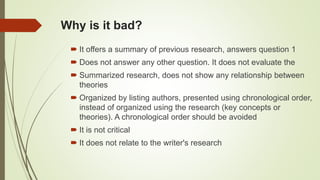
Why is it bad?
 It offers a summary of previous research, answers question 1
 Does not answer any other question. It does not evaluate the
 Summarized research, does not show any relationship between
theories
 Organized by listing authors, presented using chronological order,
instead of organized using the research (key concepts or
theories). A chronological order should be avoided
 It is not critical
 It does not relate to the writer's research
Example -2
Automated storage and retrieval systems (AS/RS) are being introduced into the industry and warehousing at an
increasing rate. Forecasts indicate that this trend will continue for the foreseeable future (see [1]). Research in
the area of AS/RS has followed several avenues. Early work by Hausman, Schwarz andGraves [6, 7] was
concerned with storage assignment and interleaving policies, based on turnover rates of the various items.
Elsayed [3] and Elsayed and Stern [4] compared algorithms for handling orders in AR/RS. Additional work by
Karasawa et al. [9], Azadivar [2] and Parry et al. [11] deals with the design of an AS/RS and the determination of
its throughput by simulation and optimization techniques. Several researchers addressed the problem of the
optimal handling unit (pallet or container) size, to be used in material handling and warehousing systems.
Steudell [13], Tanchoco and
Agee[14], Tanchoco et al. [15] and Grasso and Tanchoco [5] studied various aspects of this subject. The last
two references incorporate the size of the pallet, or unit load, in evaluation of the optimal lot sizes for multi-
inventory systems with limited storage space. In a report on a specific case, Normandin [10] has demonstrated
that using the 'best-size' container can result in considerable savings. A simulation model combining container
size and warehouse capacity considerations, in an AS/RS environment, was developed by Kadosh [8]. The
general results, reflecting the stochastic nature of the flow of goods, are similar to those reported by Rosenblatt
and Roll [12]. Nevertheless, container size was found to affect strongly overall warehousing costs.
In this paper, we present an analytical framework for approximating the optimal size of a warehouse container.
The approximation is based on series of generalizations and specific assumptions. However, these are valid for
a wide range of real life situations. The underlying assumptions of the model are presented in the following
section
Why is it good?
 Grouped similar information
 Shows the relations between different works
 It is organized following the outline presented earlier
 It is organized around ideas and not researchers
Resources
The Literature Review: A Few Tips on Conducting It: http://www.utoronto.ca/writing/litrev.html
The Literature Review: http://www.library.cqu.edu.au/litreviewpages/
How to Write a Literature Review: http://library.ucsc.edu/ref/howto/literaturereview.html
How to Write a Literature Review:
www.unc.edu/depts/wcweb/ handouts.pdf/Literature%20Review.pdf
Writing at University. Literature Review:
http://www.canberra.edu.au/studyskills/writing/litreview.html
The Literature Review: http://www.deakin.edu.au/library/litrev.html
Research and Writing: using the literature: http://www.clet.ait.ac.th/EL21LIT.HTM
Academic Writing: Reviews of Literature
http://www.wisc.edu/writing/Handbook/ReviewofLiterature.html
Literature Review Template
https://www.tru.ca/__shared/assets/Literature_Review_Template30564.pdf
Reviewing Literature
http://uq.edu.au/student-services/pdf/learning/lit-reviews-for-rx-students-v7.pdf
To be in touch with literature and updates
• Google alerts
• Conference alert i.e. international and national
• Journal alert
• Sage alerting system
• Research gate
• Academia
• Emerald http://www.emeraldinsight.com/
• HEC Digital Library
Alerts ‫انتباہ‬
Conclusion
 What is a literature review?
 Why to conduct it?
 When to conduct it?
 How to conduct it?
 How to present it?
 Don’ts of Literature Review
 Resources
Any Question..?

M.saleem literature review

  • 1.
    Literature Review ‫ادب‬‫کا‬‫جائزہ‬ MuhammadSaleem Department of Pakistani Languages Allama Iqbal Open University Islamabad February 3, 2016
  • 2.
    Plan  Lecture  Feedback Discussion  Short Break  Lecture  Summary  Question and Answer Session
  • 3.
    Outline  What isa literature review?  Why to conduct it?  When to conduct it?  How to conduct it?  How to present it?  Don’ts of Literature Review  Resources
  • 4.
  • 5.
    What is LiteratureReview?  Literature review is ‘an interpretation and synthesis of published work’ (Merriam, 1988).  You need to be actively involved in interpreting the literature that you are reviewing, and in explaining that interpretation to the reader, rather than just listing what others have written.  The term ‘synthesis’ refers to the bringing together of material from different sources, and the creation of an integrated whole.
  • 6.
    “A body oftext and its main goal is to bring the reader up to date with current literature on a topic and forms the basis for another goal, such as the justification for future research in the area. It seeks to describe, summarize, evaluate, clarify and/or integrate the content of previous researches". Chris Hart (p.27) ..literature review
  • 7.
    7 Sources Reports Theses Emails Conference reports Companyreports Unpublished manuscript sources Newspapers Books Journals Internet Some government publications Abstracts Encyclopedia Dictionnaires Bibliographies Citation indexes Search Engines Primary Sources Secondary Sources Tertiary sources Adapted from “research Methods for business Students” by Mark Saunders (p.68)
  • 8.
    8 Tertiary sources TertiaryResource available at Superior can be accessed via following address http://www.digitallibrary.edu.pk/superior.html or www.superior.edu.pk Name Type Internet address Google Search engine www.google.com Google Scholar Search engine for scholarly material www.scholar.google.com Yahoo Search engine www.yahoo.com Ebscohost Database Springer link Database http://www.springerlink.com Blackwell synergy http://www.blackwell-synergy.com Oxford press Publisher http://www.oxfordscholarship.com/oso/public/index. html University Of Chicago Press Publisher http://www.journals.uchicago.edu
  • 9.
  • 11.
    Why Literature Review? To find a worth reasearching problem  To contextualize your research  Opportunity to persuade your reader (and examiner) that your work is relevant and that it was worth doing!  Use literature review to learn about research design for your project – build on work of previous scholars  If there is no previous published research look for empirical work from related areas
  • 12.
    Why write LR? Ina broader context Hart (1998) lists the following purposes of a review: Distinguishing what has been done from what needs to be done; Discovering important variables relevant to the topic; Identifying relationships between ideas and practice; Establishing the context of the topic or problem;
  • 13.
    When to ConductLiterature Review?
  • 14.
    When to ConductLiterature Review?  An early review is needed to establish the context and rationale for your study and to confirm your choice of research focus/question;  As the study period gets longer, you need to make sure that you keep in touch with current, relevant research in your field, which is published during the period of your research.
  • 15.
    Questions while reviewingliterature  What research question(s) are you asking? Why?  Has anything similar been done in this area before?  What is already known/understood about this topic?  How might your project challenge existing beliefs or add to this understanding?
  • 16.
  • 17.
    How to conductliterature review 1. Identify the topic 2. Locate sources of literature 3. Read the literature 4. Analyze the literature 5. Assembling and organizing 6. Writing the literature
  • 18.
    - Process ofReviewing
  • 19.
    Book/Article Review I. Introduction II.Summary III.Analysis A. Strengths B. Weaknesses IV.Conclusion Sample Outline
  • 20.
  • 21.
    Presenting Literature Review Write up your review part way through your reading in order to identify gaps/weaknesses  Keep the focus on your study and not the literature  Make sure the structure leads the reader through the key issues  Make sure that the literature review is framed by your research questions  Where possible, use original sources rather than other people’s review of literature(s)
  • 22.
    …Presenting Literature Review There is not one ‘ideal’ structure for your literature review  Topical Order—organize by main topics or issues; emphasize the relationship of the issues to the main “problem”  Chronological Order  Problem-Cause-Solution Order  General-to-Specific Order—(Also called the funnel approach)  Specific-to-General Order
  • 23.
    What did youlearn ..?
  • 26.
    The Literature ReviewProcess Select a Topic Search the Literature Develop your Argument Survey the Literature Critique the Literature Write the Review From The Literature Review (2009) by Machi and McEvoy
  • 27.
    Comparison A ‘good’ literaturereview….. - is a synthesis of available research - is a critical evaluation - has appropriate breadth and depth - has clarity and conciseness - uses rigorous and consistent methods A ‘poor’ literature review is….. - an annotated bibliography - confined to description - narrow and shallow - confusing and longwinded - constructed in an arbitrary way 27
  • 28.
    Final checklist  HaveI fulfilled the purpose of the literature review?  Is it written at a level appropriate to its audience?  Are its facts correct?  Is all the information included relevant?  Are the layout and presentation easy on the eye?  Is the language clear, concise and academic?  Does the abstract summarise the entire review?  Does the introduction adequately introduce the topic?  Is the body organised logically?  Does the conclusion interpret, analyse and evaluate?  Are the recommendations reasonable?  Does the table of contents correspond with the actual contents? Are page numbers correct?  Have I acknowledged all sources of information through correct referencing?  Have I checked spelling, grammar and punctuation?  Have I carefully proof-read the final draft? 28
  • 29.
    The Writing Process Rough Draft  Final Draft  Edit  Edit Again 29
  • 30.
    Show others Have someoneelse look at your literature review for  Clarity  Can they understand what you’re trying to say?  Flow  Does the organization make sense?  Completeness  Are there areas left out?  Questions left unanswered?  Statements without citations? 30
  • 31.
    Lit. Rev. shouldnot be….  Too global (for example, discussing the history of education when the topic is on specific instructional strategy)  An attempt to cover everything written on your topic  A descriptive list of papers or summaries of research  Organised around the sources with each described in great detail
  • 32.
    should not be…. An argument for the importance of what you are researching with no contextualisation of key issues  Review doesn’t relate literature to the study  Too few references or outdated references cited  Review isn’t written in author’s own words  Review reads like a series of disjointed summaries Instead, your literature review must be organised around ideas with an assessment of previous studies (including their strengths and weaknesses).
  • 33.
    A Good LiteratureReview is:  Focused - The topic should be narrow. You should only present ideas and only report on studies that are closely related to topic.  Concise - Ideas should be presented economically. Don’t take any more space than you need to present your ideas.  Logical - The flow within and among paragraphs should be a smooth, logical progression from one idea to the next  Developed - Don’t leave the story half told.  Integrative - Your paper should stress how the ideas in the studies are related. Focus on the big picture. What commonality do all the studies share? How are some studies different than others? Your paper should stress how all the studies reviewed contribute to your topic.  Current - Your review should focus on work being done on the cutting edge of your topic. 33
  • 34.
    Example -1 Until recentlymany researchers have shown interest in the field of coastal erosion and the resulting beach profiles. They have carried out numerous laboratory experiments and field observations to illuminate the darkness of this field. Their findings and suggestions are reviewed here. JACHOWSKI (1964) developed a model investigation conducted on the interlocking precast concrete block seawall. After a result of a survey of damages caused by the severe storm at the coast of USA, a new and especially shaped concrete block was developed for use in shore protection. This block was designed to be used in a revetment type seawall that would be both durable and economical as well as reduce wave run-up and overtopping, and scour at its base or toe. It was proved that effective shore protection could be designed utilizing these units. HOM-MA and HORIKAWA (1964) studied waves forces acting on the seawall which was located inside the surf zone. On the basis of the experimental results conducted to measure waves forces against a vertical wall, the authors proposed an empirical formula of wave pressure distribution on a seawall. The computed results obtained by using the above formula were compared well with the field data of wave pressure on a vertical wall. SELEZOV and ZHELEZNYAK (1965) conducted experiments on scour of sea bottom in front of harbour seawalls, basing on the theoretical investigation of solitary wave interaction with a vertical wall using Boussinesque type equation. It showed that the numerical results were in reasonable agreement with laboratory experimental data.
  • 35.
    Why is itbad?  It offers a summary of previous research, answers question 1  Does not answer any other question. It does not evaluate the  Summarized research, does not show any relationship between theories  Organized by listing authors, presented using chronological order, instead of organized using the research (key concepts or theories). A chronological order should be avoided  It is not critical  It does not relate to the writer's research
  • 36.
    Example -2 Automated storageand retrieval systems (AS/RS) are being introduced into the industry and warehousing at an increasing rate. Forecasts indicate that this trend will continue for the foreseeable future (see [1]). Research in the area of AS/RS has followed several avenues. Early work by Hausman, Schwarz andGraves [6, 7] was concerned with storage assignment and interleaving policies, based on turnover rates of the various items. Elsayed [3] and Elsayed and Stern [4] compared algorithms for handling orders in AR/RS. Additional work by Karasawa et al. [9], Azadivar [2] and Parry et al. [11] deals with the design of an AS/RS and the determination of its throughput by simulation and optimization techniques. Several researchers addressed the problem of the optimal handling unit (pallet or container) size, to be used in material handling and warehousing systems. Steudell [13], Tanchoco and Agee[14], Tanchoco et al. [15] and Grasso and Tanchoco [5] studied various aspects of this subject. The last two references incorporate the size of the pallet, or unit load, in evaluation of the optimal lot sizes for multi- inventory systems with limited storage space. In a report on a specific case, Normandin [10] has demonstrated that using the 'best-size' container can result in considerable savings. A simulation model combining container size and warehouse capacity considerations, in an AS/RS environment, was developed by Kadosh [8]. The general results, reflecting the stochastic nature of the flow of goods, are similar to those reported by Rosenblatt and Roll [12]. Nevertheless, container size was found to affect strongly overall warehousing costs. In this paper, we present an analytical framework for approximating the optimal size of a warehouse container. The approximation is based on series of generalizations and specific assumptions. However, these are valid for a wide range of real life situations. The underlying assumptions of the model are presented in the following section
  • 37.
    Why is itgood?  Grouped similar information  Shows the relations between different works  It is organized following the outline presented earlier  It is organized around ideas and not researchers
  • 38.
    Resources The Literature Review:A Few Tips on Conducting It: http://www.utoronto.ca/writing/litrev.html The Literature Review: http://www.library.cqu.edu.au/litreviewpages/ How to Write a Literature Review: http://library.ucsc.edu/ref/howto/literaturereview.html How to Write a Literature Review: www.unc.edu/depts/wcweb/ handouts.pdf/Literature%20Review.pdf Writing at University. Literature Review: http://www.canberra.edu.au/studyskills/writing/litreview.html The Literature Review: http://www.deakin.edu.au/library/litrev.html Research and Writing: using the literature: http://www.clet.ait.ac.th/EL21LIT.HTM Academic Writing: Reviews of Literature http://www.wisc.edu/writing/Handbook/ReviewofLiterature.html Literature Review Template https://www.tru.ca/__shared/assets/Literature_Review_Template30564.pdf Reviewing Literature http://uq.edu.au/student-services/pdf/learning/lit-reviews-for-rx-students-v7.pdf
  • 39.
    To be intouch with literature and updates • Google alerts • Conference alert i.e. international and national • Journal alert • Sage alerting system • Research gate • Academia • Emerald http://www.emeraldinsight.com/ • HEC Digital Library Alerts ‫انتباہ‬
  • 40.
    Conclusion  What isa literature review?  Why to conduct it?  When to conduct it?  How to conduct it?  How to present it?  Don’ts of Literature Review  Resources
  • 42.