Research Writing Literature Review WTUC Dec 2006
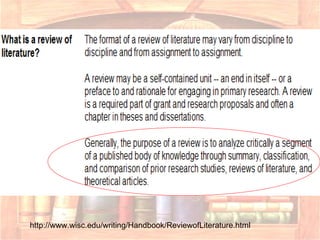
http://www.wisc.edu/writing/Handbook/ReviewofLiterature.html
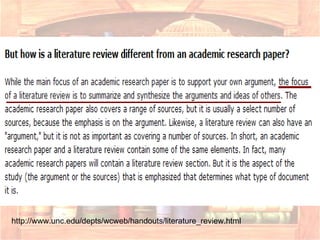
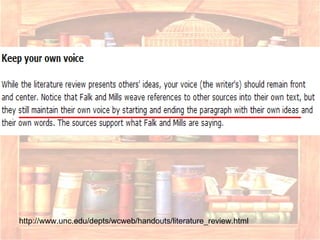
http://www.unc.edu/depts/wcweb/handouts/literature_review.html
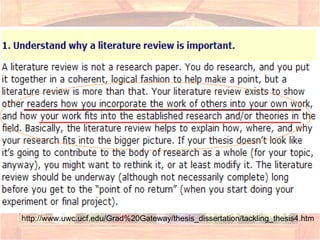
http://www.uwc.ucf.edu/Grad%20Gateway/thesis_dissertation/tackling_thesis4.htm
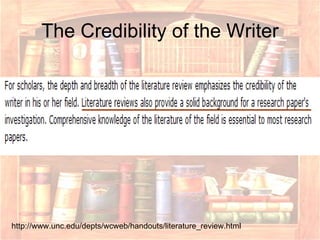
The Credibility of the Writer http://www.unc.edu/depts/wcweb/handouts/literature_review.html
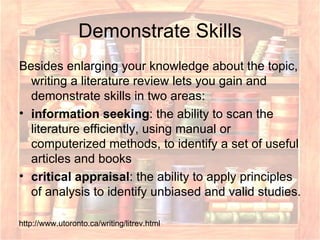
Demonstrate Skills Besides enlarging your knowledge about the topic, writing a literature review lets you gain and demonstrate skills in two areas:  information seeking : the ability to scan the literature efficiently, using manual or computerized methods, to identify a set of useful articles and books  critical appraisal : the ability to apply principles of analysis to identify unbiased and valid studies.  http://www.utoronto.ca/writing/litrev.html
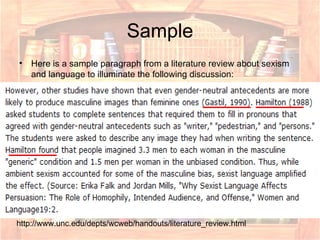
Sample Here is a sample paragraph from a literature review about sexism and language to illuminate the following discussion:  http://www.unc.edu/depts/wcweb/handouts/literature_review.html
http://www.unc.edu/depts/wcweb/handouts/literature_review.html
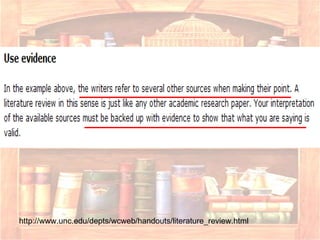
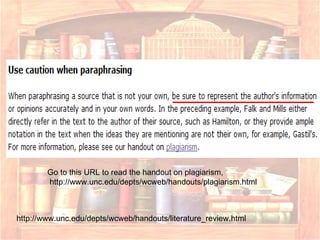
http://www.unc.edu/depts/wcweb/handouts/literature_review.html Go to this URL to read the handout on plagiarism, http://www.unc.edu/depts/wcweb/handouts/plagiarism.html
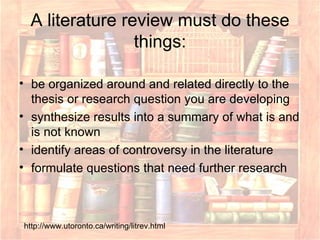
A literature review must do these things: be organized around and related directly to the thesis or research question you are developing  synthesize results into a summary of what is and is not known  identify areas of controversy in the literature  formulate questions that need further research  http://www.utoronto.ca/writing/litrev.html
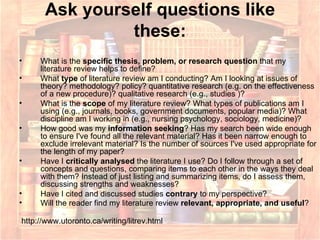
Ask yourself questions like these: What is the  specific thesis, problem, or research question  that my literature review helps to define?  What  type  of literature review am I conducting? Am I looking at issues of theory? methodology? policy? quantitative research (e.g. on the effectiveness of a new procedure)? qualitative research (e.g., studies )?  What is the  scope  of my literature review? What types of publications am I using (e.g., journals, books, government documents, popular media)? What discipline am I working in (e.g., nursing psychology, sociology, medicine)?  How good was my  information seeking ? Has my search been wide enough to ensure I've found all the relevant material? Has it been narrow enough to exclude irrelevant material? Is the number of sources I've used appropriate for the length of my paper?  Have I  critically analysed  the literature I use? Do I follow through a set of concepts and questions, comparing items to each other in the ways they deal with them? Instead of just listing and summarizing items, do I assess them, discussing strengths and weaknesses?  Have I cited and discussed studies  contrary  to my perspective?  Will the reader find my literature review  relevant, appropriate, and useful ?   http://www.utoronto.ca/writing/litrev.html
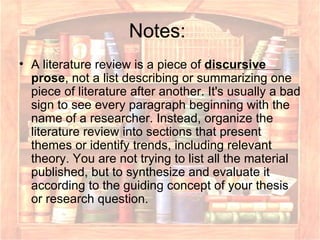
Notes:  A literature review is a piece of  discursive prose , not a list describing or summarizing one piece of literature after another. It's usually a bad sign to see every paragraph beginning with the name of a researcher. Instead, organize the literature review into sections that present themes or identify trends, including relevant theory. You are not trying to list all the material published, but to synthesize and evaluate it according to the guiding concept of your thesis or research question.
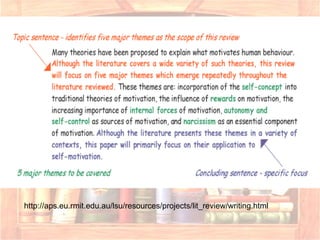
http://aps.eu.rmit.edu.au/lsu/resources/projects/lit_review/writing.html
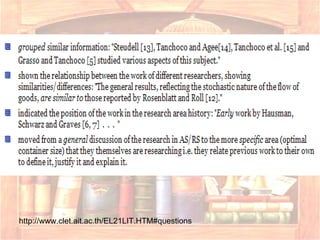
http://www.clet.ait.ac.th/EL21LIT.HTM#questions
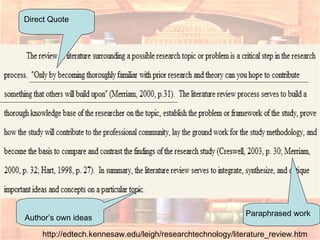
Direct Quote Paraphrased work Author’s own ideas http://edtech.kennesaw.edu/leigh/researchtechnology/literature_review.htm

Lit Review

  • 1.
    Research Writing LiteratureReview WTUC Dec 2006
  • 2.
  • 3.
  • 4.
  • 5.
    The Credibility ofthe Writer http://www.unc.edu/depts/wcweb/handouts/literature_review.html
  • 6.
    Demonstrate Skills Besidesenlarging your knowledge about the topic, writing a literature review lets you gain and demonstrate skills in two areas: information seeking : the ability to scan the literature efficiently, using manual or computerized methods, to identify a set of useful articles and books critical appraisal : the ability to apply principles of analysis to identify unbiased and valid studies. http://www.utoronto.ca/writing/litrev.html
  • 7.
    Sample Here isa sample paragraph from a literature review about sexism and language to illuminate the following discussion: http://www.unc.edu/depts/wcweb/handouts/literature_review.html
  • 8.
  • 9.
  • 10.
    http://www.unc.edu/depts/wcweb/handouts/literature_review.html Go tothis URL to read the handout on plagiarism, http://www.unc.edu/depts/wcweb/handouts/plagiarism.html
  • 11.
    A literature reviewmust do these things: be organized around and related directly to the thesis or research question you are developing synthesize results into a summary of what is and is not known identify areas of controversy in the literature formulate questions that need further research http://www.utoronto.ca/writing/litrev.html
  • 12.
    Ask yourself questionslike these: What is the specific thesis, problem, or research question that my literature review helps to define? What type of literature review am I conducting? Am I looking at issues of theory? methodology? policy? quantitative research (e.g. on the effectiveness of a new procedure)? qualitative research (e.g., studies )? What is the scope of my literature review? What types of publications am I using (e.g., journals, books, government documents, popular media)? What discipline am I working in (e.g., nursing psychology, sociology, medicine)? How good was my information seeking ? Has my search been wide enough to ensure I've found all the relevant material? Has it been narrow enough to exclude irrelevant material? Is the number of sources I've used appropriate for the length of my paper? Have I critically analysed the literature I use? Do I follow through a set of concepts and questions, comparing items to each other in the ways they deal with them? Instead of just listing and summarizing items, do I assess them, discussing strengths and weaknesses? Have I cited and discussed studies contrary to my perspective? Will the reader find my literature review relevant, appropriate, and useful ? http://www.utoronto.ca/writing/litrev.html
  • 13.
    Notes: Aliterature review is a piece of discursive prose , not a list describing or summarizing one piece of literature after another. It's usually a bad sign to see every paragraph beginning with the name of a researcher. Instead, organize the literature review into sections that present themes or identify trends, including relevant theory. You are not trying to list all the material published, but to synthesize and evaluate it according to the guiding concept of your thesis or research question.
  • 14.
  • 15.
  • 16.
    Direct Quote Paraphrasedwork Author’s own ideas http://edtech.kennesaw.edu/leigh/researchtechnology/literature_review.htm