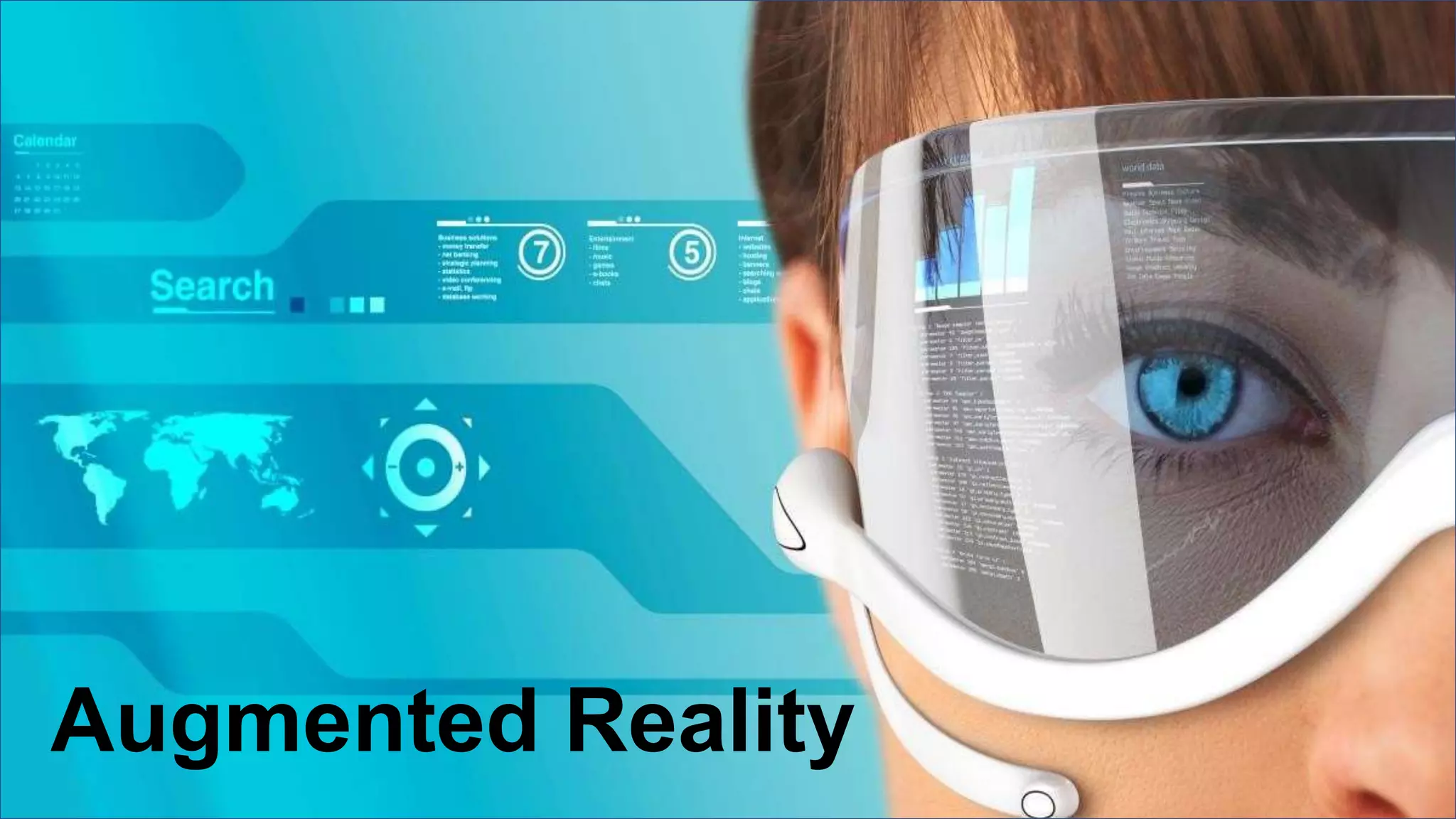
Augmented Reality
What is Augmented Reality?
• Augmented reality (AR) is a field of computer research which deals with the
combination of real-world and computer-generated data.
AR is the future of how we will interact with digital
information
VIEW INTERACT
ACCESS
Combines real and virtual
objects in a real environment
Is interactive in real-time
Registers (aligns) real and
virtual objects with each other.
AR systems have the following three characteristics
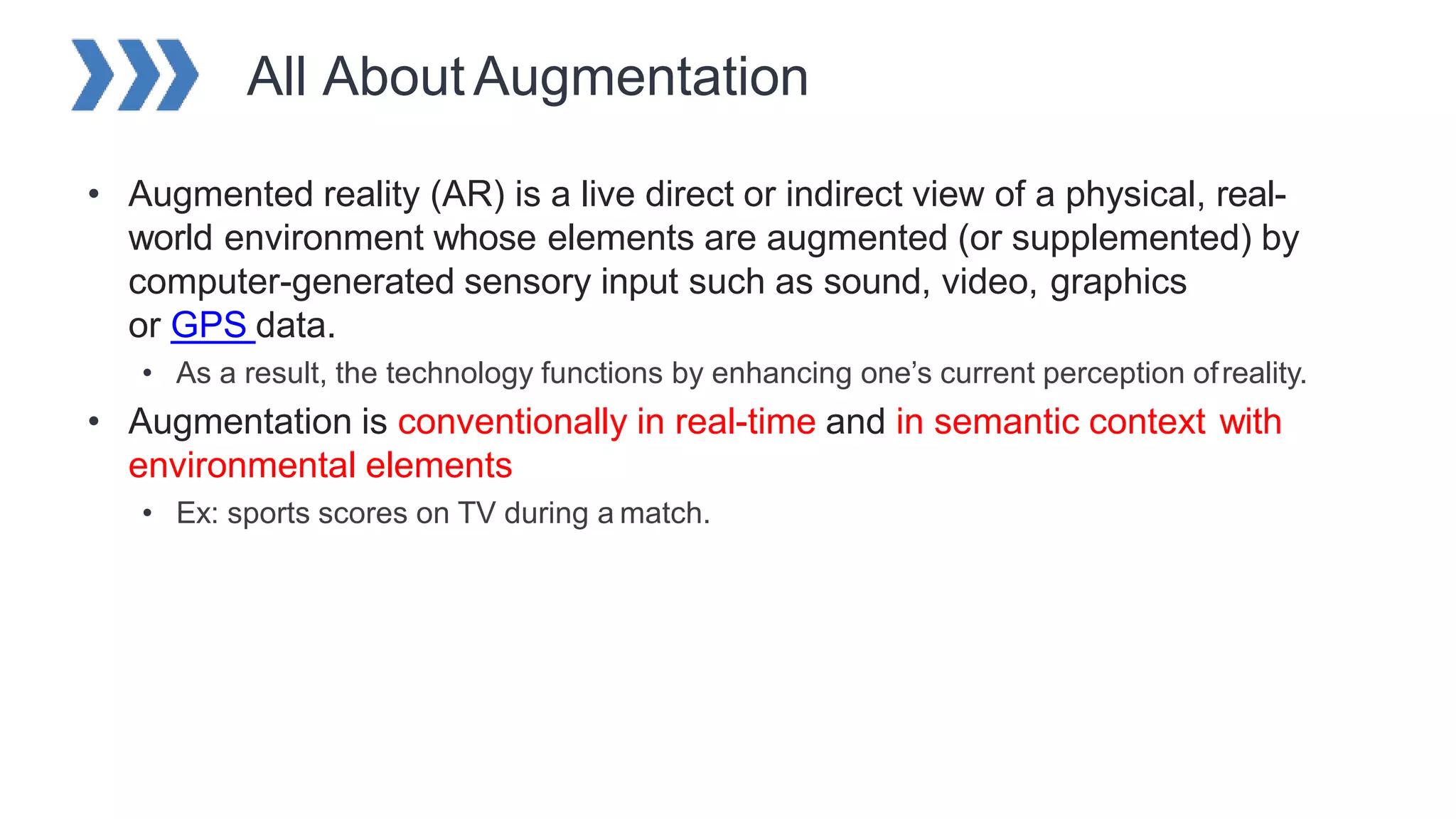
All AboutAugmentation
• Augmented reality (AR) is a live direct or indirect view of a physical, real-
world environment whose elements are augmented (or supplemented) by
computer-generated sensory input such as sound, video, graphics
or GPS data.
• As a result, the technology functions by enhancing one’s current perception ofreality.
• Augmentation is conventionally in real-time and in semantic context with
environmental elements
• Ex: sports scores on TV during a match.
Augmented Reality v.s. Virtual Reality
VR technologies completely
immerse a user inside a
synthetic environment. While
immersed, the user cannot
see the real world around
him.
In contrast, AR allows the user
to see the real world, with
virtual objects superimposed
upon or composited with the
real world.
6Copyright © William El Kaim 2016
Augmented Reality Example
Augmented Reality
In
Advertising
Major advertising and marketing channels
have started using AR
Mobile Online POP Print TV OOH
Benefits of Using Augmented Reality
 Innovation
 Affordability
 Brand Connection
 Geo-Targeting
 Repeat Customers
 Increase in Offline Sales
 Go Mobile
Challenges to Overcome
• Gimmick
• User experience
• Privacy Issue
• Information Overload
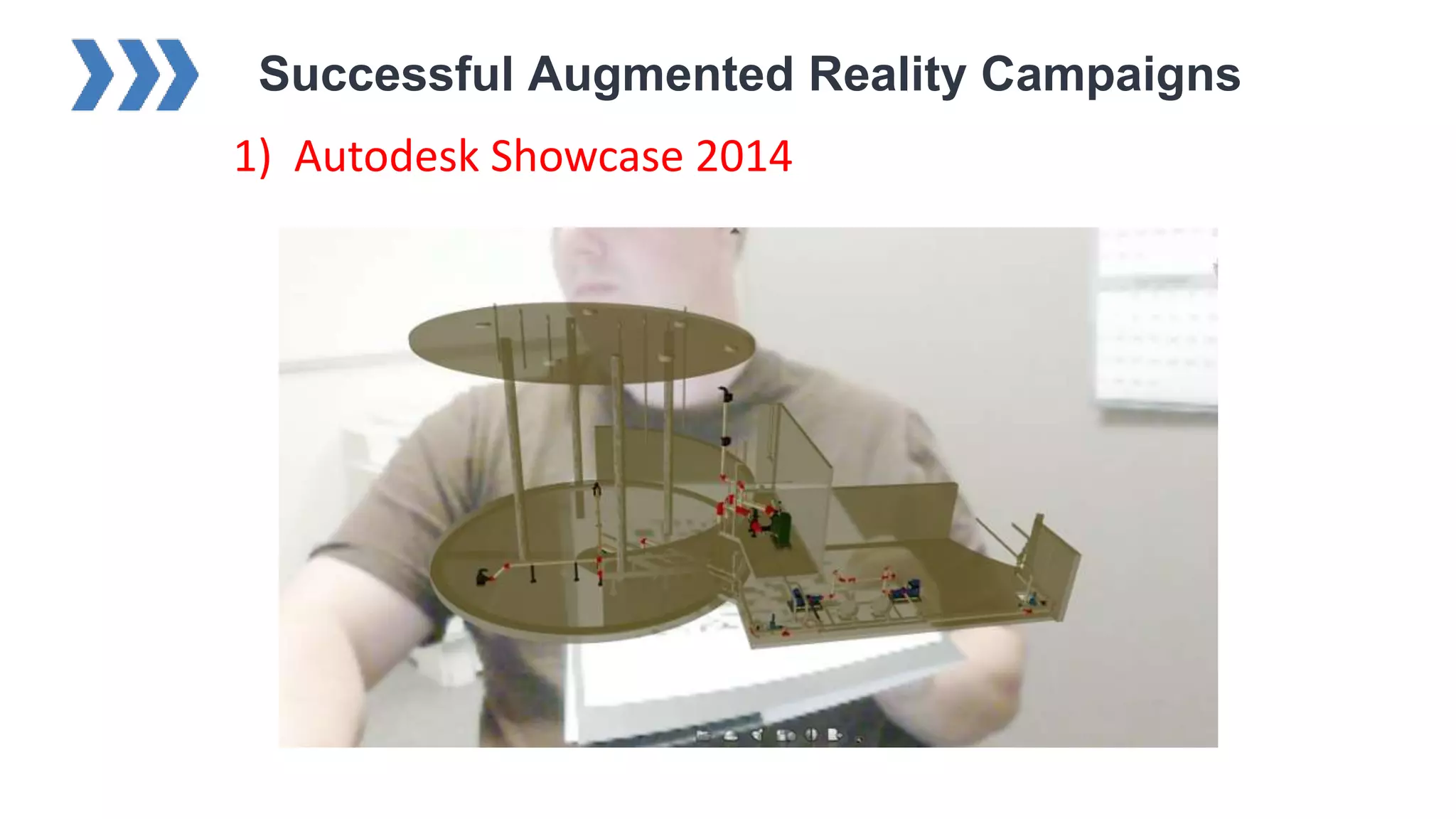
Successful Augmented Reality Campaigns
1) Autodesk Showcase 2014
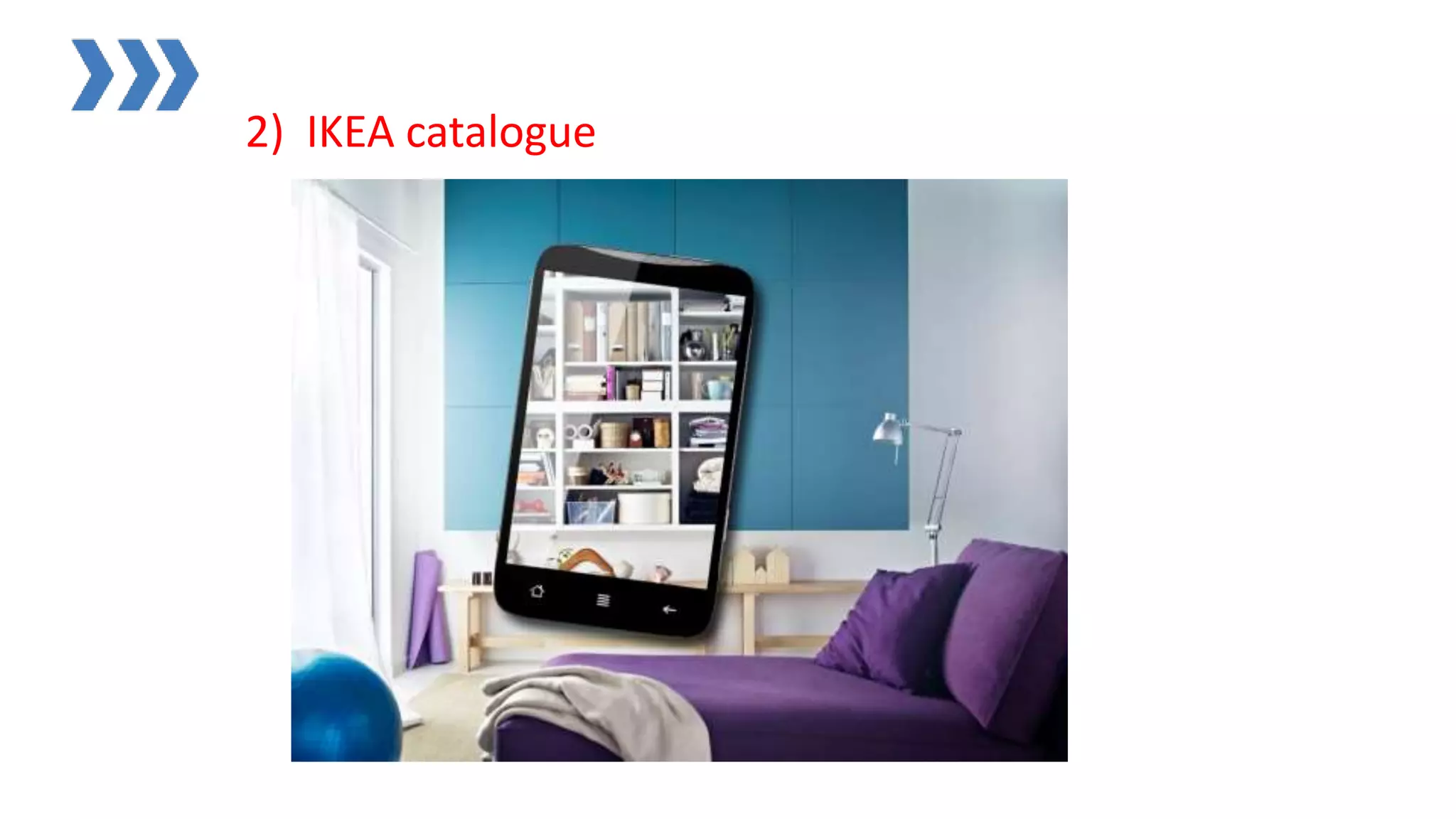
2) IKEA catalogue
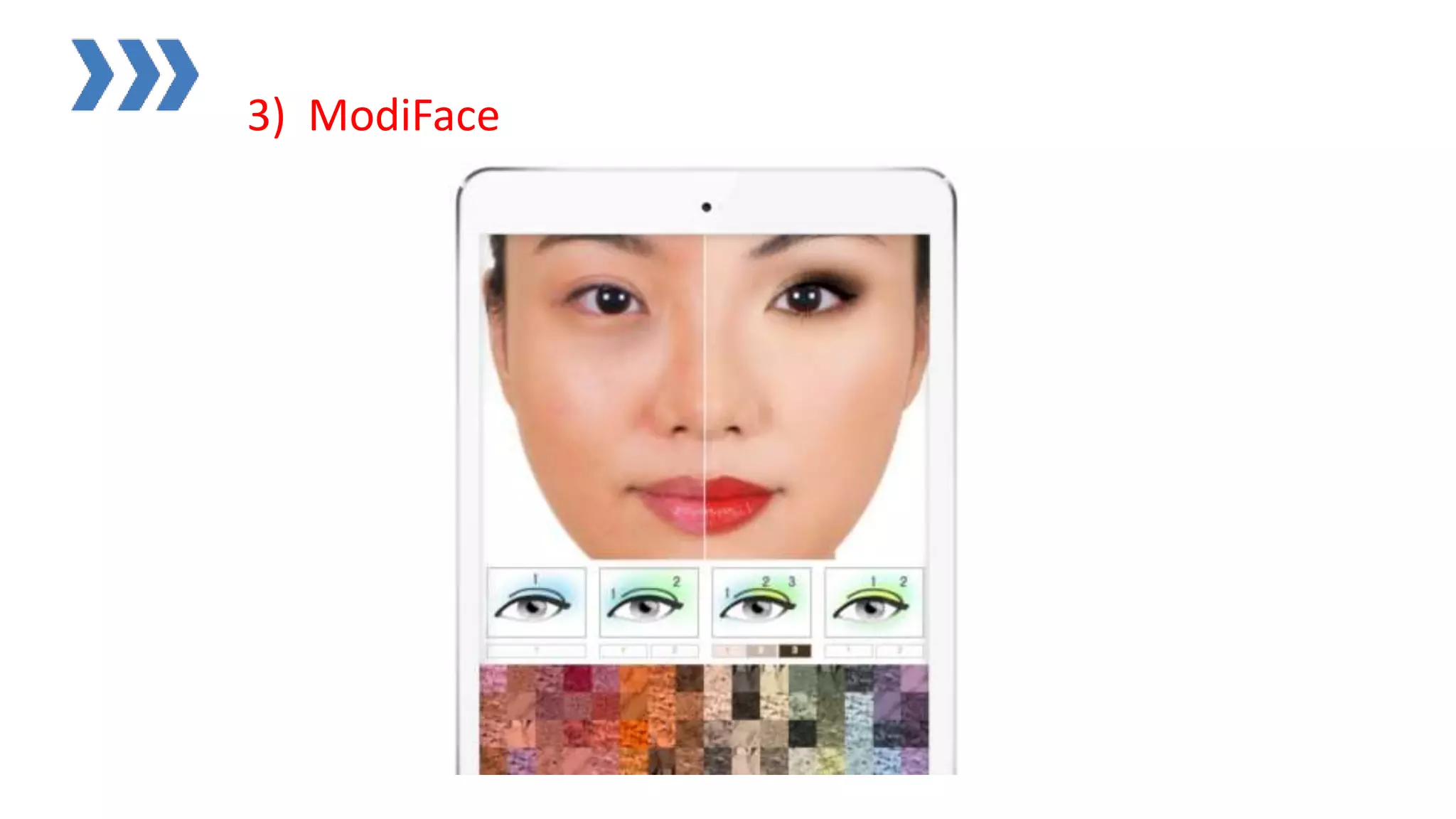
3) ModiFace
Unsuccessful Augmented Reality Campaigns
1) Best Buy AR Campaign
2) Dodge Avenger AR Campaign
Augmented Reality

Augmented Reality

  • 1.
  • 2.
    What is AugmentedReality? • Augmented reality (AR) is a field of computer research which deals with the combination of real-world and computer-generated data.
  • 3.
    AR is thefuture of how we will interact with digital information VIEW INTERACT ACCESS
  • 4.
    Combines real andvirtual objects in a real environment Is interactive in real-time Registers (aligns) real and virtual objects with each other. AR systems have the following three characteristics
  • 5.
    All AboutAugmentation • Augmentedreality (AR) is a live direct or indirect view of a physical, real- world environment whose elements are augmented (or supplemented) by computer-generated sensory input such as sound, video, graphics or GPS data. • As a result, the technology functions by enhancing one’s current perception ofreality. • Augmentation is conventionally in real-time and in semantic context with environmental elements • Ex: sports scores on TV during a match.
  • 6.
    Augmented Reality v.s.Virtual Reality VR technologies completely immerse a user inside a synthetic environment. While immersed, the user cannot see the real world around him. In contrast, AR allows the user to see the real world, with virtual objects superimposed upon or composited with the real world. 6Copyright © William El Kaim 2016
  • 7.
  • 8.
  • 9.
  • 10.
    Major advertising andmarketing channels have started using AR Mobile Online POP Print TV OOH
  • 11.
    Benefits of UsingAugmented Reality  Innovation  Affordability  Brand Connection  Geo-Targeting  Repeat Customers  Increase in Offline Sales  Go Mobile
  • 12.
    Challenges to Overcome •Gimmick • User experience • Privacy Issue • Information Overload
  • 13.
    Successful Augmented RealityCampaigns 1) Autodesk Showcase 2014
  • 14.
  • 15.
  • 16.
    Unsuccessful Augmented RealityCampaigns 1) Best Buy AR Campaign
  • 17.
    2) Dodge AvengerAR Campaign