Augmented Reality
PRESENTED BY :-
1. ISTEKHAR HUSSAIN
2. NAVEEN KUMAR SAINI
3. NITIN KUMAR MEENA
4. RINKU KUMAR
What is Augmented Reality?
 Augmented reality (AR) is a field of computer research which deals with
the combination of real-world and computer-generated data.
 Most of the AR research is currently concerned with the use of video
imagery which is digitally processed and augmented by adding computer-
generated graphics.
 Combines real and virtual realities
 Interactive in real time
What is AR? (cont.)
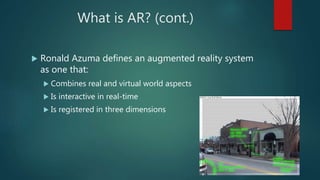
 Ronald Azuma defines an augmented reality system
as one that:
 Combines real and virtual world aspects
 Is interactive in real-time
 Is registered in three dimensions
Combining the Real and the Virtual
Worlds.
 Register models of all 3D objects of interest with their counterparts in the
scene
 Track the objects over time when the user moves and interacts with the
scene
Augmented vs. Virtual Reality
 One of the identifying marks of a virtual reality system is the head
mounted display worn by users.
 These displays block out all the external world and present to the wearer a
view that is under the complete control of the computer.
 In Augmented Reality, the user must still be aware that he or she is present
in the “real world.”
Procedure of Augmentation
What is needed?
 There are three components needed in order to make an
augmented-reality system work:
 Display
 Tracking system
 Mobile computing power

Display Technologies
 Monitor Based
 Laptops
 Cell phones
 Projectors (more Ubiquitous Computing)
 Head Mounted Displays:
 Video see-through
 Optical see-through
Applications of AR
Applications (contd.)
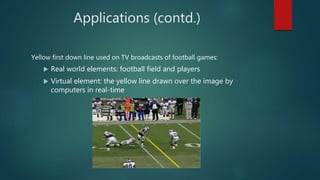
Yellow first down line used on TV broadcasts of football games:
 Real world elements: football field and players
 Virtual element: the yellow line drawn over the image by
computers in real-time
Applications (contd.)
 HUD (Head Up Display):
 Used in commercial aircraft, automobiles, and other applications
 Presents data without requiring the user to look away from his or
her usual viewpoint
Example
 Google glasses is a wearable AR system.
 When walking around a chosen culturally interesting area, the user will feel
as though they are watching a film.
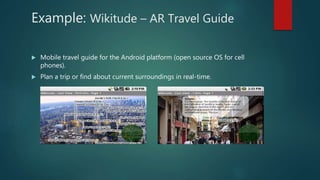
Example: Wikitude – AR Travel Guide
 Mobile travel guide for the Android platform (open source OS for cell
phones).
 Plan a trip or find about current surroundings in real-time.
Future of AR
 Military:
 The Office of Naval Research has sponsored AR research
 AR system could provide troops with vital information about their
surroundings.
 Medical:
 Superimpose an image from an MRI onto a patient’s body.
 This might allow surgeons to pinpoint a tumor to remove.
 Education:
 Used in labs where students can learn more about the experiments
they are participating in.
Future of AR (contd.)
 Gaming:
 AR-Quake is an AR version of the popular game Quake.
 1st person shooter that allows the user to run around in the real world while
playing a game in the computer generated world.
 Uses GPS, a hybrid magnetic and interial orientation sensor, gun controller,
and a standard laptop carried in a backpack.
Why continue research in AR?
 AR systems will instantly recognize what someone is looking at, and
retrieve and display the data related to that view.
 There are hundreds of potential applications for such a technology,
gaming and entertainment being the most obvious ones.
 Any system that gives people instant information, requiring no research on
their part, is bound to be a valuable to anyone in any field.
SUMMARY
 What is AR?
 The ability to overlay computer graphics onto the real world.
 What can AR do?
 Combines real and virtual realities to turn an empty space into a very rich
educational experience.
 How can AR be used in Real World?
 Offers seamless interaction between the real and virtual worlds, a tangible
interface metaphor, and a means for transitioning between real and virtual
worlds to create learning opportunities and knowledge connections.
CONCLUSION
 This project proposes a augmented reality application using different
operating system which will help to combine virtual objects with the real
environment facilitating various applications as mentioned in this paper.
The main advantage is use of low cost devices as compared to the costly
head mounted display devices. Secondly with the help of this project you
need not buy product and then see how it will suit your environment. In
future images of objects from various views can be fetched directly from
vendor’s websites; same could be modelled into a 3D objects and
augmented. Also multiple objects will be augmented which is currently a
major challenge.
REFERENCES
 http://wp.nmc.org/horizon2010/chapters/simple-augmented-reality/
 http://www.bing.com/images/search?q=Augmented+reality+pictures&FORM=
IGRE&qpvt=Augmented+reality+pictures
 http://www.bing.com/images/search?q=Augmented+reality+pictures&FORM=IGRE
&qpvt=Augmented+reality+pictures
 http://www.howstuffworks.com/augmented-reality.htm
 http://www.britannica.com/EBchecked/topic/1196641/augmented-reality
 http://www.bing.com/images/search?q=Augmented+reality+pictures&FORM=
IGRE&qpvt=Augmented+reality+pictures.#
THANK YOU

Augmented reality

  • 1.
    Augmented Reality PRESENTED BY:- 1. ISTEKHAR HUSSAIN 2. NAVEEN KUMAR SAINI 3. NITIN KUMAR MEENA 4. RINKU KUMAR
  • 2.
    What is AugmentedReality?  Augmented reality (AR) is a field of computer research which deals with the combination of real-world and computer-generated data.  Most of the AR research is currently concerned with the use of video imagery which is digitally processed and augmented by adding computer- generated graphics.  Combines real and virtual realities  Interactive in real time
  • 3.
    What is AR?(cont.)  Ronald Azuma defines an augmented reality system as one that:  Combines real and virtual world aspects  Is interactive in real-time  Is registered in three dimensions
  • 4.
    Combining the Realand the Virtual Worlds.  Register models of all 3D objects of interest with their counterparts in the scene  Track the objects over time when the user moves and interacts with the scene
  • 5.
    Augmented vs. VirtualReality  One of the identifying marks of a virtual reality system is the head mounted display worn by users.  These displays block out all the external world and present to the wearer a view that is under the complete control of the computer.  In Augmented Reality, the user must still be aware that he or she is present in the “real world.”
  • 6.
  • 7.
    What is needed? There are three components needed in order to make an augmented-reality system work:  Display  Tracking system  Mobile computing power 
  • 8.
    Display Technologies  MonitorBased  Laptops  Cell phones  Projectors (more Ubiquitous Computing)  Head Mounted Displays:  Video see-through  Optical see-through
  • 9.
  • 10.
    Applications (contd.) Yellow firstdown line used on TV broadcasts of football games:  Real world elements: football field and players  Virtual element: the yellow line drawn over the image by computers in real-time
  • 11.
    Applications (contd.)  HUD(Head Up Display):  Used in commercial aircraft, automobiles, and other applications  Presents data without requiring the user to look away from his or her usual viewpoint
  • 12.
    Example  Google glassesis a wearable AR system.  When walking around a chosen culturally interesting area, the user will feel as though they are watching a film.
  • 13.
    Example: Wikitude –AR Travel Guide  Mobile travel guide for the Android platform (open source OS for cell phones).  Plan a trip or find about current surroundings in real-time.
  • 14.
    Future of AR Military:  The Office of Naval Research has sponsored AR research  AR system could provide troops with vital information about their surroundings.  Medical:  Superimpose an image from an MRI onto a patient’s body.  This might allow surgeons to pinpoint a tumor to remove.  Education:  Used in labs where students can learn more about the experiments they are participating in.
  • 15.
    Future of AR(contd.)  Gaming:  AR-Quake is an AR version of the popular game Quake.  1st person shooter that allows the user to run around in the real world while playing a game in the computer generated world.  Uses GPS, a hybrid magnetic and interial orientation sensor, gun controller, and a standard laptop carried in a backpack.
  • 16.
    Why continue researchin AR?  AR systems will instantly recognize what someone is looking at, and retrieve and display the data related to that view.  There are hundreds of potential applications for such a technology, gaming and entertainment being the most obvious ones.  Any system that gives people instant information, requiring no research on their part, is bound to be a valuable to anyone in any field.
  • 17.
    SUMMARY  What isAR?  The ability to overlay computer graphics onto the real world.  What can AR do?  Combines real and virtual realities to turn an empty space into a very rich educational experience.  How can AR be used in Real World?  Offers seamless interaction between the real and virtual worlds, a tangible interface metaphor, and a means for transitioning between real and virtual worlds to create learning opportunities and knowledge connections.
  • 18.
    CONCLUSION  This projectproposes a augmented reality application using different operating system which will help to combine virtual objects with the real environment facilitating various applications as mentioned in this paper. The main advantage is use of low cost devices as compared to the costly head mounted display devices. Secondly with the help of this project you need not buy product and then see how it will suit your environment. In future images of objects from various views can be fetched directly from vendor’s websites; same could be modelled into a 3D objects and augmented. Also multiple objects will be augmented which is currently a major challenge.
  • 19.
    REFERENCES  http://wp.nmc.org/horizon2010/chapters/simple-augmented-reality/  http://www.bing.com/images/search?q=Augmented+reality+pictures&FORM= IGRE&qpvt=Augmented+reality+pictures http://www.bing.com/images/search?q=Augmented+reality+pictures&FORM=IGRE &qpvt=Augmented+reality+pictures  http://www.howstuffworks.com/augmented-reality.htm  http://www.britannica.com/EBchecked/topic/1196641/augmented-reality  http://www.bing.com/images/search?q=Augmented+reality+pictures&FORM= IGRE&qpvt=Augmented+reality+pictures.#
  • 20.