THE AUDIOLINGUAL  METHOD By Teachers Claudia M and Paula B
ORIGINS USA- 1950- technologies- Soviet Union- satellite. USA- major power- foreign students. Rethink the Direct Method. Fries and his group in Michigan –materials based on behaviorism (Skinner)- emerged the audio lingual method. “ “ They require drill, drill, and more drill, and only enough vocabulary to make such drills possible"  (Hockett 1959).
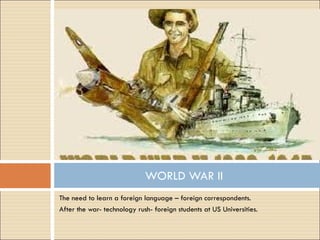
The need to learn a foreign language – foreign correspondents. After the war- technology rush- foreign students at US Universities. WORLD WAR II
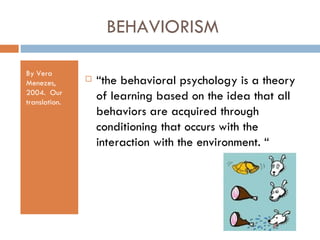
BEHAVIORISM By Vera Menezes, 2004.  Our  translation. “ the behavioral psychology is a theory of learning based on the idea that all behaviors are acquired through conditioning that occurs with the interaction with the environment. “
stimulus, response and reinforcement. It is a method seen as a habit formation using the memorization and the learning through dialogs and drills ,  DEFINITION
FEATURES Foreign language learning is a process of mechanical habit; Good habits are acquired by giving correct responses rather than by making mistakes; Memorizing dialogues minimizes mistakes; The target language is presented in the oral form first, prior to its written form;
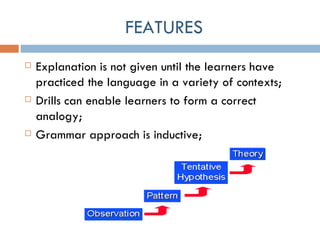
FEATURES Explanation is not given until the learners have practiced the language in a variety of contexts; Drills can enable learners to form a correct analogy; Grammar approach is inductive;
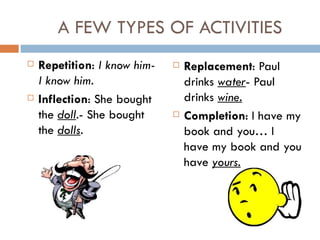
A FEW TYPES OF ACTIVITIES Repetition :  I know him- I know him . Inflection : She bought the  doll .- She bought the  dolls . Replacement : Paul drinks  water - Paul drinks  wine . Completion : I have my book and you… I have my book and you have  yours.
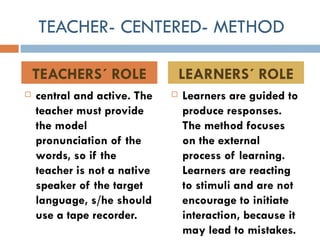
TEACHER- CENTERED- METHOD central and active. The teacher must provide the model pronunciation of the words, so if the teacher is not a native speaker of the target language, s/he should use a tape recorder. Learners are guided to produce responses. The method focuses on the external process of learning. Learners are reacting to stimuli and are not encourage to initiate interaction, because it may lead to mistakes.  TEACHERS´ ROLE LEARNERS´ ROLE
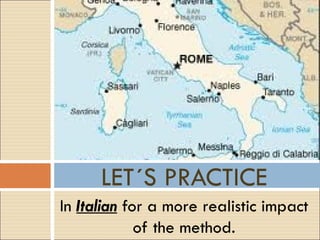
In  Italian  for a more realistic impact of the method. LET´S PRACTICE
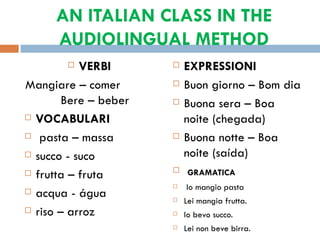
AN ITALIAN CLASS IN THE AUDIOLINGUAL METHOD VERBI Mangiare – comer Bere – beber VOCABULARI   pasta – massa succo - suco frutta – fruta acqua - água riso – arroz EXPRESSIONI  Buon giorno – Bom dia Buona sera – Boa noite (chegada) Buona notte – Boa noite (saída)   GRAMATICA   Io mangio pasta Lei mangia frutta. Io bevo succo. Lei non beve birra.
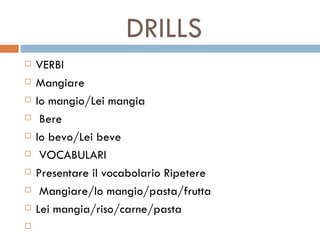
DRILLS VERBI Mangiare Io mangio/Lei mangia   Bere Io bevo/Lei beve   VOCABULARI Presentare il vocabolario Ripetere   Mangiare/Io mangio/pasta/frutta Lei mangia/riso/carne/pasta  
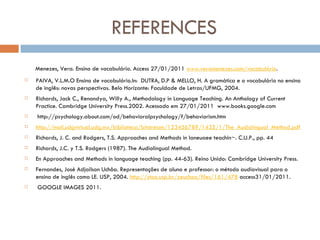
REFERENCES Menezes, Vera. Ensino de vocabulário. Access 27/01/2011  www.veramenezes.com/vocabulário .  PAIVA, V.L.M.O Ensino de vocabulário.In:  DUTRA, D.P & MELLO, H. A gramática e o vocabulário no ensino de inglês: novas perspectivas. Belo Horizonte: Faculdade de Letras/UFMG, 2004.  Richards, Jack C., Renandya, Willy A., Methodology in Language Teaching. An Anthology of Current Practice. Cambridge University Press.2002. Acessado em 27/01/2011  www.books.google.com    http://psychology.about.com/od/behavioralpsychology/f/behaviorism.htm http://mail.udgvirtual.udg.mx/biblioteca/bitstream/123456789/1435/1/The_Audiolingual_Method.pdf Richards, J. C. and Rodgers, T.S. Approaches and Methods in laneuaee teachin~. C.U.P., pp. 44 Richards, J.C. y T.S. Rodgers (1987). The Audiolingual Method. En Approaches and Methods in language teaching (pp. 44-63).  Reino Unido: Cambridge University Press. Fernandes, José Adjailson Uchôa. Representações de aluno e professor: o método audiovisual para o ensino de inglês como LE.  USP, 2004.  http://stoa.usp.br/zeuchoa/files/161/478  access31/01/2011.   GOOGLE IMAGES 2011.

Audiolingual method

  • 1.
    THE AUDIOLINGUAL METHOD By Teachers Claudia M and Paula B
  • 2.
    ORIGINS USA- 1950-technologies- Soviet Union- satellite. USA- major power- foreign students. Rethink the Direct Method. Fries and his group in Michigan –materials based on behaviorism (Skinner)- emerged the audio lingual method. “ “ They require drill, drill, and more drill, and only enough vocabulary to make such drills possible" (Hockett 1959).
  • 3.
    The need tolearn a foreign language – foreign correspondents. After the war- technology rush- foreign students at US Universities. WORLD WAR II
  • 4.
    BEHAVIORISM By VeraMenezes, 2004. Our translation. “ the behavioral psychology is a theory of learning based on the idea that all behaviors are acquired through conditioning that occurs with the interaction with the environment. “
  • 5.
    stimulus, response andreinforcement. It is a method seen as a habit formation using the memorization and the learning through dialogs and drills , DEFINITION
  • 6.
    FEATURES Foreign languagelearning is a process of mechanical habit; Good habits are acquired by giving correct responses rather than by making mistakes; Memorizing dialogues minimizes mistakes; The target language is presented in the oral form first, prior to its written form;
  • 7.
    FEATURES Explanation isnot given until the learners have practiced the language in a variety of contexts; Drills can enable learners to form a correct analogy; Grammar approach is inductive;
  • 8.
    A FEW TYPESOF ACTIVITIES Repetition : I know him- I know him . Inflection : She bought the doll .- She bought the dolls . Replacement : Paul drinks water - Paul drinks wine . Completion : I have my book and you… I have my book and you have yours.
  • 9.
    TEACHER- CENTERED- METHODcentral and active. The teacher must provide the model pronunciation of the words, so if the teacher is not a native speaker of the target language, s/he should use a tape recorder. Learners are guided to produce responses. The method focuses on the external process of learning. Learners are reacting to stimuli and are not encourage to initiate interaction, because it may lead to mistakes. TEACHERS´ ROLE LEARNERS´ ROLE
  • 10.
    In Italian for a more realistic impact of the method. LET´S PRACTICE
  • 11.
    AN ITALIAN CLASSIN THE AUDIOLINGUAL METHOD VERBI Mangiare – comer Bere – beber VOCABULARI   pasta – massa succo - suco frutta – fruta acqua - água riso – arroz EXPRESSIONI Buon giorno – Bom dia Buona sera – Boa noite (chegada) Buona notte – Boa noite (saída)   GRAMATICA   Io mangio pasta Lei mangia frutta. Io bevo succo. Lei non beve birra.
  • 12.
    DRILLS VERBI MangiareIo mangio/Lei mangia   Bere Io bevo/Lei beve   VOCABULARI Presentare il vocabolario Ripetere   Mangiare/Io mangio/pasta/frutta Lei mangia/riso/carne/pasta  
  • 13.
    REFERENCES Menezes, Vera.Ensino de vocabulário. Access 27/01/2011 www.veramenezes.com/vocabulário . PAIVA, V.L.M.O Ensino de vocabulário.In: DUTRA, D.P & MELLO, H. A gramática e o vocabulário no ensino de inglês: novas perspectivas. Belo Horizonte: Faculdade de Letras/UFMG, 2004. Richards, Jack C., Renandya, Willy A., Methodology in Language Teaching. An Anthology of Current Practice. Cambridge University Press.2002. Acessado em 27/01/2011 www.books.google.com   http://psychology.about.com/od/behavioralpsychology/f/behaviorism.htm http://mail.udgvirtual.udg.mx/biblioteca/bitstream/123456789/1435/1/The_Audiolingual_Method.pdf Richards, J. C. and Rodgers, T.S. Approaches and Methods in laneuaee teachin~. C.U.P., pp. 44 Richards, J.C. y T.S. Rodgers (1987). The Audiolingual Method. En Approaches and Methods in language teaching (pp. 44-63). Reino Unido: Cambridge University Press. Fernandes, José Adjailson Uchôa. Representações de aluno e professor: o método audiovisual para o ensino de inglês como LE. USP, 2004. http://stoa.usp.br/zeuchoa/files/161/478 access31/01/2011.   GOOGLE IMAGES 2011.