The Audiolingual Method is a method for
foreign language teaching which emphasized
the teaching of listening and speaking before
reading and writing.
The Audio-Lingual method of teaching English as a
second language had its origins during World War II when it
became known as the Army method.
 
 
The Audio-Lingual method is based on the theory
that language learning is a question of habit formation.  It
has its origins in Skinner’s principles of behavior theory. 
Since learning is thought to be a question of habit
formation,  errors are considered to be bad and to be
avoided.  Further, teachers “reward” students by saying
“Good!” and praising the class when they perform well.
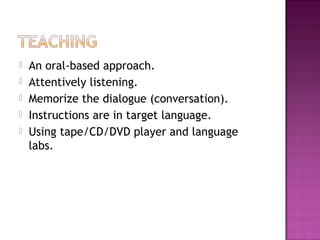
 An oral-based approach.
 Attentively listening.
 Memorize the dialogue (conversation).
 Instructions are in target language.
 Using tape/CD/DVD player and language
labs.
 Repetition drill. This drill is the simplest drill
used in learning language patterns. It is used at
the very beginning of language class. Language
learners merely repeat what the teacher says or
the tape recorder produces.
 Substitution Drill. Language learners are required
to replace one word with another. The may
replaced a word on the model sentence with a
pronoun, number, or gender and make some the
necessary change.
 Transformation Drill. Language learners are
required to change sentence from negative to
positive, from positive to interrogative, or from
simple present tense to simple past tense,
depending on the instruction from the teacher.
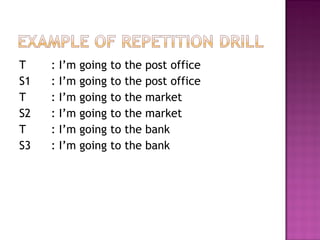
T : I’m going to the post office
S1 : I’m going to the post office
T : I’m going to the market
S2 : I’m going to the market
T : I’m going to the bank
S3 : I’m going to the bank
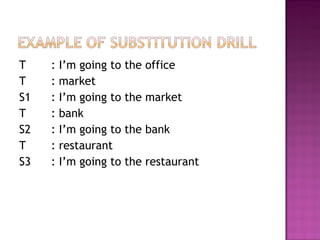
T : I’m going to the office
T : market
S1 : I’m going to the market
T : bank
S2 : I’m going to the bank
T : restaurant
S3 : I’m going to the restaurant
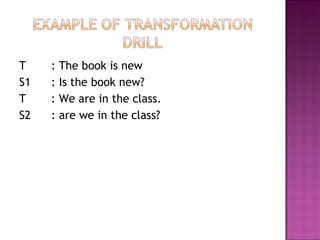
T : The book is new
S1 : Is the book new?
T : We are in the class.
S2 : are we in the class?
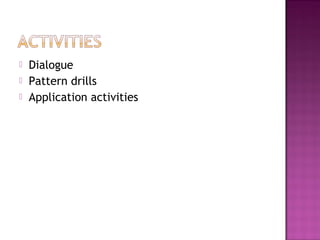
 Dialogue
 Pattern drills
 Application activities
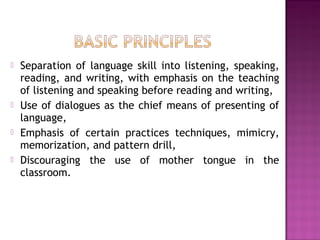
 Separation of language skill into listening, speaking,
reading, and writing, with emphasis on the teaching
of listening and speaking before reading and writing,
 Use of dialogues as the chief means of presenting of
language,
 Emphasis of certain practices techniques, mimicry,
memorization, and pattern drill,
 Discouraging the use of mother tongue in the
classroom.
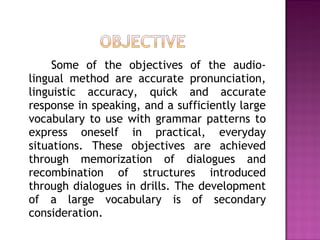
Some of the objectives of the audio-
lingual method are accurate pronunciation,
linguistic accuracy, quick and accurate
response in speaking, and a sufficiently large
vocabulary to use with grammar patterns to
express oneself in practical, everyday
situations. These objectives are achieved
through memorization of dialogues and
recombination of structures introduced
through dialogues in drills. The development
of a large vocabulary is of secondary
consideration.
 an emphasis on using language or vocabulary to create
meaning,
 recognition of errors as a useful part of language learning,
 student interaction with each other and with native
speakers of the target language while using the target
language,
 attention to grammatical explanations in instruction,
 attention to the emotional aspects of learning,
 acknowledgment of one's native language as a foundation
on which to base learning a second language, and
 acknowledgment of what some call “large C” cultural
artifacts, such as masterpieces of the culture's literature,
performing arts, and visual arts.
 All the students are actives in the class
 The circumstance class are more interesting
and life
 The speaking and listening skill are more
drilled, so the pronunciation skill and
listening skill are more controlled
 For the smart students this method is bored,
because the procedure of the ALM method is
majority repeat the sentence.
 Sometimes the students are confused
because the teacher explain the material in
simple way not in detail way.
 The grammar skill is not more drilled

Nami punya method

  • 2.
    The Audiolingual Methodis a method for foreign language teaching which emphasized the teaching of listening and speaking before reading and writing.
  • 3.
    The Audio-Lingual methodof teaching English as a second language had its origins during World War II when it became known as the Army method.    
  • 4.
    The Audio-Lingual methodis based on the theory that language learning is a question of habit formation.  It has its origins in Skinner’s principles of behavior theory.  Since learning is thought to be a question of habit formation,  errors are considered to be bad and to be avoided.  Further, teachers “reward” students by saying “Good!” and praising the class when they perform well.
  • 5.
     An oral-basedapproach.  Attentively listening.  Memorize the dialogue (conversation).  Instructions are in target language.  Using tape/CD/DVD player and language labs.
  • 6.
     Repetition drill.This drill is the simplest drill used in learning language patterns. It is used at the very beginning of language class. Language learners merely repeat what the teacher says or the tape recorder produces.  Substitution Drill. Language learners are required to replace one word with another. The may replaced a word on the model sentence with a pronoun, number, or gender and make some the necessary change.  Transformation Drill. Language learners are required to change sentence from negative to positive, from positive to interrogative, or from simple present tense to simple past tense, depending on the instruction from the teacher.
  • 7.
    T : I’mgoing to the post office S1 : I’m going to the post office T : I’m going to the market S2 : I’m going to the market T : I’m going to the bank S3 : I’m going to the bank
  • 8.
    T : I’mgoing to the office T : market S1 : I’m going to the market T : bank S2 : I’m going to the bank T : restaurant S3 : I’m going to the restaurant
  • 9.
    T : Thebook is new S1 : Is the book new? T : We are in the class. S2 : are we in the class?
  • 10.
     Dialogue  Patterndrills  Application activities
  • 11.
     Separation oflanguage skill into listening, speaking, reading, and writing, with emphasis on the teaching of listening and speaking before reading and writing,  Use of dialogues as the chief means of presenting of language,  Emphasis of certain practices techniques, mimicry, memorization, and pattern drill,  Discouraging the use of mother tongue in the classroom.
  • 12.
    Some of theobjectives of the audio- lingual method are accurate pronunciation, linguistic accuracy, quick and accurate response in speaking, and a sufficiently large vocabulary to use with grammar patterns to express oneself in practical, everyday situations. These objectives are achieved through memorization of dialogues and recombination of structures introduced through dialogues in drills. The development of a large vocabulary is of secondary consideration.
  • 13.
     an emphasison using language or vocabulary to create meaning,  recognition of errors as a useful part of language learning,  student interaction with each other and with native speakers of the target language while using the target language,  attention to grammatical explanations in instruction,  attention to the emotional aspects of learning,  acknowledgment of one's native language as a foundation on which to base learning a second language, and  acknowledgment of what some call “large C” cultural artifacts, such as masterpieces of the culture's literature, performing arts, and visual arts.
  • 14.
     All thestudents are actives in the class  The circumstance class are more interesting and life  The speaking and listening skill are more drilled, so the pronunciation skill and listening skill are more controlled
  • 15.
     For thesmart students this method is bored, because the procedure of the ALM method is majority repeat the sentence.  Sometimes the students are confused because the teacher explain the material in simple way not in detail way.  The grammar skill is not more drilled