Presented To :-
Kanchan Mam
Presented By:-
Garima Pathak
COMMUNICATION
Topic:
Audio Visual Aids
Presented by:- GARIMA PATHAK
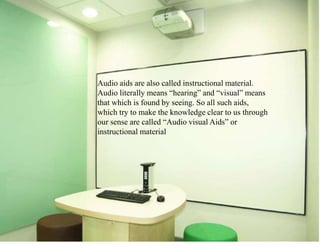
Audio aids are also called instructional material.
Audio literally means “hearing” and “visual” means
that which is found by seeing. So all such aids,
which try to make the knowledge clear to us through
our sense are called “Audio visual Aids” or
instructional material
According to K P. Neeraja
An audio visual aid is an
instructional device in which the
message can be heard as well as
seen
Purpose of Audio Visual Aids:
 Best motivation.
 Clear image.
 Save energy and time.
 Antidote of the disease of verbal instructions.
 Capture attention.
 reinforcement to learner.
 Positive transfer of learning.
 Gain & hold student interest.
 Increase understanding and retention.
 Stimulate the development of understanding and attitudes
THE ROLE OF AUDIO VISUALAIDS IN
EDUCATION
Audio visual aids are important in education
system. Audio visual aids are those devices
which are used in classrooms to encourage
teaching learning process and make it easier and
interesting.
 Students will gain knowledge of the latest in evolving
theoretical and practical application in the
communication field utilizing various resources and
methods of inquiry.
 Students will grow intellectually in their oral and
written communication and critical thinking skills.
 Student will become aware of the ethical and spiritual
implications of communication on a diverse and global
level.
Importance of Teaching aids
Teaching aids play an very important role in Teaching-
Learning process. Importance of Teaching aids are as follows :-
1) Motivation
Teaching aids motivate the students so that they can learn
better.
2) Clarification
Through teaching aids , the teacher clarify the subject matter
more easily.
3) Discouragement of Cramming
Teaching aids can facilitate the proper understanding to the
students which discourage the act of cramming.
Functions of Audio visual aides:
 They supply a concrete basis for conceptual
thinking and hence, reduce meaningless
word response of students.
 They have high degree of interest for
students.
 They make learning more permanent.
 They offer a reality of experience which
stimulate self activity on the part of pupil.
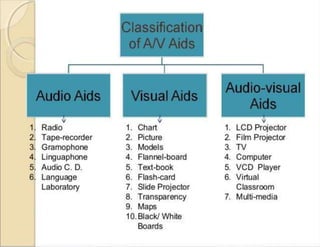
Types of AV Aids
There are many aids available these days. We
may classify these aids as follows-
 Visual Aids
Audio Aids
 Audio - Visual Aids
1) Audio Aids
The aids that involve the sense of hearing are
called Audio aids. For example :- radio, tape
recorder, gramophone etc.
2) Visual Aids
The aids which use sense of vision are called
Visual aids. For example :- actual objects,
models, pictures, charts, maps, flash cards,
flannel board, bulletin board, chalkboard,
overhead projector, slides etc. Out of these
black board and chalk are the commonest ones.
3) Audio - Visual Aids
The aids which involve the sense of
vision as well as hearing are called
Audio- Visual aids. For example :-
television, film projector, film strips etc.
Purposes:
To visualize an item, it is
otherwise difficult to explain
only in words.
To highlight important points.
To provide outline for materials
covered in presentation.
 To show continuity in process.
 For creating problems and
stimulating thinking.
 For showing development of
structure.
Limitation
Using of audio visual aids
decreases teacher ’s autonomy in
the classroom. For effective
functioning of the audio-visual
aids the trained experts are
required which is not possible all
the time
Advantages of AV Aids.
1. Help to make the learning process more effective and
conceptual.
2. Help to grab the attention of targeted audience.
3. Build interest and motivation.
4. Enhance the energy level of teaching.
5. Provide a realistic approach and experience
6. easy to follow
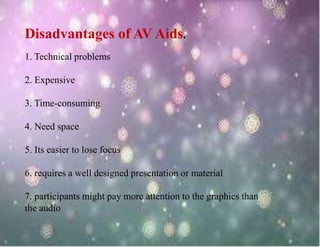
Disadvantages of AV Aids.
1. Technical problems
2. Expensive
3. Time-consuming
4. Need space
5. Its easier to lose focus
6. requires a well designed presentation or material
7. participants might pay more attention to the graphics than
the audio
Audio visual aids presentation

Audio visual aids presentation

  • 1.
    Presented To :- KanchanMam Presented By:- Garima Pathak COMMUNICATION
  • 2.
  • 4.
    Audio aids arealso called instructional material. Audio literally means “hearing” and “visual” means that which is found by seeing. So all such aids, which try to make the knowledge clear to us through our sense are called “Audio visual Aids” or instructional material
  • 5.
    According to KP. Neeraja An audio visual aid is an instructional device in which the message can be heard as well as seen
  • 6.
    Purpose of AudioVisual Aids:  Best motivation.  Clear image.  Save energy and time.  Antidote of the disease of verbal instructions.  Capture attention.  reinforcement to learner.  Positive transfer of learning.  Gain & hold student interest.  Increase understanding and retention.  Stimulate the development of understanding and attitudes
  • 8.
    THE ROLE OFAUDIO VISUALAIDS IN EDUCATION Audio visual aids are important in education system. Audio visual aids are those devices which are used in classrooms to encourage teaching learning process and make it easier and interesting.
  • 9.
     Students willgain knowledge of the latest in evolving theoretical and practical application in the communication field utilizing various resources and methods of inquiry.  Students will grow intellectually in their oral and written communication and critical thinking skills.  Student will become aware of the ethical and spiritual implications of communication on a diverse and global level.
  • 10.
    Importance of Teachingaids Teaching aids play an very important role in Teaching- Learning process. Importance of Teaching aids are as follows :- 1) Motivation Teaching aids motivate the students so that they can learn better. 2) Clarification Through teaching aids , the teacher clarify the subject matter more easily. 3) Discouragement of Cramming Teaching aids can facilitate the proper understanding to the students which discourage the act of cramming.
  • 11.
    Functions of Audiovisual aides:  They supply a concrete basis for conceptual thinking and hence, reduce meaningless word response of students.  They have high degree of interest for students.  They make learning more permanent.  They offer a reality of experience which stimulate self activity on the part of pupil.
  • 12.
    Types of AVAids There are many aids available these days. We may classify these aids as follows-  Visual Aids Audio Aids  Audio - Visual Aids
  • 13.
    1) Audio Aids Theaids that involve the sense of hearing are called Audio aids. For example :- radio, tape recorder, gramophone etc. 2) Visual Aids The aids which use sense of vision are called Visual aids. For example :- actual objects, models, pictures, charts, maps, flash cards, flannel board, bulletin board, chalkboard, overhead projector, slides etc. Out of these black board and chalk are the commonest ones.
  • 14.
    3) Audio -Visual Aids The aids which involve the sense of vision as well as hearing are called Audio- Visual aids. For example :- television, film projector, film strips etc.
  • 16.
    Purposes: To visualize anitem, it is otherwise difficult to explain only in words. To highlight important points. To provide outline for materials covered in presentation.  To show continuity in process.  For creating problems and stimulating thinking.  For showing development of structure.
  • 17.
    Limitation Using of audiovisual aids decreases teacher ’s autonomy in the classroom. For effective functioning of the audio-visual aids the trained experts are required which is not possible all the time
  • 18.
    Advantages of AVAids. 1. Help to make the learning process more effective and conceptual. 2. Help to grab the attention of targeted audience. 3. Build interest and motivation. 4. Enhance the energy level of teaching. 5. Provide a realistic approach and experience 6. easy to follow
  • 19.
    Disadvantages of AVAids. 1. Technical problems 2. Expensive 3. Time-consuming 4. Need space 5. Its easier to lose focus 6. requires a well designed presentation or material 7. participants might pay more attention to the graphics than the audio