TEACHER
–ROLE& RESPONSIBILITES,
FUNCTIONS,
CHARACTERISTICS,
COMPETENCIES & QUALITIES
“A good teacher is like a
candle-it consumes
itself to light the way
for others”
 ROLE: The characteristic and expected
social behaviour of an individual.
 RESPONSIBILITY: Taking care of your
duties.
 CHARACTERISTIC: A feature that helps to
identify, tell apart, or describe
recognizably; a distinguishing mark or
trait.
 COMPETENCE: A specific range of skill,
knowledge, or ability.
 FUNCTION: The action for which a person
or thing is particularly fitted or employed.
 QUALITY:The ongoing process of building
and sustaining relationships by assessing,
anticipating, and fulfilling stated and
implied needs.‘
 PASSION: the energy that comes from
bringing more of YOU into what you do.
 TEACHING : It is concerned with growth and
development of whole personality of the
student-her mind, spirit, character and
effective behaviour.
 It is a mixture of art and science.
 A nurse educator is a nurse who
teaches and prepares licensed
practical nurses (LPN) and
registered nurses (RN) for entry
into practice positions.
 -Wikipedia
ADMINISTRATOR
ROLE
INDIVIDUAL
ROLE
FACULTY ROLE
INSTRUCTIONAL
ROLE
 Planning and organising courses
 Creating and maintaining a
desirable group climate
 Adapting teaching and
instructional materials.
 Motivating and challenging
 students to pursue & sustain
 learning activities.
Teaching consisting of a complex role:
 Supplying information
 Explaining ,clarifying,& interpreting
 Demonstrating & explaining procedure, a
process or exhibiting materials
 Serve as guie for student projects
 Supervise student’s performance
 Evaluate teaching and learning outcomes.
 As a staff member of organizational
hierarchy-chaiman/dean or member of
one or more committees like
currriculum,board of examiners, etc.
 Counselor of students
 Researcher
 Resource person to outside groups
 Representative to professional
nursing organizations
 Public health relation agent.
 Personal role
 Teacher role
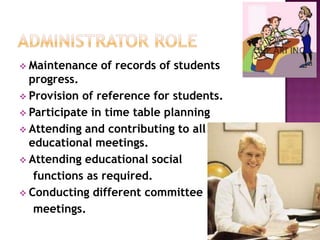
 Maintenance of records of students
progress.
 Provision of reference for students.
 Participate in time table planning
 Attending and contributing to all
educational meetings.
 Attending educational social
functions as required.
 Conducting different committee
meetings.
 PREFERRRED FUTURE OF NURSE EDUCATORS WOULD
BE:
 More attractive & flexible career opportunities with
creative employment models & working practices.
 Improved strategic relationship, robust workforce
planning and coherent national frameworks for health
& social care education.
 Career pathways can be aligned with PG clinicians*&
delivery of contemporary health care.
 Review of funding for education & staff development.
 Greater recognition & reward for the specialized
knowledge& preparation required for practice.
Socially
Responsib
le
Teacher
Teacher
of High
Values
and
Morality
Teacher
Managing
Identity
Crises
Learner
centered
teacher
Openness
of a
Teacher
Account
ability
Profession
alism
Teacher with
the Best
Talent
Good
Commun
icator
Conten
t
Manage
ment
Skills
Teacher with
Knowledge
Management
Qualities
Teacher with
Leadership
Qualities
Nursing
Teacher in
Progression
 Explaining, informing
 initiating,directing & administering
 Unifying group
 Giving security
 Clarifying attitudes,beliefs &
problems
 Diagnosing learning problems
 Making curriculum material
 Evaluating ,recording and reporting
 Enriching community activity
 Arranging & organizing classroom
 Participating in educational
institutional activities
 Participating in professional life.
DESIRED CHARACTERISTICS
OF EFFECTIVE NURSE
EDUCATORS
 INSTRUCTIONAL ABILITY /COMMUNICATION
SKILLS
 INTERPERSONAL SKILLS
 PERSONALITY TRAITS
 ACCESSIBILITY
 NURSING COMPETENCE /PROFESSIONALISM
 EVALUATION PROCEDURES
 Communicates effectively; breaks down
content in a down-to-earth manner
 Clear goals, expectations, deadlines,
desired outcomes
 Organized
 Knowledgeable of course materials
 Interacts with students
 Enthusiastic, energetic, eager
 Well-prepared
 Self-confident
 Creative
 Encouraging demeanour
 Friendly attitude
 Mentoring approach
 Motivational
 Supportive
 Respectful
 Receptive to people and ideas
 Open minded, objective,
 non-judgmental
 Attentive
 Nurturing
 Demonstrates concern
about students
 Flexible, easy-going
manner
 Sense of humour
 Approachable, welcoming
 Has designated office hours
 Good role model
 Dedicated
 Clearly enjoys nursing and
teaching
 Skilled clinician
 Provides study guides/ outlines
 Provides timely, constructive, and specific feedback
 Gives tests that reflect course objectives, lecture
materials, and
study guides
COMPETENCY 1: FACILITATE LEARNING
COMPETENCY 2: FACILITATE LEARNER DEVELOPMENT & SOCALIZATION
COMPETENCY 3: USE ASSESSMENT & EVALUATION STRATEGIES
COMPETENCY 4: PARTICIPATE IN CURRICULUM DESIGN & EVALUATION OF
PROGRAM OUTCOMES
COMPETENCY 5: FUNCTION AS CHANGE AGENTS AND LEADERS
COMPETENCY 6: PURSUE CONTINUOUS QUALITY IMPROVEMENT IN THE NURSE
EDUCATOR ROLE
COMPETENCY 7: ENGAGE IN SCHOLARSHIP
COMPETENCY 8: FUNCTION WITHIN THE EDUCATIONAL ENVIRONMENT
 Implements a variety of teaching strategies appropriate
to learner needs
 • Grounds teaching strategies in educational theory and
evidence-based teaching practices
 • Recognizes multicultural, gender, and experiential
influences on teaching and learning
 • Engages in self-reflection and continued learning to
improve teaching practices that facilitate learning
 • Uses information technologies skillfully to support the
teaching-learning process
 • Practices skilled oral, written, and electronic
communication that reflects an awareness of self and
others
 • Models critical and reflective thinking
COMPETENCY 1: FACILITATE LEARNING
 • Creates opportunities for learners to develop their
critical thinking
 • Shows enthusiasm for teaching, learning, and nursing
that inspires and motivates students
 • Demonstrates interest in and respect for learners
 • Uses personal attributes (e.g., caring, confidence,
patience, integrity and flexibility) that facilitate learning
 • Develops collegial working relationships with students,
faculty colleagues, and clinical agency personnel to
promote positive learning environments
 • Maintains the professional practice knowledge base
needed to help learners prepare for contemporary
nursing practice
 • Serves as a role model of professional nursing
 Identifies individual learning styles and unique
learning needs Of multicultural, educationally
disadvantaged, physically challenged, at-risk, and
second degree learners
 Provides resources to diverse learners that help
meet their individual learning needs
 Engages in effective advisement and counseling
strategies that help learners meet their
professional goals
 Creates learning environments that are focused on
socialization to the role of the nurse and facilitate
learners’ self-reflection and personal goal setting
COMPETENCY 2: FACILITATE LEARNER
DEVELOPMENT & SOCALIZATION
 Recognizes the influence of teaching styles
and interpersonal interactions on learner
outcomes
 Assists learners to develop the ability to
engage in thoughtful and constructive self and
peer evaluation
 Uses extant literature to develop evidence-based
assessment and evaluation practices
 Uses a variety of strategies to assess and evaluate
learning in the cognitive, psychomotor, and affective
domains
 Implements evidence-based assessment and
evaluation strategies that are appropriate to the
learner and to learning goals
 Provides timely, constructive, and thoughtful
feedback to learners
 Demonstrates skill in the design and use of tools for
assessing clinical practice
COMPETENCY 3: USE ASSESSMENT & EVALUATION
STRATEGIES
 Ensures that the curriculum reflects institutional
philosophy and mission, current nursing and health
care trends, and community and societal needs
 Demonstrates knowledge of curriculum
development including identifying program
 outcomes, developing competency statements,
writing learning objectives, and selecting
appropriate learning activities and evaluation
strategies
 Bases curriculum design and implementation
decisions on sound educational principles, theory,
and research
 • Revises the curriculum based on
assessment of program outcomes, learner
needs, and societal and health care trends
 • Implements curricular revisions using
appropriate change theories and strategies
 • Creates and maintains community and
clinical partnerships that support
educational goals
 • Collaborates with external constituencies
throughout the process of curriculum
revision
 • Participates in interdisciplinary efforts to address
health care and educational needs locally, regionally,
nationally, or internationally
 • Evaluates organizational effectiveness in nursing
education
 • Implements strategies for organizational change
 • Provides leadership in the parent institution as well as
in the nursing program to enhance the visibility of
nursing and its contributions to the academic community
 • Promotes innovative practices in educational
environments
 • Develops leadership skills to shape and implement
change
 Demonstrates a commitment to life-long learning
 • Recognizes that career enhancement needs and
activities change as experience is gained in the role
 • Participates in professional development opportunities
that increase one’s effectiveness in the role
 • Balances the teaching, scholarship, and service
demands inherent in the role of educator and member
of an academic institution
 • Uses feedback gained from self, peer, student, and
administrative evaluation to improve role effectiveness
 • Mentors and supports faculty colleagues
 • Exhibits a spirit of inquiry about teaching and
learning, student development, evaluation methods,
and other aspects of the role
 • Designs and implements scholarly activities in an
established area of expertise
 • Disseminates nursing and teaching knowledge to a
variety of audiences through various means
 • Demonstrates skill in proposal writing for initiatives
that include, but are not limited to, research,
resource acquisition, program development, and
policy development
 • Demonstrates qualities of a scholar: integrity,
courage, perseverance, vitality, and creativity
 Uses knowledge of history and current trends and issues
in higher education as a basis for making
recommendations and decisions on educational issues
 • Identifies how social, economic, political, and
institutional forces influence higher education in
general and nursing education in particular
 • Develops networks, collaborations, and partnerships to
enhance nursing’s influence within the academic
community
 • Determines own professional goals within the context
of academic nursing and the mission of the parent
institution and nursing program
 Respect for the student’s maturity & sense
of responsibility
 Stimulating
 Assignments
 Subject matter content
 Time management
 Personal attributes
 International Journal of Nursing Education
Scholarship
 Vol. 7 (2010)/ Issue 1 / Articles
 Learner-Centered Characteristics of Nurse
Educators
 A qualitative research design was used to address
the research question. Themes that emerged were
placed under the concepts of power, role of
teacher, responsibility of learner, and philosophy
of evaluation guided by Weimer's (2002)
conceptual framework of a learner-centered
philosophy of teaching. Themes and meaning units
derived from the study helped to generate textual
and structure statements that represent the
characterizations of learner-centered nurse
educators.
 THE CLINICAL INSTRUCTOR ROLE IN NURSING EDUCATION:
A STRUCTURED LITERATURE REVIEW
 Abstract
 A structured literature review was conducted to
understand clinical instructors’ perceptions of their role
and the factors that facilitate and constrain their teaching
in undergraduate nursing programs. The literature
published in English between 2000 and 2011 was searched,
and data were extracted from 15 articles that met the
inclusion criteria. The analysis identified four themes—
characteristics of the role, characteristics of effective
clinical teaching, influence of the clinical context on the
role, and influence of the academic context on the role.
Clinical instructors are portrayed as needing to be good
educators, as well as excellent clinicians. However, they
often lack formal education and professional development
opportunities related to the role and must draw on their
individual personal and professional experiences to guide
their teaching to meet the demands of both the clinical
and academic contexts in which they simultaneously work.
 Mujibul hasan,Technology In Teacher
Education,APH Publication -2004,NewDelhi.
 Diane M.Billings,Teaching In Nursing-A Guide
For Faculty,3rd edition,2009,Elsevier
publication,st.louis.
 K.P.Neeraja,Textbook Of Nursing Education,
7th edition, Jaypee publication, Delhi.
 www.nursetogether.com
 www.healio.com
 www.pubmed.com
 www.google.com
Teacher

Teacher

  • 2.
  • 4.
    “A good teacheris like a candle-it consumes itself to light the way for others”
  • 5.
     ROLE: Thecharacteristic and expected social behaviour of an individual.  RESPONSIBILITY: Taking care of your duties.  CHARACTERISTIC: A feature that helps to identify, tell apart, or describe recognizably; a distinguishing mark or trait.  COMPETENCE: A specific range of skill, knowledge, or ability.
  • 6.
     FUNCTION: Theaction for which a person or thing is particularly fitted or employed.  QUALITY:The ongoing process of building and sustaining relationships by assessing, anticipating, and fulfilling stated and implied needs.‘  PASSION: the energy that comes from bringing more of YOU into what you do.
  • 7.
     TEACHING :It is concerned with growth and development of whole personality of the student-her mind, spirit, character and effective behaviour.  It is a mixture of art and science.
  • 8.
     A nurseeducator is a nurse who teaches and prepares licensed practical nurses (LPN) and registered nurses (RN) for entry into practice positions.  -Wikipedia
  • 10.
  • 11.
     Planning andorganising courses  Creating and maintaining a desirable group climate  Adapting teaching and instructional materials.  Motivating and challenging  students to pursue & sustain  learning activities.
  • 12.
    Teaching consisting ofa complex role:  Supplying information  Explaining ,clarifying,& interpreting  Demonstrating & explaining procedure, a process or exhibiting materials  Serve as guie for student projects  Supervise student’s performance  Evaluate teaching and learning outcomes.
  • 13.
     As astaff member of organizational hierarchy-chaiman/dean or member of one or more committees like currriculum,board of examiners, etc.  Counselor of students  Researcher  Resource person to outside groups  Representative to professional nursing organizations  Public health relation agent.
  • 14.
  • 15.
     Maintenance ofrecords of students progress.  Provision of reference for students.  Participate in time table planning  Attending and contributing to all educational meetings.  Attending educational social functions as required.  Conducting different committee meetings.
  • 16.
     PREFERRRED FUTUREOF NURSE EDUCATORS WOULD BE:  More attractive & flexible career opportunities with creative employment models & working practices.  Improved strategic relationship, robust workforce planning and coherent national frameworks for health & social care education.  Career pathways can be aligned with PG clinicians*& delivery of contemporary health care.  Review of funding for education & staff development.  Greater recognition & reward for the specialized knowledge& preparation required for practice.
  • 17.
    Socially Responsib le Teacher Teacher of High Values and Morality Teacher Managing Identity Crises Learner centered teacher Openness of a Teacher Account ability Profession alism Teacherwith the Best Talent Good Commun icator Conten t Manage ment Skills Teacher with Knowledge Management Qualities Teacher with Leadership Qualities Nursing Teacher in Progression
  • 18.
     Explaining, informing initiating,directing & administering  Unifying group  Giving security  Clarifying attitudes,beliefs & problems  Diagnosing learning problems  Making curriculum material  Evaluating ,recording and reporting  Enriching community activity  Arranging & organizing classroom  Participating in educational institutional activities  Participating in professional life.
  • 19.
  • 20.
     INSTRUCTIONAL ABILITY/COMMUNICATION SKILLS  INTERPERSONAL SKILLS  PERSONALITY TRAITS  ACCESSIBILITY  NURSING COMPETENCE /PROFESSIONALISM  EVALUATION PROCEDURES
  • 21.
     Communicates effectively;breaks down content in a down-to-earth manner  Clear goals, expectations, deadlines, desired outcomes  Organized  Knowledgeable of course materials  Interacts with students  Enthusiastic, energetic, eager  Well-prepared  Self-confident  Creative
  • 22.
     Encouraging demeanour Friendly attitude  Mentoring approach  Motivational  Supportive  Respectful  Receptive to people and ideas  Open minded, objective,  non-judgmental
  • 23.
     Attentive  Nurturing Demonstrates concern about students  Flexible, easy-going manner  Sense of humour
  • 24.
     Approachable, welcoming Has designated office hours
  • 25.
     Good rolemodel  Dedicated  Clearly enjoys nursing and teaching  Skilled clinician
  • 26.
     Provides studyguides/ outlines  Provides timely, constructive, and specific feedback  Gives tests that reflect course objectives, lecture materials, and study guides
  • 28.
    COMPETENCY 1: FACILITATELEARNING COMPETENCY 2: FACILITATE LEARNER DEVELOPMENT & SOCALIZATION COMPETENCY 3: USE ASSESSMENT & EVALUATION STRATEGIES COMPETENCY 4: PARTICIPATE IN CURRICULUM DESIGN & EVALUATION OF PROGRAM OUTCOMES COMPETENCY 5: FUNCTION AS CHANGE AGENTS AND LEADERS COMPETENCY 6: PURSUE CONTINUOUS QUALITY IMPROVEMENT IN THE NURSE EDUCATOR ROLE COMPETENCY 7: ENGAGE IN SCHOLARSHIP COMPETENCY 8: FUNCTION WITHIN THE EDUCATIONAL ENVIRONMENT
  • 29.
     Implements avariety of teaching strategies appropriate to learner needs  • Grounds teaching strategies in educational theory and evidence-based teaching practices  • Recognizes multicultural, gender, and experiential influences on teaching and learning  • Engages in self-reflection and continued learning to improve teaching practices that facilitate learning  • Uses information technologies skillfully to support the teaching-learning process  • Practices skilled oral, written, and electronic communication that reflects an awareness of self and others  • Models critical and reflective thinking COMPETENCY 1: FACILITATE LEARNING
  • 30.
     • Createsopportunities for learners to develop their critical thinking  • Shows enthusiasm for teaching, learning, and nursing that inspires and motivates students  • Demonstrates interest in and respect for learners  • Uses personal attributes (e.g., caring, confidence, patience, integrity and flexibility) that facilitate learning  • Develops collegial working relationships with students, faculty colleagues, and clinical agency personnel to promote positive learning environments  • Maintains the professional practice knowledge base needed to help learners prepare for contemporary nursing practice  • Serves as a role model of professional nursing
  • 31.
     Identifies individuallearning styles and unique learning needs Of multicultural, educationally disadvantaged, physically challenged, at-risk, and second degree learners  Provides resources to diverse learners that help meet their individual learning needs  Engages in effective advisement and counseling strategies that help learners meet their professional goals  Creates learning environments that are focused on socialization to the role of the nurse and facilitate learners’ self-reflection and personal goal setting COMPETENCY 2: FACILITATE LEARNER DEVELOPMENT & SOCALIZATION
  • 32.
     Recognizes theinfluence of teaching styles and interpersonal interactions on learner outcomes  Assists learners to develop the ability to engage in thoughtful and constructive self and peer evaluation
  • 33.
     Uses extantliterature to develop evidence-based assessment and evaluation practices  Uses a variety of strategies to assess and evaluate learning in the cognitive, psychomotor, and affective domains  Implements evidence-based assessment and evaluation strategies that are appropriate to the learner and to learning goals  Provides timely, constructive, and thoughtful feedback to learners  Demonstrates skill in the design and use of tools for assessing clinical practice COMPETENCY 3: USE ASSESSMENT & EVALUATION STRATEGIES
  • 34.
     Ensures thatthe curriculum reflects institutional philosophy and mission, current nursing and health care trends, and community and societal needs  Demonstrates knowledge of curriculum development including identifying program  outcomes, developing competency statements, writing learning objectives, and selecting appropriate learning activities and evaluation strategies  Bases curriculum design and implementation decisions on sound educational principles, theory, and research
  • 35.
     • Revisesthe curriculum based on assessment of program outcomes, learner needs, and societal and health care trends  • Implements curricular revisions using appropriate change theories and strategies  • Creates and maintains community and clinical partnerships that support educational goals  • Collaborates with external constituencies throughout the process of curriculum revision
  • 36.
     • Participatesin interdisciplinary efforts to address health care and educational needs locally, regionally, nationally, or internationally  • Evaluates organizational effectiveness in nursing education  • Implements strategies for organizational change  • Provides leadership in the parent institution as well as in the nursing program to enhance the visibility of nursing and its contributions to the academic community  • Promotes innovative practices in educational environments  • Develops leadership skills to shape and implement change
  • 37.
     Demonstrates acommitment to life-long learning  • Recognizes that career enhancement needs and activities change as experience is gained in the role  • Participates in professional development opportunities that increase one’s effectiveness in the role  • Balances the teaching, scholarship, and service demands inherent in the role of educator and member of an academic institution  • Uses feedback gained from self, peer, student, and administrative evaluation to improve role effectiveness  • Mentors and supports faculty colleagues
  • 38.
     • Exhibitsa spirit of inquiry about teaching and learning, student development, evaluation methods, and other aspects of the role  • Designs and implements scholarly activities in an established area of expertise  • Disseminates nursing and teaching knowledge to a variety of audiences through various means  • Demonstrates skill in proposal writing for initiatives that include, but are not limited to, research, resource acquisition, program development, and policy development  • Demonstrates qualities of a scholar: integrity, courage, perseverance, vitality, and creativity
  • 39.
     Uses knowledgeof history and current trends and issues in higher education as a basis for making recommendations and decisions on educational issues  • Identifies how social, economic, political, and institutional forces influence higher education in general and nursing education in particular  • Develops networks, collaborations, and partnerships to enhance nursing’s influence within the academic community  • Determines own professional goals within the context of academic nursing and the mission of the parent institution and nursing program
  • 42.
     Respect forthe student’s maturity & sense of responsibility  Stimulating  Assignments  Subject matter content  Time management  Personal attributes
  • 43.
     International Journalof Nursing Education Scholarship  Vol. 7 (2010)/ Issue 1 / Articles  Learner-Centered Characteristics of Nurse Educators  A qualitative research design was used to address the research question. Themes that emerged were placed under the concepts of power, role of teacher, responsibility of learner, and philosophy of evaluation guided by Weimer's (2002) conceptual framework of a learner-centered philosophy of teaching. Themes and meaning units derived from the study helped to generate textual and structure statements that represent the characterizations of learner-centered nurse educators.
  • 44.
     THE CLINICALINSTRUCTOR ROLE IN NURSING EDUCATION: A STRUCTURED LITERATURE REVIEW  Abstract  A structured literature review was conducted to understand clinical instructors’ perceptions of their role and the factors that facilitate and constrain their teaching in undergraduate nursing programs. The literature published in English between 2000 and 2011 was searched, and data were extracted from 15 articles that met the inclusion criteria. The analysis identified four themes— characteristics of the role, characteristics of effective clinical teaching, influence of the clinical context on the role, and influence of the academic context on the role. Clinical instructors are portrayed as needing to be good educators, as well as excellent clinicians. However, they often lack formal education and professional development opportunities related to the role and must draw on their individual personal and professional experiences to guide their teaching to meet the demands of both the clinical and academic contexts in which they simultaneously work.
  • 47.
     Mujibul hasan,TechnologyIn Teacher Education,APH Publication -2004,NewDelhi.  Diane M.Billings,Teaching In Nursing-A Guide For Faculty,3rd edition,2009,Elsevier publication,st.louis.  K.P.Neeraja,Textbook Of Nursing Education, 7th edition, Jaypee publication, Delhi.  www.nursetogether.com  www.healio.com  www.pubmed.com  www.google.com