

ATTITUDES

      Submitted by:
       Naveen Sihag
       B.Tech(CS)
Contents
Meaning
Components of attitudes
Formation of attitudes
Work related attitudes
Attitude change
Barriers to changing attitudes
Meaning
An attitude is a psychological tendency,
expressed by evaluating an entity with
some degree of favor or disfavor.
It reflects How one feels about something?
Attitude is a hypothetical construct that
represents an individual’s like or dislike for
an item.
I say “I like my job”, I am expressing my
attitude about work.
ABC Model
  Attitudes develop on the basis of
  evaluation responding. An individual does
  not have an attitude until he or she
  responds to an entity (person, object,
  situation, issue) on an affective, cognitive
  or behavioral basis.
  Three components:
 affect
 behavioral intention
 cognition
Affect:- is the emotional component of
   an attitude. It refers to an individuals
  feeling about something or someone.
               “I like this…..”
              “I prefer that…”
These reflect effective component of an
                    attitude.
Behavioral intention:- The intention
 to behave in a certain way towards an
             object or person.
Cognition:- reflects person’s perception or
 beliefs. Cognitive elements are evaluative
beliefs and are measured by attitude scales
        or by asking about thoughts.

“I believe Japanese workers are industrious”
 reflects cognitive component of an attitude.
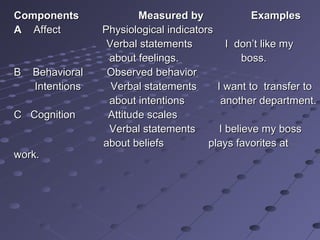
Components               Measured by               Examples
A Affect         Physiological indicators
                  Verbal statements          I don’t like my
                  about feelings.                boss.
B   Behavioral    Observed behavior
    Intentions     Verbal statements      I want to transfer to
                  about intentions         another department.
C Cognition       Attitude scales
                  Verbal statements        I believe my boss
                 about beliefs          plays favorites at
work.
Attitude Formation
Two major influences on attitudes are:
 Direct experience
 Social learning
Direct experience with an object or person is a
  powerful influence on attitudes.
They are stronger, held more confidently, and are
  more resistant to change tan attitudes formed
  through indirect experience. This means that the
  attitudes are easily accessed and are active in
  our cognitive processes.
Social learning:-The process of deriving
attitudes from family, peer groups, religious
          organizations and culture.
Children learn to adopt certain attitudes by
 the reinforcement they are given by their
                   parents.
      After overhearing other individuals
  expressing an opinion or watching them
   engaging in a behavior that reflects an
 attitude, the observer adopts the attitude.
Work Attitudes
  Attitudes at work are important because
  directly or indirectly, they affect work
  behavior. These job-related attitudes tap
  positive or negative evaluations that
  employees hold about aspects of their
  work environment.
 Job satisfaction
 Organizational commitment
Job satisfaction
 A pleasurable or positive emotional state
  resulting from appraisal of one’s job or job
  experiences. It has been treated both as a
  general attitude and a satisfaction with five
  specific dimensions of the job:
 Pay
 Work itself
 Promotion opportunities
 Supervision
 coworkers
Job satisfaction is related to organizational
citizenship behavior- behavior that is above
and beyond the call of duty.
        Satisfied employees are more likely
to help their coworkers, make positive
comments about company and refrain from
complaining when things at work do not go
well.
       Going beyond the call of duty is
especially important to organizations using
teams to get work done. Employees
depend on extra help from each other to
get things accomplished
Satisfied workers want to give something
 back to the organization because they want
   to reciprocate their positive experiences.
Organizational citizenship behaviors (OCBs)
influence performance evaluation. Employee
     who exhibit behaviors such as helping
 others, making suggestions for innovations
  and developing their skills receive higher
             performance ratings.
    “Companies with satisfied workers have
  better performance than Companies with
             dissatisfied workers.”
Organizational Commitment
  The degree to which an employee
  identifies with a particular organization and
  its goals, and wishes to maintain
  membership in the organization.
  Three kinds of Organizational
  Commitment:
 Affective commitment
 Continuance commitment
 Normative commitment
Affective commitment is an employee’s
intention to remain in an organization
because of strong desire to do so. It
consists of 3 factors:
   . A belief in the goals and values of the
organization
   . A willingness to put forth effort on behalf
of the organization
  . A desire to remain a member of the
organization.

Affective commitment encompasses loyalty.
Continuance commitment is an
employee’s tendency to remain in an
organization because the person cannot
afford to leave. Employees believe that if
they leave, they will lose a great deal of
their investments in time, effort and
benefits ant that they cannot replace these
investments.
   Normative commitment is a perceived
obligation to remain with the organization.
Individuals who experience normative
commitment stay with the organization
because they fell that they should.
Attitude change
  Attitudes can be changed through
  persuasion. Through persuasion, one
  individual (the source) tries to change the
  attitude of another person (the target).
  Factors that affect the persuasiveness of a
  message are:
 Target characteristics
 Source characteristics
 Message characteristics
 Cognitive routes
Target characteristics:

These are the characteristics that refer to
the person who receives and processes a
message. Individuals with low self-esteem
are more likely to change their attitude in
response to persuasion than are
individuals with high self-esteem. The
mind frame and mood of the target also
plays a role in this process.
Source characteristics:
Three major characteristics of the source
  affect persuasion are:
 Expertise
 Trustworthiness
 Attractiveness.
A source who is perceived as an expert is
  particularly persuasive. The credibility of a
  perceived message is a key variable,
  example: If one reads a report about
  health and believes it came from a
  professional medical journal, one may
be more easily persuaded than if one
believes it is from a popular newspaper.
Some psychologists have debated that this
is a long-lasting effect and others are of
view that effect of telling people that a
message came from credible source
disappeared after several weeks (“sleeper
effect”).
If people are informed of the source of a
message before hearing it, there is less
likelihood of a sleeper effect than if they are
told of message and then source.
Message characteristics:
The nature of the message plays a role in
persuasion. Sometimes presenting both
sides story is useful to change attitude.
Example: If you want to implement an
unpopular policy at work. You have to
persuade your employees that the policy
is a positive change
Cognitive routes:
  Persuasion occurs over two routes:
 Central route
 Peripheral route
In the central route to persuasion the
  individual is presented with the data and
  motivated to evaluate the data and arrive
  at an attitude changing conclusion. The
  content of message is more important and
  it involves direct cognitive processing of
  the message’s content.
In peripheral route to attitude change, the
 individual is encouraged to not look at the
content but at the source i.e. individual is not
   motivated to pay much attention to the
             message’s content.
     This is commonly seen in modern
   advertisements that feature celebrities.

  In some cases, physicians, doctors, or
 experts are used. In other cases film stars
     are used for their attractiveness.
Barriers to changing attitudes:
 Prior commitments
 Strong commitments
 Publicly expressed attitudes
 Low credibility
 Insufficient information
 Degree of fear

Attitudes

  • 1.
    ATTITUDES Submitted by: Naveen Sihag B.Tech(CS)
  • 2.
    Contents Meaning Components of attitudes Formationof attitudes Work related attitudes Attitude change Barriers to changing attitudes
  • 3.
    Meaning An attitude isa psychological tendency, expressed by evaluating an entity with some degree of favor or disfavor. It reflects How one feels about something? Attitude is a hypothetical construct that represents an individual’s like or dislike for an item. I say “I like my job”, I am expressing my attitude about work.
  • 4.
    ABC Model Attitudes develop on the basis of evaluation responding. An individual does not have an attitude until he or she responds to an entity (person, object, situation, issue) on an affective, cognitive or behavioral basis. Three components:  affect  behavioral intention  cognition
  • 5.
    Affect:- is theemotional component of an attitude. It refers to an individuals feeling about something or someone. “I like this…..” “I prefer that…” These reflect effective component of an attitude. Behavioral intention:- The intention to behave in a certain way towards an object or person.
  • 6.
    Cognition:- reflects person’sperception or beliefs. Cognitive elements are evaluative beliefs and are measured by attitude scales or by asking about thoughts. “I believe Japanese workers are industrious” reflects cognitive component of an attitude.
  • 7.
    Components Measured by Examples A Affect Physiological indicators Verbal statements I don’t like my about feelings. boss. B Behavioral Observed behavior Intentions Verbal statements I want to transfer to about intentions another department. C Cognition Attitude scales Verbal statements I believe my boss about beliefs plays favorites at work.
  • 8.
    Attitude Formation Two majorinfluences on attitudes are:  Direct experience  Social learning Direct experience with an object or person is a powerful influence on attitudes. They are stronger, held more confidently, and are more resistant to change tan attitudes formed through indirect experience. This means that the attitudes are easily accessed and are active in our cognitive processes.
  • 9.
    Social learning:-The processof deriving attitudes from family, peer groups, religious organizations and culture. Children learn to adopt certain attitudes by the reinforcement they are given by their parents. After overhearing other individuals expressing an opinion or watching them engaging in a behavior that reflects an attitude, the observer adopts the attitude.
  • 10.
    Work Attitudes Attitudes at work are important because directly or indirectly, they affect work behavior. These job-related attitudes tap positive or negative evaluations that employees hold about aspects of their work environment.  Job satisfaction  Organizational commitment
  • 11.
    Job satisfaction Apleasurable or positive emotional state resulting from appraisal of one’s job or job experiences. It has been treated both as a general attitude and a satisfaction with five specific dimensions of the job:  Pay  Work itself  Promotion opportunities  Supervision  coworkers
  • 12.
    Job satisfaction isrelated to organizational citizenship behavior- behavior that is above and beyond the call of duty. Satisfied employees are more likely to help their coworkers, make positive comments about company and refrain from complaining when things at work do not go well. Going beyond the call of duty is especially important to organizations using teams to get work done. Employees depend on extra help from each other to get things accomplished
  • 13.
    Satisfied workers wantto give something back to the organization because they want to reciprocate their positive experiences. Organizational citizenship behaviors (OCBs) influence performance evaluation. Employee who exhibit behaviors such as helping others, making suggestions for innovations and developing their skills receive higher performance ratings. “Companies with satisfied workers have better performance than Companies with dissatisfied workers.”
  • 14.
    Organizational Commitment The degree to which an employee identifies with a particular organization and its goals, and wishes to maintain membership in the organization. Three kinds of Organizational Commitment:  Affective commitment  Continuance commitment  Normative commitment
  • 15.
    Affective commitment isan employee’s intention to remain in an organization because of strong desire to do so. It consists of 3 factors: . A belief in the goals and values of the organization . A willingness to put forth effort on behalf of the organization . A desire to remain a member of the organization. Affective commitment encompasses loyalty.
  • 16.
    Continuance commitment isan employee’s tendency to remain in an organization because the person cannot afford to leave. Employees believe that if they leave, they will lose a great deal of their investments in time, effort and benefits ant that they cannot replace these investments. Normative commitment is a perceived obligation to remain with the organization. Individuals who experience normative commitment stay with the organization because they fell that they should.
  • 17.
    Attitude change Attitudes can be changed through persuasion. Through persuasion, one individual (the source) tries to change the attitude of another person (the target). Factors that affect the persuasiveness of a message are:  Target characteristics  Source characteristics  Message characteristics  Cognitive routes
  • 18.
    Target characteristics: These arethe characteristics that refer to the person who receives and processes a message. Individuals with low self-esteem are more likely to change their attitude in response to persuasion than are individuals with high self-esteem. The mind frame and mood of the target also plays a role in this process.
  • 19.
    Source characteristics: Three majorcharacteristics of the source affect persuasion are:  Expertise  Trustworthiness  Attractiveness. A source who is perceived as an expert is particularly persuasive. The credibility of a perceived message is a key variable, example: If one reads a report about health and believes it came from a professional medical journal, one may
  • 20.
    be more easilypersuaded than if one believes it is from a popular newspaper. Some psychologists have debated that this is a long-lasting effect and others are of view that effect of telling people that a message came from credible source disappeared after several weeks (“sleeper effect”). If people are informed of the source of a message before hearing it, there is less likelihood of a sleeper effect than if they are told of message and then source.
  • 21.
    Message characteristics: The natureof the message plays a role in persuasion. Sometimes presenting both sides story is useful to change attitude. Example: If you want to implement an unpopular policy at work. You have to persuade your employees that the policy is a positive change
  • 22.
    Cognitive routes: Persuasion occurs over two routes:  Central route  Peripheral route In the central route to persuasion the individual is presented with the data and motivated to evaluate the data and arrive at an attitude changing conclusion. The content of message is more important and it involves direct cognitive processing of the message’s content.
  • 23.
    In peripheral routeto attitude change, the individual is encouraged to not look at the content but at the source i.e. individual is not motivated to pay much attention to the message’s content. This is commonly seen in modern advertisements that feature celebrities. In some cases, physicians, doctors, or experts are used. In other cases film stars are used for their attractiveness.
  • 24.
    Barriers to changingattitudes:  Prior commitments  Strong commitments  Publicly expressed attitudes  Low credibility  Insufficient information  Degree of fear