Organizational Behavior
ATTITUDE
Author : Ms. Habeeb DHRM15
Over view
• Nature of attitude
• Components of attitude
• Attitude and behavior
• Causes of negative behavior
• Employee dissatisfaction
• Types of attitude and its function
• Measuring and conclusion
Nature of attitude
“Attitude” which represent ones belief, feeling and ideas ,actions in a
particular way toward some object or ideas.
=========================================================
• They tend to persist unless something is done to change them.
• They can fall anywhere along a continuum from very favorable to very
unfavorable.
• They are directed toward some object about which a person has feelings and
beliefs.
• It can also be defined as,” A complex mental state involving beliefs and
feelings and values and dispositions to act in certain ways.”
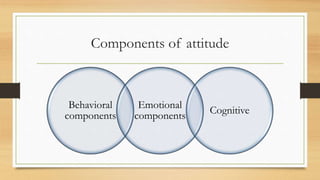
Components of attitude
Behavioral
components
Emotional
components
Cognitive
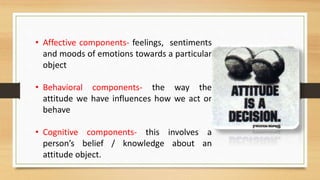
• Affective components- feelings, sentiments
and moods of emotions towards a particular
object
• Behavioral components- the way the
attitude we have influences how we act or
behave
• Cognitive components- this involves a
person’s belief / knowledge about an
attitude object.
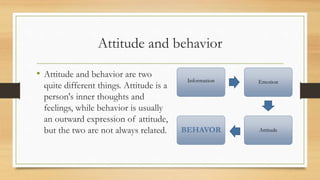
Attitude and behavior
• Attitude and behavior are two
quite different things. Attitude is a
person's inner thoughts and
feelings, while behavior is usually
an outward expression of attitude,
but the two are not always related.
Information Emotion
AttitudeBEHAVOR
Causes of dissatisfaction and negative attitude
• No promotion and job security
• Less salary and unfair reduction
• Working condition is poor
• Behavioral aspects are bad
• No support from management
• No welfare in organization
• Lack of training and orientation
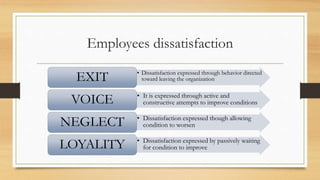
Employees dissatisfaction
• Dissatisfaction expressed through behavior directed
toward leaving the organizationEXIT
• It is expressed through active and
constructive attempts to improve conditionsVOICE
• Dissatisfaction expressed though allowing
condition to worsenNEGLECT
• Dissatisfaction expressed by passively waiting
for condition to improveLOYALITY
Barriers to changing an attitude
• Cognitive dissonance- when a person behaves in a fashion that is inconsistent
with his or her attitude.
• Prior commitment-means the belief is unchanged and unwilling to change.
• Insufficient information-two way communication is not possible from top
management and workers which creates a negative attitude.
Types of attitude
Job lovers- the peoples who love their job, some people just fit in a company or
do not let thing bother them or get to them. This helps a great deal in
developing love attitude.
Job haters- these are the people who hate their job no matter what the
organization does for them, they will have issues with doing a job they feel it is
beneath them or not being recognized enough in their opinion , for the work
they do.
Job doers- these are the people in the middle. There’s nothing good or bad
about these individuals, they simply believe job is a part of life they just well do
their job.
Function of attitude
• According to Katz(1960), attitudes serve four important functions from
the viewpoint of organizational behavior. They are
The adjustment function
Ego-defensive function
Value expressive function
The knowledge function
Organizational factor of positive attitude
• Employees satisfaction-Provide them right salary right Behavior.
• Promotion and Fringe Benefits-Provide them benefits for particular situation ,Incentives,
Allowances
• Welfare-Provide them education, Good working Condition to make a good belief.
• HRD-Provide them Training and development and Rights .
• Flexible working Condition-Working culture ,Job Profile must be good for make a positive
attitude
Measuring
• Opinion survey-by give questionnaires to individual and groups to find out the
result and measure the attitude accordingly.
• Interview-by asking him yes and no questions about a particular objective to
understand the attitude.
• Projective survey-provide him a particular situation and handle it alone to
understand the attitude
• Trust one scale-in this method the first data collected from the respondent and
the next data collected from the others and compare the whole process to find
out the attitude
Conclusion
Attitudes have traditionally been described as a process in which we logically
calculate our feelings toward the attitude object based on an analysis of our
beliefs. Thus, beliefs predict feelings, which predict behavioral intentions, which
predict behavior. But this traditional perspective overlooks the role of emotions,
which have an important influence on attitudes and behavior
• BELIEF + VALUE = ATTITUDE > BEHAVIOR
Organizational behavior lubna

Organizational behavior lubna

  • 1.
  • 2.
    Over view • Natureof attitude • Components of attitude • Attitude and behavior • Causes of negative behavior • Employee dissatisfaction • Types of attitude and its function • Measuring and conclusion
  • 3.
    Nature of attitude “Attitude”which represent ones belief, feeling and ideas ,actions in a particular way toward some object or ideas. ========================================================= • They tend to persist unless something is done to change them. • They can fall anywhere along a continuum from very favorable to very unfavorable. • They are directed toward some object about which a person has feelings and beliefs. • It can also be defined as,” A complex mental state involving beliefs and feelings and values and dispositions to act in certain ways.”
  • 4.
  • 5.
    • Affective components-feelings, sentiments and moods of emotions towards a particular object • Behavioral components- the way the attitude we have influences how we act or behave • Cognitive components- this involves a person’s belief / knowledge about an attitude object.
  • 6.
    Attitude and behavior •Attitude and behavior are two quite different things. Attitude is a person's inner thoughts and feelings, while behavior is usually an outward expression of attitude, but the two are not always related. Information Emotion AttitudeBEHAVOR
  • 7.
    Causes of dissatisfactionand negative attitude • No promotion and job security • Less salary and unfair reduction • Working condition is poor • Behavioral aspects are bad • No support from management • No welfare in organization • Lack of training and orientation
  • 8.
    Employees dissatisfaction • Dissatisfactionexpressed through behavior directed toward leaving the organizationEXIT • It is expressed through active and constructive attempts to improve conditionsVOICE • Dissatisfaction expressed though allowing condition to worsenNEGLECT • Dissatisfaction expressed by passively waiting for condition to improveLOYALITY
  • 9.
    Barriers to changingan attitude • Cognitive dissonance- when a person behaves in a fashion that is inconsistent with his or her attitude. • Prior commitment-means the belief is unchanged and unwilling to change. • Insufficient information-two way communication is not possible from top management and workers which creates a negative attitude.
  • 10.
    Types of attitude Joblovers- the peoples who love their job, some people just fit in a company or do not let thing bother them or get to them. This helps a great deal in developing love attitude. Job haters- these are the people who hate their job no matter what the organization does for them, they will have issues with doing a job they feel it is beneath them or not being recognized enough in their opinion , for the work they do. Job doers- these are the people in the middle. There’s nothing good or bad about these individuals, they simply believe job is a part of life they just well do their job.
  • 11.
    Function of attitude •According to Katz(1960), attitudes serve four important functions from the viewpoint of organizational behavior. They are The adjustment function Ego-defensive function Value expressive function The knowledge function
  • 12.
    Organizational factor ofpositive attitude • Employees satisfaction-Provide them right salary right Behavior. • Promotion and Fringe Benefits-Provide them benefits for particular situation ,Incentives, Allowances • Welfare-Provide them education, Good working Condition to make a good belief. • HRD-Provide them Training and development and Rights . • Flexible working Condition-Working culture ,Job Profile must be good for make a positive attitude
  • 13.
    Measuring • Opinion survey-bygive questionnaires to individual and groups to find out the result and measure the attitude accordingly. • Interview-by asking him yes and no questions about a particular objective to understand the attitude. • Projective survey-provide him a particular situation and handle it alone to understand the attitude • Trust one scale-in this method the first data collected from the respondent and the next data collected from the others and compare the whole process to find out the attitude
  • 14.
    Conclusion Attitudes have traditionallybeen described as a process in which we logically calculate our feelings toward the attitude object based on an analysis of our beliefs. Thus, beliefs predict feelings, which predict behavioral intentions, which predict behavior. But this traditional perspective overlooks the role of emotions, which have an important influence on attitudes and behavior • BELIEF + VALUE = ATTITUDE > BEHAVIOR

Editor's Notes

  • #8 Causes of dissatisfaction and negative attitude for the organization