MALIGNANT OTITIS EXTERNA
Dr Manohar Suryawanshi
ENT Resident, INHS Asvini
• Anatomy
• Introduction
• Microbiology
• Pathogenesis
• Diagnosis
• Investigations
• Treatment
Introduction
Definition
• Aggressive and potentially life-threatening infection
of the soft tissues of the external ear and
surrounding structures, quickly spreading to involve
the periostium and bone of the skull base.
Microbiology:
• Pseudomonas aeruginosa (95%)
• Fungus (A. Fumigatus, A. Flavus, A. Niger)
• Fungal MOE: HIV more commonly than in those who
have diabetes
• From middle ear or mastoid in contrast to
pseudomonal
• Pseudomonas infections CD4 levels < 100 cells/mm
• AspergillusCD4 counts <50 cells/mm
Predisposing factors
• Diabetes mellitus
• Immuno-compromised status
Pathophysiology:
• Cellulitis-> Chondritis-> Periostitis->
Osteitis ->Osteomyelitis
• Facial nerve (stylomastoid foramen) 60%
• IX, X and XI
• V and VI (petrous apex)
• Clivus and contralateral temporal bone can be
involved
• Infection can spread anteriorly into the sphenoid and
to the carotid
• Thrombosis of sigmoid sinus, IJV -> meningitis ->
cerebral abscess
• Haversian system of compact bone
• Pneumatoized portion of the temporal bone involved
late
• Otic capsule is usually spared
Clinical features:
• Long-standing otalgia (worst at night) and otorrhea
• Cranial nerve palsy
• Headaches, fever
• Neck stiffness
• Altered levels of consciousness
Hallmark finding: granulation tissue on floor of the ear
canal at the bony-cartilaginous junction
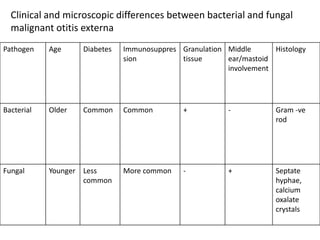
Clinical and microscopic differences between bacterial and fungal
malignant otitis externa
Pathogen Age Diabetes Immunosuppres
sion
Granulation
tissue
Middle
ear/mastoid
involvement
Histology
Bacterial Older Common Common + - Gram -ve
rod
Fungal Younger Less
common
More common - + Septate
hyphae,
calcium
oxalate
crystals
Diagnosis:
• Clinical
• Biopsy
• Pseudomonas aeruginosa on culture
• Supported by a positive bone scan and/or
the presence of microabscesses at surgery
• ESR, CRP
Investigations:
• CT scan
• MRI
• Technetium-99m bone scan:
Osteoblastic activity
Highly sensitive for bony infection
• SPECT:
Good anatomic localization
Gallium scan:
• Increased uptake during infection
• Monitoring and duration of antimicrobial
therapy
technetium Tc 99m MDP bone scan
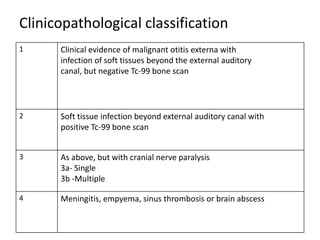
Clinicopathological classification
1 Clinical evidence of malignant otitis externa with
infection of soft tissues beyond the external auditory
canal, but negative Tc-99 bone scan
2 Soft tissue infection beyond external auditory canal with
positive Tc-99 bone scan
3 As above, but with cranial nerve paralysis
3a- Single
3b -Multiple
4 Meningitis, empyema, sinus thrombosis or brain abscess
Treatment:
Medical
• Early infections- oral fluoroquinolone
• Advanced stages- parenteral antibiotics
may be indicated
• Monotherapy with Ceftazidime
• Tobramycin can be used with minimal toxicity if peak
level doses are closely monitored
• Implantable gentamicin
• HBOT
Surgery:
• Debridement of nonviable sequestra of bone,
necrosed and Granulation tissues
• Wide resection:
Bony skull base
Stylomastoid foramen
Jugular bulb
• Introduction of viable, vascularized tissue into the
bed
References
• Scott brown 7th edition
• Ballinger 16th edition
• Cummings 5th edition
• OCNA 2012
• Indian journal of nuclear medicine
THANK YOU

Malignant otitis externa

  • 1.
    MALIGNANT OTITIS EXTERNA DrManohar Suryawanshi ENT Resident, INHS Asvini
  • 2.
    • Anatomy • Introduction •Microbiology • Pathogenesis • Diagnosis • Investigations • Treatment
  • 6.
  • 7.
    Definition • Aggressive andpotentially life-threatening infection of the soft tissues of the external ear and surrounding structures, quickly spreading to involve the periostium and bone of the skull base.
  • 8.
    Microbiology: • Pseudomonas aeruginosa(95%) • Fungus (A. Fumigatus, A. Flavus, A. Niger)
  • 9.
    • Fungal MOE:HIV more commonly than in those who have diabetes • From middle ear or mastoid in contrast to pseudomonal • Pseudomonas infections CD4 levels < 100 cells/mm • AspergillusCD4 counts <50 cells/mm
  • 10.
    Predisposing factors • Diabetesmellitus • Immuno-compromised status
  • 11.
    Pathophysiology: • Cellulitis-> Chondritis->Periostitis-> Osteitis ->Osteomyelitis
  • 12.
    • Facial nerve(stylomastoid foramen) 60% • IX, X and XI • V and VI (petrous apex) • Clivus and contralateral temporal bone can be involved • Infection can spread anteriorly into the sphenoid and to the carotid
  • 13.
    • Thrombosis ofsigmoid sinus, IJV -> meningitis -> cerebral abscess • Haversian system of compact bone • Pneumatoized portion of the temporal bone involved late • Otic capsule is usually spared
  • 14.
    Clinical features: • Long-standingotalgia (worst at night) and otorrhea
  • 15.
    • Cranial nervepalsy • Headaches, fever • Neck stiffness • Altered levels of consciousness
  • 16.
    Hallmark finding: granulationtissue on floor of the ear canal at the bony-cartilaginous junction
  • 17.
    Clinical and microscopicdifferences between bacterial and fungal malignant otitis externa Pathogen Age Diabetes Immunosuppres sion Granulation tissue Middle ear/mastoid involvement Histology Bacterial Older Common Common + - Gram -ve rod Fungal Younger Less common More common - + Septate hyphae, calcium oxalate crystals
  • 18.
    Diagnosis: • Clinical • Biopsy •Pseudomonas aeruginosa on culture • Supported by a positive bone scan and/or the presence of microabscesses at surgery • ESR, CRP
  • 19.
    Investigations: • CT scan •MRI • Technetium-99m bone scan: Osteoblastic activity Highly sensitive for bony infection • SPECT: Good anatomic localization
  • 20.
    Gallium scan: • Increaseduptake during infection • Monitoring and duration of antimicrobial therapy
  • 24.
    technetium Tc 99mMDP bone scan
  • 25.
    Clinicopathological classification 1 Clinicalevidence of malignant otitis externa with infection of soft tissues beyond the external auditory canal, but negative Tc-99 bone scan 2 Soft tissue infection beyond external auditory canal with positive Tc-99 bone scan 3 As above, but with cranial nerve paralysis 3a- Single 3b -Multiple 4 Meningitis, empyema, sinus thrombosis or brain abscess
  • 26.
    Treatment: Medical • Early infections-oral fluoroquinolone • Advanced stages- parenteral antibiotics may be indicated
  • 27.
    • Monotherapy withCeftazidime • Tobramycin can be used with minimal toxicity if peak level doses are closely monitored • Implantable gentamicin • HBOT
  • 28.
    Surgery: • Debridement ofnonviable sequestra of bone, necrosed and Granulation tissues • Wide resection: Bony skull base Stylomastoid foramen Jugular bulb
  • 29.
    • Introduction ofviable, vascularized tissue into the bed
  • 30.
    References • Scott brown7th edition • Ballinger 16th edition • Cummings 5th edition • OCNA 2012 • Indian journal of nuclear medicine
  • 31.

Editor's Notes

  • #4 body of the auricle -elastic fibrocartilage and is a continuous plate except for anarrow gap between the tragus and the anterior crus of the helix-incisura terminalis. lateral surface of the auricle prominences and depressions. Curved rim of helix-Darwins tubercle-small prominence, Concha devided by descending limb of helix. Cymba conchae-suprameatal triangle. Below the crus of the helix -tragus, Opposite the tragus, at the inferior limit of the antihelix, is the antitragus.
  • #5  Eac-2.4cm, carti-8mm and bony-1.6mm. Fissures of santorini
  • #7 Mortality in Malign otit ext-50%
  • #8 Term coined by Chandeler in 1968
  • #11 endarteritis, small vessel obliteration,which, coupled with the ability of Pseudomonas to invade vessel walls and cause a vasculitis with thrombosis and coagulation necrosis of surrounding tissue, underlies the pathophysiology of this disease Microangiopathy, impaired phagocytosis, Cerumen of high PH in DM
  • #12 Fissures of santorini,
  • #14 Complications in children include necrosis of TM, stenosis of the EAC, auricular deformity, and sensorineural and conductive hearing loss
  • #19 combination of pain,granulations, otorrhea and resistance to local therapy for at least eight to ten days are highly sensitive for making a diagnosis of malignant otitis externa. Diabetes or other immunocompromised state, Silver stain for fungal
  • #20 1. CT scan shows even small cortical erosion of the tympanic bone and is a useful first-line test.Disadvantages of CT :under appreciation of the soft tissue and intracranial extent of disease 2. Tc99 MDP detects as little as 10% demineralization 3. Involvement of the retrocondylar fat pad on MRI has been proposed as an early diagnostic
  • #21 1. Ga scan every 4wk, -ve when infection clears 2. Diagnostic accuracy (and expense) may be afforded by the simultaneous acquisition of a SPECT technetium-99m bone scan and indium-111–labeled leukocyte scan.
  • #22 CT scan showing the soft tissue obliterating left external auditory canal left mastoid, infra-temporal fossa, skull base and involving the left TMJ
  • #23 (a) increased signal beneath the skull base that reflects the inflammatory process (arrowed). (b) Indium-labelled white cell scan of the same patient showing increased uptake in the temporal bone
  • #24  SPECT-CT images provide greater definition of the pathological uptake in the right mastoid and petrous bone with no extension beyond the midline.
  • #27 Duration of treatment: 06wks or as indicated by the results of radiologic studies and clinical response.
  • #28 Gentamicin incorporated polymethyl-methacrylate beads were implanted, following surgical debridement, removed after 2 mths.
  • #29 1.Surgical resection-resistant to therapy traditional mastoidectomy should theoretically not be effective in débriding the infection. facial nerve is involved in the region of the stylomastoid foramen, facial nerve decompression
  • #30 e.g. temporalis muscle flap or microvascular free tissue transfer