ATOMIC STRUCTURE


Submitted by: Aditya Dey
   Roll no-1 ,4th sem
       Paper-401


             Submitted to : Dr. P. K. SUKLA
               Assam university,silchar
CONTENTS :
•   Introduction
•   The Greek model
•   The Dalton Model: Billiard Ball Model
•   What did Dalton base his theory on?
•   Limitation of dalton's model
•   J.J. Thomson Model- Plum-pudding Model
•   Problems with Thomson’s Model
•   Ernest Rutherford’s Model
•   Limitations of Rutherford's Model
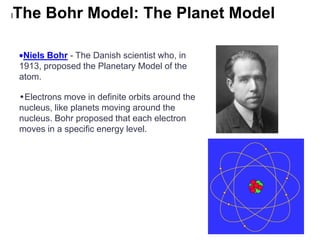
•   The Bohr Model: The Planet Model
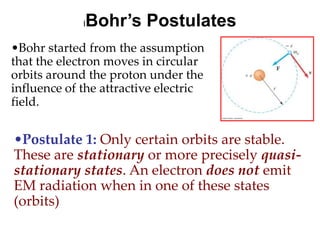
•   Bohr’s Postulates
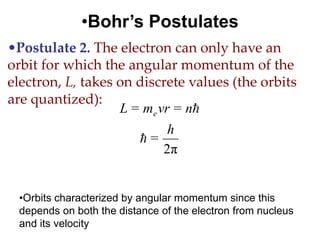
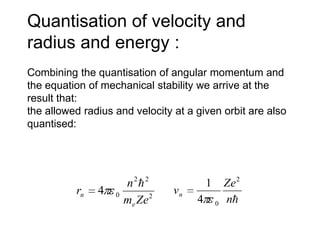
•   Quantisation of velocity and radius and energy
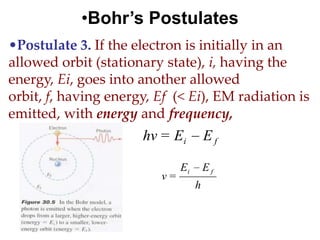
•   Sommerfeld’s relativistic atom model
•   Conclusion
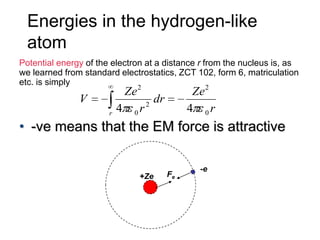
•   References
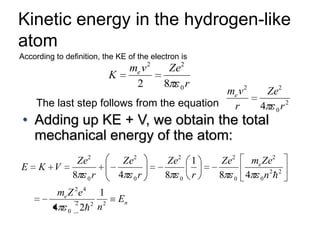
•INTRODUCTION:

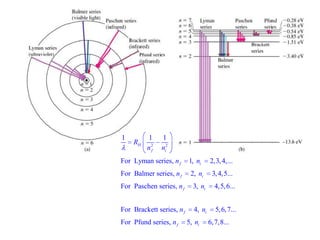
   •Atoms are so small that, even today, direct visual
inspection is all but impossible. Our model of the atom is
based on indirect experimental data. Because of this, our
  model of the atom changes as our experimental ability
                         improves
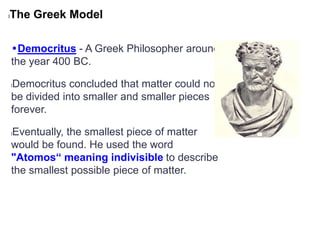
l   The Greek Model

    •Democritus - A Greek Philosopher around
    the year 400 BC.

    Democritus concluded that matter could not
    l

    be divided into smaller and smaller pieces
    forever.

    Eventually, the smallest piece of matter
    l

    would be found. He used the word
    "Atomos“ meaning indivisible to describe
    the smallest possible piece of matter.
The Dalton Model: Billiard Ball
  l

  Model
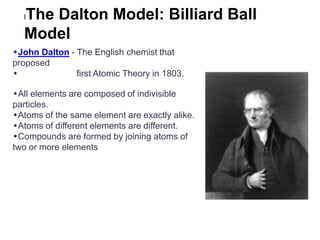
•John Dalton - The English chemist that
proposed
•              first Atomic Theory in 1803.

•All elements are composed of indivisible
particles.
•Atoms of the same element are exactly alike.
•Atoms of different elements are different.
•Compounds are formed by joining atoms of
two or more elements
l   What did Dalton base his theory on?

–Law of Conservation of Mass (Antoine
Lavosier, 1789)
  •Atoms are neither created or destroyed
  (under normal chemical reactions)
–Law of Definite Proportion, (Proust's Law)
  •Atom ratio is fixed, so mass must be
  constant.
–Law of Multiple Proportions (Dalton)
  •Applies where two elements, A and B, form
  more than one compound.
LIMITATION OF DALTON'S MODEL:


lMost of Dalton’s theory is accepted today
•However, We now know that atoms ARE divisible
•Atoms contain sub-atomic particles
•ELECTRONS
•PROTONS
lNEUTRONS
J.J. Thomson Model- Plum-pudding Model:

lJ. J. Thomson 1856 – 1940 - The English scientist who
ldiscovered Electrons in 1887.

Thomson determined the charge
of an electron to be negative in his
cathode ray experiment
Thompson initially called electrons
CORPUSLES.
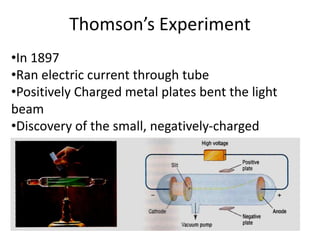
Thomson’s Experiment
•In 1897
•Ran electric current through tube
•Positively Charged metal plates bent the light
beam
•Discovery of the small, negatively-charged
electron
•Atoms are made of smaller parts
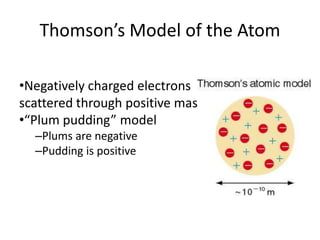
Thomson’s Model of the Atom

•Negatively charged electrons
scattered through positive mass
•“Plum pudding” model
  –Plums are negative
  –Pudding is positive
Problems with Thomson’s Model
  l


•How does the atom emit radiation?
•This model soon came into conflict with
experiments by Rutherford
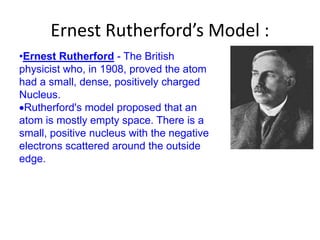
Ernest Rutherford’s Model :
•Ernest Rutherford - The British
physicist who, in 1908, proved the atom
had a small, dense, positively charged
Nucleus.
 Rutherford's model proposed that an
atom is mostly empty space. There is a
small, positive nucleus with the negative
electrons scattered around the outside
edge.
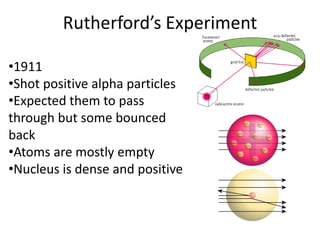
Rutherford’s Experiment

•1911
•Shot positive alpha particles
•Expected them to pass
through but some bounced
back
•Atoms are mostly empty
•Nucleus is dense and positive
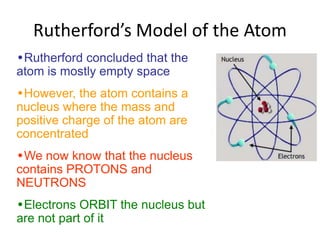
Rutherford’s Model of the Atom
•Rutherford concluded that the
atom is mostly empty space
•However, the atom contains a
nucleus where the mass and
positive charge of the atom are
concentrated
•We now know that the nucleus
contains PROTONS and
NEUTRONS
•Electrons ORBIT the nucleus but
are not part of it
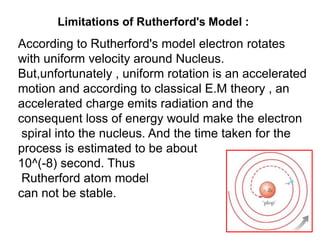
Limitations of Rutherford's Model :
According to Rutherford's model electron rotates
with uniform velocity around Nucleus.
But,unfortunately , uniform rotation is an accelerated
motion and according to classical E.M theory , an
accelerated charge emits radiation and the
consequent loss of energy would make the electron
 spiral into the nucleus. And the time taken for the
process is estimated to be about
10^(-8) second. Thus
 Rutherford atom model
can not be stable.
l   The Bohr Model: The Planet Model

     Niels Bohr - The Danish scientist who, in
    1913, proposed the Planetary Model of the
    atom.

    •Electrons move in definite orbits around the
    nucleus, like planets moving around the
    nucleus. Bohr proposed that each electron
    moves in a specific energy level.
Bohr’s Postulates
             l


•Bohr started from the assumption
that the electron moves in circular
orbits around the proton under the
influence of the attractive electric
field.


•Postulate 1: Only certain orbits are stable.
These are stationary or more precisely quasi-
stationary states. An electron does not emit
EM radiation when in one of these states
(orbits)
•Bohr’s Postulates
•Postulate 2. The electron can only have an
orbit for which the angular momentum of the
electron, L, takes on discrete values (the orbits
are quantized):
                   L = me vr = n
                            h
                      =
                           2π


 •Orbits characterized by angular momentum since this
 depends on both the distance of the electron from nucleus
 and its velocity
•Bohr’s Postulates
•Postulate 3. If the electron is initially in an
allowed orbit (stationary state), i, having the
energy, Ei, goes into another allowed
orbit, f, having energy, Ef (< Ei), EM radiation is
emitted, with energy and frequency,
                      hν = Ei          Ef

                              Ei       Ef
                         ν=
                                   h
Quantisation of velocity and
radius and energy :
Combining the quantisation of angular momentum and
the equation of mechanical stability we arrive at the
result that:
the allowed radius and velocity at a given orbit are also
quantised:


                       n2 2              1       Ze 2
          rn   4   0             vn
                       me Ze 2        4       0   n
Energies in the hydrogen-like
  atom
Potential energy of the electron at a distance r from the nucleus is, as
we learned from standard electrostatics, ZCT 102, form 6, matriculation
etc. is simply
                            Ze 2              Ze 2
               V                 2
                                   dr
                       r   4 0r              4 0r
• -ve means that the EM force is attractive

                                               -e
                               +Ze      Fe
Kinetic energy in the hydrogen-like
atom
According to definition, the KE of the electron is
                                   me v 2    Ze2
                          K
                                    2       8 0r
                                             me v 2            Ze2
     The last step follows from the equation  r               4 0r2
• Adding up KE + V, we obtain the total
  mechanical energy of the atom:
                Ze2            Ze2          Ze2 1    Ze2  me Ze2
E    K V
               8 0r           4 0r          8 0 r    8 0 4 0 n 2 2
           me Z 2e 4 1
                2     2
                              En
          4 0 2 2 n
1        1     1
    RH
         n2
          f    ni2
For Lyman series, n f      1, ni     2,3, 4,...
For Balmer series, n f      2, ni     3, 4,5...
For Paschen series, n f      3, ni     4,5, 6...


For Brackett series, n f     4, ni      5, 6, 7...
For Pfund series, n f      5, ni     6, 7,8...
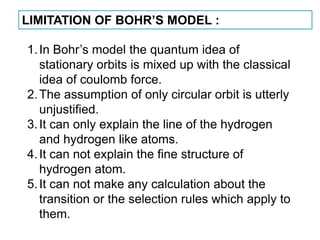
LIMITATION OF BOHR’S MODEL :

1. In Bohr’s model the quantum idea of
   stationary orbits is mixed up with the classical
   idea of coulomb force.
2. The assumption of only circular orbit is utterly
   unjustified.
3. It can only explain the line of the hydrogen
   and hydrogen like atoms.
4. It can not explain the fine structure of
   hydrogen atom.
5. It can not make any calculation about the
   transition or the selection rules which apply to
   them.
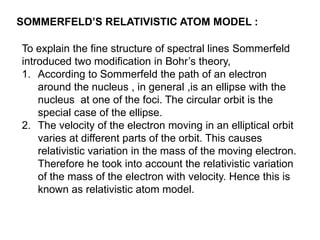
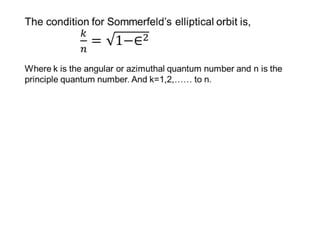
SOMMERFELD’S RELATIVISTIC ATOM MODEL :

To explain the fine structure of spectral lines Sommerfeld
introduced two modification in Bohr’s theory,
1. According to Sommerfeld the path of an electron
    around the nucleus , in general ,is an ellipse with the
    nucleus at one of the foci. The circular orbit is the
    special case of the ellipse.
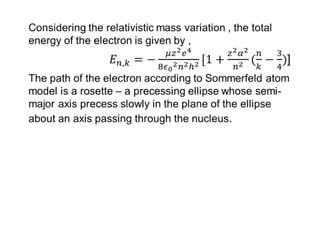
2. The velocity of the electron moving in an elliptical orbit
    varies at different parts of the orbit. This causes
    relativistic variation in the mass of the moving electron.
    Therefore he took into account the relativistic variation
    of the mass of the electron with velocity. Hence this is
    known as relativistic atom model.
REFERENCES :
1. MODERN ATOMIC AND NUCLEAR PHYSICS- A. B.
   GUPTA

2. ATOMIC AND MOLECULAR SPECTRA-LASER –RAJ
   KUMAR
01.aditya  atomic models  [repaired]

01.aditya atomic models [repaired]

  • 1.
    ATOMIC STRUCTURE Submitted by:Aditya Dey Roll no-1 ,4th sem Paper-401 Submitted to : Dr. P. K. SUKLA Assam university,silchar
  • 2.
    CONTENTS : • Introduction • The Greek model • The Dalton Model: Billiard Ball Model • What did Dalton base his theory on? • Limitation of dalton's model • J.J. Thomson Model- Plum-pudding Model • Problems with Thomson’s Model • Ernest Rutherford’s Model • Limitations of Rutherford's Model • The Bohr Model: The Planet Model • Bohr’s Postulates • Quantisation of velocity and radius and energy • Sommerfeld’s relativistic atom model • Conclusion • References
  • 3.
    •INTRODUCTION: •Atoms are so small that, even today, direct visual inspection is all but impossible. Our model of the atom is based on indirect experimental data. Because of this, our model of the atom changes as our experimental ability improves
  • 4.
    l The Greek Model •Democritus - A Greek Philosopher around the year 400 BC. Democritus concluded that matter could not l be divided into smaller and smaller pieces forever. Eventually, the smallest piece of matter l would be found. He used the word "Atomos“ meaning indivisible to describe the smallest possible piece of matter.
  • 5.
    The Dalton Model:Billiard Ball l Model •John Dalton - The English chemist that proposed • first Atomic Theory in 1803. •All elements are composed of indivisible particles. •Atoms of the same element are exactly alike. •Atoms of different elements are different. •Compounds are formed by joining atoms of two or more elements
  • 6.
    l What did Dalton base his theory on? –Law of Conservation of Mass (Antoine Lavosier, 1789) •Atoms are neither created or destroyed (under normal chemical reactions) –Law of Definite Proportion, (Proust's Law) •Atom ratio is fixed, so mass must be constant. –Law of Multiple Proportions (Dalton) •Applies where two elements, A and B, form more than one compound.
  • 7.
    LIMITATION OF DALTON'SMODEL: lMost of Dalton’s theory is accepted today •However, We now know that atoms ARE divisible •Atoms contain sub-atomic particles •ELECTRONS •PROTONS lNEUTRONS
  • 8.
    J.J. Thomson Model-Plum-pudding Model: lJ. J. Thomson 1856 – 1940 - The English scientist who ldiscovered Electrons in 1887. Thomson determined the charge of an electron to be negative in his cathode ray experiment Thompson initially called electrons CORPUSLES.
  • 9.
    Thomson’s Experiment •In 1897 •Ranelectric current through tube •Positively Charged metal plates bent the light beam •Discovery of the small, negatively-charged electron •Atoms are made of smaller parts
  • 10.
    Thomson’s Model ofthe Atom •Negatively charged electrons scattered through positive mass •“Plum pudding” model –Plums are negative –Pudding is positive
  • 11.
    Problems with Thomson’sModel l •How does the atom emit radiation? •This model soon came into conflict with experiments by Rutherford
  • 12.
    Ernest Rutherford’s Model: •Ernest Rutherford - The British physicist who, in 1908, proved the atom had a small, dense, positively charged Nucleus. Rutherford's model proposed that an atom is mostly empty space. There is a small, positive nucleus with the negative electrons scattered around the outside edge.
  • 13.
    Rutherford’s Experiment •1911 •Shot positivealpha particles •Expected them to pass through but some bounced back •Atoms are mostly empty •Nucleus is dense and positive
  • 14.
    Rutherford’s Model ofthe Atom •Rutherford concluded that the atom is mostly empty space •However, the atom contains a nucleus where the mass and positive charge of the atom are concentrated •We now know that the nucleus contains PROTONS and NEUTRONS •Electrons ORBIT the nucleus but are not part of it
  • 15.
    Limitations of Rutherford'sModel : According to Rutherford's model electron rotates with uniform velocity around Nucleus. But,unfortunately , uniform rotation is an accelerated motion and according to classical E.M theory , an accelerated charge emits radiation and the consequent loss of energy would make the electron spiral into the nucleus. And the time taken for the process is estimated to be about 10^(-8) second. Thus Rutherford atom model can not be stable.
  • 16.
    l The Bohr Model: The Planet Model Niels Bohr - The Danish scientist who, in 1913, proposed the Planetary Model of the atom. •Electrons move in definite orbits around the nucleus, like planets moving around the nucleus. Bohr proposed that each electron moves in a specific energy level.
  • 17.
    Bohr’s Postulates l •Bohr started from the assumption that the electron moves in circular orbits around the proton under the influence of the attractive electric field. •Postulate 1: Only certain orbits are stable. These are stationary or more precisely quasi- stationary states. An electron does not emit EM radiation when in one of these states (orbits)
  • 18.
    •Bohr’s Postulates •Postulate 2.The electron can only have an orbit for which the angular momentum of the electron, L, takes on discrete values (the orbits are quantized): L = me vr = n h = 2π •Orbits characterized by angular momentum since this depends on both the distance of the electron from nucleus and its velocity
  • 19.
    •Bohr’s Postulates •Postulate 3.If the electron is initially in an allowed orbit (stationary state), i, having the energy, Ei, goes into another allowed orbit, f, having energy, Ef (< Ei), EM radiation is emitted, with energy and frequency, hν = Ei Ef Ei Ef ν= h
  • 20.
    Quantisation of velocityand radius and energy : Combining the quantisation of angular momentum and the equation of mechanical stability we arrive at the result that: the allowed radius and velocity at a given orbit are also quantised: n2 2 1 Ze 2 rn 4 0 vn me Ze 2 4 0 n
  • 21.
    Energies in thehydrogen-like atom Potential energy of the electron at a distance r from the nucleus is, as we learned from standard electrostatics, ZCT 102, form 6, matriculation etc. is simply Ze 2 Ze 2 V 2 dr r 4 0r 4 0r • -ve means that the EM force is attractive -e +Ze Fe
  • 22.
    Kinetic energy inthe hydrogen-like atom According to definition, the KE of the electron is me v 2 Ze2 K 2 8 0r me v 2 Ze2 The last step follows from the equation r 4 0r2 • Adding up KE + V, we obtain the total mechanical energy of the atom: Ze2 Ze2 Ze2 1 Ze2 me Ze2 E K V 8 0r 4 0r 8 0 r 8 0 4 0 n 2 2 me Z 2e 4 1 2 2 En 4 0 2 2 n
  • 23.
    1 1 1 RH n2 f ni2 For Lyman series, n f 1, ni 2,3, 4,... For Balmer series, n f 2, ni 3, 4,5... For Paschen series, n f 3, ni 4,5, 6... For Brackett series, n f 4, ni 5, 6, 7... For Pfund series, n f 5, ni 6, 7,8...
  • 24.
    LIMITATION OF BOHR’SMODEL : 1. In Bohr’s model the quantum idea of stationary orbits is mixed up with the classical idea of coulomb force. 2. The assumption of only circular orbit is utterly unjustified. 3. It can only explain the line of the hydrogen and hydrogen like atoms. 4. It can not explain the fine structure of hydrogen atom. 5. It can not make any calculation about the transition or the selection rules which apply to them.
  • 25.
    SOMMERFELD’S RELATIVISTIC ATOMMODEL : To explain the fine structure of spectral lines Sommerfeld introduced two modification in Bohr’s theory, 1. According to Sommerfeld the path of an electron around the nucleus , in general ,is an ellipse with the nucleus at one of the foci. The circular orbit is the special case of the ellipse. 2. The velocity of the electron moving in an elliptical orbit varies at different parts of the orbit. This causes relativistic variation in the mass of the moving electron. Therefore he took into account the relativistic variation of the mass of the electron with velocity. Hence this is known as relativistic atom model.
  • 28.
    REFERENCES : 1. MODERNATOMIC AND NUCLEAR PHYSICS- A. B. GUPTA 2. ATOMIC AND MOLECULAR SPECTRA-LASER –RAJ KUMAR