Prepared by-
Shaishav Shah(170120116094)
Guided by – Prof. Bhumi Shah
Gandhinagar Institute of Technology
SUBJECT - ADA(2150703 )
Asymptotic Notations
• Execution time of an algorithm depends on the
instruction set, processor speed, disk I/O speed, etc.
• Hence, we estimate the efficiency of an algorithm
asymptotically.
• Time function of an algorithm is represented by T(n),
where n is the input size.
Types of asymptotic notations used to
represent the complexity of an
algorithm
• Following asymptotic notations are used to calculate
the running time complexity of an algorithm.
– O − Big Oh
– Ω − Big omega
– θ − Big theta
– o − Little Oh
– ω − Little omega
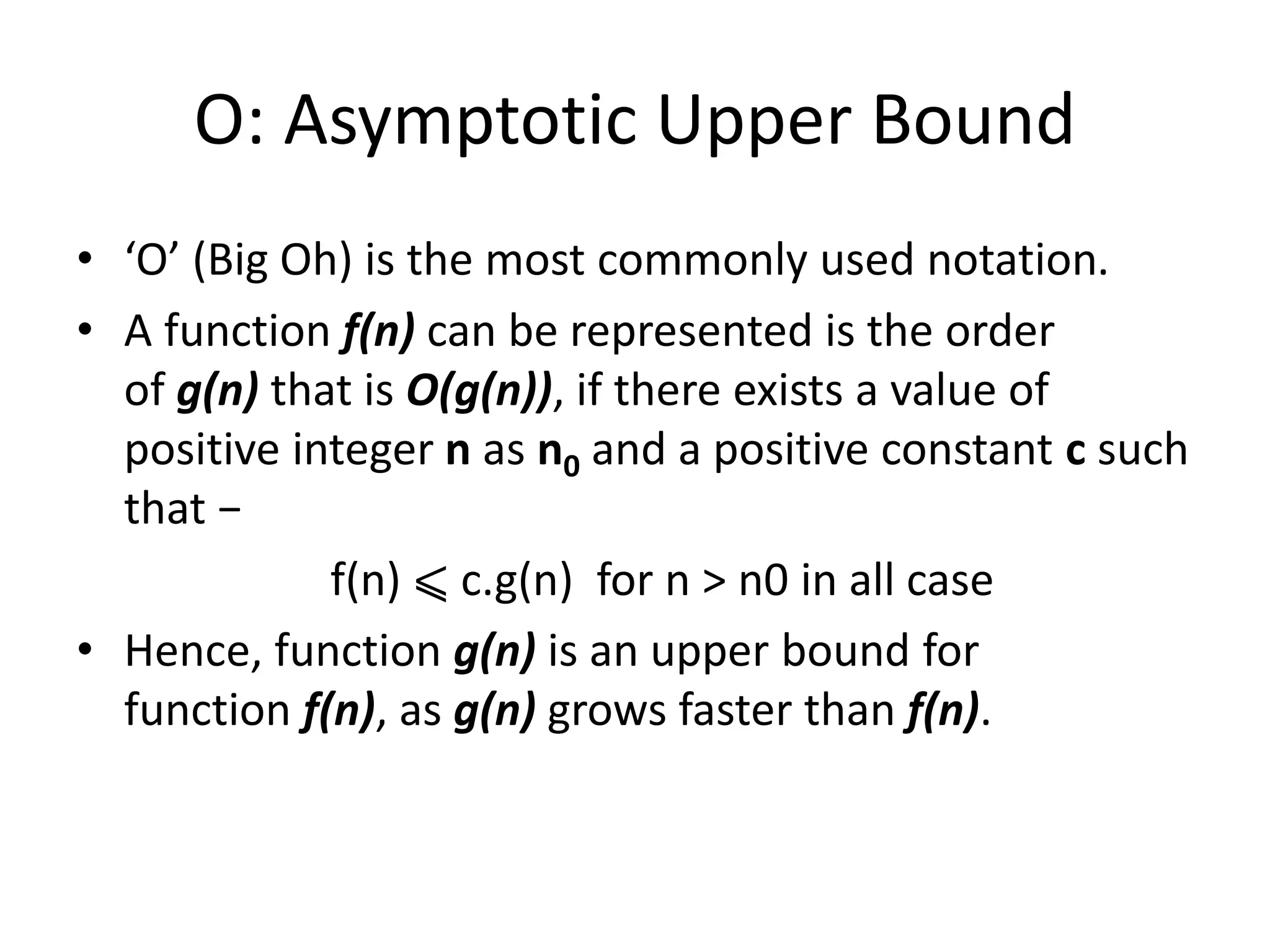
O: Asymptotic Upper Bound
• ‘O’ (Big Oh) is the most commonly used notation.
• A function f(n) can be represented is the order
of g(n) that is O(g(n)), if there exists a value of
positive integer n as n0 and a positive constant c such
that −
f(n) ⩽ c.g(n) for n > n0 in all case
• Hence, function g(n) is an upper bound for
function f(n), as g(n) grows faster than f(n).
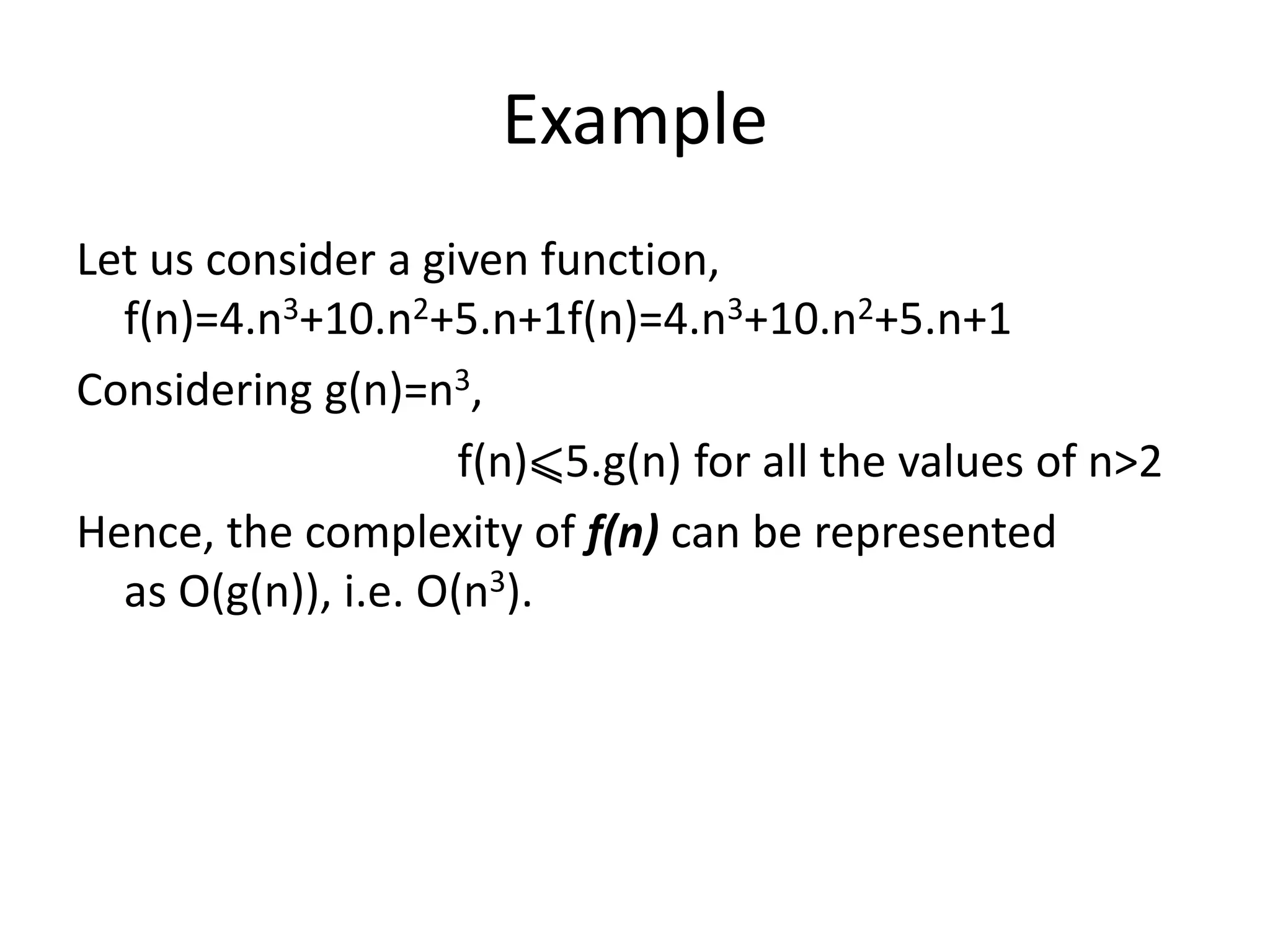
Example
Let us consider a given function,
f(n)=4.n3+10.n2+5.n+1f(n)=4.n3+10.n2+5.n+1
Considering g(n)=n3,
f(n)⩽5.g(n) for all the values of n>2
Hence, the complexity of f(n) can be represented
as O(g(n)), i.e. O(n3).
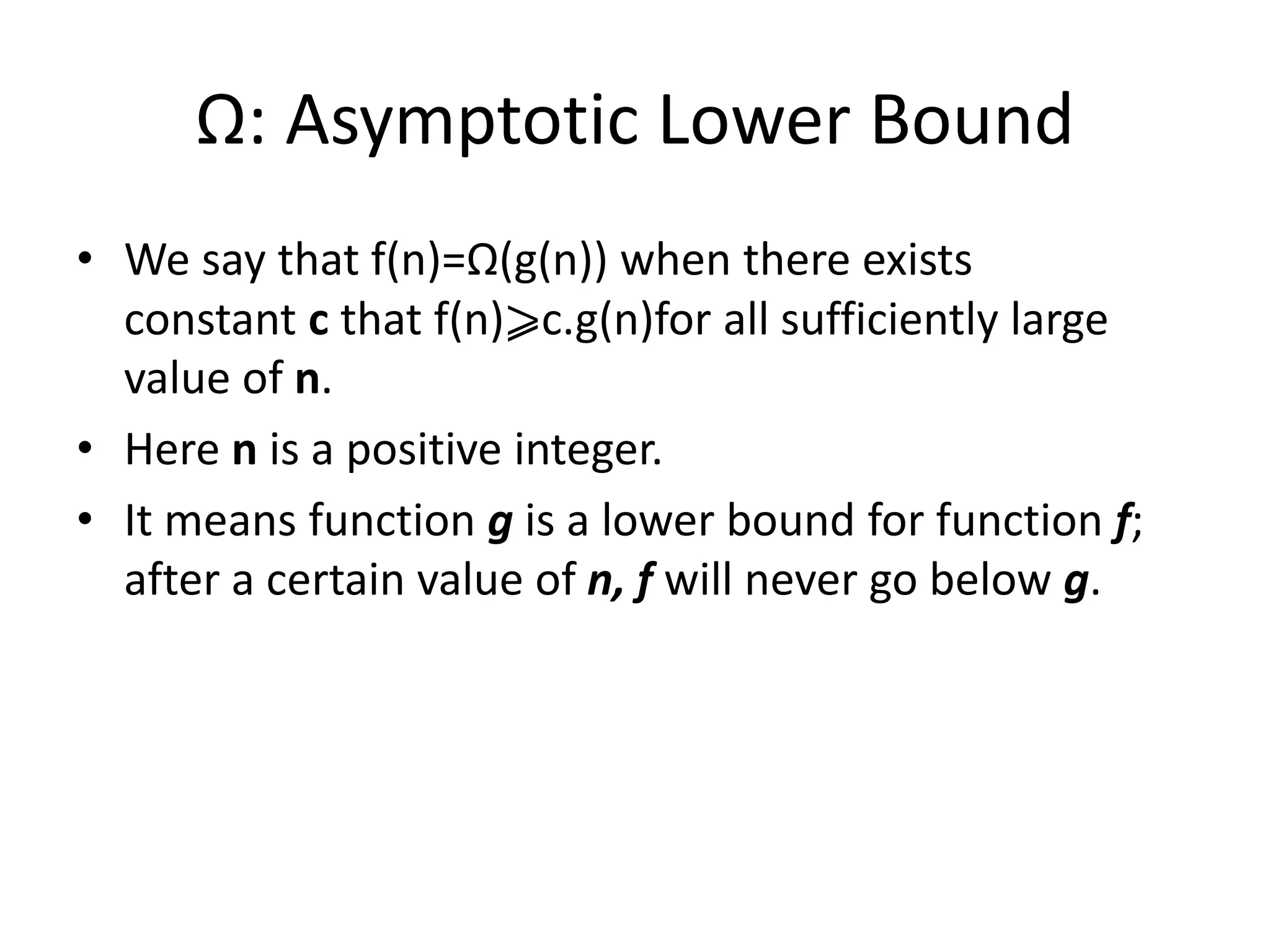
Ω: Asymptotic Lower Bound
• We say that f(n)=Ω(g(n)) when there exists
constant c that f(n)⩾c.g(n)for all sufficiently large
value of n.
• Here n is a positive integer.
• It means function g is a lower bound for function f;
after a certain value of n, f will never go below g.
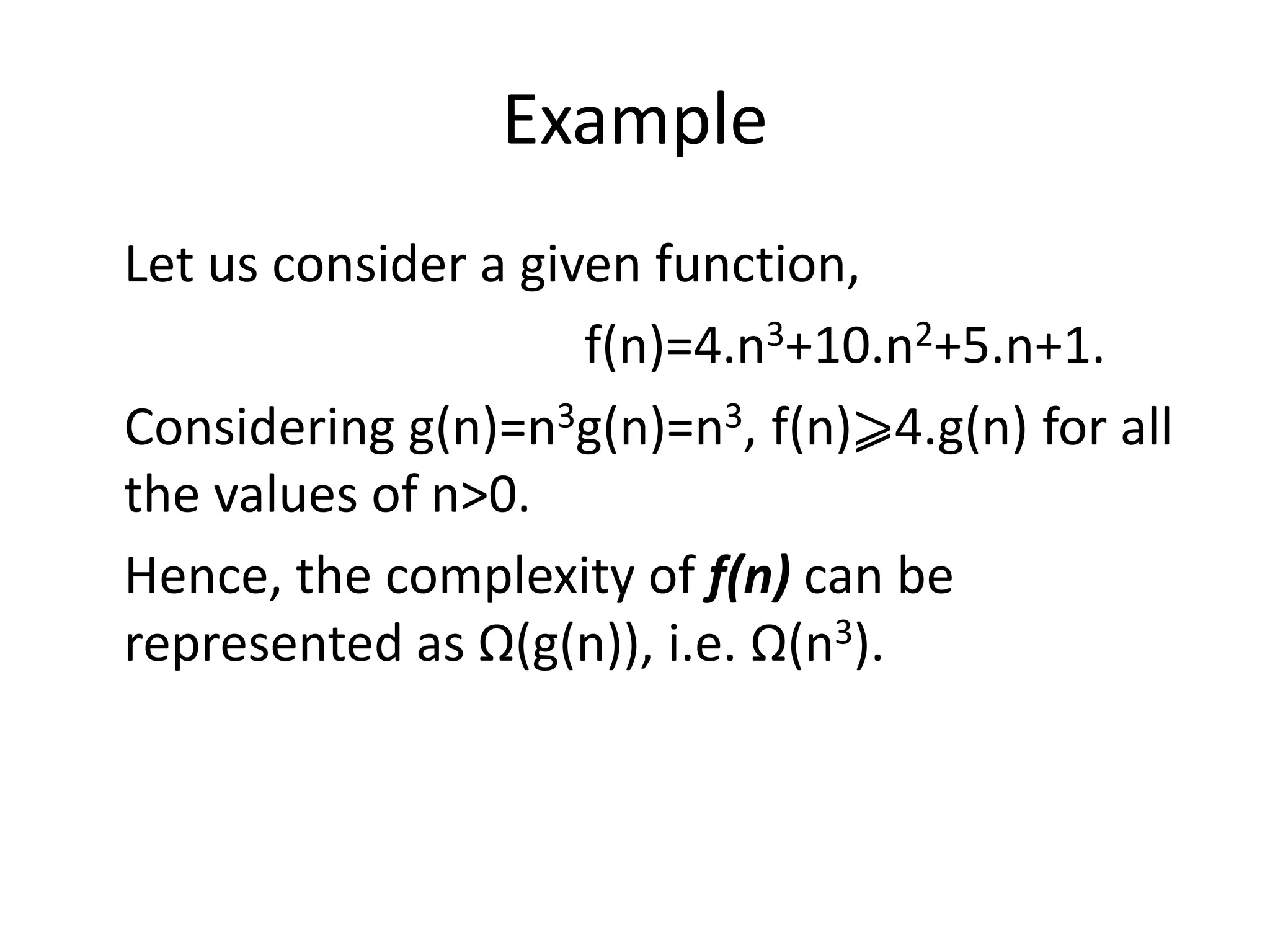
Example
Let us consider a given function,
f(n)=4.n3+10.n2+5.n+1.
Considering g(n)=n3g(n)=n3, f(n)⩾4.g(n) for all
the values of n>0.
Hence, the complexity of f(n) can be
represented as Ω(g(n)), i.e. Ω(n3).
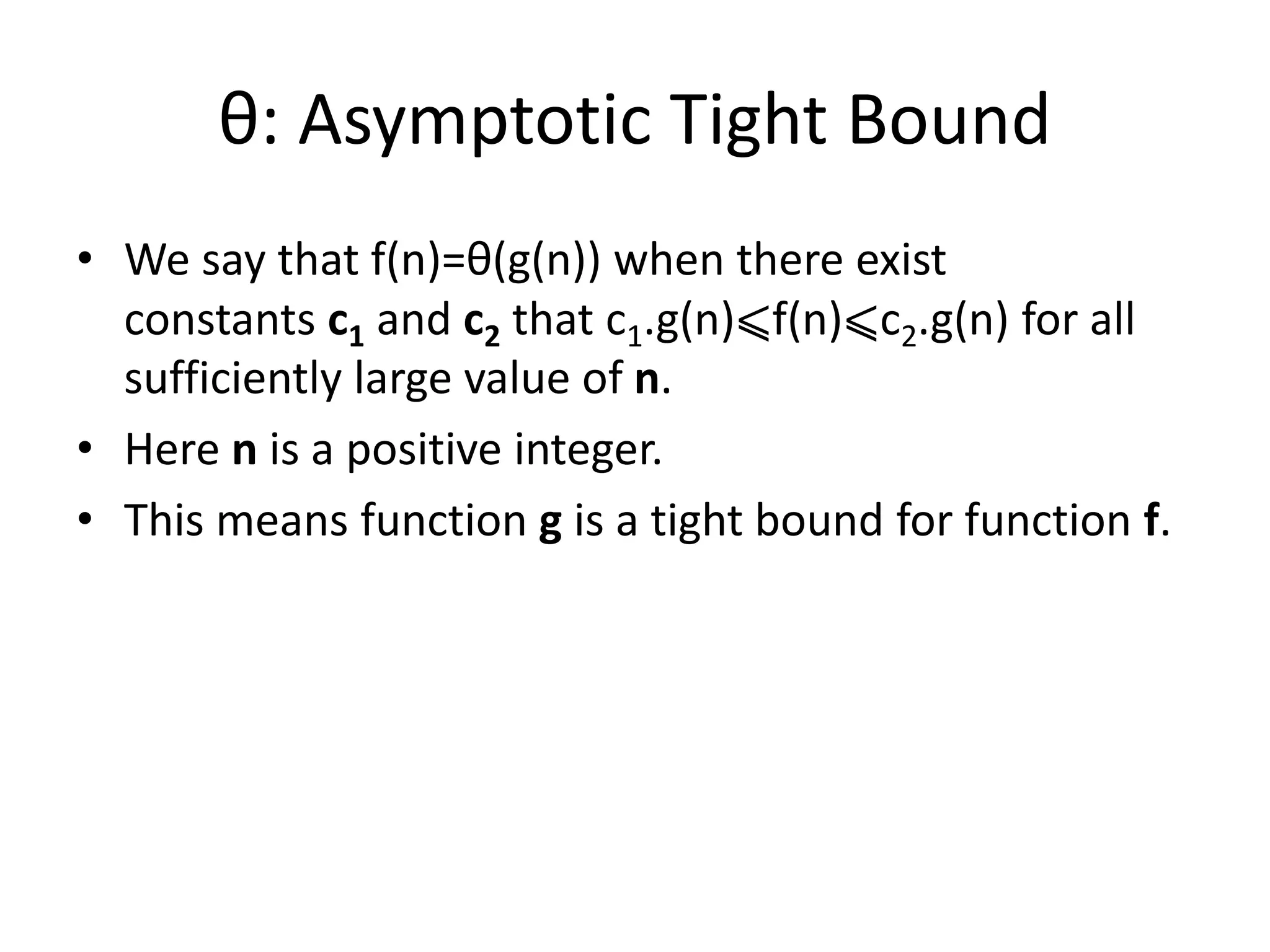
θ: Asymptotic Tight Bound
• We say that f(n)=θ(g(n)) when there exist
constants c1 and c2 that c1.g(n)⩽f(n)⩽c2.g(n) for all
sufficiently large value of n.
• Here n is a positive integer.
• This means function g is a tight bound for function f.
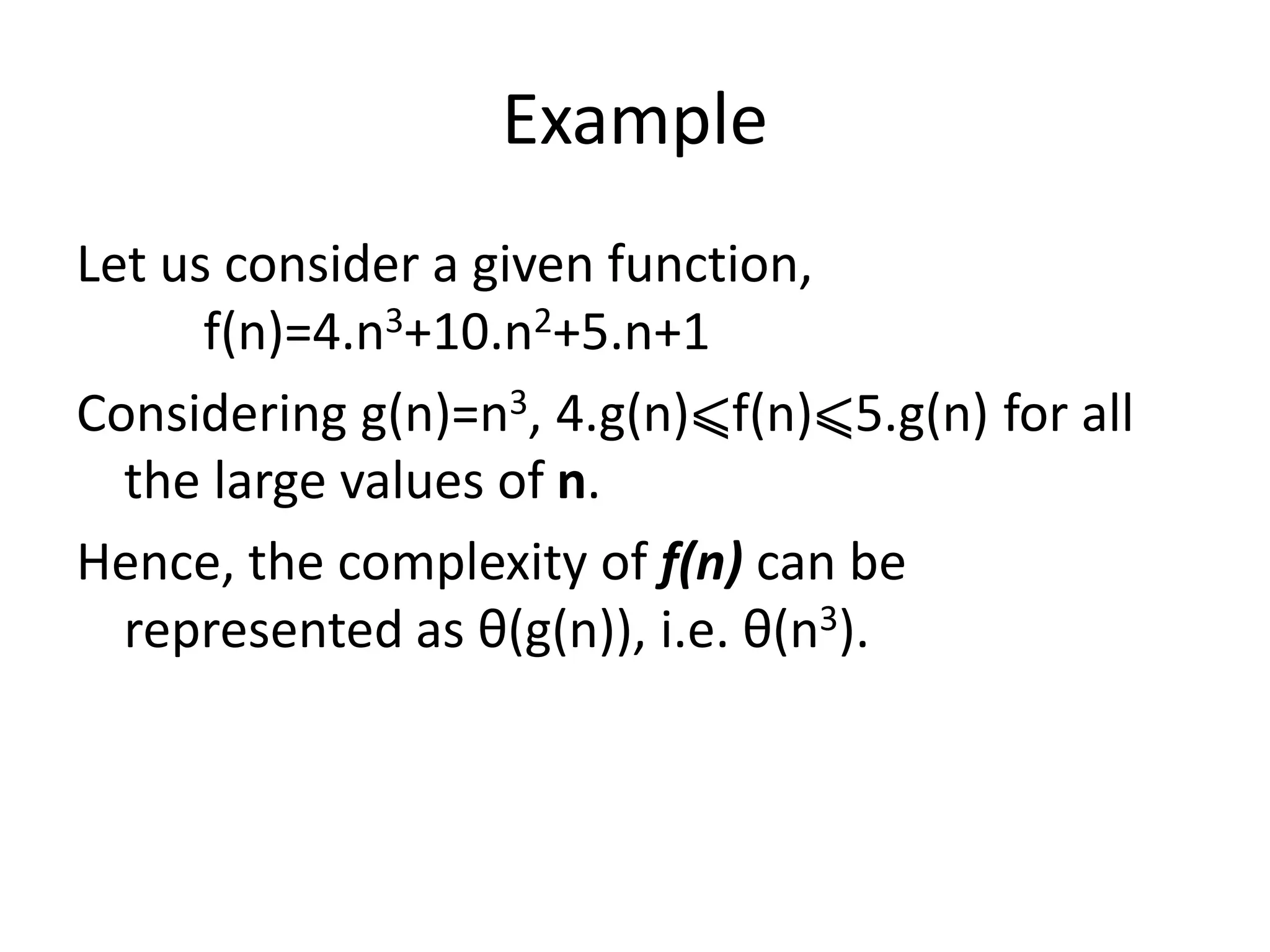
Example
Let us consider a given function,
f(n)=4.n3+10.n2+5.n+1
Considering g(n)=n3, 4.g(n)⩽f(n)⩽5.g(n) for all
the large values of n.
Hence, the complexity of f(n) can be
represented as θ(g(n)), i.e. θ(n3).
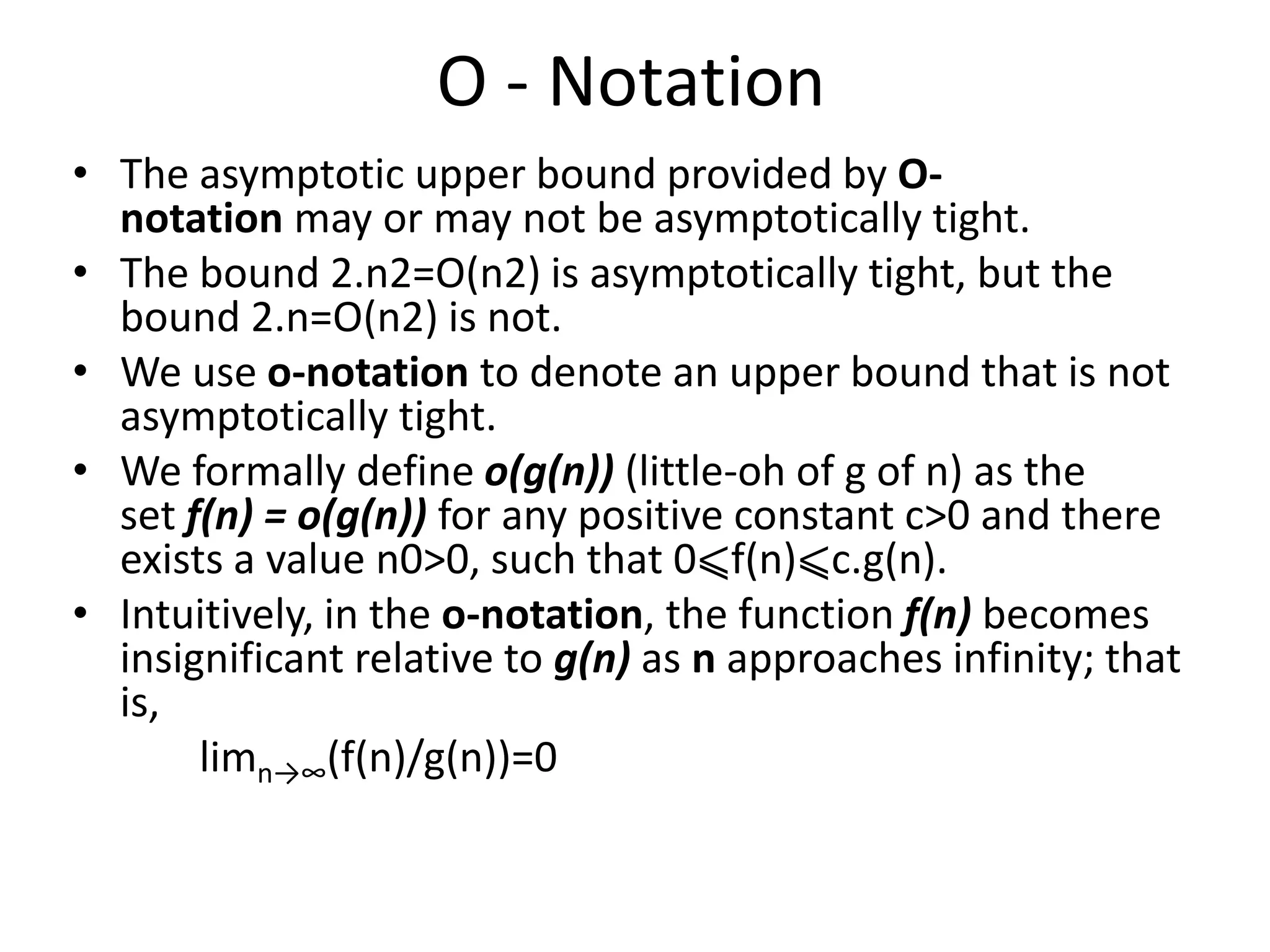
O - Notation
• The asymptotic upper bound provided by O-
notation may or may not be asymptotically tight.
• The bound 2.n2=O(n2) is asymptotically tight, but the
bound 2.n=O(n2) is not.
• We use o-notation to denote an upper bound that is not
asymptotically tight.
• We formally define o(g(n)) (little-oh of g of n) as the
set f(n) = o(g(n)) for any positive constant c>0 and there
exists a value n0>0, such that 0⩽f(n)⩽c.g(n).
• Intuitively, in the o-notation, the function f(n) becomes
insignificant relative to g(n) as n approaches infinity; that
is,
limn→∞(f(n)/g(n))=0
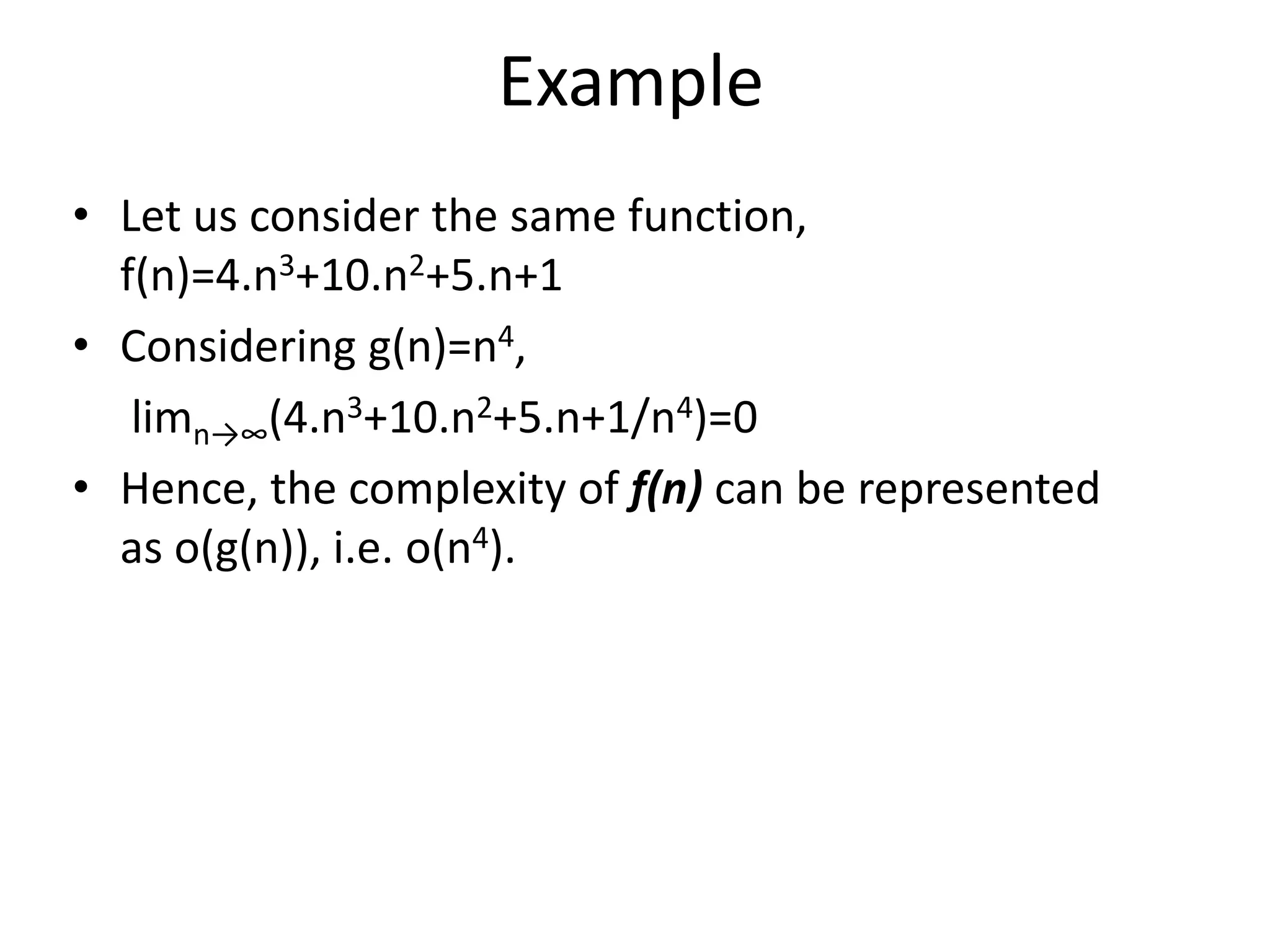
Example
• Let us consider the same function,
f(n)=4.n3+10.n2+5.n+1
• Considering g(n)=n4,
limn→∞(4.n3+10.n2+5.n+1/n4)=0
• Hence, the complexity of f(n) can be represented
as o(g(n)), i.e. o(n4).
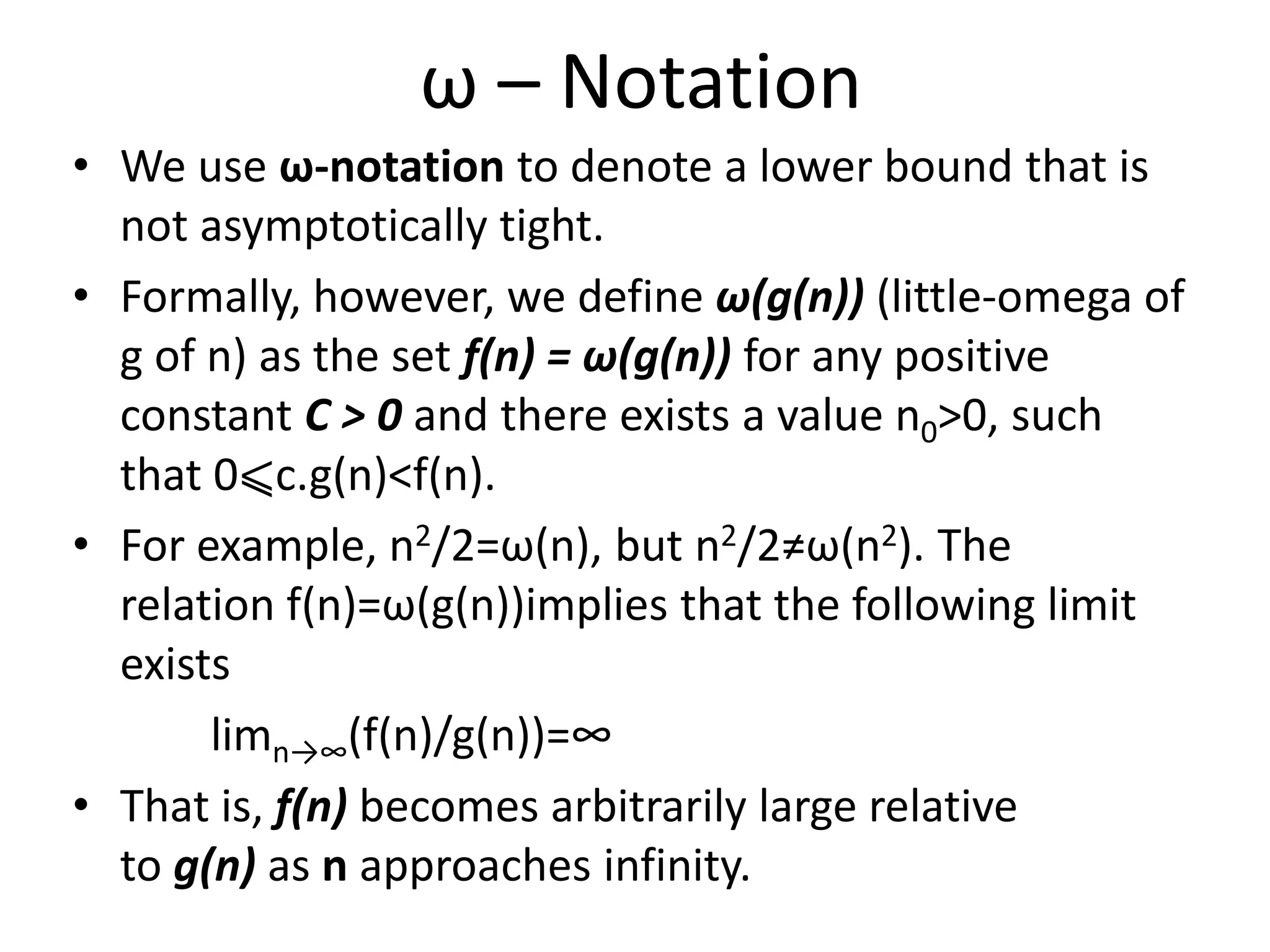
ω – Notation
• We use ω-notation to denote a lower bound that is
not asymptotically tight.
• Formally, however, we define ω(g(n)) (little-omega of
g of n) as the set f(n) = ω(g(n)) for any positive
constant C > 0 and there exists a value n0>0, such
that 0⩽c.g(n)<f(n).
• For example, n2/2=ω(n), but n2/2≠ω(n2). The
relation f(n)=ω(g(n))implies that the following limit
exists
limn→∞(f(n)/g(n))=∞
• That is, f(n) becomes arbitrarily large relative
to g(n) as n approaches infinity.
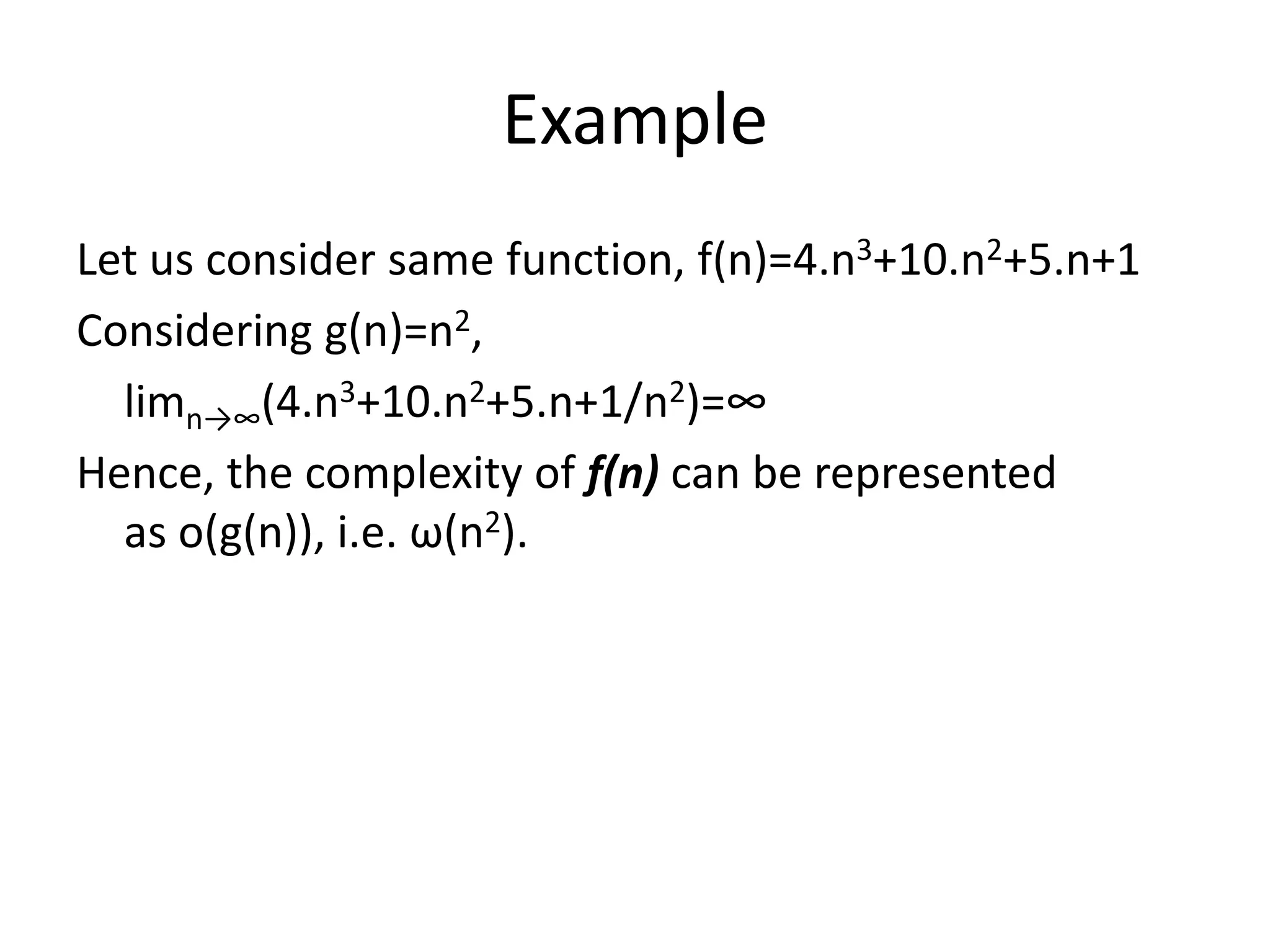
Example
Let us consider same function, f(n)=4.n3+10.n2+5.n+1
Considering g(n)=n2,
limn→∞(4.n3+10.n2+5.n+1/n2)=∞
Hence, the complexity of f(n) can be represented
as o(g(n)), i.e. ω(n2).
Thank You

Asymptotic notations ada

  • 1.
    Prepared by- Shaishav Shah(170120116094) Guidedby – Prof. Bhumi Shah Gandhinagar Institute of Technology SUBJECT - ADA(2150703 ) Asymptotic Notations
  • 2.
  • 3.
    Asymptotic Notations • Executiontime of an algorithm depends on the instruction set, processor speed, disk I/O speed, etc. • Hence, we estimate the efficiency of an algorithm asymptotically. • Time function of an algorithm is represented by T(n), where n is the input size.
  • 4.
    Types of asymptoticnotations used to represent the complexity of an algorithm • Following asymptotic notations are used to calculate the running time complexity of an algorithm. – O − Big Oh – Ω − Big omega – θ − Big theta – o − Little Oh – ω − Little omega
  • 5.
    O: Asymptotic UpperBound • ‘O’ (Big Oh) is the most commonly used notation. • A function f(n) can be represented is the order of g(n) that is O(g(n)), if there exists a value of positive integer n as n0 and a positive constant c such that − f(n) ⩽ c.g(n) for n > n0 in all case • Hence, function g(n) is an upper bound for function f(n), as g(n) grows faster than f(n).
  • 6.
    Example Let us considera given function, f(n)=4.n3+10.n2+5.n+1f(n)=4.n3+10.n2+5.n+1 Considering g(n)=n3, f(n)⩽5.g(n) for all the values of n>2 Hence, the complexity of f(n) can be represented as O(g(n)), i.e. O(n3).
  • 7.
    Ω: Asymptotic LowerBound • We say that f(n)=Ω(g(n)) when there exists constant c that f(n)⩾c.g(n)for all sufficiently large value of n. • Here n is a positive integer. • It means function g is a lower bound for function f; after a certain value of n, f will never go below g.
  • 8.
    Example Let us considera given function, f(n)=4.n3+10.n2+5.n+1. Considering g(n)=n3g(n)=n3, f(n)⩾4.g(n) for all the values of n>0. Hence, the complexity of f(n) can be represented as Ω(g(n)), i.e. Ω(n3).
  • 9.
    θ: Asymptotic TightBound • We say that f(n)=θ(g(n)) when there exist constants c1 and c2 that c1.g(n)⩽f(n)⩽c2.g(n) for all sufficiently large value of n. • Here n is a positive integer. • This means function g is a tight bound for function f.
  • 10.
    Example Let us considera given function, f(n)=4.n3+10.n2+5.n+1 Considering g(n)=n3, 4.g(n)⩽f(n)⩽5.g(n) for all the large values of n. Hence, the complexity of f(n) can be represented as θ(g(n)), i.e. θ(n3).
  • 11.
    O - Notation •The asymptotic upper bound provided by O- notation may or may not be asymptotically tight. • The bound 2.n2=O(n2) is asymptotically tight, but the bound 2.n=O(n2) is not. • We use o-notation to denote an upper bound that is not asymptotically tight. • We formally define o(g(n)) (little-oh of g of n) as the set f(n) = o(g(n)) for any positive constant c>0 and there exists a value n0>0, such that 0⩽f(n)⩽c.g(n). • Intuitively, in the o-notation, the function f(n) becomes insignificant relative to g(n) as n approaches infinity; that is, limn→∞(f(n)/g(n))=0
  • 12.
    Example • Let usconsider the same function, f(n)=4.n3+10.n2+5.n+1 • Considering g(n)=n4, limn→∞(4.n3+10.n2+5.n+1/n4)=0 • Hence, the complexity of f(n) can be represented as o(g(n)), i.e. o(n4).
  • 13.
    ω – Notation •We use ω-notation to denote a lower bound that is not asymptotically tight. • Formally, however, we define ω(g(n)) (little-omega of g of n) as the set f(n) = ω(g(n)) for any positive constant C > 0 and there exists a value n0>0, such that 0⩽c.g(n)<f(n). • For example, n2/2=ω(n), but n2/2≠ω(n2). The relation f(n)=ω(g(n))implies that the following limit exists limn→∞(f(n)/g(n))=∞ • That is, f(n) becomes arbitrarily large relative to g(n) as n approaches infinity.
  • 14.
    Example Let us considersame function, f(n)=4.n3+10.n2+5.n+1 Considering g(n)=n2, limn→∞(4.n3+10.n2+5.n+1/n2)=∞ Hence, the complexity of f(n) can be represented as o(g(n)), i.e. ω(n2).
  • 15.