GANDHINAGAR INSTITUTE OF TECHNOLGY
Department of Information Technology
Introduction To Data Warehouse
Group ID: IT_B1_00
Student Name(Enroll No): Shaishav Shah(170120116094)
Name of Faculty: Prof. Rahul Vaghela
Data Mining & Business Intelligence(2170715)
What is Data Warehouse?
• “A data warehouse is a subject-oriented, integrated,
time-variant, and non-volatile collection of data in
support of management’s decision-making
process.”—W. H. Inmon
• Data warehousing:
– The process of constructing and using data
warehouses.
Data Warehouse Features
1. Subject Oriented
2. Integrated
3. Time Variant
4. Non-volatile
Subject-Oriented
• Organized around major subjects, such as customer,
product, sales, employee.
• Focusing on the modeling and analysis of data for
decision makers, not on daily operations or
transaction processing.
• Provide a simple and concise view around particular
subject issues by excluding data that are not useful in
the decision support process.
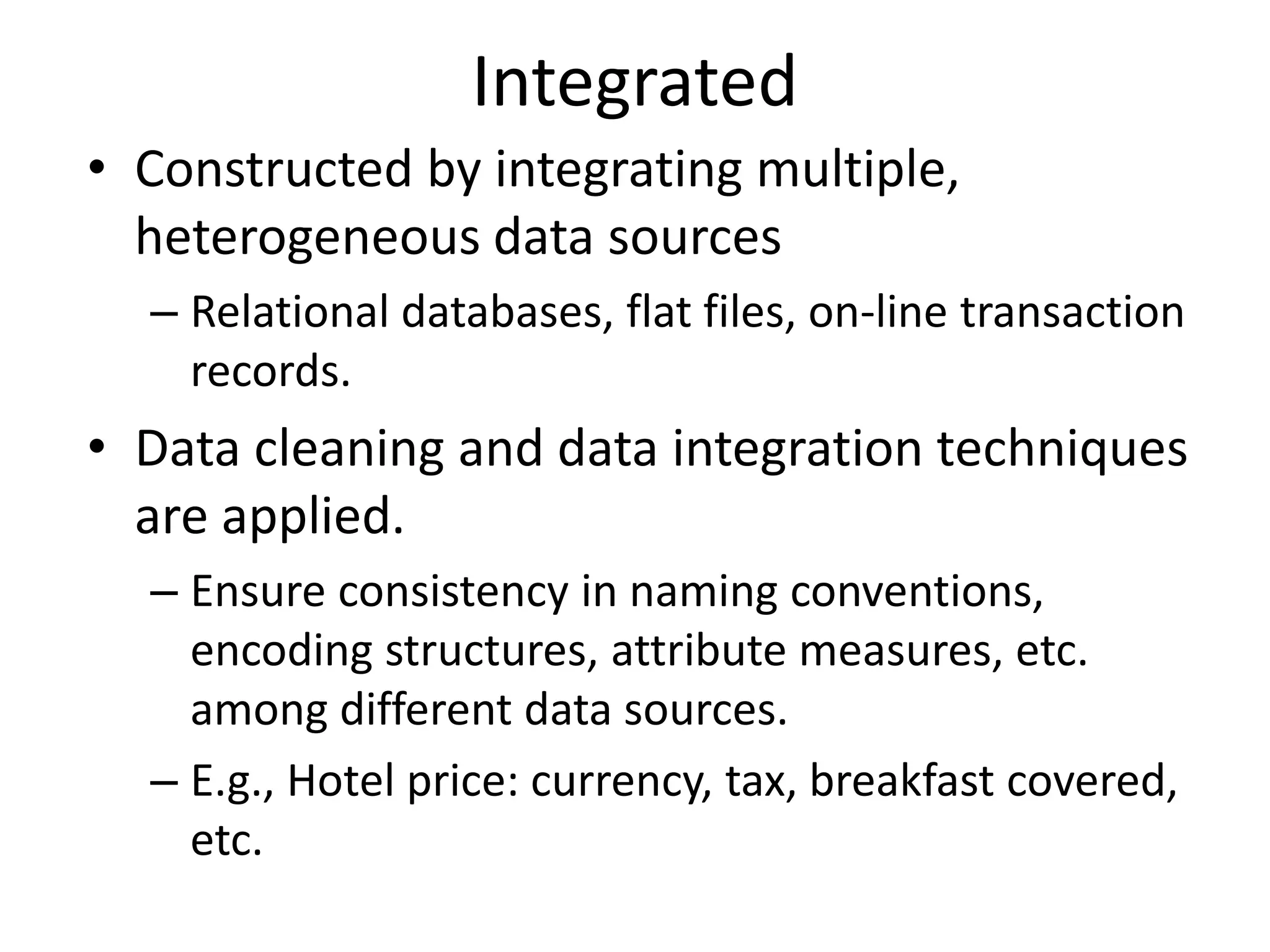
Integrated
• Constructed by integrating multiple,
heterogeneous data sources
– Relational databases, flat files, on-line transaction
records.
• Data cleaning and data integration techniques
are applied.
– Ensure consistency in naming conventions,
encoding structures, attribute measures, etc.
among different data sources.
– E.g., Hotel price: currency, tax, breakfast covered,
etc.
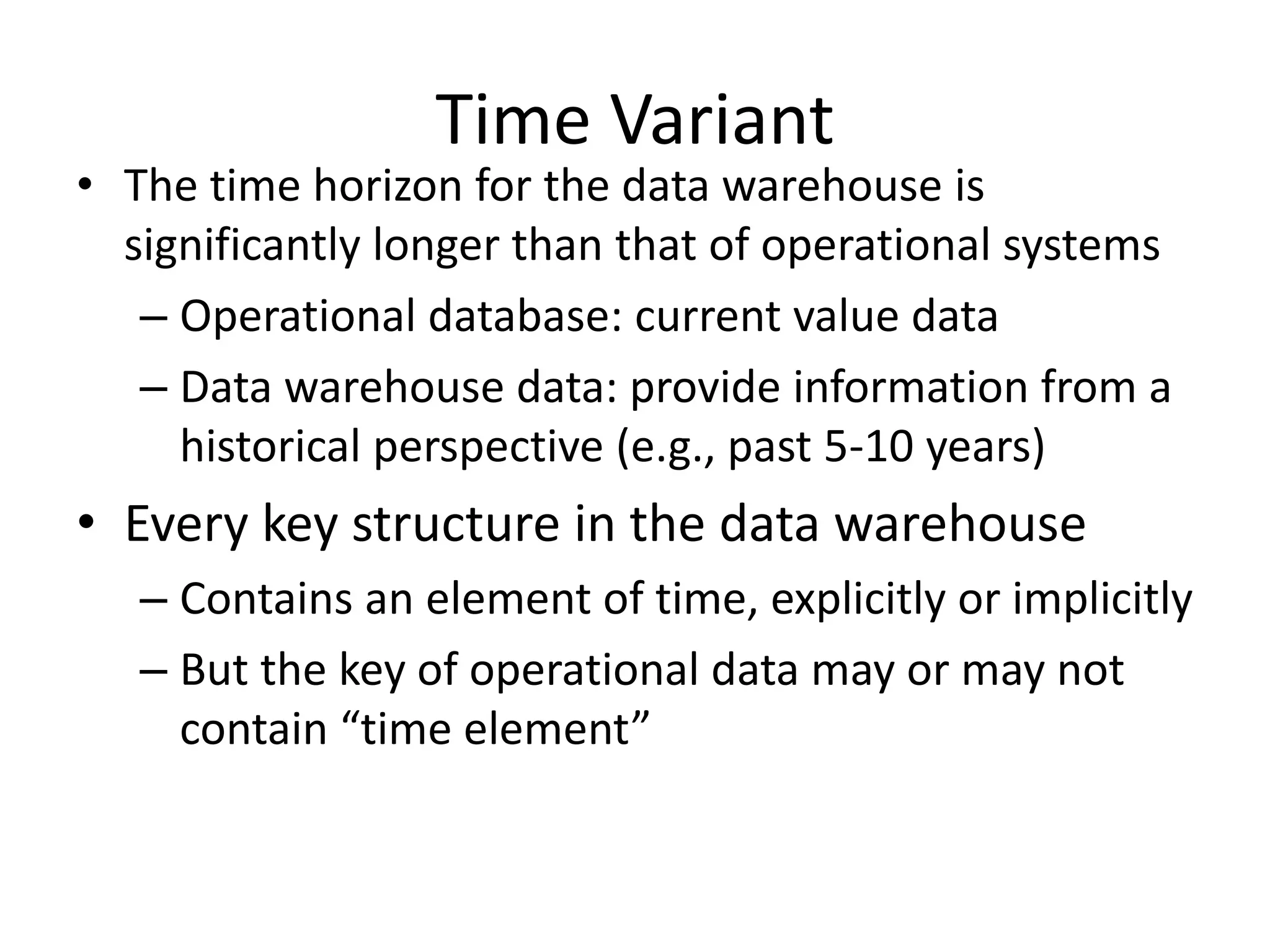
Time Variant
• The time horizon for the data warehouse is
significantly longer than that of operational systems
– Operational database: current value data
– Data warehouse data: provide information from a
historical perspective (e.g., past 5-10 years)
• Every key structure in the data warehouse
– Contains an element of time, explicitly or implicitly
– But the key of operational data may or may not
contain “time element”
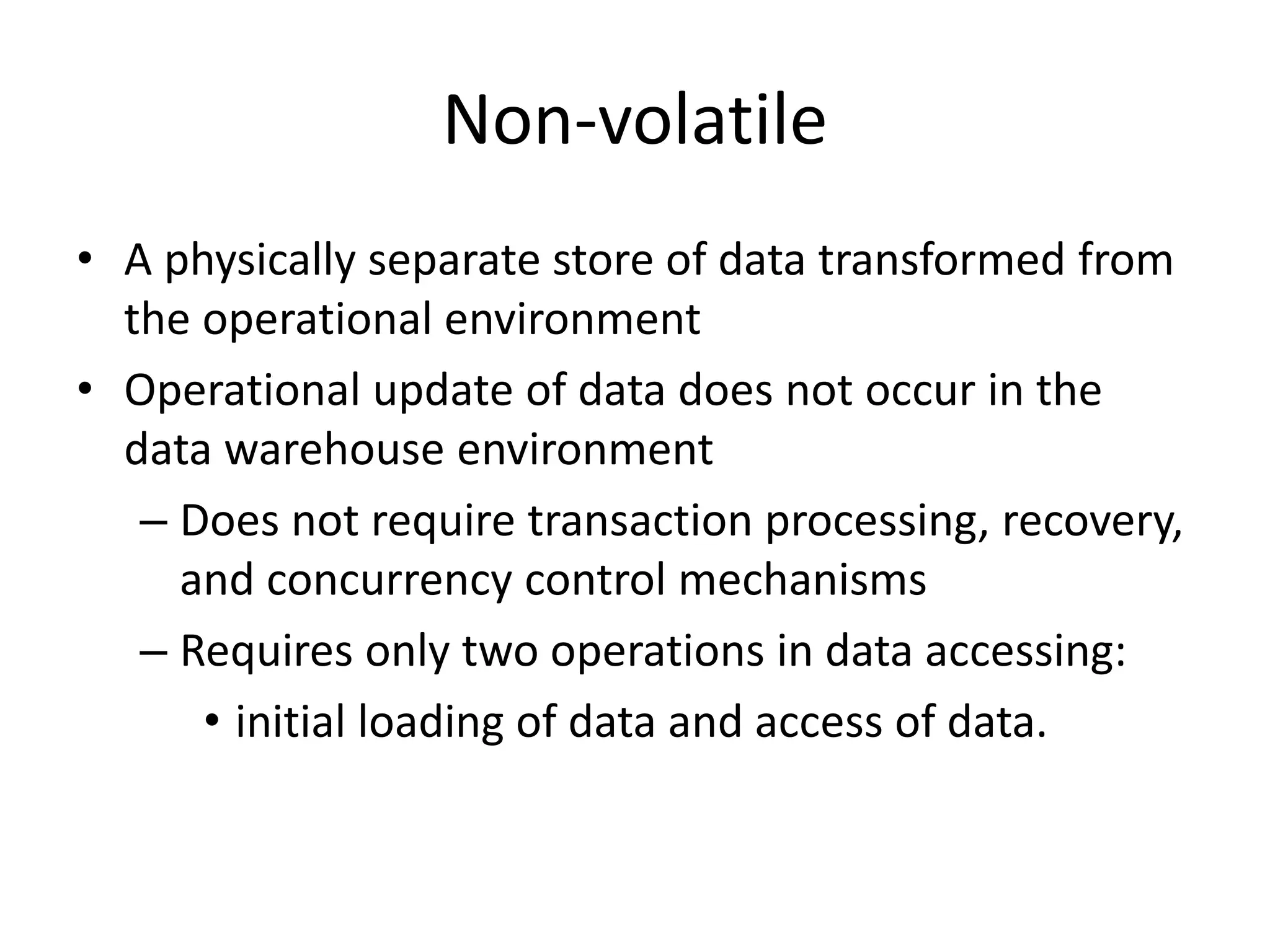
Non-volatile
• A physically separate store of data transformed from
the operational environment
• Operational update of data does not occur in the
data warehouse environment
– Does not require transaction processing, recovery,
and concurrency control mechanisms
– Requires only two operations in data accessing:
• initial loading of data and access of data.
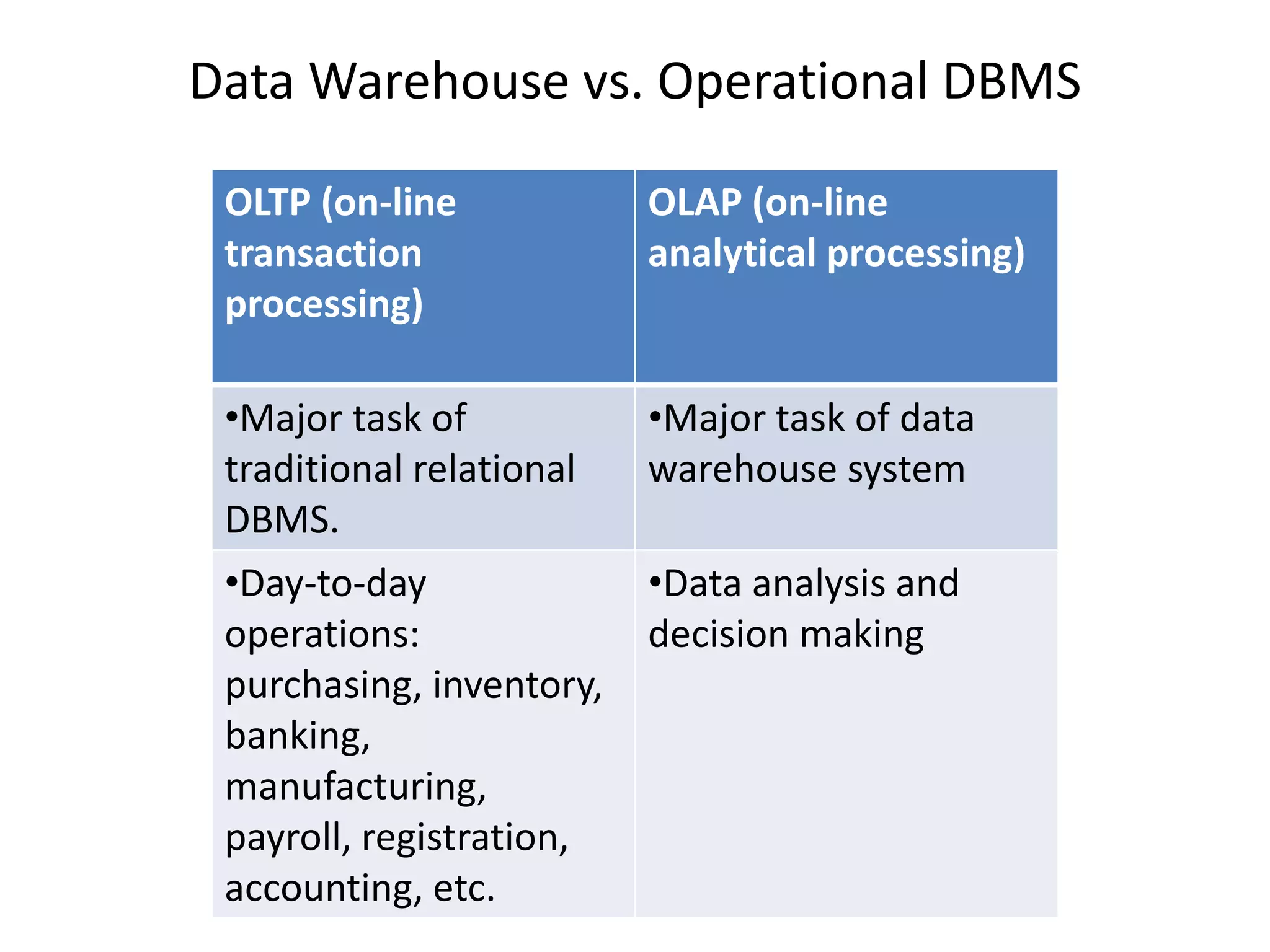
Data Warehouse vs. Operational DBMS
OLTP (on-line
transaction
processing)
OLAP (on-line
analytical processing)
•Major task of
traditional relational
DBMS.
•Major task of data
warehouse system
•Day-to-day
operations:
purchasing, inventory,
banking,
manufacturing,
payroll, registration,
accounting, etc.
•Data analysis and
decision making
Thank You

Introduction to data warehouse dmbi

  • 1.
    GANDHINAGAR INSTITUTE OFTECHNOLGY Department of Information Technology Introduction To Data Warehouse Group ID: IT_B1_00 Student Name(Enroll No): Shaishav Shah(170120116094) Name of Faculty: Prof. Rahul Vaghela Data Mining & Business Intelligence(2170715)
  • 2.
    What is DataWarehouse? • “A data warehouse is a subject-oriented, integrated, time-variant, and non-volatile collection of data in support of management’s decision-making process.”—W. H. Inmon • Data warehousing: – The process of constructing and using data warehouses.
  • 3.
    Data Warehouse Features 1.Subject Oriented 2. Integrated 3. Time Variant 4. Non-volatile
  • 4.
    Subject-Oriented • Organized aroundmajor subjects, such as customer, product, sales, employee. • Focusing on the modeling and analysis of data for decision makers, not on daily operations or transaction processing. • Provide a simple and concise view around particular subject issues by excluding data that are not useful in the decision support process.
  • 5.
    Integrated • Constructed byintegrating multiple, heterogeneous data sources – Relational databases, flat files, on-line transaction records. • Data cleaning and data integration techniques are applied. – Ensure consistency in naming conventions, encoding structures, attribute measures, etc. among different data sources. – E.g., Hotel price: currency, tax, breakfast covered, etc.
  • 6.
    Time Variant • Thetime horizon for the data warehouse is significantly longer than that of operational systems – Operational database: current value data – Data warehouse data: provide information from a historical perspective (e.g., past 5-10 years) • Every key structure in the data warehouse – Contains an element of time, explicitly or implicitly – But the key of operational data may or may not contain “time element”
  • 7.
    Non-volatile • A physicallyseparate store of data transformed from the operational environment • Operational update of data does not occur in the data warehouse environment – Does not require transaction processing, recovery, and concurrency control mechanisms – Requires only two operations in data accessing: • initial loading of data and access of data.
  • 8.
    Data Warehouse vs.Operational DBMS OLTP (on-line transaction processing) OLAP (on-line analytical processing) •Major task of traditional relational DBMS. •Major task of data warehouse system •Day-to-day operations: purchasing, inventory, banking, manufacturing, payroll, registration, accounting, etc. •Data analysis and decision making
  • 9.