1
Basic Terminologies &AsymptoticBasic Terminologies &Asymptotic
NotationsNotations
DataStructuresDataStructures
2
Abstract Data Type (ADT)Abstract Data Type (ADT)
• Mathematical description of an object withMathematical description of an object with
set of operations on the object. Usefulset of operations on the object. Useful
building block.building block.
AlgorithmAlgorithm
• A high level, language independent,A high level, language independent,
description of a step-by-step processdescription of a step-by-step process
Data structureData structure
• A specific family of algorithms forA specific family of algorithms for
implementing an abstract data type.implementing an abstract data type.
Implementation of data structureImplementation of data structure
• A specific implementation in a specificA specific implementation in a specific
languagelanguage
TerminologyTerminology
3
TerminologyTerminology
DataData
Data refers to value orset of values.Data refers to value orset of values.
e.g.Marks obtained by the students.e.g.Marks obtained by the students.
Data typeData type
data type is a classification identifying one of variousdata type is a classification identifying one of various
typestypes
of data, such as floating-point, integer, or Boolean,of data, such as floating-point, integer, or Boolean,
thatthat
determines the possible values for that type; thedetermines the possible values for that type; the
operationsoperations
that can be done on values of that type; and the waythat can be done on values of that type; and the way
4
TerminologyTerminology
Primitive data type:Primitive data type:
These are basic data types that are provided by theThese are basic data types that are provided by the
programming language with built-in support. Theseprogramming language with built-in support. These
datadata
types are native to the language. This data type istypes are native to the language. This data type is
supported by machine directlysupported by machine directly
VariableVariable
Variable is a symbolic name given to someVariable is a symbolic name given to some
known orknown or
unknown quantity orinformation, forthe purposeunknown quantity orinformation, forthe purpose
5
RecordRecord
Collection of related data items is known as record.Collection of related data items is known as record.
TheThe
elements of records are usually Called fields orelements of records are usually Called fields or
members .members .
Records are distinguished from arrays by the factRecords are distinguished from arrays by the fact
thatthat
theirnumberof fields is typically fixed, each field hastheirnumberof fields is typically fixed, each field has
aa
name, and that each field may have a different type.name, and that each field may have a different type.
ProgramProgram
A sequence of instructions that a computercanA sequence of instructions that a computercan
TerminologyTerminology
6
AA stack is anstack is an abstractdatatypeabstractdatatype supporting push, popsupporting push, pop
and isEmpty operationsand isEmpty operations
A stackA stack datastructuredatastructure could use an array, a linkedcould use an array, a linked
list, oranything that can hold datalist, oranything that can hold data
One stackOne stack implementationimplementation is java.util.Stack; anotheris java.util.Stack; another
is java.util.LinkedListis java.util.LinkedList
Terminology examplesTerminology examples
7
AbstractAbstract
PseudocodePseudocode
AlgorithmAlgorithm
• A sequence of high-A sequence of high-
level, languagelevel, language
independentindependent
operations, which mayoperations, which may
act upon an abstractedact upon an abstracted
view of data.view of data.
Abstract Data Type (ADT)Abstract Data Type (ADT)
• A mathematicalA mathematical
description of an objectdescription of an object
and the set ofand the set of
operations on theoperations on the
AbstractAbstract
PseudocodePseudocode
AlgorithmAlgorithm
• A sequence of high-A sequence of high-
level, languagelevel, language
independentindependent
operations, which mayoperations, which may
act upon an abstractedact upon an abstracted
view of data.view of data.
Abstract Data Type (ADT)Abstract Data Type (ADT)
• A mathematicalA mathematical
description of an objectdescription of an object
and the set ofand the set of
operations on theoperations on the
ConceptsConcepts vs.vs. MechanismsMechanisms
Design and Analysis of Algorithms Chapter 2.2
8
DataStructuresDataStructures
Asymptotic AnalysisAsymptotic Analysis
Design and Analysis of Algorithms Chapter 2.2
9
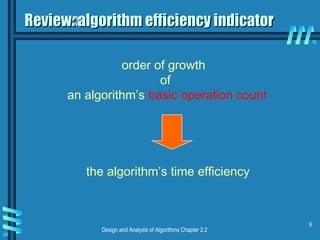
Review: algorithm efficiency indicatorReview: algorithm efficiency indicator
order of growth
of
an algorithm’s basic operation count
the algorithm’s time efficiency
Design and Analysis of Algorithms Chapter 2.2
10
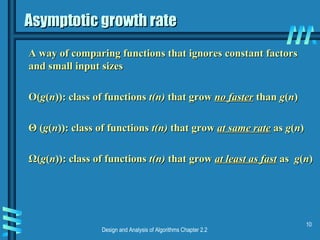
Asymptotic growth rateAsymptotic growth rate
A way of comparing functions that ignores constant factorsA way of comparing functions that ignores constant factors
and small input sizesand small input sizes
O(O(gg((nn)): class of functions)): class of functions t(n)t(n) that growthat grow no fasterno faster thanthan gg((nn))
ΘΘ ((gg((nn)): class of functions)): class of functions t(n)t(n) that growthat grow at same rateat same rate asas gg((nn))
ΩΩ((gg((nn)): class of functions)): class of functions t(n)t(n) that growthat grow at least as fastat least as fast asas gg((nn))
Design and Analysis of Algorithms Chapter 2.2
11
Big-ohBig-oh
∃c > 0, ∃n0 ≥ 0 , ∀n ≥ n0, t(n) ≤ cg(n)
t(n) ∈ O(g(n))
Design and Analysis of Algorithms Chapter 2.2
12
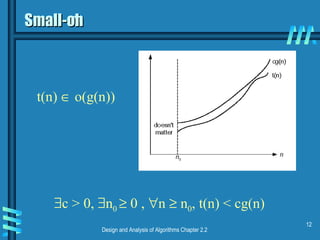
Small-ohSmall-oh
∃c > 0, ∃n0 ≥ 0 , ∀n ≥ n0, t(n) < cg(n)
t(n) ∈ o(g(n))
Design and Analysis of Algorithms Chapter 2.2
13
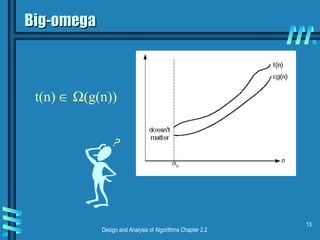
Big-omegaBig-omega
t(n) ∈ Ω(g(n))
Design and Analysis of Algorithms Chapter 2.2
14
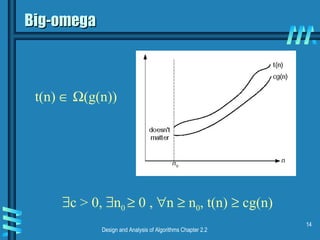
Big-omegaBig-omega
∃c > 0, ∃n0 ≥ 0 , ∀n ≥ n0, t(n) ≥ cg(n)
t(n) ∈ Ω(g(n))
Design and Analysis of Algorithms Chapter 2.2
15
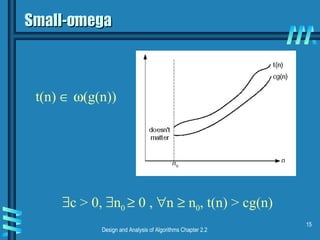
Small-omegaSmall-omega
∃c > 0, ∃n0 ≥ 0 , ∀n ≥ n0, t(n) > cg(n)
t(n) ∈ ω(g(n))
Design and Analysis of Algorithms Chapter 2.2
16
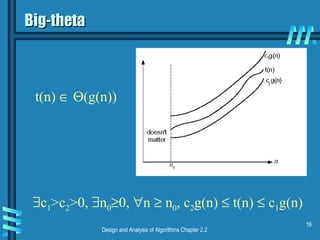
Big-thetaBig-theta
t(n) ∈ Θ(g(n))
∃c1>c2>0, ∃n0≥0, ∀n ≥ n0, c2g(n) ≤ t(n) ≤ c1g(n)
Design and Analysis of Algorithms Chapter 2.2
17
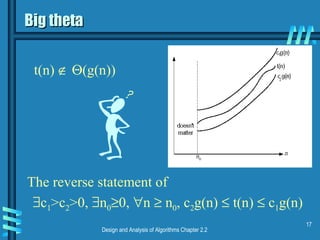
Big thetaBig theta
The reverse statement of
t(n) ∉ Θ(g(n))
∃c1>c2>0, ∃n0≥0, ∀n ≥ n0, c2g(n) ≤ t(n) ≤ c1g(n)
Design and Analysis of Algorithms Chapter 2.2
18
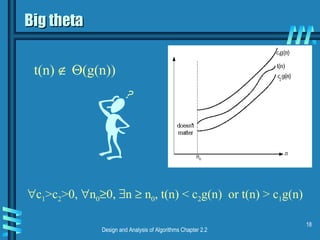
Big thetaBig theta
t(n) ∉ Θ(g(n))
∀c1>c2>0, ∀n0≥0, ∃n ≥ n0, t(n) < c2g(n) or t(n) > c1g(n)
Design and Analysis of Algorithms Chapter 2.2
19
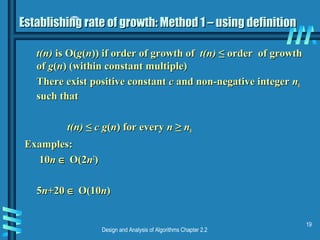
Establishing rate of growth: Method 1 – using definitionEstablishing rate of growth: Method 1 – using definition
t(n)t(n) is O(is O(gg((nn)) if order of growth of)) if order of growth of t(n)t(n) ≤ order of growth≤ order of growth
ofof gg((nn) (within constant multiple)) (within constant multiple)
There exist positive constantThere exist positive constant cc and non-negative integerand non-negative integer nn00
such thatsuch that
t(n)t(n) ≤≤ c gc g((nn) for every) for every nn ≥≥ nn00
Examples:Examples:
1010nn ∈∈ O(2O(2nn22
))
55nn+20+20 ∈∈ O(10O(10nn))
Design and Analysis of Algorithms Chapter 2.2
20
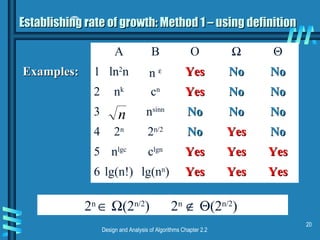
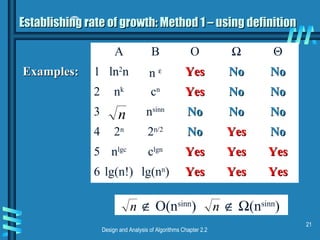
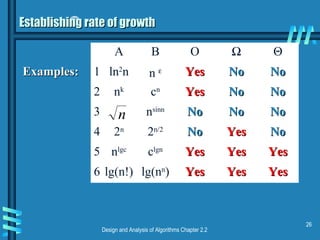
A B O Ω Θ
1 ln2
n n ε YesYes NoNo NoNo
2 nk
cn
YesYes NoNo NoNo
3 nsinn
NoNo NoNo NoNo
4 2n
2n/2
NoNo YesYes NoNo
5 nlgc
clgn
YesYes YesYes YesYes
6 lg(n!) lg(nn
) YesYes YesYes YesYes
n
2n
∈ Ω(2n/2
) 2n
∉ Θ(2n/2
)
Establishing rate of growth: Method 1 – using definitionEstablishing rate of growth: Method 1 – using definition
Examples:Examples:
Design and Analysis of Algorithms Chapter 2.2
21
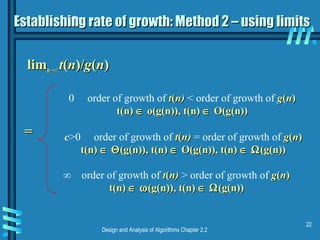
A B O Ω Θ
1 ln2
n n ε YesYes NoNo NoNo
2 nk
cn
YesYes NoNo NoNo
3 nsinn
NoNo NoNo NoNo
4 2n
2n/2
NoNo YesYes NoNo
5 nlgc
clgn
YesYes YesYes YesYes
6 lg(n!) lg(nn
) YesYes YesYes YesYes
n
∉ O(nsinn
) ∉ Ω(nsinn
)n n
Establishing rate of growth: Method 1 – using definitionEstablishing rate of growth: Method 1 – using definition
Examples:Examples:
Design and Analysis of Algorithms Chapter 2.2
22
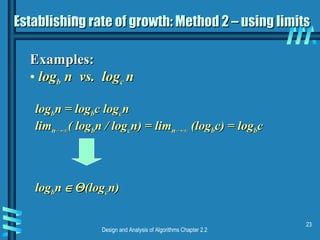
Establishing rate of growth: Method 2 – using limitsEstablishing rate of growth: Method 2 – using limits
limlimn→∞n→∞ tt((nn)/)/gg((nn))
0 order of growth of tt((n)n) < order of growth of gg((nn))
t(n)t(n) ∈∈ o(g(n)),o(g(n)), t(n)t(n) ∈∈ O(g(n))O(g(n))
c>0 order of growth of tt((n)n) = order of growth of gg((nn))
t(n)t(n) ∈∈ ΘΘ(g(n)),(g(n)), t(n)t(n) ∈∈ O(g(n)), t(n)O(g(n)), t(n) ∈∈ ΩΩ(g(n))(g(n))
∞ order of growth of tt((n)n) > order of growth of gg((nn))
t(n)t(n) ∈∈ ωω(g(n)),(g(n)), t(n)t(n) ∈∈ ΩΩ(g(n))(g(n))
==
Design and Analysis of Algorithms Chapter 2.2
23
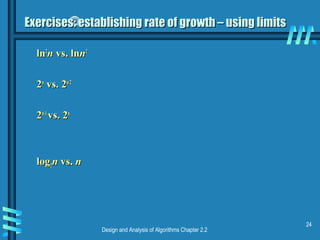
Establishing rate of growth: Method 2 – using limitsEstablishing rate of growth: Method 2 – using limits
Examples:Examples:
• loglogbb n vs. logn vs. logcc nn
loglogbbn = logn = logbbc logc logccnn
limlimn→∞n→∞( log( logbbn / logn / logccn) = limn) = limn→∞n→∞ (log(logbbc) = logc) = logbbcc
loglogbbnn ∈Θ∈Θ(log(logccn)n)
Design and Analysis of Algorithms Chapter 2.2
24
Exercises: establishing rate of growth – using limitsExercises: establishing rate of growth – using limits
lnln22
nn vs. lnvs. lnnn22
22nn
vs. 2vs. 2n/2n/2
22n-1n-1
vs. 2vs. 2nn
loglog22nn vs.vs. nn
Design and Analysis of Algorithms Chapter 2.2
25
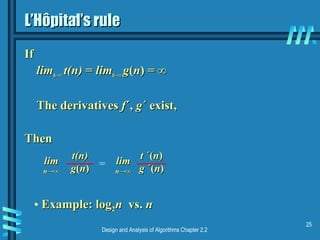
L’Hôpital’s ruleL’Hôpital’s rule
IfIf
limlimn→∞n→∞ t(n)t(n) == limlimn→∞n→∞ gg((nn) = ∞) = ∞
The derivativesThe derivatives ff´,´, gg´ exist,´ exist,
ThenThen
t(n)t(n)
gg((nn))
limlim
nn→∞→∞
=
tt ´(´(nn))
gg ´(´(nn))
limlim
nn→∞→∞
• Example: logExample: log22nn vs.vs. nn
Design and Analysis of Algorithms Chapter 2.2
26
A B O Ω Θ
1 ln2
n n ε YesYes NoNo NoNo
2 nk
cn
YesYes NoNo NoNo
3 nsinn
NoNo NoNo NoNo
4 2n
2n/2
NoNo YesYes NoNo
5 nlgc
clgn
YesYes YesYes YesYes
6 lg(n!) lg(nn
) YesYes YesYes YesYes
n
Establishing rate of growthEstablishing rate of growth
Examples:Examples:
Design and Analysis of Algorithms Chapter 2.2
27
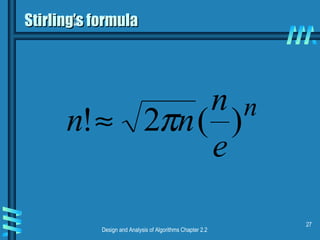
Stirling’s formulaStirling’s formula
n
e
n
nn )(2! π≈
Design and Analysis of Algorithms Chapter 2.2
28
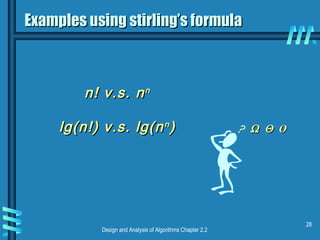
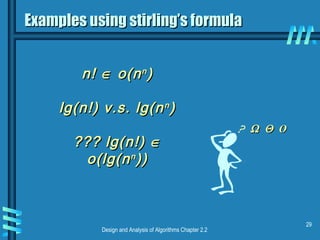
n! v.s. nn! v.s. nnn
lg(n!) v.s. lg(nlg(n!) v.s. lg(nnn
))
Examples using stirling’s formulaExamples using stirling’s formula
ΩΩ ΘΘ OO
Design and Analysis of Algorithms Chapter 2.2
29
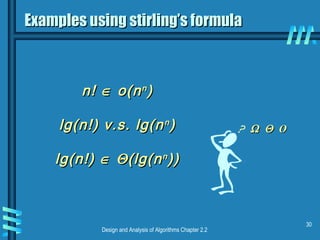
n!n! ∈∈ o(no(nnn
))
lg(n!) v.s. lg(nlg(n!) v.s. lg(nnn
))
??? lg(n!)??? lg(n!) ∈∈
o(lg(no(lg(nnn
))))
Examples using stirling’s formulaExamples using stirling’s formula
ΩΩ ΘΘ OO
Design and Analysis of Algorithms Chapter 2.2
30
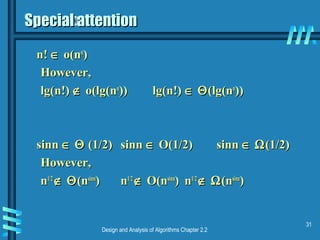
n!n! ∈∈ o(no(nnn
))
lg(n!) v.s. lg(nlg(n!) v.s. lg(nnn
))
lg(n!)lg(n!) ∈∈ ΘΘ(lg(n(lg(nnn
))))
Examples using stirling’s formulaExamples using stirling’s formula
ΩΩ ΘΘ OO
Design and Analysis of Algorithms Chapter 2.2
31
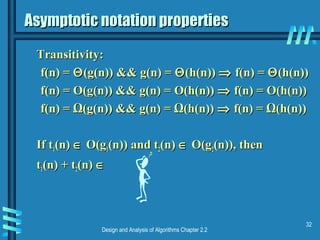
Special attentionSpecial attention
n!n! ∈∈ o(no(nnn
))
However,However,
lg(n!)lg(n!) ∉∉ o(lg(no(lg(nnn
)))) lg(n!)lg(n!) ∈∈ ΘΘ(lg(n(lg(nnn
))))
sinnsinn ∈∈ ΘΘ (1/2)(1/2) sinnsinn ∈∈ O(1/2)O(1/2) sinnsinn ∈∈ ΩΩ(1/2)(1/2)
However,However,
nn1/21/2
∉∉ ΘΘ(n(nsinnsinn
)) nn1/21/2
∉∉ O(nO(nsinnsinn
)) nn1/21/2
∉∉ ΩΩ(n(nsinnsinn
))
Design and Analysis of Algorithms Chapter 2.2
32
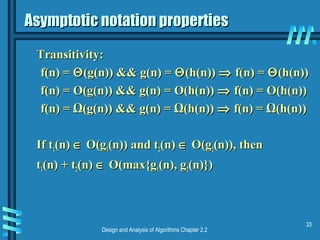
Asymptotic notation propertiesAsymptotic notation properties
Transitivity:Transitivity:
f(n) =f(n) = ΘΘ(g(n)) && g(n) =(g(n)) && g(n) = ΘΘ(h(n))(h(n)) ⇒⇒ f(n) =f(n) = ΘΘ(h(n))(h(n))
f(n) = O(g(n)) && g(n) = O(h(n))f(n) = O(g(n)) && g(n) = O(h(n)) ⇒⇒ f(n) = O(h(n))f(n) = O(h(n))
f(n) = Ω(g(n)) && g(n) = Ω(h(n))f(n) = Ω(g(n)) && g(n) = Ω(h(n)) ⇒⇒ f(n) = Ω(h(n))f(n) = Ω(h(n))
If tIf t11(n)(n) ∈∈ O(gO(g11(n)) and t(n)) and t22(n)(n) ∈∈ O(gO(g22(n)), then(n)), then
tt11(n) + t(n) + t22(n)(n) ∈∈
Design and Analysis of Algorithms Chapter 2.2
33
Asymptotic notation propertiesAsymptotic notation properties
Transitivity:Transitivity:
f(n) =f(n) = ΘΘ(g(n)) && g(n) =(g(n)) && g(n) = ΘΘ(h(n))(h(n)) ⇒⇒ f(n) =f(n) = ΘΘ(h(n))(h(n))
f(n) = O(g(n)) && g(n) = O(h(n))f(n) = O(g(n)) && g(n) = O(h(n)) ⇒⇒ f(n) = O(h(n))f(n) = O(h(n))
f(n) = Ω(g(n)) && g(n) = Ω(h(n))f(n) = Ω(g(n)) && g(n) = Ω(h(n)) ⇒⇒ f(n) = Ω(h(n))f(n) = Ω(h(n))
If tIf t11(n)(n) ∈∈ O(gO(g11(n)) and t(n)) and t22(n)(n) ∈∈ O(gO(g22(n)), then(n)), then
tt11(n) + t(n) + t22(n)(n) ∈∈ O(max{gO(max{g11(n), g(n), g22(n)})(n)})

Basics & asymptotic notations

  • 1.
    1 Basic Terminologies &AsymptoticBasicTerminologies &Asymptotic NotationsNotations DataStructuresDataStructures
  • 2.
    2 Abstract Data Type(ADT)Abstract Data Type (ADT) • Mathematical description of an object withMathematical description of an object with set of operations on the object. Usefulset of operations on the object. Useful building block.building block. AlgorithmAlgorithm • A high level, language independent,A high level, language independent, description of a step-by-step processdescription of a step-by-step process Data structureData structure • A specific family of algorithms forA specific family of algorithms for implementing an abstract data type.implementing an abstract data type. Implementation of data structureImplementation of data structure • A specific implementation in a specificA specific implementation in a specific languagelanguage TerminologyTerminology
  • 3.
    3 TerminologyTerminology DataData Data refers tovalue orset of values.Data refers to value orset of values. e.g.Marks obtained by the students.e.g.Marks obtained by the students. Data typeData type data type is a classification identifying one of variousdata type is a classification identifying one of various typestypes of data, such as floating-point, integer, or Boolean,of data, such as floating-point, integer, or Boolean, thatthat determines the possible values for that type; thedetermines the possible values for that type; the operationsoperations that can be done on values of that type; and the waythat can be done on values of that type; and the way
  • 4.
    4 TerminologyTerminology Primitive data type:Primitivedata type: These are basic data types that are provided by theThese are basic data types that are provided by the programming language with built-in support. Theseprogramming language with built-in support. These datadata types are native to the language. This data type istypes are native to the language. This data type is supported by machine directlysupported by machine directly VariableVariable Variable is a symbolic name given to someVariable is a symbolic name given to some known orknown or unknown quantity orinformation, forthe purposeunknown quantity orinformation, forthe purpose
  • 5.
    5 RecordRecord Collection of relateddata items is known as record.Collection of related data items is known as record. TheThe elements of records are usually Called fields orelements of records are usually Called fields or members .members . Records are distinguished from arrays by the factRecords are distinguished from arrays by the fact thatthat theirnumberof fields is typically fixed, each field hastheirnumberof fields is typically fixed, each field has aa name, and that each field may have a different type.name, and that each field may have a different type. ProgramProgram A sequence of instructions that a computercanA sequence of instructions that a computercan TerminologyTerminology
  • 6.
    6 AA stack isanstack is an abstractdatatypeabstractdatatype supporting push, popsupporting push, pop and isEmpty operationsand isEmpty operations A stackA stack datastructuredatastructure could use an array, a linkedcould use an array, a linked list, oranything that can hold datalist, oranything that can hold data One stackOne stack implementationimplementation is java.util.Stack; anotheris java.util.Stack; another is java.util.LinkedListis java.util.LinkedList Terminology examplesTerminology examples
  • 7.
    7 AbstractAbstract PseudocodePseudocode AlgorithmAlgorithm • A sequenceof high-A sequence of high- level, languagelevel, language independentindependent operations, which mayoperations, which may act upon an abstractedact upon an abstracted view of data.view of data. Abstract Data Type (ADT)Abstract Data Type (ADT) • A mathematicalA mathematical description of an objectdescription of an object and the set ofand the set of operations on theoperations on the AbstractAbstract PseudocodePseudocode AlgorithmAlgorithm • A sequence of high-A sequence of high- level, languagelevel, language independentindependent operations, which mayoperations, which may act upon an abstractedact upon an abstracted view of data.view of data. Abstract Data Type (ADT)Abstract Data Type (ADT) • A mathematicalA mathematical description of an objectdescription of an object and the set ofand the set of operations on theoperations on the ConceptsConcepts vs.vs. MechanismsMechanisms
  • 8.
    Design and Analysisof Algorithms Chapter 2.2 8 DataStructuresDataStructures Asymptotic AnalysisAsymptotic Analysis
  • 9.
    Design and Analysisof Algorithms Chapter 2.2 9 Review: algorithm efficiency indicatorReview: algorithm efficiency indicator order of growth of an algorithm’s basic operation count the algorithm’s time efficiency
  • 10.
    Design and Analysisof Algorithms Chapter 2.2 10 Asymptotic growth rateAsymptotic growth rate A way of comparing functions that ignores constant factorsA way of comparing functions that ignores constant factors and small input sizesand small input sizes O(O(gg((nn)): class of functions)): class of functions t(n)t(n) that growthat grow no fasterno faster thanthan gg((nn)) ΘΘ ((gg((nn)): class of functions)): class of functions t(n)t(n) that growthat grow at same rateat same rate asas gg((nn)) ΩΩ((gg((nn)): class of functions)): class of functions t(n)t(n) that growthat grow at least as fastat least as fast asas gg((nn))
  • 11.
    Design and Analysisof Algorithms Chapter 2.2 11 Big-ohBig-oh ∃c > 0, ∃n0 ≥ 0 , ∀n ≥ n0, t(n) ≤ cg(n) t(n) ∈ O(g(n))
  • 12.
    Design and Analysisof Algorithms Chapter 2.2 12 Small-ohSmall-oh ∃c > 0, ∃n0 ≥ 0 , ∀n ≥ n0, t(n) < cg(n) t(n) ∈ o(g(n))
  • 13.
    Design and Analysisof Algorithms Chapter 2.2 13 Big-omegaBig-omega t(n) ∈ Ω(g(n))
  • 14.
    Design and Analysisof Algorithms Chapter 2.2 14 Big-omegaBig-omega ∃c > 0, ∃n0 ≥ 0 , ∀n ≥ n0, t(n) ≥ cg(n) t(n) ∈ Ω(g(n))
  • 15.
    Design and Analysisof Algorithms Chapter 2.2 15 Small-omegaSmall-omega ∃c > 0, ∃n0 ≥ 0 , ∀n ≥ n0, t(n) > cg(n) t(n) ∈ ω(g(n))
  • 16.
    Design and Analysisof Algorithms Chapter 2.2 16 Big-thetaBig-theta t(n) ∈ Θ(g(n)) ∃c1>c2>0, ∃n0≥0, ∀n ≥ n0, c2g(n) ≤ t(n) ≤ c1g(n)
  • 17.
    Design and Analysisof Algorithms Chapter 2.2 17 Big thetaBig theta The reverse statement of t(n) ∉ Θ(g(n)) ∃c1>c2>0, ∃n0≥0, ∀n ≥ n0, c2g(n) ≤ t(n) ≤ c1g(n)
  • 18.
    Design and Analysisof Algorithms Chapter 2.2 18 Big thetaBig theta t(n) ∉ Θ(g(n)) ∀c1>c2>0, ∀n0≥0, ∃n ≥ n0, t(n) < c2g(n) or t(n) > c1g(n)
  • 19.
    Design and Analysisof Algorithms Chapter 2.2 19 Establishing rate of growth: Method 1 – using definitionEstablishing rate of growth: Method 1 – using definition t(n)t(n) is O(is O(gg((nn)) if order of growth of)) if order of growth of t(n)t(n) ≤ order of growth≤ order of growth ofof gg((nn) (within constant multiple)) (within constant multiple) There exist positive constantThere exist positive constant cc and non-negative integerand non-negative integer nn00 such thatsuch that t(n)t(n) ≤≤ c gc g((nn) for every) for every nn ≥≥ nn00 Examples:Examples: 1010nn ∈∈ O(2O(2nn22 )) 55nn+20+20 ∈∈ O(10O(10nn))
  • 20.
    Design and Analysisof Algorithms Chapter 2.2 20 A B O Ω Θ 1 ln2 n n ε YesYes NoNo NoNo 2 nk cn YesYes NoNo NoNo 3 nsinn NoNo NoNo NoNo 4 2n 2n/2 NoNo YesYes NoNo 5 nlgc clgn YesYes YesYes YesYes 6 lg(n!) lg(nn ) YesYes YesYes YesYes n 2n ∈ Ω(2n/2 ) 2n ∉ Θ(2n/2 ) Establishing rate of growth: Method 1 – using definitionEstablishing rate of growth: Method 1 – using definition Examples:Examples:
  • 21.
    Design and Analysisof Algorithms Chapter 2.2 21 A B O Ω Θ 1 ln2 n n ε YesYes NoNo NoNo 2 nk cn YesYes NoNo NoNo 3 nsinn NoNo NoNo NoNo 4 2n 2n/2 NoNo YesYes NoNo 5 nlgc clgn YesYes YesYes YesYes 6 lg(n!) lg(nn ) YesYes YesYes YesYes n ∉ O(nsinn ) ∉ Ω(nsinn )n n Establishing rate of growth: Method 1 – using definitionEstablishing rate of growth: Method 1 – using definition Examples:Examples:
  • 22.
    Design and Analysisof Algorithms Chapter 2.2 22 Establishing rate of growth: Method 2 – using limitsEstablishing rate of growth: Method 2 – using limits limlimn→∞n→∞ tt((nn)/)/gg((nn)) 0 order of growth of tt((n)n) < order of growth of gg((nn)) t(n)t(n) ∈∈ o(g(n)),o(g(n)), t(n)t(n) ∈∈ O(g(n))O(g(n)) c>0 order of growth of tt((n)n) = order of growth of gg((nn)) t(n)t(n) ∈∈ ΘΘ(g(n)),(g(n)), t(n)t(n) ∈∈ O(g(n)), t(n)O(g(n)), t(n) ∈∈ ΩΩ(g(n))(g(n)) ∞ order of growth of tt((n)n) > order of growth of gg((nn)) t(n)t(n) ∈∈ ωω(g(n)),(g(n)), t(n)t(n) ∈∈ ΩΩ(g(n))(g(n)) ==
  • 23.
    Design and Analysisof Algorithms Chapter 2.2 23 Establishing rate of growth: Method 2 – using limitsEstablishing rate of growth: Method 2 – using limits Examples:Examples: • loglogbb n vs. logn vs. logcc nn loglogbbn = logn = logbbc logc logccnn limlimn→∞n→∞( log( logbbn / logn / logccn) = limn) = limn→∞n→∞ (log(logbbc) = logc) = logbbcc loglogbbnn ∈Θ∈Θ(log(logccn)n)
  • 24.
    Design and Analysisof Algorithms Chapter 2.2 24 Exercises: establishing rate of growth – using limitsExercises: establishing rate of growth – using limits lnln22 nn vs. lnvs. lnnn22 22nn vs. 2vs. 2n/2n/2 22n-1n-1 vs. 2vs. 2nn loglog22nn vs.vs. nn
  • 25.
    Design and Analysisof Algorithms Chapter 2.2 25 L’Hôpital’s ruleL’Hôpital’s rule IfIf limlimn→∞n→∞ t(n)t(n) == limlimn→∞n→∞ gg((nn) = ∞) = ∞ The derivativesThe derivatives ff´,´, gg´ exist,´ exist, ThenThen t(n)t(n) gg((nn)) limlim nn→∞→∞ = tt ´(´(nn)) gg ´(´(nn)) limlim nn→∞→∞ • Example: logExample: log22nn vs.vs. nn
  • 26.
    Design and Analysisof Algorithms Chapter 2.2 26 A B O Ω Θ 1 ln2 n n ε YesYes NoNo NoNo 2 nk cn YesYes NoNo NoNo 3 nsinn NoNo NoNo NoNo 4 2n 2n/2 NoNo YesYes NoNo 5 nlgc clgn YesYes YesYes YesYes 6 lg(n!) lg(nn ) YesYes YesYes YesYes n Establishing rate of growthEstablishing rate of growth Examples:Examples:
  • 27.
    Design and Analysisof Algorithms Chapter 2.2 27 Stirling’s formulaStirling’s formula n e n nn )(2! π≈
  • 28.
    Design and Analysisof Algorithms Chapter 2.2 28 n! v.s. nn! v.s. nnn lg(n!) v.s. lg(nlg(n!) v.s. lg(nnn )) Examples using stirling’s formulaExamples using stirling’s formula ΩΩ ΘΘ OO
  • 29.
    Design and Analysisof Algorithms Chapter 2.2 29 n!n! ∈∈ o(no(nnn )) lg(n!) v.s. lg(nlg(n!) v.s. lg(nnn )) ??? lg(n!)??? lg(n!) ∈∈ o(lg(no(lg(nnn )))) Examples using stirling’s formulaExamples using stirling’s formula ΩΩ ΘΘ OO
  • 30.
    Design and Analysisof Algorithms Chapter 2.2 30 n!n! ∈∈ o(no(nnn )) lg(n!) v.s. lg(nlg(n!) v.s. lg(nnn )) lg(n!)lg(n!) ∈∈ ΘΘ(lg(n(lg(nnn )))) Examples using stirling’s formulaExamples using stirling’s formula ΩΩ ΘΘ OO
  • 31.
    Design and Analysisof Algorithms Chapter 2.2 31 Special attentionSpecial attention n!n! ∈∈ o(no(nnn )) However,However, lg(n!)lg(n!) ∉∉ o(lg(no(lg(nnn )))) lg(n!)lg(n!) ∈∈ ΘΘ(lg(n(lg(nnn )))) sinnsinn ∈∈ ΘΘ (1/2)(1/2) sinnsinn ∈∈ O(1/2)O(1/2) sinnsinn ∈∈ ΩΩ(1/2)(1/2) However,However, nn1/21/2 ∉∉ ΘΘ(n(nsinnsinn )) nn1/21/2 ∉∉ O(nO(nsinnsinn )) nn1/21/2 ∉∉ ΩΩ(n(nsinnsinn ))
  • 32.
    Design and Analysisof Algorithms Chapter 2.2 32 Asymptotic notation propertiesAsymptotic notation properties Transitivity:Transitivity: f(n) =f(n) = ΘΘ(g(n)) && g(n) =(g(n)) && g(n) = ΘΘ(h(n))(h(n)) ⇒⇒ f(n) =f(n) = ΘΘ(h(n))(h(n)) f(n) = O(g(n)) && g(n) = O(h(n))f(n) = O(g(n)) && g(n) = O(h(n)) ⇒⇒ f(n) = O(h(n))f(n) = O(h(n)) f(n) = Ω(g(n)) && g(n) = Ω(h(n))f(n) = Ω(g(n)) && g(n) = Ω(h(n)) ⇒⇒ f(n) = Ω(h(n))f(n) = Ω(h(n)) If tIf t11(n)(n) ∈∈ O(gO(g11(n)) and t(n)) and t22(n)(n) ∈∈ O(gO(g22(n)), then(n)), then tt11(n) + t(n) + t22(n)(n) ∈∈
  • 33.
    Design and Analysisof Algorithms Chapter 2.2 33 Asymptotic notation propertiesAsymptotic notation properties Transitivity:Transitivity: f(n) =f(n) = ΘΘ(g(n)) && g(n) =(g(n)) && g(n) = ΘΘ(h(n))(h(n)) ⇒⇒ f(n) =f(n) = ΘΘ(h(n))(h(n)) f(n) = O(g(n)) && g(n) = O(h(n))f(n) = O(g(n)) && g(n) = O(h(n)) ⇒⇒ f(n) = O(h(n))f(n) = O(h(n)) f(n) = Ω(g(n)) && g(n) = Ω(h(n))f(n) = Ω(g(n)) && g(n) = Ω(h(n)) ⇒⇒ f(n) = Ω(h(n))f(n) = Ω(h(n)) If tIf t11(n)(n) ∈∈ O(gO(g11(n)) and t(n)) and t22(n)(n) ∈∈ O(gO(g22(n)), then(n)), then tt11(n) + t(n) + t22(n)(n) ∈∈ O(max{gO(max{g11(n), g(n), g22(n)})(n)})

Editor's Notes

  • #12 N0: pronounced as n_nought
  • #20 Examples: 10n is O(2n2) since 10n ≤ 5 ( 2n2) for n ≥ 1 c n0 5n+20 is O(10n) since 5n+20 ≤ 10 n for n ≥ 4 c n0
  • #23 Instert &amp;lt;, =, &amp;gt; in the ____ spaces respectively as you discuss the intuition behind it.
  • #26 [lopiˈtal]